Seventeen dead men. A locked-door mystery in the wilderness of Svalbard. Was the supernatural to blame for the horrors of Svenskhuset during the winter of 1872?
In the summer of 1873, a group of Norwegian sailors approached a windswept wooden house perched on a tundral slope, dark cliffs rising toward the snow-capped ridge of Frostistinden above. No smoke rose from the chimney; the doors and shutters were closed. The wind howled, and grey clouds hung low, obscuring the sunlight. As they drew closer, they saw a bulging tarpaulin by the door and a note nailed to the roughly cut wood: "Do not enter," scrawled in labored handwriting. The tarpaulin was pulled back - the bodies of five men lay stacked beneath it, their grey faces frozen in pain.
They returned to the door and pulled at the handle. But it was stuck fast, locked from the inside.
Forcing the door, the group entered the small house to find a scene of chaos. The bodies of ten men were scattered throughout the house; some sat in chairs, some piled together in a corner. Others lay in beds or sprawled on the frozen floor. Supplies, food, and equipment were stacked throughout the house, and a winter store of coal lay unused. Clearly, the men hadn't starved. But what had killed them? And who had locked the door from the inside?
Shocked, the group hurriedly turned to leave, stopping only to take a small diary from the hands of a man slumped near the door. Its dry, stained pages held a partial story and mysterious clues about the fate of everyone found within the silent walls of Svenskhuset.
An Arctic Horror Revealed
The diary had been kept by one of the men, a Norwegian sealer named Karl Albertsen. The previous year, Karl and a group of Norwegian seal hunters became stranded on Spitsbergen after heavy ice and early snowfall prevented them from leaving by ship. With limited food stores and no winter shelter, the group sought assistance from the explorer Adolf Erik Nordenskiöld, who was leading an expedition in the area.
Nordenskiöld lacked the resources to support the entire group, so they agreed that seventeen men would make their way to Svenskhuset, a Swedish-built refuge intended as a winter shelter on the shores of Isfjorden. In October 1872, they set out for Svenskhuset in rowboats, covering 350km (220 mi) over seven increasingly harsh days.
The house was an ideal refuge. When they arrived, they found preserved food and winter supplies. The stout walls promised protection from the brutal Arctic winter, and the group also had access to hunting equipment and knew how to prevent scurvy. But as the weeks passed, the men began to fall ill, one by one. According to Albertsen's diary, by mid-November two men were sick. The first man, Hans Hansen, died towards the end of the month. By Christmas 1872, the entire group was suffering.
More deaths followed in January, and the bodies were stacked beneath a tarpaulin. A research team discovered several more buried nearby years later. More men died in February and March, until the final diary entry in April 1873 suggested that Albertsen, alone in the death-filled house, had become the last of the group to pass away.
An Invisible Killer
For generations, scurvy was widely blamed for the disaster. Yet the men had plenty of provisions, and they knew how to avoid the disease. So why did every one of them die? For over 135 years, the cause remained a mystery. In 2008, researchers examined skeletal material from the bodies buried close to Svenskhuset. Their analysis found exceptionally high concentrations of lead in the bones of one of the sealers, while investigators found no visible skeletal evidence of scurvy.
The suspected culprit was the solder used to seal the men's food tins. In the nineteenth century, canned provisions could contain substantial amounts of lead in their seams. When they ate the supplies, the men may have unknowingly consumed a dangerous dose over the winter. Yet, this remains only a theory, and agreement is that lead poisoning may have been one of several factors at play within the walls of Svenskhuset.
The incident, and subsequent research, eerily evokes another Arctic tragedy that remained unsolved for more than a century. In 1845, Sir John Franklin led 129 officers and crew aboard HMS Erebus and HMS Terror in search of the Northwest Passage. Arctic ice trapped both ships, and the expedition vanished, its fate a mystery for decades. Later evidence revealed a desperate struggle to survive, with starvation, disease, and cannibalism evident in makeshift camps scattered across the Canadian Arctic. Crucially, high lead levels were found in some of the remains, suggesting the expedition may have relied on contaminated food, dooming everyone to a frozen, agonizing end. Researchers discovered the wrecks of both ships in 2014 and 2016, and they continue to uncover the remains of those aboard to this day.
Svalbard's Haunting Beauty
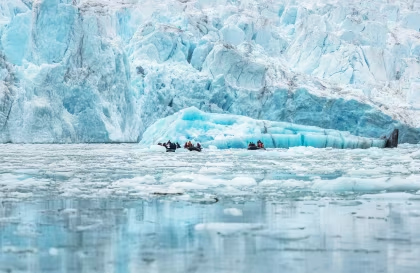
Today, Svalbard remains a place where history and wilderness meet, and perhaps, supernatural forces roam. Glaciers spill into deep fjords, jagged mountains rise above the sea, and the wind howls over desolate plateaus.

Photo by Enrico Pescantini
On an expedition cruise, as you sail out of Longyearbyen toward the Arctic pack ice or the archipelago's spectacular far north, turn your gaze back along Isfjorden toward Kapp Thordsen. There, Svenskhuset still stands, silent in the shadow of the mountains above. Its wooden walls are now warped with time, darkness spilling out from empty window frames.
As the wind picks up, you might hear whispers from beyond, carried out into the frozen sea as the first snowflakes begin to fall.
Discover our Svalbard expedition cruises and start planning your own journey into the high Arctic. Will you answer the call?