• Home
  • Triplogs
  • HDS25-26, trip log, Falkland Islands - South Georgia - Antarctica

HDS25-26, trip log, Falkland Islands - South Georgia - Antarctica

by Oceanwide Expeditions

Photo gallery

Logbook

Day 1: Ushuaia, Embarkation day - Setting sail for Antarctica

Ushuaia, Embarkation day - Setting sail for Antarctica
Date: 21.12.2025
Position: 54°48.5 S, 068°17.9 W
Wind: SW3
Weather: Overcast
Air Temperature: +12

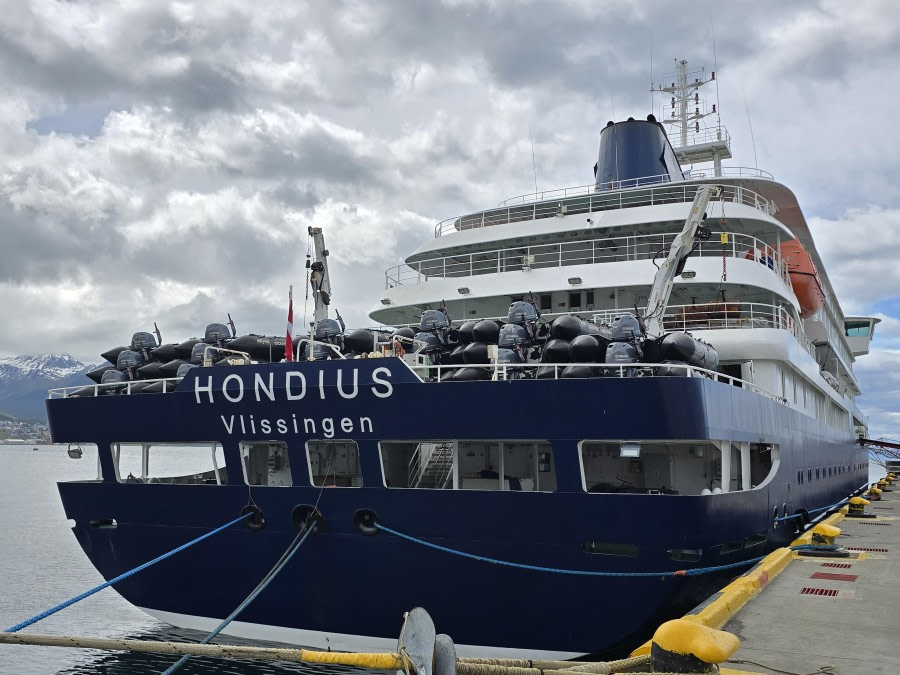
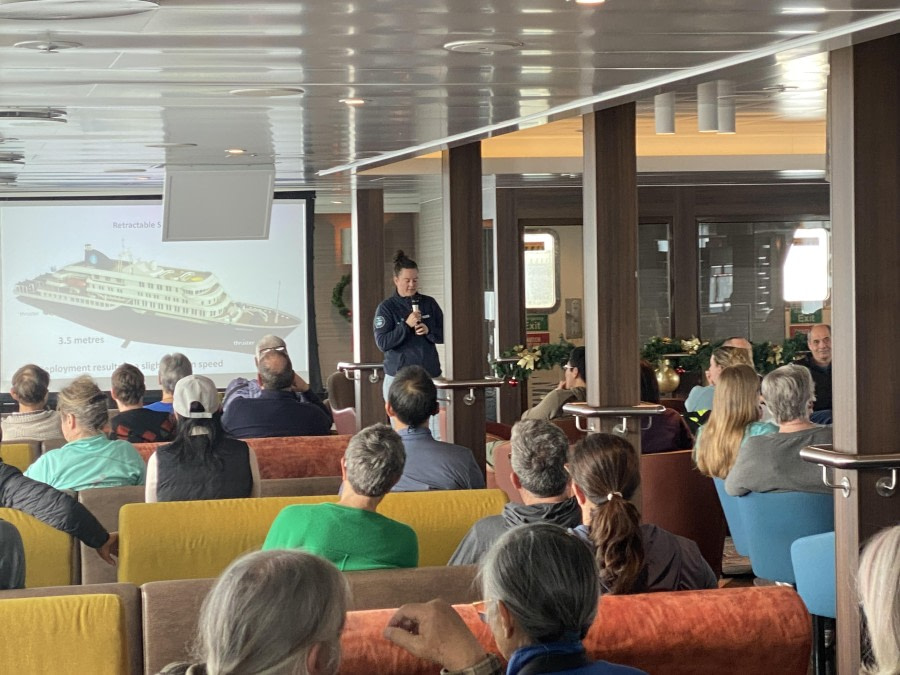
Our first day of the expedition began, with everyone coming aboard excited to go to Antarctica. After settling into our cabins and confirming that our luggage had arrived safely, most of us drifted into the lounge where tea and coffee were waiting. The mood was bright and chatty as people compared cabins and swapped stories about how long they had dreamed of making this journey. We were called to the lounge by our Expedition Leader Chris, to first inform us about some matters of safety.

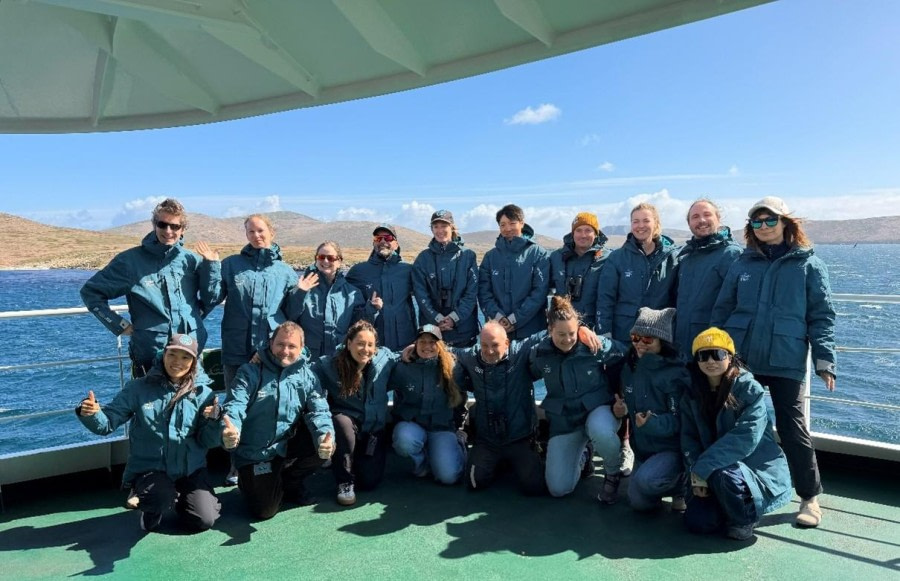
As we began the drill, we all gathered and put on our life jackes, oddly reassuring that we now know what to do in an emergency. After the drill, Captain Ernesto invited us into the observation lounge with an inspiring welcome speech. Chris explained some what to expect from our adventure, and the expedition team also introduced themselves; 17 guides with each their speciality! With that done, we quickly went to the buffet dinner, meeting new people and exchanging stories.

As evening settled in we met again at 20:30 for the zodiac and IAATO briefing. The reality of what lay ahead began to land as we learned how we would move around in the days to come. By then we could already feel a gentle roll underfoot, and some of us took extra precautions by paying the doctor a visit for some seasickness medication. There was a steady flow of passengers exchanging wry smiles as they collected tablets and advice.

Before turning in for the night we secured our belongings as instructed, aware that we would be sailing into open sea within hours. The ship creaked softly and a few mugs rattled on their saucers as we made our way back to our cabins. It felt like the true beginning of the adventure a mix of anticipation, sea breeze and the pleasant uncertainty of what the next days would bring.

Day 2: Drake Passage - At sea sailing towards Antarctica

Drake Passage - At sea sailing towards Antarctica
Date: 22.12.2025
Position: 56°54.65’S / 65°50.4’W
Wind: NW4
Weather: Overcast
Air Temperature: +6

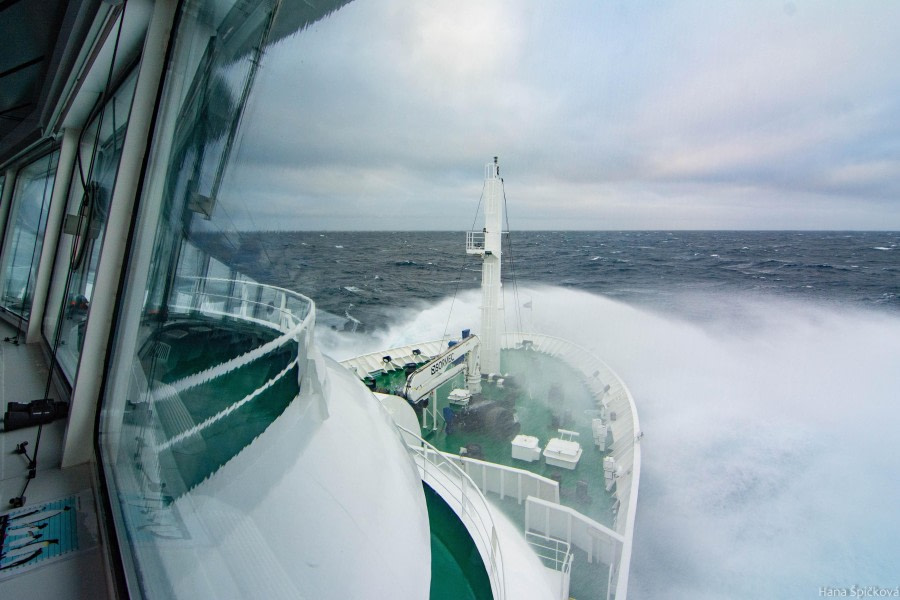
Today's programme was filled with preparations for our visit to Antarctica. On our second day at sea, we received our first 'Good Morning, Good Morning!' wake-up call and began our crossing through the Drake Passage. The waves, around 4 or 5 metres high, gave us an idea of what the famous 'Drake' is like. Although it was not extremely rough for some of us, it was still relentless.

Our first lecture of the day was given by Simon, one of our ornithologist on board. He explained how and why birds follow the ship, and to our amazement, that albatrosses spend most of their lives on the sea. Meanwhile, some of us were watching these amazing birds fly by outside! Just before lunch, we had another lecture by Andi, one of our whale experts on board. She described the whales of the Southern Ocean, and what we could expect from our voyage.

After lunch, we had a little bit of free time, which most of spend processing all the new information that was just given, or being up on the bridge, or outside, watching the birds Simon just talked about this morning fly by, sometimes extremely close!

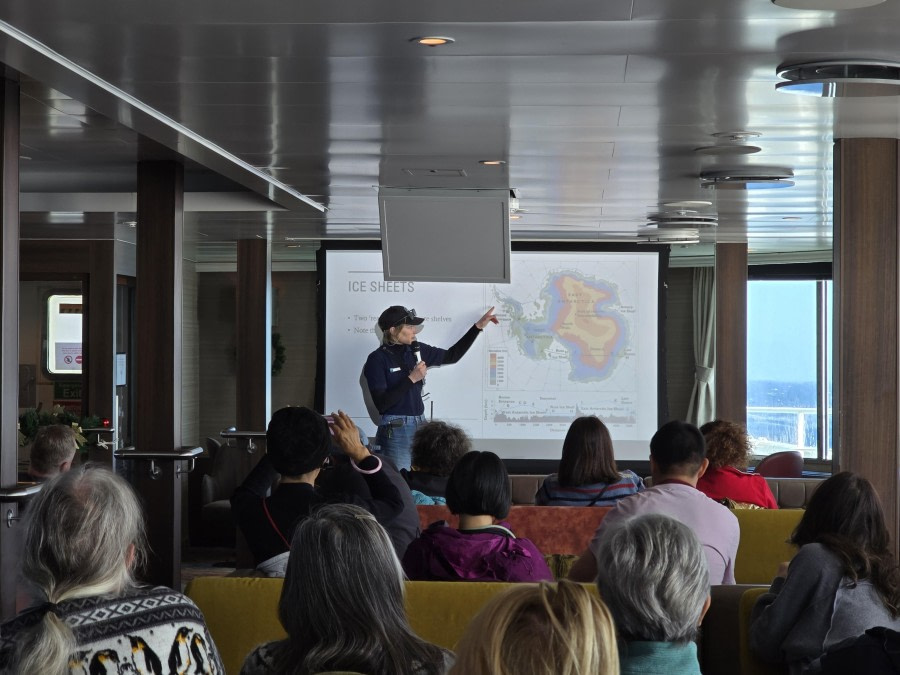
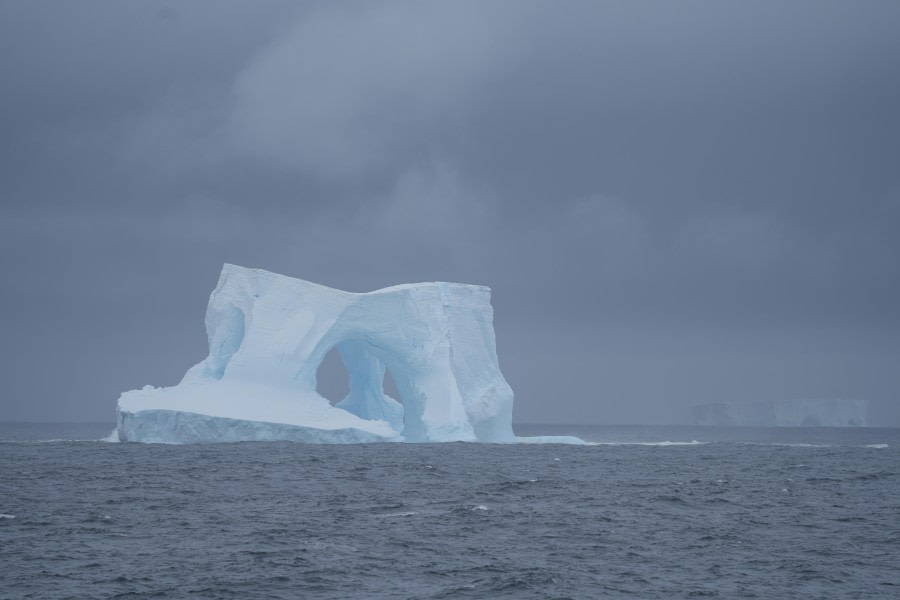
In the afternoon, Annelou told us more about the types of ice we would see in Antarctica, as an icy introduction to the coolest continent.

Our first day on sea flew by! Recap was already ay 18:00 followed by a plated dinner. As the sea was quite tiring for most of us, we went to bed early, ready for another day at sea.

Day 3: Drake Passage – At sea sailing towards Antarctica

Drake Passage – At sea sailing towards Antarctica
Date: 23.12.2025
Position: 61°01.2’S / 064°08.4’W
Wind: SE4
Weather: Partially cloudy
Air Temperature: +7

Our second day crossing the Drake Passage—an ocean stretch infamous for its wild and unpredictable seas—was met with remarkable luck. Instead of the legendary waves, we were greeted by relatively gentle conditions. Thanks to the calm seas, we traveled comfortably toward the White Continent. With the sun shining and a blue sky overhead, the conditions were perfect for wildlife watching. Around the ship, numerous bird species took advantage of the winds, effortlessly dynamic soaring just above the waves.

We were treated to an incredible aerial display. Wandering albatrosses—famous for having the largest wingspan of any bird in the world—glided around us. Alongside them were giant petrels, black-browed albatrosses, Wilson’s storm petrels, cape petrels, and many others. As we continued south, we spotted whale blows in the distance, a sign that we were nearing Antarctic waters.

This day was dedicated to preparation for our upcoming Antarctica landings. The morning began on a high note with a delicious breakfast, followed by a series of mandatory safety meetings. We learned about protecting the pristine Antarctic environment, proper behavior on land, and essential safety procedures for traveling at sea and zodiac boat operations. These briefings emphasized how fragile and unique this part of the world is, and how important our responsibility is as visitors.

In the afternoon, we were rewarded with our first views of Antarctica. After two full days at sea, this moment felt special. The first land we spotted was Smith Island in the South Shetland Islands, emerging on the horizon.

The view of towering mountains grew closer and more dramatic. This far south, darkness never truly arrives, and the sun dips below the horizon for only about three short hours. The evening felt like one long, never-ending sunset, painted with a beautiful play of colors of soft golds, deep oranges, and gentle pinks. It was a magical atmosphere, making time seem to slow as we sailed deeper into the Antarctic world.

Day 4: Orne Harbour & Stony Point

Orne Harbour & Stony Point
Date: 24.12.2025
Position: 64°37.7’S / 62°32.6’W
Wind: E4
Weather: Overcast
Air Temperature: +1

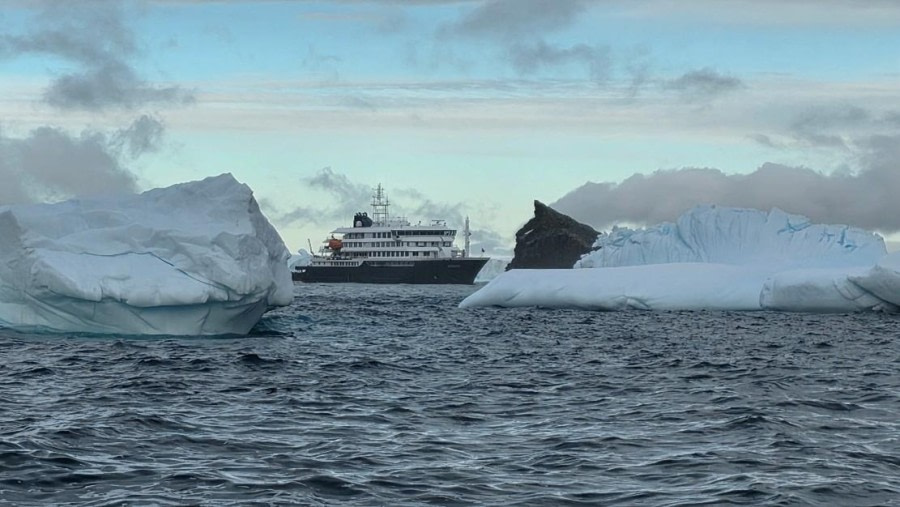
The first day of operations for MV Hondius in Antarctica delivered an unforgettable introduction to the White Continent, combining wildlife encounters, scenic landings, and classic polar adventure under remarkably favourable conditions.

Our morning began at Orne Harbour, where calm seas and an overcast sky created a serene and atmospheric welcome. Before even entering the harbour, excitement built as a small group of Orca were spotted patrolling along the shoreline. Although they kept their distance and moved steadily past the entrance to Orne Harbour, the brief sighting was an awe-inspiring reminder that we had truly arrived in one of the world’s great wildernesses.

Once safely inside the harbour, expedition operations commenced with efficiency and enthusiasm. Passengers were divided into two groups to make the most of the area. One group went ashore to tackle the steep climb up to the Chinstrap Penguin colony perched high above the landing site. The ascent was challenging but rewarded those who made it with close views of the bustling colony and spectacular panoramas over the harbour below. The energy and noise of the penguins, set against dramatic Antarctic scenery, made the effort well worthwhile.

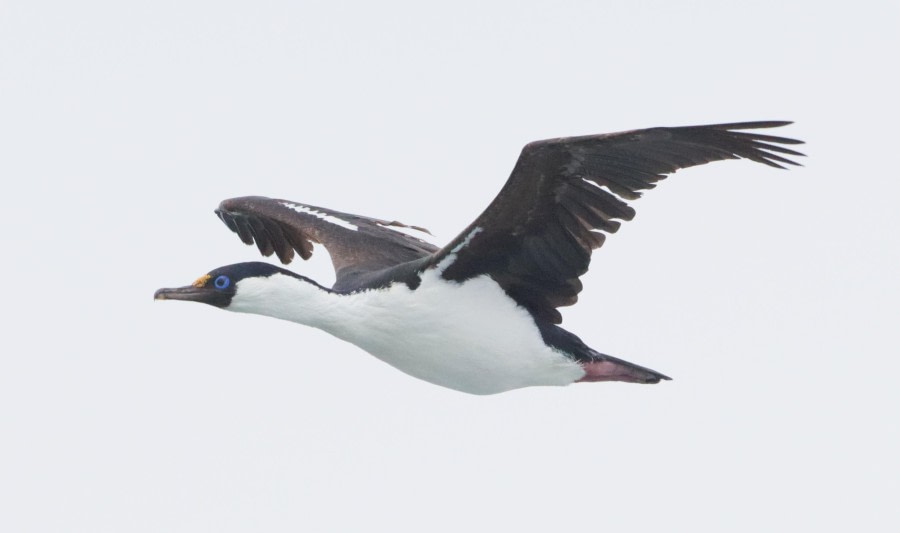
Meanwhile, the second group enjoyed a Zodiac cruise along the shoreline and out toward the entrance of the bay. Here, wildlife sightings came thick and fast. Chinstrap and Gentoo penguins dotted the rocks and snowfields, while Snowy Sheathbills and Antarctic Shags added to the diversity. The true highlight, however, was a group of Humpback Whales actively feeding near the mouth of the harbour. Their repeated surfacing and powerful movements provided a thrilling and memorable display.

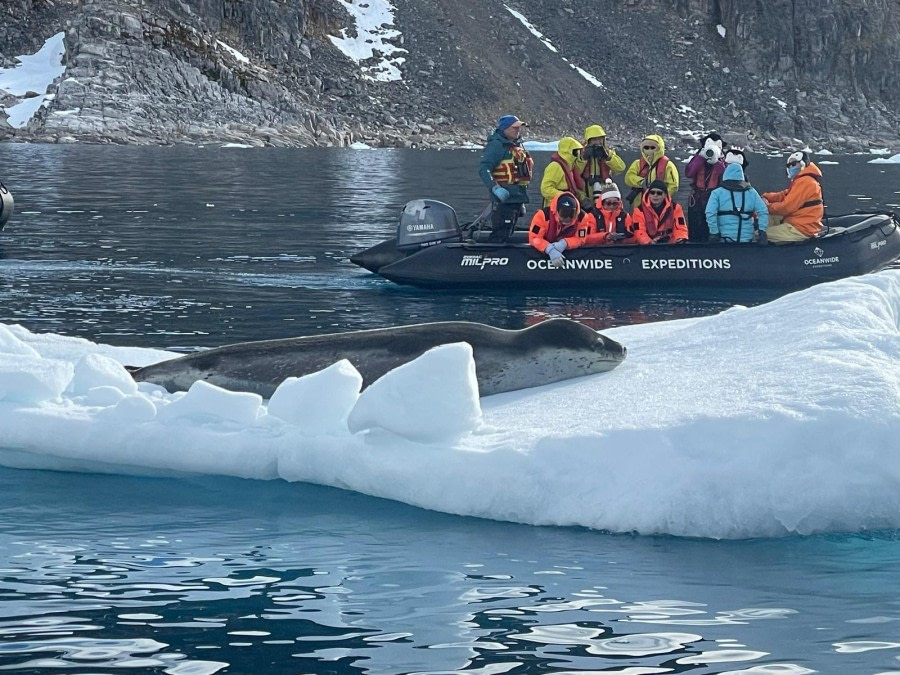
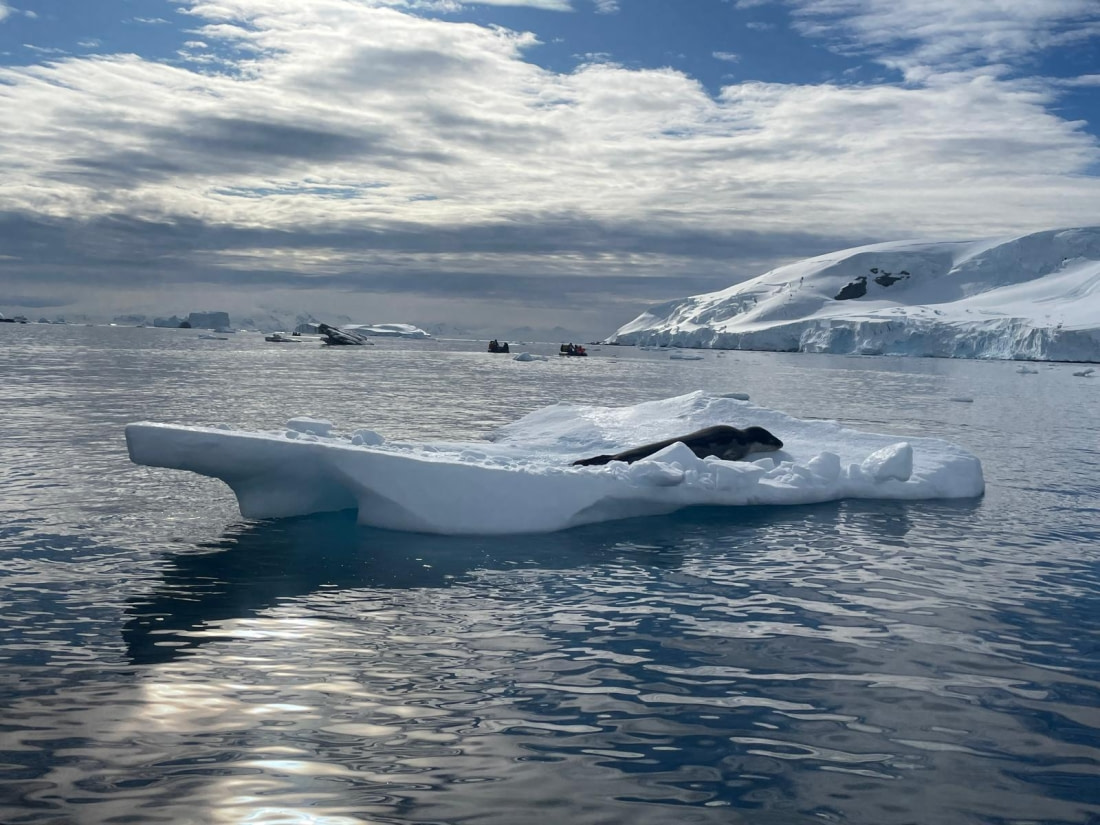
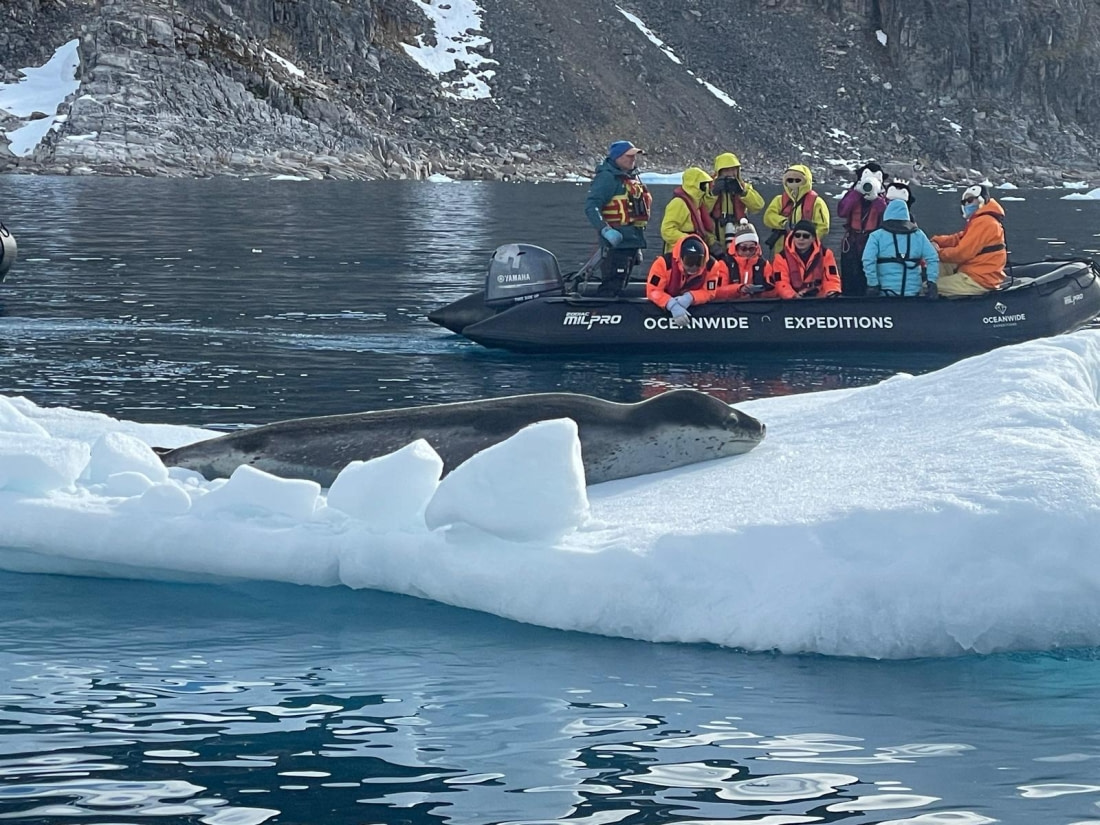
After the groups swapped activities, operations were briefly overseen by an unexpected onshore observer: an inquisitive Leopard Seal, its head emerging from the brash ice near the landing site, calmly watching the comings and goings of passengers and Zodiacs alike.

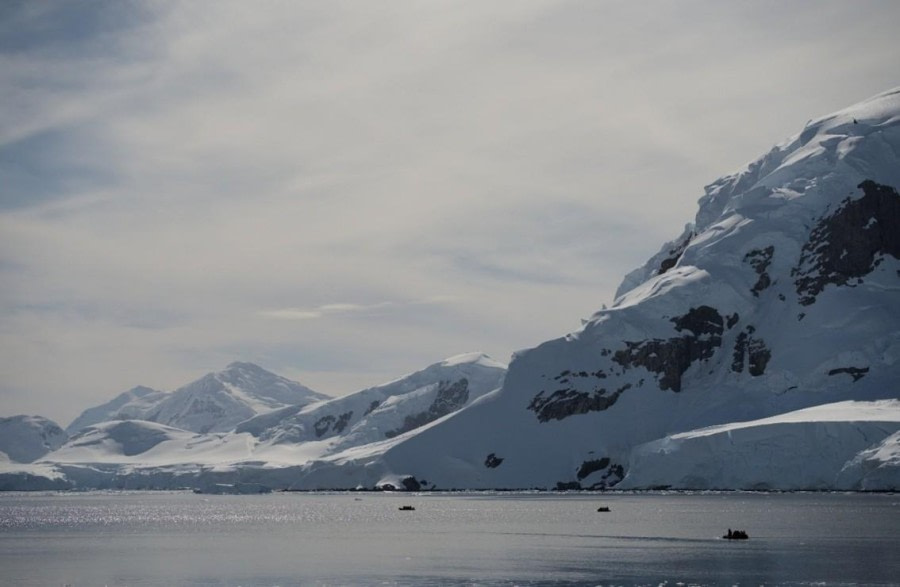
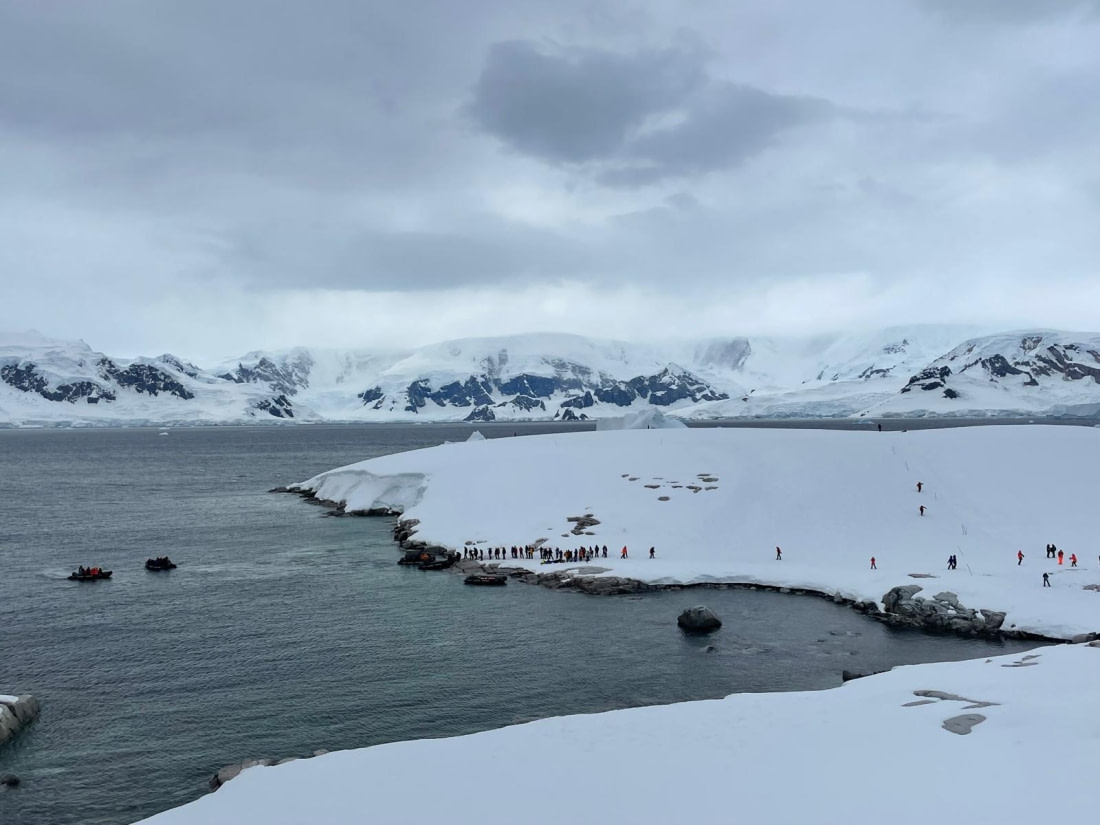
Following a short transit, the afternoon brought us to Stony Point in Paradise Harbour, where the weather transformed dramatically. The sun broke through, bathing the landscape in brilliant light and revealing why this area is considered one of the most beautiful in Antarctica. With relatively limited wildlife here, some guests took the opportunity to climb a small peak and enjoy the snow more freely—lying down, playing, and taking in the incredible surroundings. Along the shoreline, several Weddell Seals were hauled out, resting peacefully in the afternoon sun.

The day concluded with a highlight for many: a lively and well-attended Polar Plunge. Brave souls entered the icy Antarctic waters for a brief dip before racing back to shore, greeted by warm towels, cheers, and a quick Zodiac ride back to the ship and a well-earned hot shower.

It was, by every measure, an outstanding first day of Antarctic operations for MV Hondius—rich in wildlife, blessed with fine weather, and filled with moments that will be remembered long after the expedition ends.

Day 5: Portal Point & Punta Sucia

Portal Point & Punta Sucia
Date: 25.12.2025
Position: 64°29.8’S / 61°44.7’W
Wind: S4
Weather: Overcast
Air Temperature: +2

Christmas Day dawned with a true reminder of Antarctica’s power. We awoke to blustery conditions at Portal Point, with winds gusting to 35 knots and seas building to around four feet. These conditions made for challenging Zodiac operations, demanding focus, teamwork, and respect for the environment as we maneuvered through Charlotte Bay.

Portal Point is a narrow, rocky promontory on the Reclus Peninsula along the Danco Coast of Graham Land (64°30′S, 61°46′W). Historically, it served as a vital “gateway” route for early British explorers attempting to ascend the hazardous glaciers leading to the Antarctic Plateau—hence its name. In 1956, a small British refuge hut known as Cape Reclus was established here and occupied briefly during the winters of 1957–1958 for survey work. The hut was later dismantled and relocated to the Falkland Islands in 1996, where it now stands in the Falkland Islands Museum in Stanley. Today, the only trace remaining at Portal Point is its concrete foundation, often buried beneath snow.

Despite the weather, the landing site was alive with wildlife. Gentoo penguins busily navigated the shoreline, while snow petrels fluttered effortlessly in the wind. Crabeater seals lounged along the ice edge, unfazed by the swell. Those cruising by Zodiac were rewarded with unforgettable sightings of humpback whales, their massive flukes lifting gracefully from the water. Humpback whales are known for their long pectoral fins—the longest of any whale species—which can reach up to one-third of their body length and help them maneuver with surprising agility.

During lunch, nature delivered one of its most poignant moments. A pod of Type B killer whales appeared along the starboard side of the ship, methodically surveying the area. Their attention was fixed on a nearby humpback whale and her calf. The scene was a quiet reminder that Antarctica is not only a place of beauty, but also of raw ecological truth—where survival, care, and loss exist side by side in delicate balance.

In the afternoon, we relocated to Punta Sucia in the South Shetland Islands. Here, the weather transformed completely, revealing beaming sunshine and calm conditions. Punta Sucia showcases the classic geology of the maritime Antarctic: dark basalt and andesite from ancient lava flows, layers of volcanic tuff and breccia, and bands of metamorphic rocks such as schist and gneiss. In places, sedimentary rocks hint at a warmer prehistoric Antarctica, sometimes preserving fossilized wood or leaf impressions. Ice-free areas supported resilient mosses, clinging to life in this harsh environment.

Wildlife encounters continued to delight. A leopard seal rested contentedly on an ice floe after feeding, while Antarctic shags nested nearby. Gentoo penguin rookeries bustled with activity, elephant seals lounged heavily along the shore, and humpback whales once again surfaced offshore.

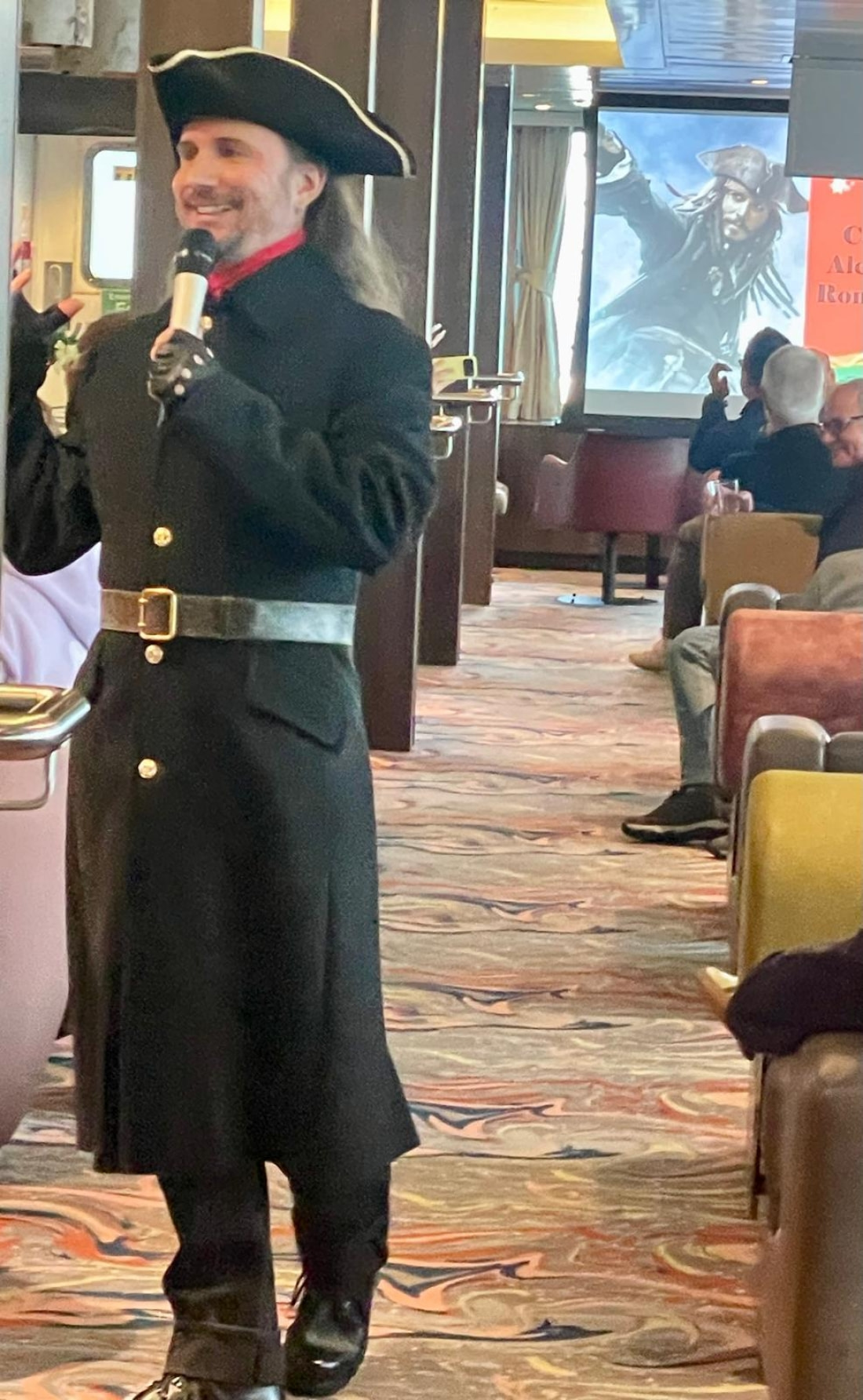
The day concluded with a festive Christmas dinner, followed by an evening of celebration. Guests revealed impressive talents -singing carols with enthusiasm, excelling in Antarctic trivia, and embracing the joy of the season. To everyone’s amusement, we were even visited by Captain Jack Sparrow and, incredibly, Santa Claus himself, having journeyed all the way from the North Pole.

As we turned in for the night, spirits were high and hearts were full—grateful for the warmth of Christmas cheer set against the awe-inspiring wonders of Antarctica.  

Day 6: At sea near Penguin Island

At sea near Penguin Island
Date: 26.12.2025
Position: 62°37.5’S / 58°59.6’W
Wind: E5
Weather: Overcast
Air Temperature: -1

It wasn’t the easiest of Antarctic days.

The forecast had already warned us: conditions around Penguin Island would be challenging. Still, the night found a way to surprise us. Ice pressed against the hull, and the steady banging along the side of Hondius kept more than a few of us awake, listening to Antarctica rearrange itself in the dark.

By morning, difficult navigation reshaped the plan. Instead of heading straight out, we shifted gears and leaned into education mode. The expedition team turned the delay into an opportunity. Pierre guided us through the world of humpback whales and their peculiar behaviors. Rose took us deep into Antarctic geology—this time in Mandarin—while Annelou explored why scientists often compare the polar regions to outer space: extreme isolation, hostile conditions, and the way life adapts against all odds.

Outside, the open waters kept rewarding those willing to brave the cold. Deck 6 aft became a familiar gathering spot for eager birders. As the winds picked up, so did the sightings. Black-browed albatrosses appeared, effortlessly cutting through the air, joined by cape petrels dancing low over the waves.

Fin whales teased us for most of the day. A distant blow here, another there—always solitary, always just out of reach. Until suddenly, the rhythm changed. A larger aggregation emerged, close enough to stop people mid-sentence and pull them toward the windows. This time, no binoculars were needed. We watched their immense bodies glide past the ship, taking in the subtle colors, the textures of their skin, the clean lines of their dorsal fins. A quiet, shared moment of awe.

As snow began to fall and night settled in, the expedition team offered a screening of a Shackleton documentary. The promise of popcorn and polar history was tempting—but fatigue won. One by one, people drifted off to their cabins, choosing rest over the screen.

Dinner ended early for many. The next day’s wake-up call was set for 3:45 a.m. Painfully early for some of us. Completely worth it.

But that… is a story for another day.

Day 7: Elephant Island, Point Wild

Elephant Island, Point Wild
Date: 27.12.2025
Position: 61°03.2’S / 54°46.2’W
Wind: S5
Weather: Overcast
Air Temperature: +3

We woke up very early in the morning at 3:30 am. We had daylight and it was very quiet on the ship. The reason for the early wake-up was very special. We were at Elephant Island, at a place called Point Wild. This place is very important in Antarctic history.

Point Wild is known because of Ernest Shackleton and his expedition in 1916. After their ship Endurance was crushed by ice, Shackleton and his crew had to escape. Finally, 22 men were left on Elephant Island. They had almost nothing: very little food, and very bad weather. They built a small camp with boats turned upside down and waited there for help. Shackleton left the island with five men to get help, and the others stayed behind for more than four months.

They did not know if Shackleton would come back. In the end, they were rescued by Captain Luis Pardo, a Chilean captain, and all 22 men survived. This makes Point Wild a very emotional and historic place.

Only a few times it is possible to go out with a zodiac cruise at Point Wild because the weather and ice are often too dangerous. But today was our lucky day. The conditions were great, so we went out in the zodiacs. We saw many penguins on the rocks and in the water. We passed the statue of Captain Pardo, which stands there to remember the rescue. We also saw a leopard seal hunting a penguin, which was intense and very real nature. Around us was a lot of ice, big and small pieces. It was an unforgettable experience.

After the zodiac cruise, we went back to the ship and had breakfast. Everyone was happy but also tired, so we took a nap. Later, Simon gave us a talk and taught us everything about penguins. We learned about their life, how they survive the cold, and how they raise their chicks.

After a good lunch and another short nap, Jerry and Hana gave a lecture about ice and icebergs. They explained how ice is formed and why icebergs have different shapes and colors.

In the evening, we had a good dinner. It was a long and special day. Everyone was very tired, so we all went to sleep early, with many strong memories of Elephant Island.

Day 8: At sea towards South Georgia

At sea towards South Georgia
Date: 28.12.2025
Position: 60°30.75’S / 047°00.8’W
Wind: SE5
Weather: Overcast
Air Temperature: +3

We awoke to a true Southern Ocean Sea day, the Hondius steadily pressing northward from the South Shetland Islands toward South Georgia. Overnight the weather had built, and by morning it was clear that the swell and wind would not allow us to safely carry out our planned operation in the South Orkney Islands. Though there was a collective sigh of disappointment, we were reminded that flexibility is part of polar travel, just as it was for the great explorers who once sailed these same waters.

The ship became our world for the day, and what a fine refuge it was. As we rolled gently through the grey-blue sea, we gathered for a lecture on Sir Ernest Shackleton from Jody. We traced his legendary Imperial Trans-Antarctic Expedition and reflected on the astonishing open-boat journey of the James Caird from Elephant Island to South Georgia in 1916. Knowing we were following a similar route gave the ocean around us a deeper meaning; these were not just waves and wind, but a living corridor of history.

Later, we turned from history to wildlife with a talk from Andi on orcas. We learned that orcas are the largest members of the dolphin family and are highly intelligent, living in tight-knit, matrilineal pods. Different ecotypes specialize in different prey, from fish to seals, using sophisticated hunting techniques passed down through generations. As apex predators with no natural enemies, they play a crucial role in maintaining the balance of the Southern Ocean ecosystem.

After lunch, we focused on the practicalities ahead with our South Georgia biosecurity briefing and recap. We carefully reviewed procedures to ensure that no non-native species would be carried ashore, understanding how vital these measures are for protecting South Georgia’s fragile and remarkable environment.

The day wound down with dinner and a sense of anticipation for what lay ahead. In the evening, there was the option to watch a documentary about penguins in Antarctica, their resilience and charm a perfect counterpoint to the wild seas outside. As the Hondius continued her course through the night, we felt both humbled and exhilarated—part of a long tradition of voyagers moving through these storied southern waters.

Day 9: At sea towards South Georgia

At sea towards South Georgia
Date: 29.12.2025
Position: 57°37.2’S / 040°32.5’W
Wind: SSE4
Weather: Snow
Air Temperature: 0

The day unfolded as a gentle transition from open ocean to the promise of land ahead, as the ship sailed through the Scotia Sea en route to South Georgia. The sea carried a sense of anticipation, its cold blue surface stretching endlessly toward the horizon, while the air itself seemed alive with movement and story.

Morning brought immediate excitement. Snow petrels and Kerguelen petrels appeared early, gliding effortlessly around the ship, their crisp white and soft grey forms cutting through the polar light. Their presence felt like a welcome sign that the Southern Ocean was truly revealing itself. Between sightings, the morning settled into a rhythm of learning, with a series of lectures that added depth and context to the journey.

Mark spoke first, sharing insights from his time working and living on South Georgia. His stories painted a vivid picture of life on the remote island—its isolation, resilience, and the deep connection formed with such a rugged environment. This was followed by Jodi’s lecture on whaling in the Southern Ocean, a sobering and powerful account of the region’s history. Her talk traced the legacy of exploitation and the long-lasting impacts on wildlife, grounding the voyage in reflection as much as discovery.

Just before lunch, the ocean offered another surprise. A lone Orca appeared briefly alongside the ship, its sleek black-and-white body breaking the surface with quiet authority. Though the encounter was short, it left a lasting impression—an electric reminder of the wildness that defines these waters.

The afternoon continued with learning and observation in equal measure. Carina delivered a fascinating lecture on the behind-the-scenes workings of Hondius, revealing the complex choreography required to keep an expedition ship running smoothly in such remote conditions. It offered a new appreciation for the crew’s efforts, often unseen but essential to every moment of the journey.

Throughout the afternoon, snow petrels came and went, sometimes appearing in pairs, sometimes in small flurries, as if escorting the ship onward. Their intermittent presence was matched by a striking sight on the horizon: a large tabular iceberg. Its flat, monumental shape stood in stark contrast to the surrounding sea, a floating cathedral of ice that drew eyes and cameras alike.

As evening approached, the focus shifted once more to storytelling. Sasha delivered an engaging lecture about his own personal intriguing journey to Antarctica, weaving together personal experience, challenge, and wonder. His narrative echoed much of what was being felt onboard—a shared sense of privilege at traveling through such a rare and powerful place.

The day concluded quietly but symbolically. As the ship drew closer to South Georgia, the blinds were closed for the first evening, marking a subtle but meaningful transition. It was a gesture of respect and readiness, signalling entry into a new chapter of the voyage. Outside, the sea continued its steady motion, while inside, the sense of arrival—both physical and emotional—settled gently over the ship.

Day 10: St Andrews Bay

St Andrews Bay
Date: 30.12.2025
Position: 54°26.1’ S, 036°10.5’W
Wind: S6/7
Weather: Clouds
Air Temperature: +3

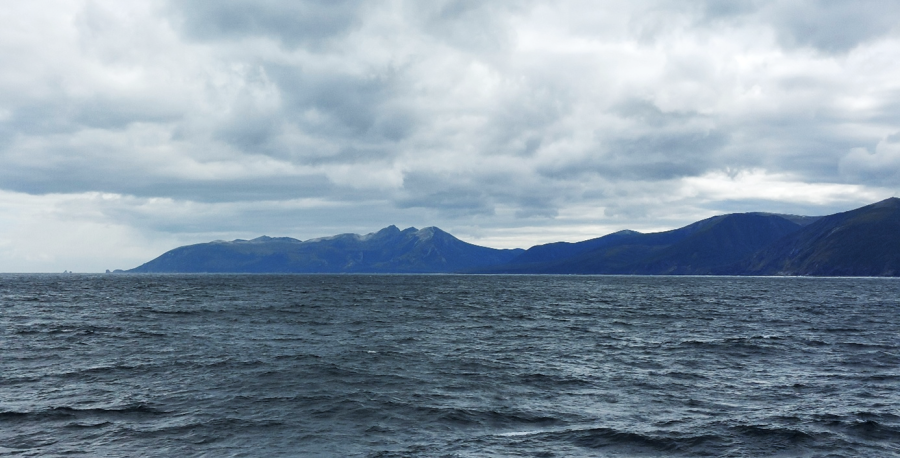
The morning of our fifth day at sea was gloomy. Low, layered clouds, gusty wind — damp and cold — and the huge, lazy waves of the Southern Ocean: this scene had already become familiar to us, almost dear. Yet this time there was something different about it. The waves were less aggressive, the wind had eased, and the character of the clouds had noticeably changed. All signs pointed to our proximity to land. And then, when the darkness of night had fully given way to the murky light of morning, silhouettes of a chain of jagged mountains slowly began to emerge from behind the veil of mist. This was the legendary South Georgia — mysterious, bristling with snow-covered peaks, a harsh and unwelcoming land. It was here that we were to spend the next four days. And yet, alongside its severity and hostility, there was something in this lost kingdom that felt alluring, beckoning, even hopeful: in places along the coast, the mountain slopes were covered with grass. The glaciers creeping through the valleys were not as monolithic as their Antarctic relatives, the colour of the sea shifted from deep blue to a lighter, greenish hue, and the wind carried from shore the scent of soil and peat.

If one looks at a map, South Georgia’s outline bears a striking resemblance to a Chinese dragon — long, elongated, with a deeply indented coastline. Having rounded the island from the south, Hondius now set a north westerly course, advancing along the northern shore and steadily closing the distance to land.

At a quarter to eight, the now painfully familiar voice of Chris, our expedition leader, sounded over the PA system: “Good morning, Hondius, good morning…” In his unhurried, calm manner, Chris informed us that we had successfully reached the shores of South Georgia and that Hondius would soon be dropping anchor in a bay bearing the name of Saint Andrew. He then gave us a brief weather update and promised that the day would be unforgettable.

By that time, many of us had already been up for quite a while and, cameras at the ready, were peering into the distance from the open decks. Some, squinting slightly and leaning back in their chairs, were enjoying their morning coffee in the Observatory Lounge, while most were still luxuriating in their beds, rocked by the lazy ocean swell like children in cradles. One way or another, it was time to get up and prepare for great deeds and unforgettable impressions.

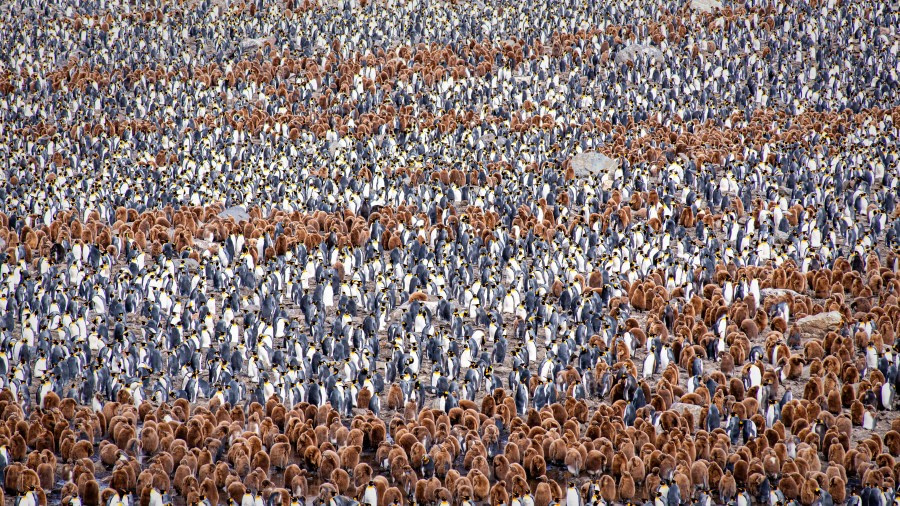
If South Georgia itself is rightly considered a diamond in the crown of Antarctic and sub Antarctic islands, then St. Andrew’s Bay is a diamond — or rather, a black pearl — in the necklace of the island’s many bays and coves. One hundred and fifty thousand pairs of king penguins! One hundred and fifty thousand — just think of it! Add to this southern elephant seals, Antarctic fur seals, giant petrels, Antarctic skuas, and so much more, not to mention the truly breathtaking beauty of the local landscapes. Each of us was eager to see all of this with our own eyes.

At eight o’clock, the restaurant on Deck 5 opened its doors and we rushed in for breakfast. Meanwhile, Hondius finally came to a stop. The anchor chain screeched and thundered as the massive anchor dropped to the bottom of the bay.

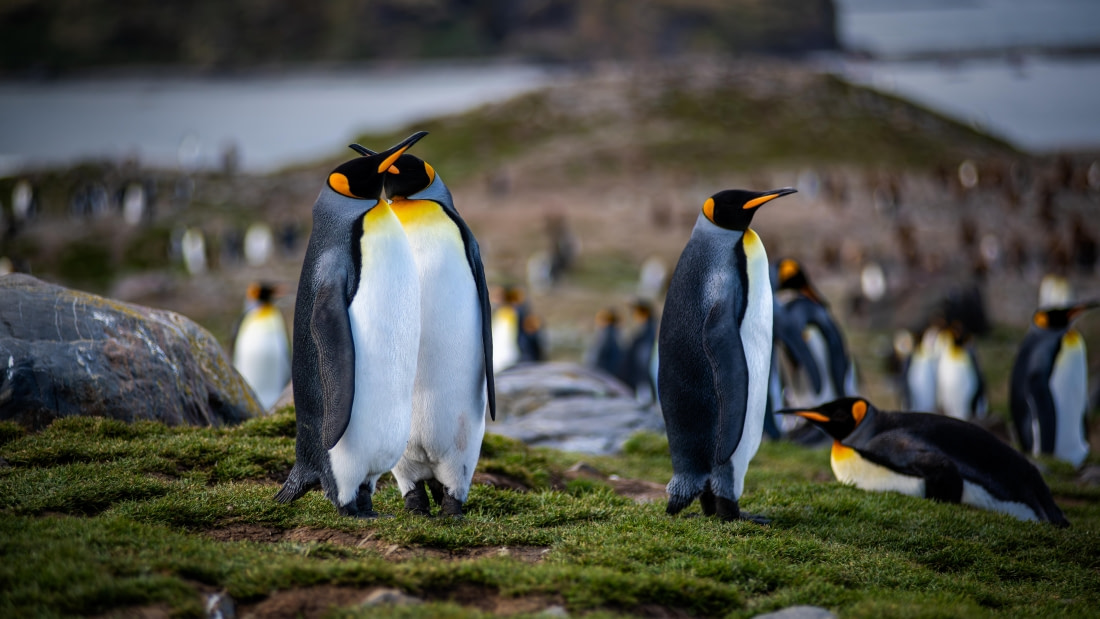
A vast valley framed on three sides by mountains whose snow capped peaks stood out against the overcast sky; three glaciers descending the slopes; and a tussock covered plain split in two by a long, narrow moraine — this was St. Andrew’s Bay. But this description is meaningless without mentioning its main inhabitants — the king penguins. Thousands upon thousands of these remarkable birds were everywhere, as far as the eye could see. It seemed as though half the valley was covered by a vast carpet with a strange pattern — all of it penguins! What delighted us even more was the fact that we would not be spending three or four hours in this extraordinary place, but the entire day.

At 08:30, the Zodiacs were launched. Two of them immediately sped toward shore, carrying several guides and the equipment needed for landings. The remaining Zodiacs, also operated by guides, stayed by the ship to await us.

On South Georgia, the same rules apply as in Antarctica: no more than one hundred people may be ashore at any given time. Accordingly, the plan was simple — half of us would go ashore until lunchtime, while the other half would explore the coastline of St. Andrew’s Bay from the water on a Zodiac cruise.

We were just beginning to gather near the Zodiac Boarding Area when William, our hotel manager, announced the start of the operation over the PA system. Well then — the time had come.

In groups of ten, we boarded the Zodiacs one by one and headed for shore. Tall but calm waves rolled gently in the same direction as we did. At the same time, the wind continued to blow offshore, and at times its gusts were quite strong, covering the sea’s surface with short, sharp, biting waves running against the ocean swell. The whole scene felt strangely surreal, as if we were about to discover a portal to a parallel world. Meanwhile, our guides bravely handled the boats, doing their best to spare us from the salty spray that kept exploding into the air like fireworks.

The most serious part of the ordeal awaited us at the landing site. One could not simply pull up to the shore: the Zodiac driver had to surf the wave, riding its crest and allowing it to throw the Zodiac onto the beach. Our guides, to their credit, handled this task brilliantly. Once the Zodiac was beached in the surf zone, we had to disembark without the slightest delay and move a couple of dozen metres inland. There, members of the expedition team explained where to go, what to look at, and how to behave around the aggressively inclined fur seals. Meanwhile, the Zodiac driver, lifted from the sand by the next incoming wave, had to return with it to the realm of water. This continued until all of us were safely ashore.

We looked around. A sandy beach giving way to a valley covered in low grass; mountains; enormous glaciers partially strewn with rock debris; a terminal moraine already overgrown with grass — and early morning light. The air, like our spirits, felt fresh and joyful.

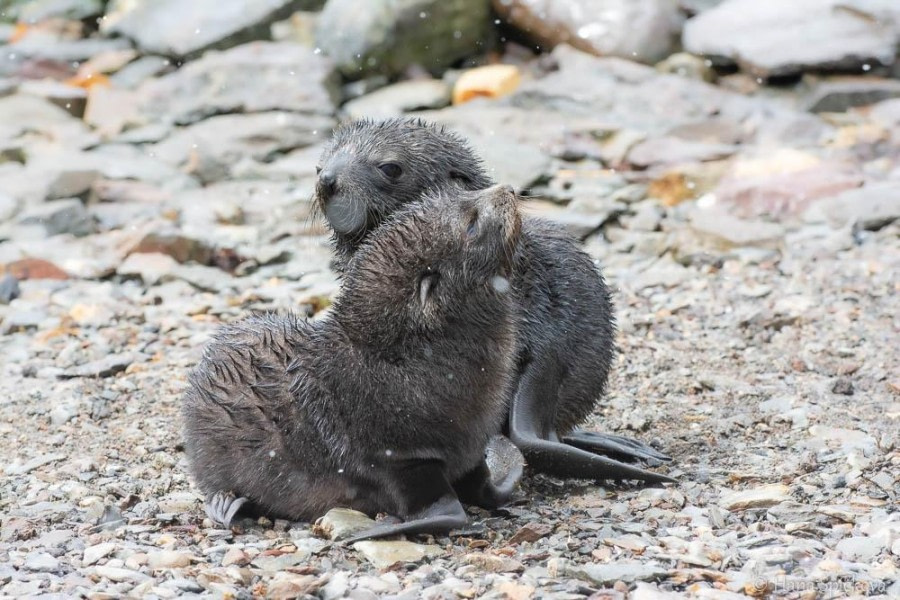
The beach and the valley were teeming with wildlife: giant petrels dozing with their heads tucked under their wings, elephant seal pups abandoned by their parents, fur seals casting menacing glances around with their muzzles raised high, and, of course, hordes of king penguins, whose main colony lay beyond the glacial moraine. Cameras at the ready, we slowly moved forward.

The route ahead was not short and even included an obstacle — a small but spirited river crossing the entire valley, originating from a glacial lake. The path, or rather the trajectory of our movement, was marked with red poles, thanks to our guides.

Moving from pole to pole and occasionally arguing with fur seals clearly displeased by our presence, we soon reached the river, which turned out to be favoured by hundreds upon hundreds of moulting penguins. They stood motionless along its banks, dropping their old feathers into the water one by one, while new, bright and clean ones grew in their place. Moulting is a difficult process: during this time, penguins lose their waterproofing and therefore cannot swim. As a result, they go without food for weeks, standing forlornly on the riverbank, waiting for the moult to end. Trying not to disturb them, we carefully waded across the river, with our guides actively helping us. The water was shallow, but the current was remarkably strong.

After walking a few hundred more metres, we began climbing the moraine. On one of the slopes, right beside the path, we came across a skua nest. The chick, nimbly moving its little legs, was exploring its surroundings, while its parents kept a vigilant watch to make sure nothing happened to it. Whenever one of us stopped to take photos, one of the adults would spread its wings menacingly, puff out its chest, and open its beak in a show of aggression. That was enough to make it clear that we should move on.

A few more dozen metres, another steep section, a couple more steps — and we found ourselves on top of the moraine. There, Mark, our ornithologist, was waiting for us along with a couple of guides. A crooked grin spread across Mark’s face: he clearly knew something and was anticipating our reaction — but to what? The answer followed almost immediately, as soon as we walked a few dozen metres farther. The moraine dropped steeply into the western part of the valley, which opened up before us in its entirety, laid out like a map. And there — there! Thousands, tens of thousands, HUNDREDS OF THOUSANDS of king penguins. Before us stood the largest colony of these incredible birds in the world. We stopped dead in our tracks, unable to believe our own eyes. It took some time before we began to recover and notice the details.

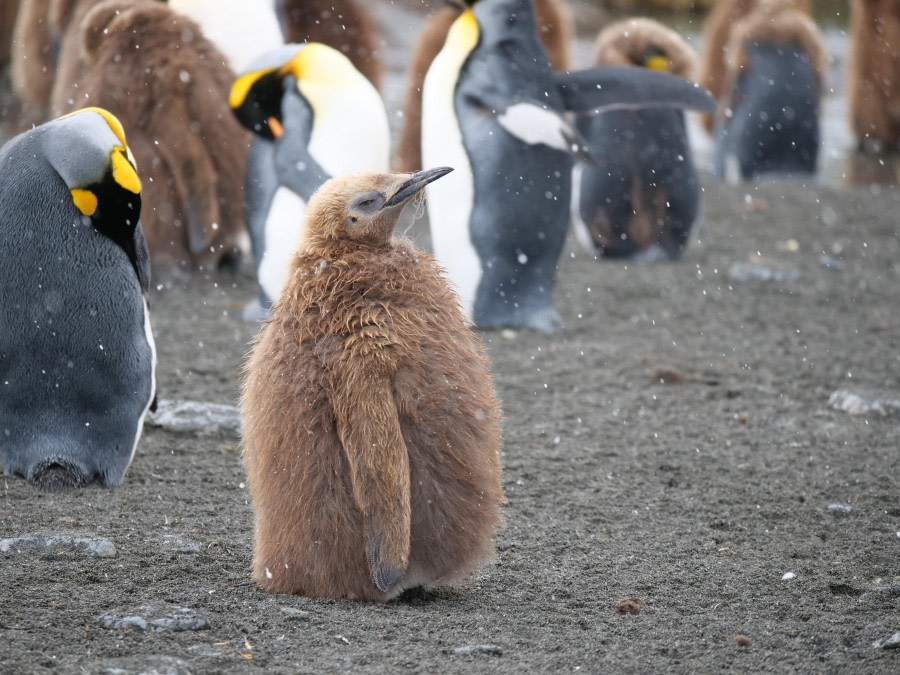
At first glance, complete chaos reigned in the colony, amplified by a cacophony of penguin calls so loud that we had to raise our voices to talk — although most of us, stunned by the sight, preferred silence. Still, the “nurseries” were clearly visible — areas where chicks in their ridiculous brown feathered “pyjamas” clustered together. As for the adults, some were moving toward the sea, while others, waddling slowly from side to side and carrying a rich haul of krill and fish in their bellies, were heading inland. Most, however, simply stood in place, going nowhere at all.

Unfortunately, we were pressed for time and could not afford to remain atop the moraine for several hours, so before long we had to begin our return journey. Once again skirting angry fur seals, once again wading across the river, and weaving between elephant seal pups.

Every seasoned traveller setting off for some remote backwater knows that reaching the destination is only half the journey, and that just as much effort will be required to get back out again. So it was with us: standing on the shore and donning our life jackets, we understood perfectly well that there was no way back to the ship except by climbing into a Zodiac once more and trusting the skill of its driver in battling the waves.

At Chris’s command, the driver surfed the wave and was “thrown” onto the beach. Our task was to get into the Zodiac as quickly as possible. This already challenging feat was made even harder by the waves that kept slamming into the stern, drenching us from head to toe with icy, salty seawater mixed with sand — and generously laced with penguin feathers. Brrr.

Reaching the shell door, we disembarked from the violently rocking Zodiacs one by one and, with the help of the guides and deck crew, climbed back aboard Hondius.

After reaching our cabins and hanging our clothes up to dry, we went to lunch. We had worked up an excellent appetite, to say the least. This was followed by a very short post lunch rest, after which it was time to get dressed again and board the Zodiacs once more.

The Zodiac cruise served as a perfect postscript to our morning excursion. Gently bobbing on the waves, we explored the coastline of St. Andrew’s Bay, continuing to marvel at the sheer number of penguins. At the same time, those whose schedule placed the Zodiac cruise first were finally able to go ashore to follow the same route we had taken in the morning. To be honest, there was a touch of good natured envy — after all, they still had the river crossing ahead of them and the moment of standing atop the moraine, frozen in awe at the spectacle unfolding before their eyes.

Evening came suddenly. Soon the last of us had returned aboard Hondius, the Zodiacs were hoisted back onto the deck, and the shell doors were securely closed. A short recap followed, during which Chris told us about the plans for the next day, and then came the long awaited dinner.

Meanwhile, the weather began to turn capricious. Like spies slipping through mountain passes from the island’s southern coast, low clouds crept into the valley. Light snow began to fall. It grew chilly. How good it was that we were already back on board.

Goodbye, St. Andrew’s Bay! Farewell, penguins!

Day 11: Grytviken & Hercules Bay

Grytviken & Hercules Bay
Date: 31.12.2025
Position: 54°17.4’ S, 036°28.9’W
Wind: N2
Weather: Snow
Air Temperature: +3

At 07:15, we were gently awakened as the ship lay off the rugged coast of South Georgia, where jagged mountains rose steeply from the cold Southern Ocean.

By 07:30, breakfast was being served onboard, and guests gathered in quiet anticipation while the island slowly revealed itself through low cloud and drifting mist.

As the morning progressed, our arrival at Grytviken brought us into one of the most historically significant places in the sub-Antarctic. Before landing, customs formalities were completed with the Government Officer, followed by a short presentation by the South Georgia Heritage Trust, highlighting conservation achievements and the successful rat eradication project that has allowed native bird populations to recover. During this time, individual biosecurity inspections were carried out at the shell doors to ensure the protection of this fragile environment.

Once ashore later in the morning, we landed near the weathered shipwrecks in front of the museum. Grytviken, established in 1904, was once the center of the Antarctic whaling industry. Walking among the historic buildings—the church, museum, post office, and gallery—it was impossible not to imagine the lives of the thousands of men who once worked here, isolated at the edge of the world. Guided walking tours of the whaling station departed from the museum at 10:00 and 11:00, offering deeper insight into the industry that shaped the island’s past.

At 10:30 and again at 11:30, some guests made their way to the cemetery overlooking the bay to raise a traditional toast to Sir Ernest Shackleton. Shackleton, whose legendary Endurance expedition defined the spirit of polar exploration, is buried here, and the moment felt both humbling and deeply moving.

By 12:30, we had returned to the ship, where lunch was served until 13:30, as we prepared for the afternoon’s adventure deeper into South Georgia’s wilderness.

In the early afternoon, the ship repositioned to Hercules Bay, a spectacular natural amphitheater of steep mountains, and cascading waterfalls. Named after the vessel Hercules, the bay felt wild and untouched.

At 14:45, the Red Group set out on a Zodiac cruise, followed by the Blue Group at 15:00. From the water, we encountered thriving colonies of Macaroni Penguins, alongside King Penguins, while southern elephant seals and fur seals lined the shore, crashing water, and the sheer scale of the landscape made this an exhilarating highlight of the voyage.

As the day drew to a close, we reconvened at 18:30 in the lounge for the expedition recap, reflecting on the history, wildlife, and unforgettable scenery experienced throughout the day. At 19:00, a barbecue dinner was served on the aft of Deck 5, enjoyed in the crisp polar air with the dramatic South Georgia coastline as our backdrop.

The day concluded at 22:00 with a New Year’s toast in the Observation Lounge. Surrounded by ice, ocean, and mountains, we welcomed the New Year from one of the most remote places on Earth—an extraordinary end to an unforgettable day of exploration.

Day 12: Gold Harbour & Drygalski Fjord

Gold Harbour & Drygalski Fjord
Date: 01.01.2026
Position: 54°37.6’ S, 035°56.2’W
Wind: VAR
Weather: Partially cloudy
Air Temperature: +3

This morning felt different from any other morning of the expedition. Happy New Year 2026. Beginning both the day and the year aboard Hondius was truly special and an experience most of us will never forget. The expedition team and crew had planned everything perfectly, offering us a genuine South Georgia expedition day at Gold Harbour. When we looked out the windows early on, we were greeted by a vast and dramatic bay where we were lucky enough to spend the entire day.

After a delicious breakfast, we dressed in full winter gear. Snow was falling steadily, creating a beautiful atmosphere. The group then split for the morning activities, with some heading out on a Zodiac cruise and others going ashore for a landing.

At the landing site, the staff ashore stood knee deep in the water, catching the Zodiacs in the swell. We stepped onto a striking black sand beach and were immediately surrounded by life. Elephant seals rested along the shore, fur seals played in the surf, and king penguins were everywhere. Wherever we looked, wildlife filled the scene and it felt like stepping straight into a nature documentary.

A marked path led us closer to the main part of the colony, allowing us to observe the chicks from a respectful distance. Brown and fluffy, they watched the adult penguins coming and going from the sea, seemingly wondering what they were doing and when they might be able to join them.

Meanwhile, the Zodiac cruise explored the bay from south to north, starting near the lagoon and continuing along the rocky shoreline past Gold Head, a stunning mountain partly hidden by clouds and fresh snow. Wildlife was abundant here as well, with southern giant petrels and fur seals sharing the kelp forests as they fed along the coast.

After lunch, the groups swapped activities so everyone could enjoy what they had not done in the morning. Light snow continued to fall throughout the day, often transforming the landscape into a pristine winter wonderland. Just before returning to the ship, the clouds lifted and the sun appeared, bathing the steep cliffs in warm light and offering a brief hint of why this place is called Gold Harbour.

That golden light stayed with us into the evening. After a delicious buffet dinner, we were invited out onto the decks and up to the bridge as the captain carefully navigated us through the Drygalski Fjord. This narrow and dramatic fjord is fed by several glaciers, and we were able to spot the two main ones, Risting and Jenkins.

After several hours of cruising, we finally made our way to bed, our minds full of memories. The first day of the year could not have begun in a better way.

Day 13: Leith Harbour

Leith Harbour
Date: 02.01.2026
Position: 54°08.7 S, 036°40.5 W
Wind: VAR
Weather: Overcast
Air Temperature: +2

Today began even better than the past few days. The sun had been shining since the night before, and everyone woke up to bright light waiting outside.

Chris woke us at 6:45 am, a little earlier than usual, as the team had planned a different kind of morning. Today we were going hiking in Leith Harbour.

After a good breakfast, the long hikers were called first to board the Zodiacs, followed shortly by the short hikers.

Our arrival in Leith Harbour was stunning. Thick kelp surrounded the landing site, so the Zodiac drivers approached slowly, giving us time to observe the old whaling station before reaching a beach crowded with wildlife. Fur seals greeted us under the warm sunshine of the bay.

The long hikers gathered farther inland where wildlife was more sparse. The hike was led by Jerry, Lu, Rose, Hana, Annelou, Zoy and Anne. Most of us were eager to walk, and the guides explained that such hiking opportunities are rare here, as the weather often does not allow it.

We hiked along the edge of the mountains, passed an old glacier tongue, and reached a gentoo penguin colony halfway along the route. Here we observed two month old chicks before continuing on. We crossed a river, stopped for a group photo, and completed our ascent at the highest viewpoint, a large rocky moraine. At the top, we shared five minutes of silence while Antarctic terns flew above our heads. It was a truly refreshing and meditative moment.

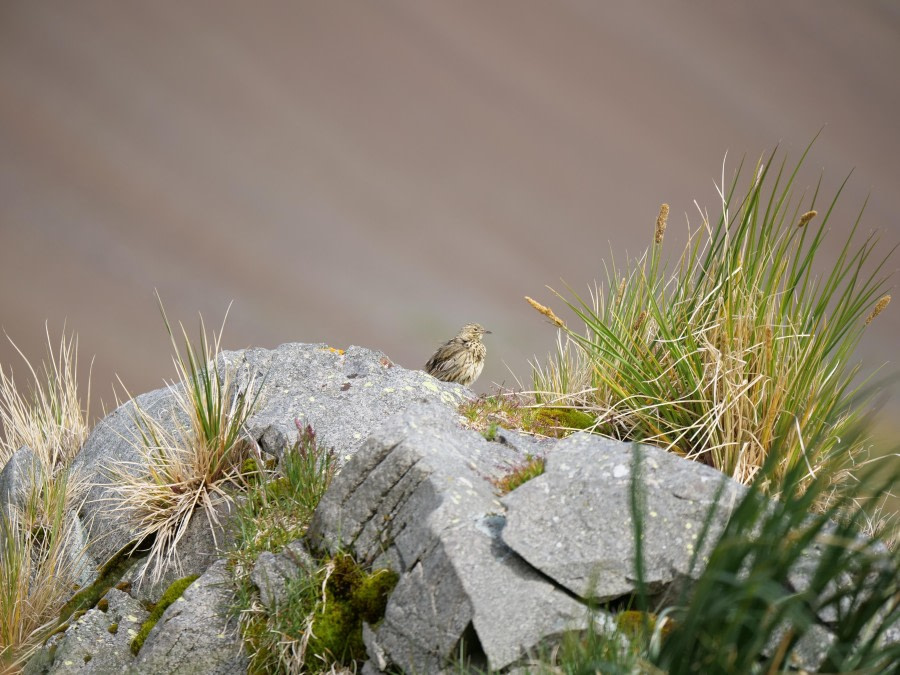
Meanwhile, the short hikers arrived after the long hikers had already departed, leaving the area calm and peaceful. We followed a marked path to a viewpoint overlooking the abandoned whaling station. Along the way, we walked through damp moss and grassy fields where fur seals and elephant seals rested. We spotted the occasional gentoo penguin heading toward the shore, and some of us were lucky enough to see South Georgia pipits as well.

The sun continued to shine throughout the morning, offering clear views of the surrounding snow covered mountain peaks.

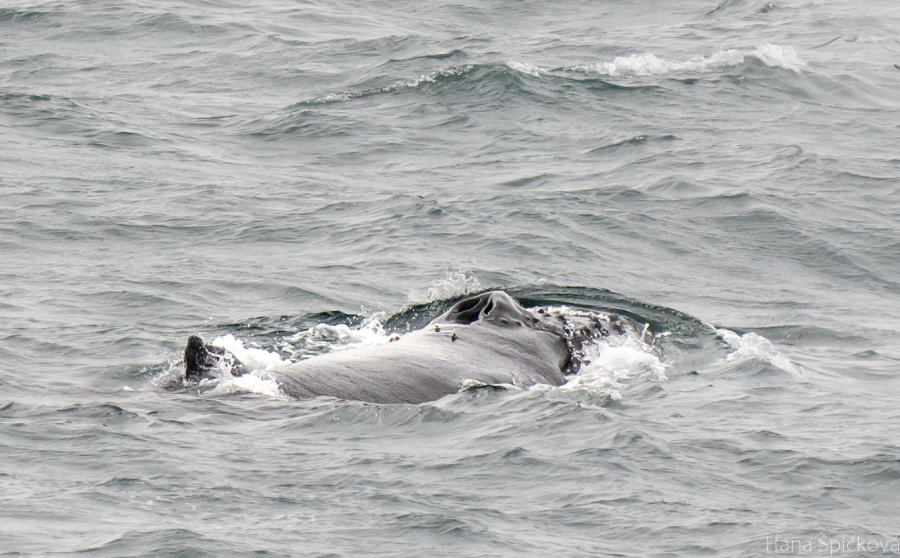
Right after lunch, we were called out onto the decks as whales appeared all around the ship. We had begun our journey toward the Falkland Islands, and some of us spotted humpback whales breaching or fin slapping, a beautiful farewell as we left South Georgia after an unforgettable stay.

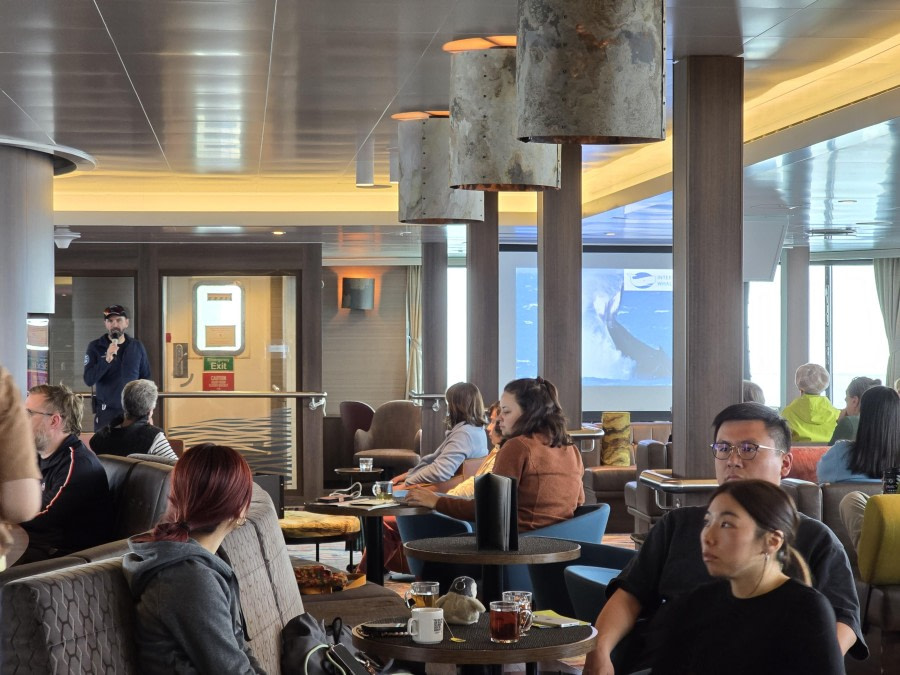
Later in the afternoon, Chris gathered us in the lounge to share an incredible story about his time living at the New Zealand Antarctic station.

After a plated dinner, and chocolate lava cake for some of us, we settled in for a calm evening and a good night’s sleep, our dreams filled with memories of our remarkable time in South Georgia.

Day 14: At sea towards the Falklands Islands

At sea towards the Falklands Islands
Date: 03.01.2026
Position: 52°54.6 S, 042°10.1 W
Wind: SW5
Weather: Overcast
Air Temperature: +1

Our adventures on our first full day at sea crossing the Drake Passage from South Georgia to the Falkland Islands began before the sun even rose in the sky. We were awoken around 3:30 am with the good news that the weather was clear enough for us to see the famous giant iceberg A23a. Now the fourth largest iceberg in the world, it stretched on much further than we could see, even had it been full daylight. Covering approximately 1700 square kilometers (650 square miles), it is less than half its original size – but still as large as greater London.

Later in the morning, after most of us had gone back to bed for a few hours, Annelou treated us to a lecture about the geology of South Georgia. It was fascinating to learn about huge slabs of sedimentary rock experiencing a significant upheaval event and literally folding in upon itself. We had already seen the rock folds ourselves; learning about the processes that created them only deepened our appreciation.

Lu then gave us a lecture full of unexpected cuteness, as she discussed her favorite types of plankton that she sees while diving in polar waters. From diatoms that create most of the oxygen we breathe to sea angels that turn devilish and everything in between, she filled our eyes and hearts with beautiful bioluminescence and giant whales. Partway through her lecture, as though on cue, a pod of humpback whales were seen all around the ship, fin and tail slapping, even breaching a time or two, as they fed on – what else – plankton in the form of krill. A few fin whales were also spotted, but they were outnumbered by the humpbacks.

We all congratulated Lu on her ability to get the whales to show up at the precisely appropriate time in her lecture.

After lunch, Carina told us more about the life cycle of giant icebergs, focusing on A23a. We learned how they form, how they break apart, and how A23a has traveled throughout its 40-year lifespan: cruising along the Antarctic coast, getting stuck on the seafloor for 30 years, its eventual refloating, and its voyage past Elephant Island and around South Georgia to its current location west of the island. Though it is no longer the largest, A23a is still an impressive berg.

At recap we learned the nautical origins of some of our English phrases and customs, including “hung-over” and why you shouldn’t put your elbows on the table when you eat; saw just how large albatross wing spans actually are; and got a taste of what life is like on a polar research vessel. Then we were off to another delicious four-course dinner. The day ended on two additional positive notes: we got to set our clocks back an hour before bed (an extra hour of sleep!), and for the first time since arriving at South Georgia, we were not required to black out the windows. We could enjoy the evening sky all we wanted while remaining warm in the observation lounge. It was a good day.

Day 15: At sea towards the Falklands Islands

At sea towards the Falklands Islands
Date: 04.01.2026
Position: 52°13.9 S, 050°39.2 W
Wind: NW4
Weather: Overcast
Air Temperature: +5

After getting a lovely extra hour of sleep this morning due to the clocks being turned back an hour overnight, our first scheduled event for the day was a very interesting talk by Mark where we learned about the massive (and not so massive) birds of the Southern Ocean, the albatrosses and petrels. They comprise a diverse group of birds, all with fascinating adaptations to their lives spent mostly on the wing, rarely coming to land. Can I interest anyone in half a brain’s nap?

Shortly after Mark’s lecture, hourglass dolphins made their first appearance of the voyage. They proceeded to come and go throughout the day, but you had to be very quick to see them; they never stayed for long. Those spending their time out on the decks were rewarded; those waiting for the announcements usually missed them. Such is expedition life!

Gabi then filled us in on some of the general history of the Falkland Islands, including Darwin’s fascination with the cara cara and the lack of Falkland trees. Tomorrow everyone will be trying to find Phil to learn the story of the mistake on a currency bill, plus trying to take photos of sheep and penguins peacefully sharing a hillside. We will also be rejoicing that we do not have to sail around oil platforms to reach the islands -- at least not yet.

After lunch (at the beginning of which more hourglass dolphins appeared), we watched a documentary called “The Untold Story” about the British experience in the Falklands War, as told by some of the military personnel who were directly involved. It was a moving story, highlighting how close the British came to losing the war – and how frequently they almost lost the war. It was good preparatory information before our landing in Stanley tomorrow.

Our final lecture of the day was given by Pierre, and it covered the International Whaling Commission (the IWC) and the Commission for the Conservation of Antarctic Marine Life Resources, or CCAMLR. Here we discovered that the IWC is not actually intended to protect whales, but rather to regulate the hunting of them, and that its members are deeply divided between hunting nations and those more interested in whale conservation. We also learned that coming from a completely land-locked country is no obstacle to developing a career as a cetacean veterinarian!

A happy hour followed an early dinner, both a warm-up to the evening’s highlight: the charity auction to benefit the South Georgia Heritage Trust. It was an evening of lively bidding on jewelry, artwork, rare whiskeys, tumblers, and more. We even had a visitor from the northern polar regions: a walrus made an appearance as a guest auctioneer’s assistant. In the end 2600 British pounds were raised for the SGHT. Well done!

Day 16: Falkland Islands, Stanley

Falkland Islands, Stanley
Date: 05.01.2026
Position: 51°39.5 S, 057°41.5 W
Wind: SW6
Weather: Partially cloudy
Air Temperature: +11

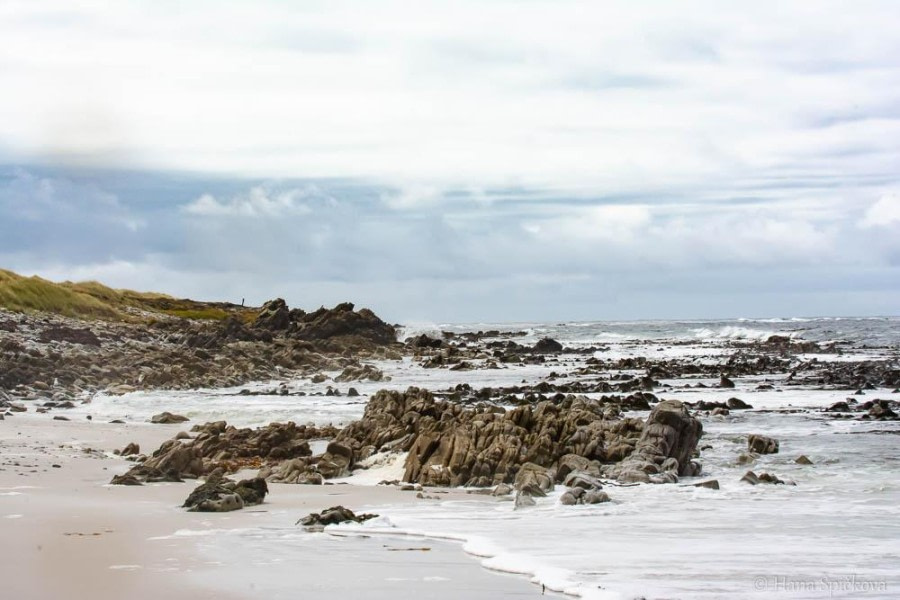
Today we arrived at the Falkland Islands, and in the morning we reached the capital town, Stanley. The weather was good, and everyone was excited to spend a full day on land. After many days at sea and in remote places, it felt very nice to arrive in a small town again.

We were taken from the ship to the shore by zodiac boats. The ride was short, and soon we arrived at the jetty in Stanley. From there, we were free to walk around the town on our own. It was great to have time to explore at our own speed.

Many of us joined tours and hikes outside of town. The main goal for most people was to see more penguins. We were lucky and saw Magellanic penguins and Gentoo penguins. They were walking, resting, and going in and out of the water. It was also very good to stretch our legs after being on the ship for so long. Walking on land for a full day felt refreshing and gave us new energy.

Back in Stanley, we enjoyed simple things that we had missed. It was time to buy souvenirs, send postcards, and visit small shops. Many of us stopped at cafés to have a coffee, and we enjoyed lunch off the ship, which felt special and different. The town has a lot of history, and while walking around, we could see old buildings, memorials, and learn more about life on the islands.

We spent the whole day in and around town, enjoying being off the ship and feeling closer to normal life again. We also saw many birds, not only penguins, which made the day even better. Being back in a place with roads, houses, and shops made us feel closer to civilization again.

In the late afternoon, we returned to the ship by zodiac. Once everyone was back onboard, we had our daily recap. During the recap, we talked about today and learned about the plans for tomorrow, when we will travel to New Island.

In the evening, we enjoyed a buffet dinner. People talked about their day, shared photos, and exchanged stories about penguins, birds, and town life. It was a relaxing end to a very enjoyable day in the Falklands.

Day 17: Falkland Islands, New Island

Falkland Islands, New Island
Date: 06.01.2026
Position: 51°30.3 S, 061°06.9 W
Wind: W8
Weather: Overcast
Air Temperature: +6

The night was far from pleasant. Our ship, Hondius, was rounding the Malvinas (Falkland) Islands from the north, forcing her way through strong winds that had whipped the ocean into towering three-metre waves, their crests raging with white foam. A fifty-knot wind battered the flag on Hondius’s bow with all its might, threatening to tear it loose and carry it off into the unknown.

Such weather conditions, naturally, took their toll on our well-being. Some lay stricken with seasickness, others simply failed to get any sleep because of the rolling, while those more tolerant of storms cheerfully greeted the dawn from the Observatory Lounge. There was no wake-up call — Chris, our expedition leader, had decided to let us sleep in until breakfast, as there was no rush that morning.

Our hotel manager William, however, wasted no time: as soon as the clock struck eight, he thundered the breakfast announcement over the PA system. Not everyone — far from it — made it down to the restaurant, but those who did clattered their cutlery merrily, enjoying omelettes, porridge, fruit, and sipping their morning coffee.

After breakfast came a lecture, and then Hondius began to slow down. The swell eased, and with it a flicker of optimism stirred within us: could it really happen, would we really be able to land? Some of us were particularly eager to see southern rockhopper penguins and black-browed albatrosses — and that was possible only at our intended landing site, an island with the simple name of The New Island.

When lunch — yes, lunch — was already well under way, our guides began cautiously lowering the Zodiacs into the water. It was no easy task. The swell had subsided because we were now sheltered by the island, having anchored on its leeward side, but the wind had not gone anywhere. Gusts of up to fifty (!) knots were no joke.

Nevertheless, once the Zodiacs were in the water and some of the guides were already waiting for us ashore, William announced five-minute readiness. As usual, boarding ten people per Zodiac, we set off toward land. Choppy, angry little waves, salty sea spray, and at the same time warmth and the scent of grass — such was our journey ashore.

On the beach we were met by the guides, flightless steamer ducks, and kelp geese with a brood of goslings. We stowed our life jackets in white bags and set off on foot toward the albatross and penguin colonies. Some of us, however, chose to linger first by the souvenir shop.

A dirt track led uphill along the slope. Geese grazed everywhere, small birds flitted about — birds whose names only our ornithologists knew — and higher in the sky one could spot skuas and shags.

Despite the wind, which nearly knocked us off our feet, it was warm, as the sun was shining — and after all, one should not forget that the Malvinas (Falkland) Islands lie in temperate latitudes. We moved forward slowly, and each time we reached the edge of a cliff we froze in amazement: none of us had expected to see such a concentration of birds.

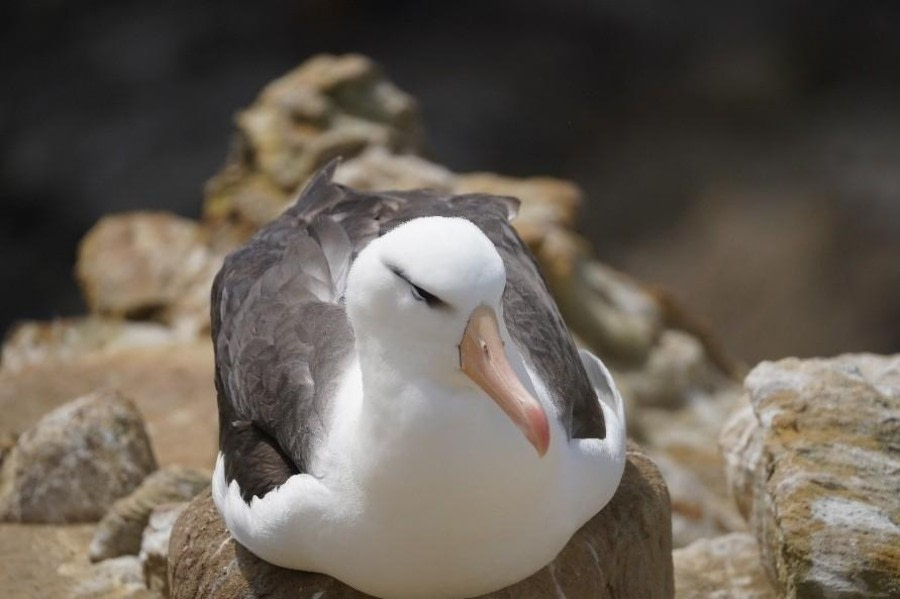
Black-browed albatrosses patiently tended to their chicks, covered in soft grey down. The same was true of the rockhopper penguins. Nasty skuas darted back and forth, while shags filled the air with noise.

Below, at the very foot of the cliffs, enormous ocean waves slammed into the rocks with full force, hurling myriads of spray skyward. The squally wind seized them and carried them farther and higher, and very soon we all began to taste salt on our lips.

After some time, having had our fill of birds and the untamed elements, we set off on the return walk. The way back was far more cheerful, as the path now led downhill.

On the shore, donning our life jackets and boarding the Zodiacs, we headed back to the ship. Thus ended our final landing of the cruise. Our birders were in seventh heaven.

Back on board, we had to return our rubber boots, as there was no further need for them. It felt oddly sad to part with them, for it was in these very boots that we had first set foot on the Seventh Continent and on the mysterious South Georgia — but such is life.

By the time of the daily recap in the Observatory Lounge, Hondius was already back in the open sea, and the ocean swell had once again set her rocking.

What a wonderful day! And now — the road to Ushuaia, which is to say, in effect, the journey home.

Day 18: At sea towards Ushaia

At sea towards Ushaia
Date: 07.01.2026
Position: 53°27.8 S, 063°27.6 W
Wind: SW6
Weather: Partially cloudy
Air Temperature: +5

Our last final day on Hondius! We awoke with luckily slightlier easier seas than yesterday, as the swell reduced over the night. During the morning, we were still lucky enough to see several whale blows, and many black-browed albatrosses around the ship. Our first lecture of the day was given by Simon; he took us on a journey into the world of birding, and then specifically the language of birders. After the lecture, we were enriched with a new vocabulary!
Gez introduced us at 11:00 to the ocean currents, which came in handy as we were still feeling the waves, however, most of us were pretty adjusted to the ship by now, after almost 3 weeks.

After lunch we had the opportunity to watch the National Geographic Endurance documentary, about finding Shackletons lost ship in the ice in the Weddell Sea. Some of us bought the signed original book in Stanley!

Our final recap was something special; the expedition team came in formal clothes, and the Captain offered us a toast. We had some time to reflect back on the amazing trip we had, and Gabi surprised us with a wonderful slideshow she made, capturing the essence of the trip in videos, pictures, and music, for all of us. After raising our glasses, we went for the final time to dinner; a farewell dinner. All of the galley team, stewards, housekeeping and laundry were given several rounds of applause, ending with William and Victoria, our hotel manager and our assistant hotel manager. With our bags packed, and late in the evening we saw the first signs of land again, we went to bed early, ready for our last wake up call.

Day 19: Ushuaia, disembarkation

Ushuaia, disembarkation
Date: 08.01.2026
Position: 54°48.5 S, 068°17.9 W
Wind: SW3
Weather: Overcast
Air Temperature: +12

Our final morning arrived quietly as the ship eased back into Ushuaia, the first light settling over the harbour. Before breakfast the corridors were already lined with luggage placed outside the cabins, a simple sign that the journey was drawing to its end. Breakfast itself felt warm and unhurried, filled with easy conversation and shared stories as everyone reflected on their favourite moments.

Soon after, we made our way ashore where our bags were arranged on the pier for collection. Farewells drifted across the group as fellow travellers exchanged hugs, handshakes and grateful thanks to the crew who had looked after us so well throughout the voyage.

With a final glance back at the ship that had carried us across the Drake Passage and through the unforgettable days in the ice, we stepped into the crisp Ushuaia morning carrying the memories of Antarctica, South Georgia and the Falklands with us.

Details

Tripcode: HDS25-26
Dates: 21 Dec, 2025 - 8 Jan, 2026
Duration: 18 nights
Ship: m/v Hondius
Embark: Ushuaia
Disembark: Ushuaia

Have you been on this voyage?

Aboard m/v Hondius

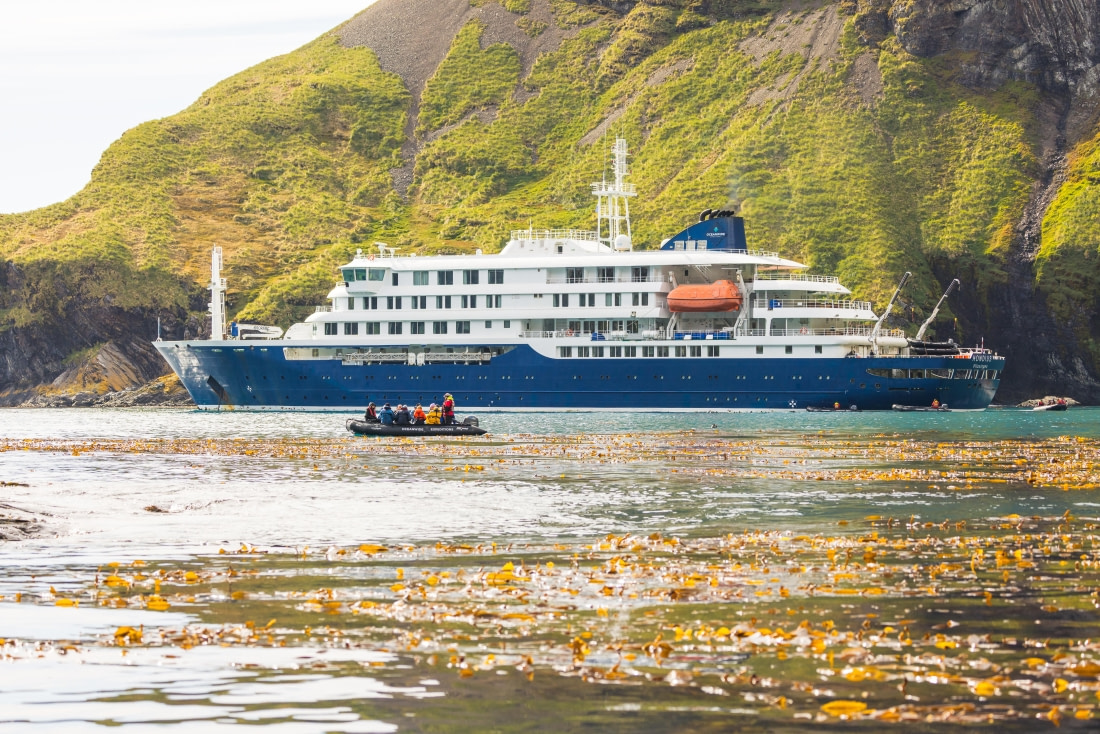
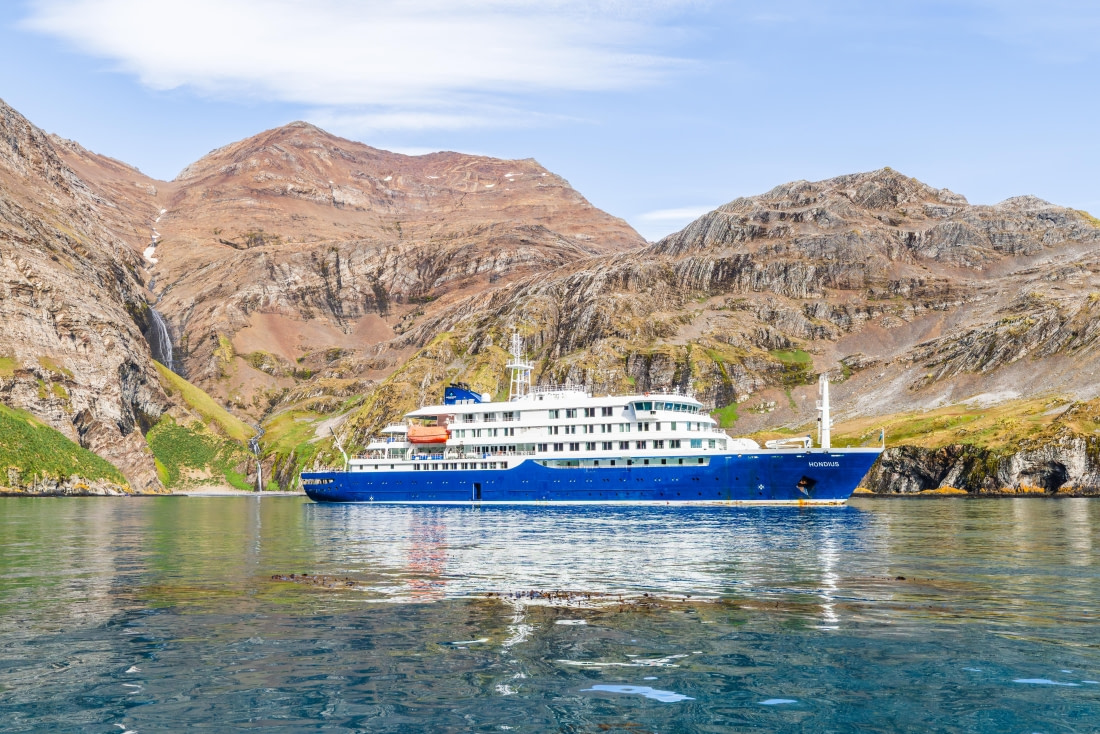
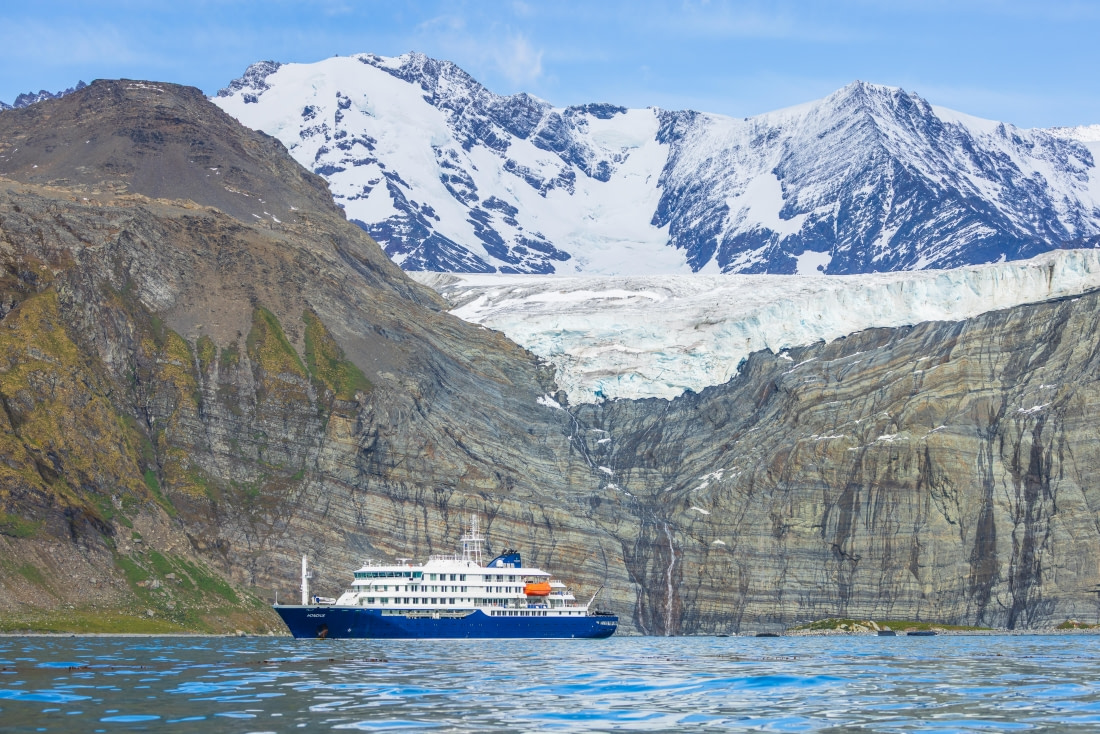
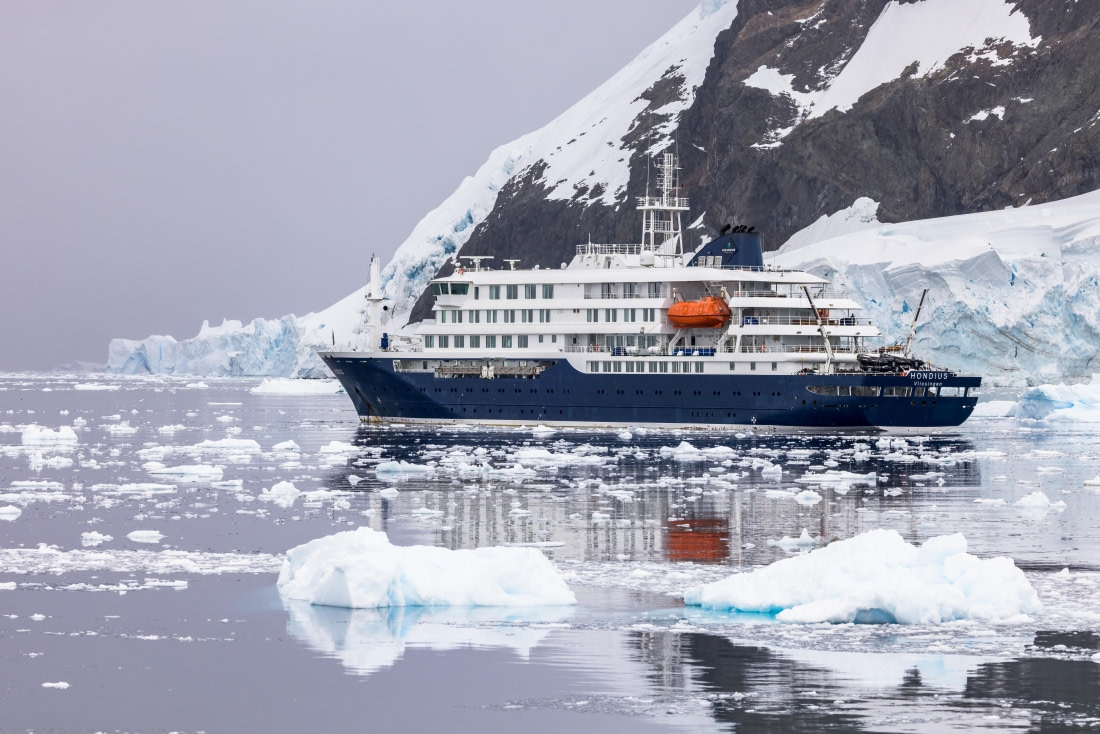
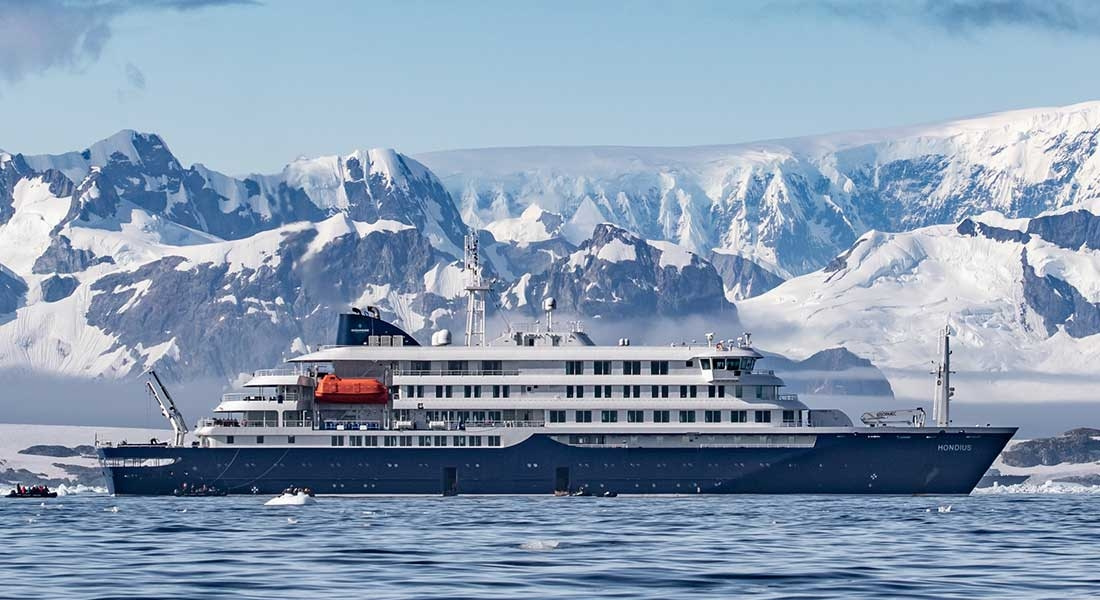
Hondius is the world’s first-registered Polar Class 6 vessel and was built from the ground up for expedition cruising.

More about the m/v Hondius »
Loading