• Home
  • Triplogs
  • OTL25-26, trip log, Falkland Islands - South Georgia - Antarctica

OTL25-26, trip log, Falkland Islands - South Georgia - Antarctica

by Oceanwide Expeditions

Photo gallery

Logbook

Day 1: Embarkation Day, Ushuaia

Embarkation Day, Ushuaia
Date: 11.12.2025
Position: 54°48.7’S, 068°17.8‘W
Wind: Var2
Weather: Partially cloudy
Air Temperature: +11.2

Most of us arrived yesterday in Ushuaia and enjoyed a good night sleep in a hotel in town. After exploring Ushuaia in the morning, we made our way down to the middle of the pier to embark on our new home, the MV Ortelius, for the next nineteen days. While boarding we’ve met some of the guides and after checking in we were brought to our cabins by one of the stewards from the hotel department and found our luggage already there. We got acquainted a little with the ship and found the tea and coffee station in the lounge on deck 6.

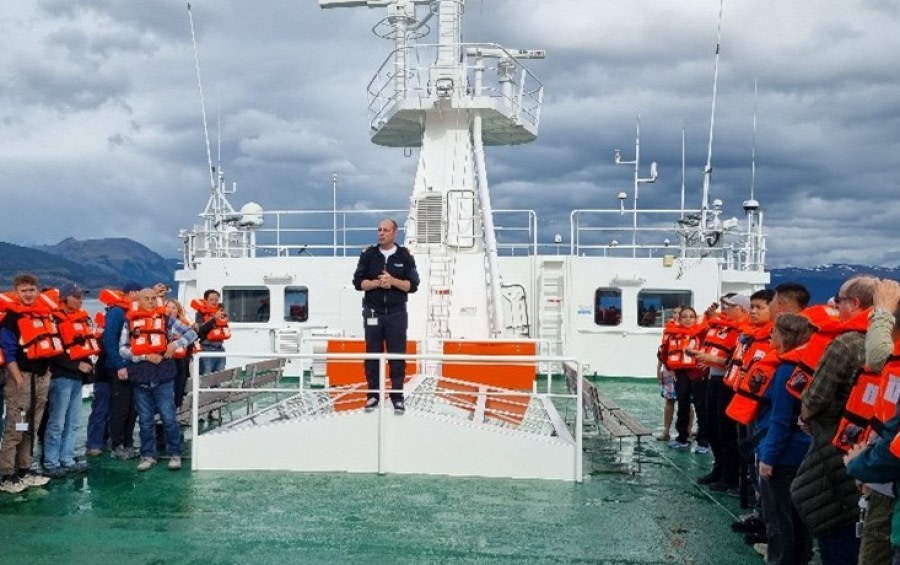
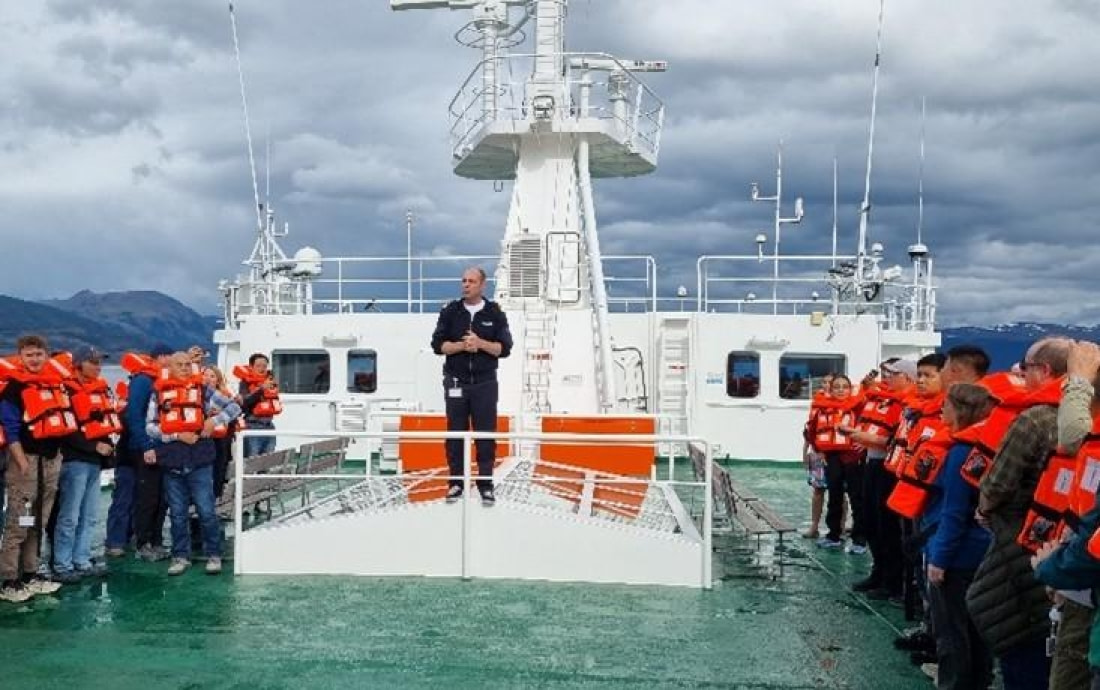
This is where we all were welcomed at 16:30 for to receive a brief introduction to your new home aboard MV Ortelius, followed by a mandatory safety briefing and lifeboat drill. We stayed out on deck as the vessel was leaving the pier and enjoyed the views, when we set sail into the Beagle Channel under a beautiful, yet dramatic cloudy sky.

At 17:15 we were asked to join our Expedition Leader Chloe and her Expedition team in the lounge again for Captain’s cocktail. We were handed a glass of prosecco or orange juice and were treated with an array of lovely snacks. Captain Remmert Koster welcomed us on board and raised our glasses to a good voyage. After that the expedition team came up to introduce themselves.

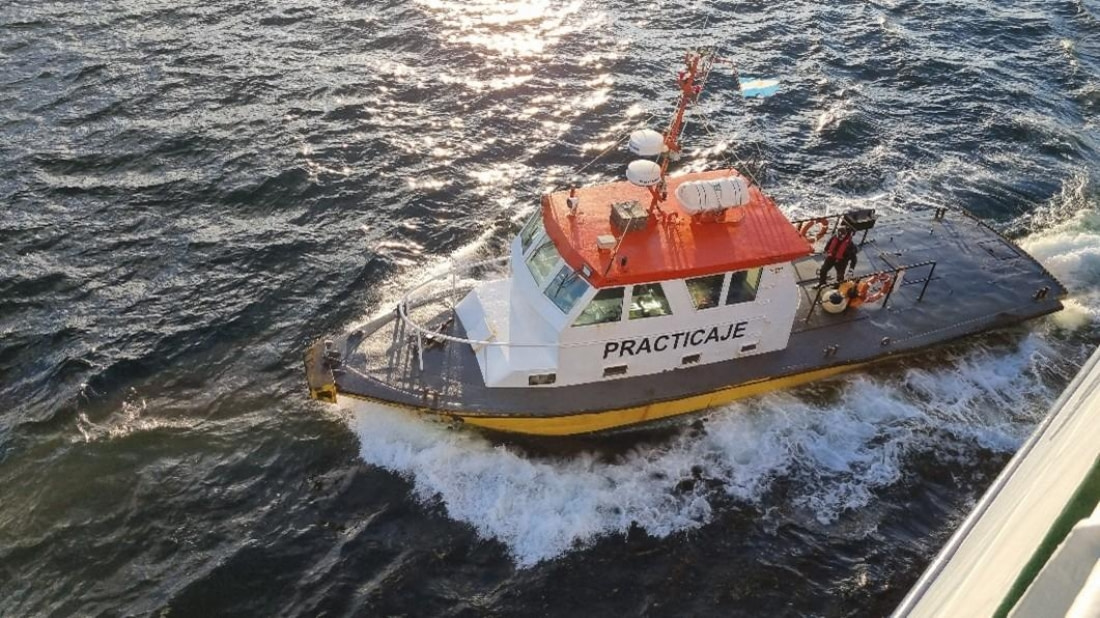
We then were invited to come down to deck 4, where the dining room doors had opened. We enjoyed a delicious dinner prepared by the galley team. Many of us were tired from travelling and from the anticipation of beginning our exciting journey and headed to our cabins for an early night. Others stayed up to watch the sun go down and enjoy the birds and scenery of the first day on board. Meantime, when all of this was happening, a pilot came on board via rope lather, to assist with leading Ortelius through the Beagle Channel. After couple of hours, the pilot was picked up again and brought back to Ushuaia.

Day 2: Sailing towards Falkland Islands

Sailing towards Falkland Islands
Date: 12.12.2025
Position: 54°02.4’S, 064°05.1‘W
Wind: NW7
Weather: Partially Cloudy
Air Temperature: +7

We woke up to the sound of Chloe’s voice for the first time. We were excited to be spending our first full day on board Ortelius. There was a strong wind whipping around the ship and the waves were around three to four metres tall. This was enough to make many people feel the effects of sea sickness and so it was a quiet day for many.

Chloe invited everyone to the lounge first thing after breakfast to deliver a zodiac safety briefing. She showed us what to wear outside and how to safely embark and disembark the zodiacs.

Later on, in the morning Gary gave a presentation about the birds and seals species that can be seen in the Falkland Islands. After a buffet lunch we were invited to collect our muck boots from the lecture room which would keep our feet warm and dry on our visits to some of the most remote and wild places. We were then asked to come in groups to the lounge to have all of our outdoor gear checked and given and extra clean. This was to ensure that we wouldn’t bring any invasive or harmful species to the Falkland Islands.

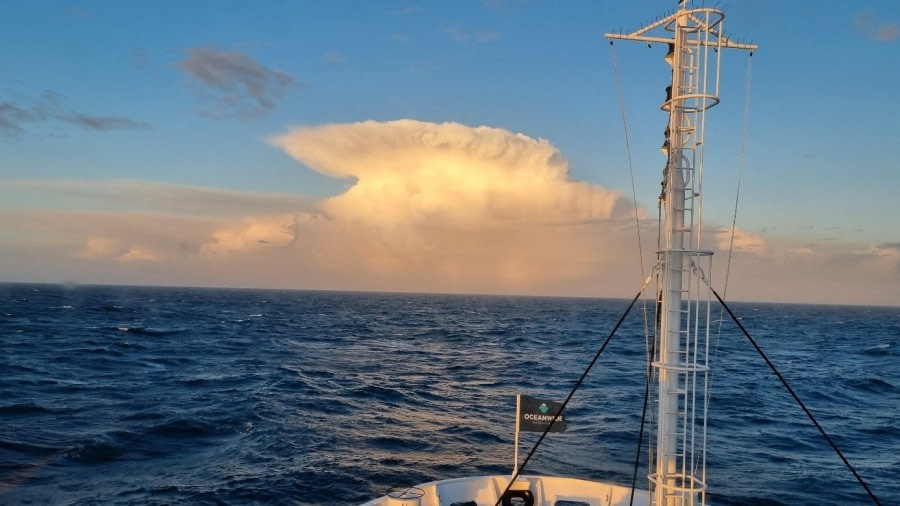
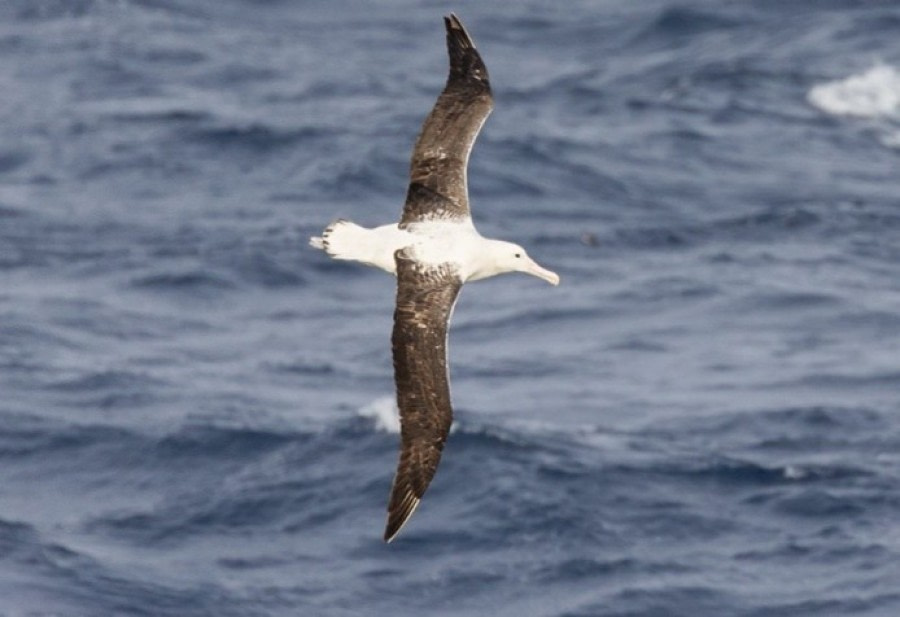
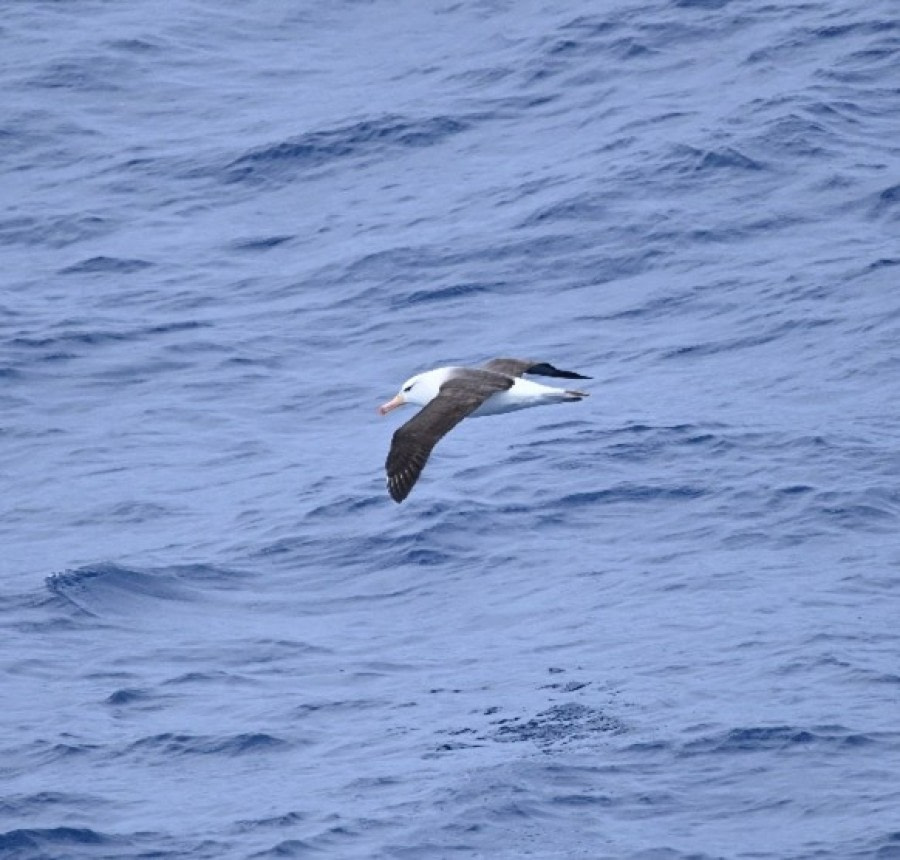
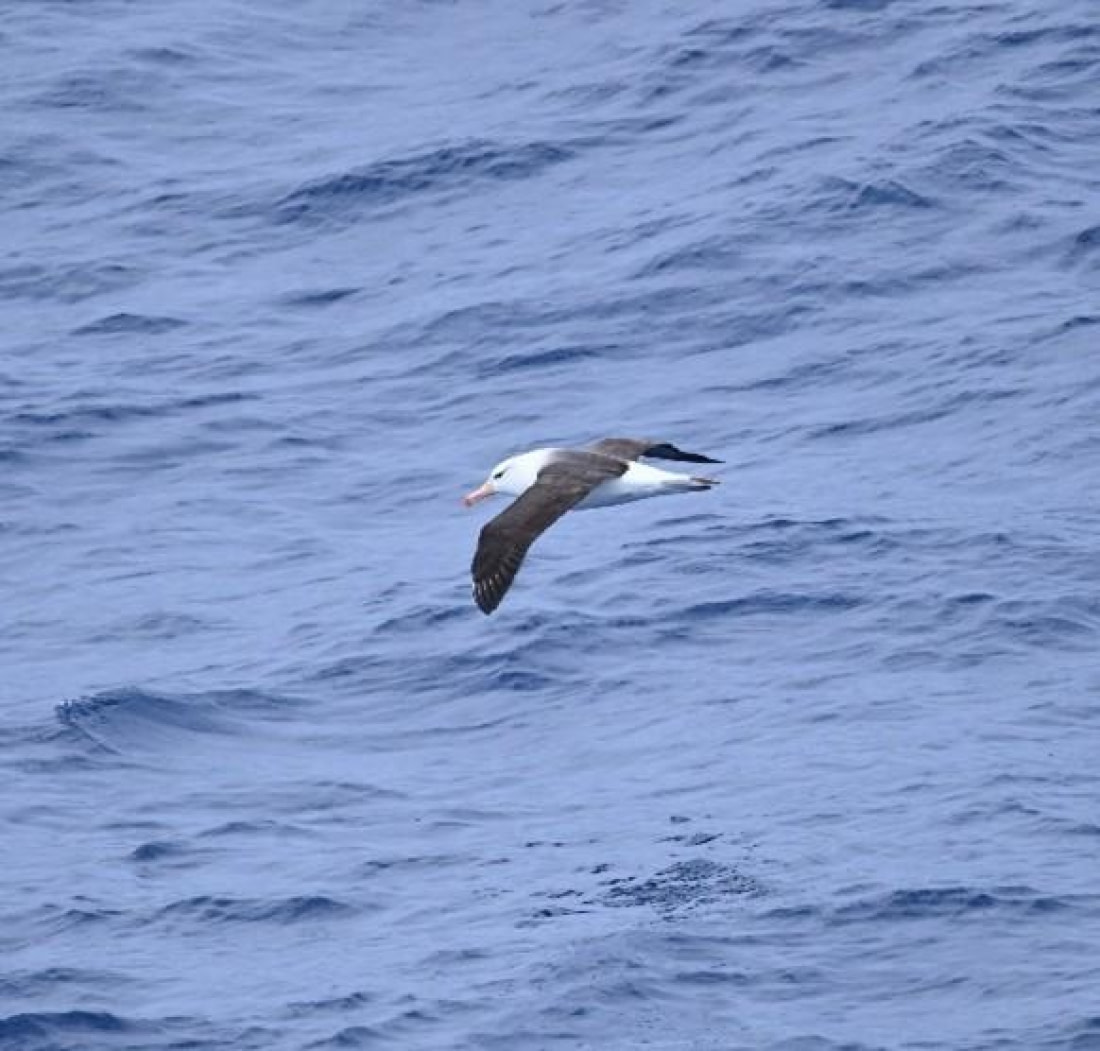
Despite the windy weather, the sun was bright and the visibility outside was excellent. We enjoyed watching the deep blue waves crashing around us. In the afternoon we spent time watching the spectacular bird species that were soaring over the waves. We could see giant petrels, black-browed albatross, prions, storm petrels, and even some Southern royal albatross flying around us. We enjoyed the challenge of trying to identify and take pictures of these special Southern Ocean residents.

In the early evening, we gathered for the first of our evening recaps. Chloe gave us the tentative plans for tomorrow. If the fifty knot winds allowed us, we would be landing on New Island, a beautiful and rugged spot home to nesting black-browed albatross and rock hopper penguins.

Jess, assisted by Gary and Saskia, gave us a visual aid (a handy piece of string) to demonstrate the lengths of the wingspans of the bird species we had seen today. We were shocked to see that the royal and wandering albatross wingspans can reach three and a half meters. Gary told us about how these birds use dynamic soaring and orographic soaring to avoid flapping their wings and expending unnecessary energy. It was great to have some further information on species that we had been observing that very day.

We headed off for dinner. Afterwards, some of us enjoyed watching the sun set and soaked up the seascape, while others enjoyed a drink at the bar.

Day 3: Landing at New Island, Falklands

Landing at New Island, Falklands
Date: 13.12.2025
Position: 51°43.2’S, 060°15.9‘W
Wind: NW10
Weather: Slight
Air Temperature: +6

Yesterday was a big trial for many of our guests with the movement of the ship. Many had to stick to their cabins and/or bunks to keep it together. Today promised to solve those problems—at least temporarily—by landing at New Island in the Falkland Islands. In high hopes of a long day on shore, we had an early wake up at 07:45 for an 08:00 breakfast. As it happened, the wind was strong and the swell a bit more than we bargained for, so we were delayed a bit getting to our anchorage. In the end, Captain chose a slightly different place to drop anchor due to wind conditions, so we had quite a long, and windy, Zodiac ride to shore. The expedition staff went ashore first to set out the equipment and to be ready to receive everyone else. Tim and Jenny, the local caretakers for the Falkland Islands Conservation Trust met us at the beach and briefed our staff on the site. It wasn’t long before we had a steady stream of passengers arriving.

Our landing site was a beautiful little beach with a hulk of an old shipwreck pushed up on shore. We all had a gorgeous greeting party of a family of Patagonia Crested Ducks with their five 4-day old ducklings in tow. Some perhaps made a quick stop at the Museum/shop in the substantial stone building at the landing site, but most set out directly on the 1 km walk up to the west edge of the island where the mixed Black-browed Albatross/King Cormorant/ South Rockhopper penguin colony perched up on the cliff tops.

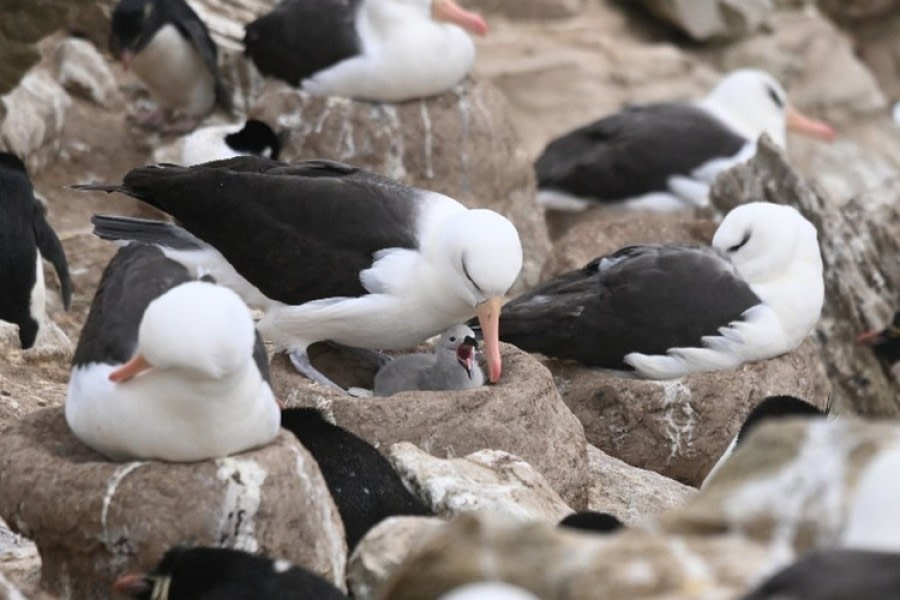
On first arriving, we encountered the part of the colony that is mostly King Cormorants. It was quiet for the most part as most of the individuals on the nests, were alone, and sitting tightly on their complement of eggs. The nests were very regular in their spacing, so the impression was of a very orderly community. Occasionally an unoccupied cormorant would arrive and bring a bit of seaweed or straw in to help build (or add to) their nest. When mates arrived from being at sea, the pair shared a few guttural growling vocalizations by way of greeting. Around the south flanks of the colony, the proportion of Southern Rockhopper penguin nests increased quickly with very few cormorants, but also now, Black-browed albatross, sitting regally on their pedestal nests. Most were still on their one egg, but a few had chicks, and regularly stood or shifted in such a way that we were able to catch glimpses of the tiny young chicks. Certainly, less than a week old, they are still small enough to be completely covered by the adult sitting over them on the nest. Patience and keen observation had their reward though, a few diligent observers did catch glimpses of those gorgeous tiny chicks.

It was wonderful to be off the pitching and rolling ship and to able to watch and study the little dramas of everyday life of these penguins, albatross and cormorants, even the few skulking predators were present in the forms of skuas and sheathbills. Eventually, the wind and driving rain convinced everyone that perhaps a warm dry ship would be a better place to be, so everyone headed back down the hill to the landing site. A visit to the museum and shop was out of the wind and rain so it was quite enticing.

Once back on board, it took everyone a little while to peel off their soaked layers and get them hung up to dry to be ready for the next time. With the wind increasing, we had to cancel the afternoon outing so we started out navigation toward Stanley as everyone sat down for lunch. For a while, we had the perfect arrangement of wind and waves, so our good ship rolled dramatically—enough to toss teacups and books and computers from their resting places. Fortunately, no injuries and no serious damage.

As everyone began to recover from the landing and be able to withstand the rolling, Jess gave us a tremendous introduction to the Whales of the Southern Oceans followed fairly quickly to a recap. Plans for tomorrow include an all-morning stop in Stanley if we can get ourselves ashore. Following the briefing, Aitana presented us with a great explanation of waves, and Gary talked about what little dramas happened with the penguins and albatrosses today while we visited. The seas have calmed considerably for a pleasant evening, so everyone has head off to bed dreaming of Stanley.

Day 4: Stanley

Stanley
Date: 14.12.2025
Position: 51°41.8’S, 057°50.1‘W
Wind: NW10
Weather: Cloudy
Air Temperature: +7.9

Today was a day of watching and waiting, a true expedition day. Early in the morning we approached Port Stanley. We sailed through the narrow gap into the port in around forty knots of wind. We were intrigued to watch the pilot boat approach our ship and see the pilot climb up via a rope ladder onto our vessel and join us on the bridge.

We could see the colourful town on the shore. After breakfast, the expedition team dropped zodiacs, and two boats made it to the jetty. However, the wind was extremely strong and started to gust at up to fifty knots. It was not safe to begin disembarking passengers in this weather. Despite the short distance between our ship and the jetty, the conditions at the gangway and on the water were far too bouncy and rough. Even the expedition team struggled to get back on board. Chloe and Koen made the good decision to wait a little while and see if the wind would drop before disembarking passengers. Throughout the morning, we could see little Commerson’s dolphins swimming and playing around our ship in the waves that were being created by what were now sixty knot gusts.

Three brave souls, Gonzalo, Sid, and Dimi, did continue to drive in the conditions and headed back to the jetty in one zodiac to pick up some supplies, and an officer from the South Georgia Government. The officer had with him a little dog called Hunter who was eight years old. Hunter was a working dog who was here to check that there were no rodents hiding on the ship before we set sail to South Georgia. The South Georgia Government and Heritage Trust spent a huge amount of time and resources eradicating rats from South Georgia, a species that was harming the nesting bird species on the island. It would be a disaster if a visiting ship like ours was to accidently reintroduce rats to the island, so hunter came to make sure we were rat free.

Because of the weather conditions, Hunter and his owner had to stay on board for a little longer than usual. The officer offered to take Hunter to the lounge where we could give him a cuddle and learn more about his training process. This ended up being the highlight of the morning, what a treat to play with Hunter and make a fuss of him after his work was done.

After lunch, at around 2.30pm the wind started to die down. The expedition staff hopped in the boats again and this time we were all finally able to get ashore in very wet and rainy weather.

We enjoyed exploring the town and hiding from the rain in the gift shops. Many of us visited the museum on the shore and the beautiful cathedral with an impressive whale bone arch outside. There was also great wildlife to be seen even in a residential area. Falkland Island steamer ducks and their tiny fluffy chicks were charming us at the jetty. We could also see lots of impressive turkey vultures soaring around and resting on the pier. We even spotted a seal swimming between the zodiacs. But the real wildlife highlight of the day was seeing the Commerson’s dolphins close up from the zodiacs as we sailed in.

By the time we finished our operation in Stanley, the water in the harbour was flat and calm, a total transformation from the choppy waves in the morning. We returned to the ship loaded with Christmas presents in the form of local gin, beautiful artwork, handmade knitwear, and lots of chocolate.

After a quick briefing in the lounge about the plans for our day at sea tomorrow, we made our way to dinner. Remarkably, the excitement of the day was still not over. A search and rescue team from the Falkland Islands asked if they could come and do a practice with their helicopter on our ship, lowering a person down onto our outer decks via a winch.

Day 5: At sea towards South Georgia

At sea towards South Georgia
Date: 15.12.2025
Position: 52°35.3’S, 053°27.8‘W
Wind: NW4
Weather: Slight
Air Temperature: +7.9

Good morning, good morning, Ortelius!

After our exciting and true expedition style activities in the Falklands, we woke up this morning in the Southern Ocean again. We had left the Falkland Islands behind us and had set course towards South Georgia. The Falkland Islands had been a great start to our journey, and we immediately saw why we were on an expedition and not on a cruise!

Luckily the ocean looked a lot calmer than the past days and if the weather and swell forecast was correct than our entire crossing to South Georgia would be calm with little swell. We deserved it!

This day was packed with lectures about different topics and for the afternoon also an outside photo workshop was planned.

QB and Koen kicked off the day with their lectures about photography. QB talked about basic photography and photography skills in the lecture room, whereas Koen shared 10 of his tips to improve our wildlife photography. Both presentations were very inspiring and motivated us to take better photos. However, Koen also shared a bonus tip which was to put your camera or phone down occasionally, as to soak up the amazing and remote places we will visit during our adventure and see it through with only our eyes.

Then it was Chloe’s turn, and she shared her passion for plankton and the underwater forest. It was a very interesting and fascinating lecture and Chloe’s enthusiasm was very inspiring. This was only part 1 of 3 so we were all looking forward to Chloe’s next chapter.

For the afternoon a photo workshop was planned with a focus on photographing birds in flight. However, it had been a meager day in terms of flying wildlife, so it was decided to postpone this workshop. But this didn’t prevent us from going outside. The weather was lovely with the sun out, little wind and mild temperatures. Many of us decided to spend time sitting on one of the benches enjoying the warm rays of the sun and the gentle movement of the ship. Some of us probably dozed off every now and then ;).

Later in the afternoon Gary treated us with a lecture about several seal species which we may encounter during our expedition. South Georgia is full of millions of fur seals, and the elephant seals and leopard seals can be found there. The day flew past and soon it was time again for our recap and then onwards we made our way down to the restaurant for a tasty dinner. One more day at sea ahead before arriving at the magnificent island of South Georgia.

Good night, everyone!

Day 6: At sea towards South Georgia

At sea towards South Georgia
Date: 16.12.2025
Position: 53°37.9’S, 044°40.8‘W
Wind: WNW5
Weather: Overcast
Air Temperature: +2.8

We woke to another full day at sea, with Ortelius steadily making her way eastward toward South Georgia. After breakfast, the lounge gradually filled as everyone gathered for a morning of briefings and talks, a rhythm that has already begun to feel familiar, and reassuring, as we move deeper into the Southern Ocean.

Our Expedition Leader, Chloe, opened the morning with a comprehensive briefing on South Georgia and Antarctica. She spoke about what we could expect in the days ahead: the landscapes, wildlife, and weather conditions, but also about our responsibilities as visitors to some of the most pristine environments on Earth. The discussion covered practical guidance as well as the broader principles behind IAATO regulations, reminding us that every step ashore is a privilege that comes with care, awareness, and respect. We also reviewed biosecurity standards and watched a video specifically focused on South Georgia, highlighting why such strict measures are essential to protect its fragile ecosystems.

Later in the morning, Gary took us on a journey through the birds of South Georgia. His talk ranged from the great albatrosses and various petrels to endemic species and penguins, weaving together scientific knowledge, field experience, and plenty of humour along the way. Through stories from past seasons and clear explanations of life cycles, migration routes, and flight strategies, Gary brought the avian world of the sub-Antarctic vividly to life. What stood out most was how these birds are perfectly adapted to an environment that, to us, feels extreme. Navigating vast distances, fierce winds, and remote islands with remarkable efficiency.

After lunch, the ship shifted into a more hands-on mode as we began our biosecurity checks. Guests were called deck by deck to the lounge, bringing outer layers, backpacks, muck boots, and equipment with them. The expedition team had vacuums, brushes, and cleaning tools ready, and the process was thorough, patient, and meticulous. Every seam, pocket, and tread was carefully inspected and cleaned to ensure nothing foreign would be carried ashore. It was a long but essential operation, and a clear demonstration of the collective effort required to protect South Georgia’s unique environment.

At 4:00 pm, Aitana invited us back to the lounge for a presentation on Ernest Shackleton and the Endurance expedition. She shared not only the events of the journey but also reflected on what made Shackleton such an extraordinary leader. His ability to adapt, to prioritise his people, and to make difficult decisions under immense pressure. It was a timely story, fitting for a voyage approaching the very landscapes that shaped one of the most remarkable survival stories in polar history.

As the day drew on, we spent time on deck and on the bridge, rewarded with sightings of wandering albatrosses, royal albatrosses, southern giant petrels, and light-mantled sooty albatrosses gliding effortlessly alongside the ship. Watching them trace wide arcs over the waves was a reminder that we were well and truly in the Southern Ocean now.

During the evening recap, Chloe outlined the tentative plans for the following day, with hopes of arriving in South Georgia waters and attempting landings at Right Whale Bay and Salisbury Plain. Assistant Expedition Leader Koen then explained the Antarctic Convergence, where cold Antarctic waters meet warmer northern seas, and why crossing this invisible boundary marks an ecological and symbolic entry into Antarctica. With that, we officially welcomed everyone south.

To end the recap on a lighter note, Jess hosted a fun sound-guessing game, inviting us to identify the calls of various polar animals. Laughter filled the lounge as guests were surprised by how different birds, mammals, and cetaceans sound in the wild.

The day concluded with a delicious three-course plated dinner, and a quiet sense of anticipation settled over the ship as we continued our approach toward South Georgia.

Day 7: South Georgia: Right Whale Bay & Salisbury Plain

South Georgia: Right Whale Bay & Salisbury Plain
Date: 17.12.2025
Position: 54°00.6’S, 037°40.9‘W
Wind: Var 3
Weather: Overcast
Air Temperature: +4.5

During the early morning hours, the ship approached the dramatic coastline of South Georgia, where steep, snow-dusted mountains rose from the sea beneath a blanket of low cloud. After days of anticipation, we had finally arrived at one of the most wildlife-rich islands on the planet. Excitement was palpable on board as guests gathered on deck, catching their first glimpses of this remote sub-Antarctic landscape.

Our first landing of the day took place at Right Whale Bay, a broad and gently sloping beach backed by tussock grass and glaciated terrain. Conditions were favourable for Zodiac operations, allowing us to begin the day smoothly. As guests stepped ashore, they were immediately greeted by the unmistakable sounds of king penguins, echoing across the bay. For many, this was a long-awaited moment, their first encounter with king penguins in the wild.

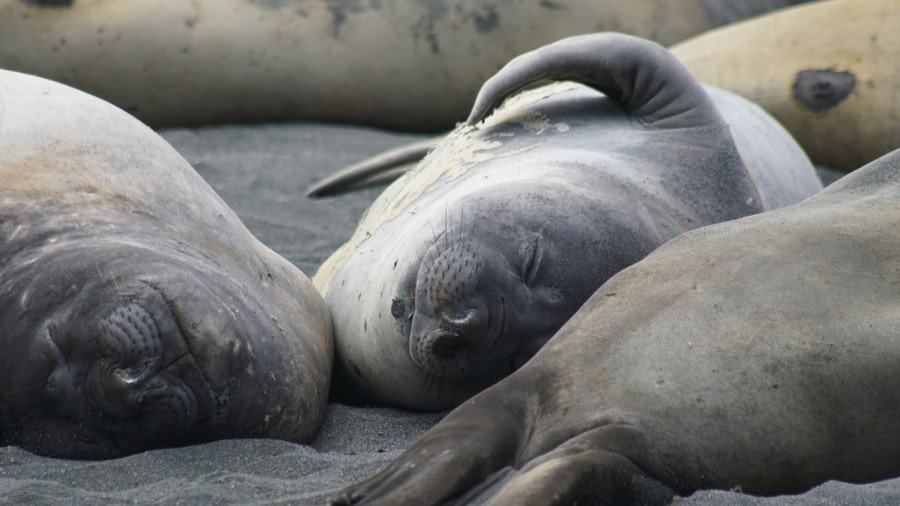
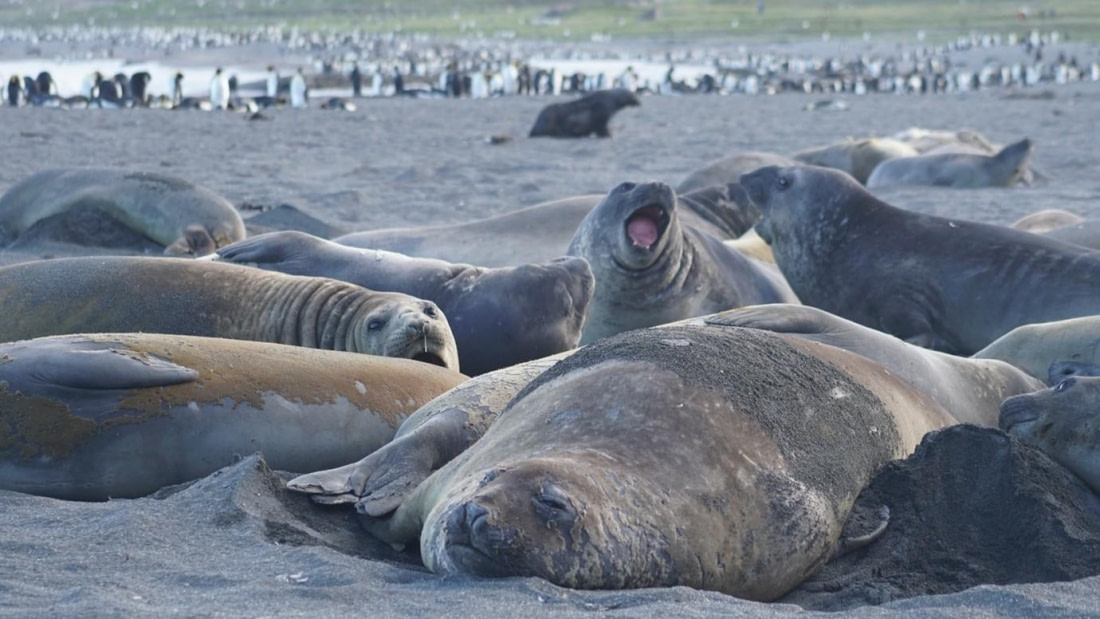
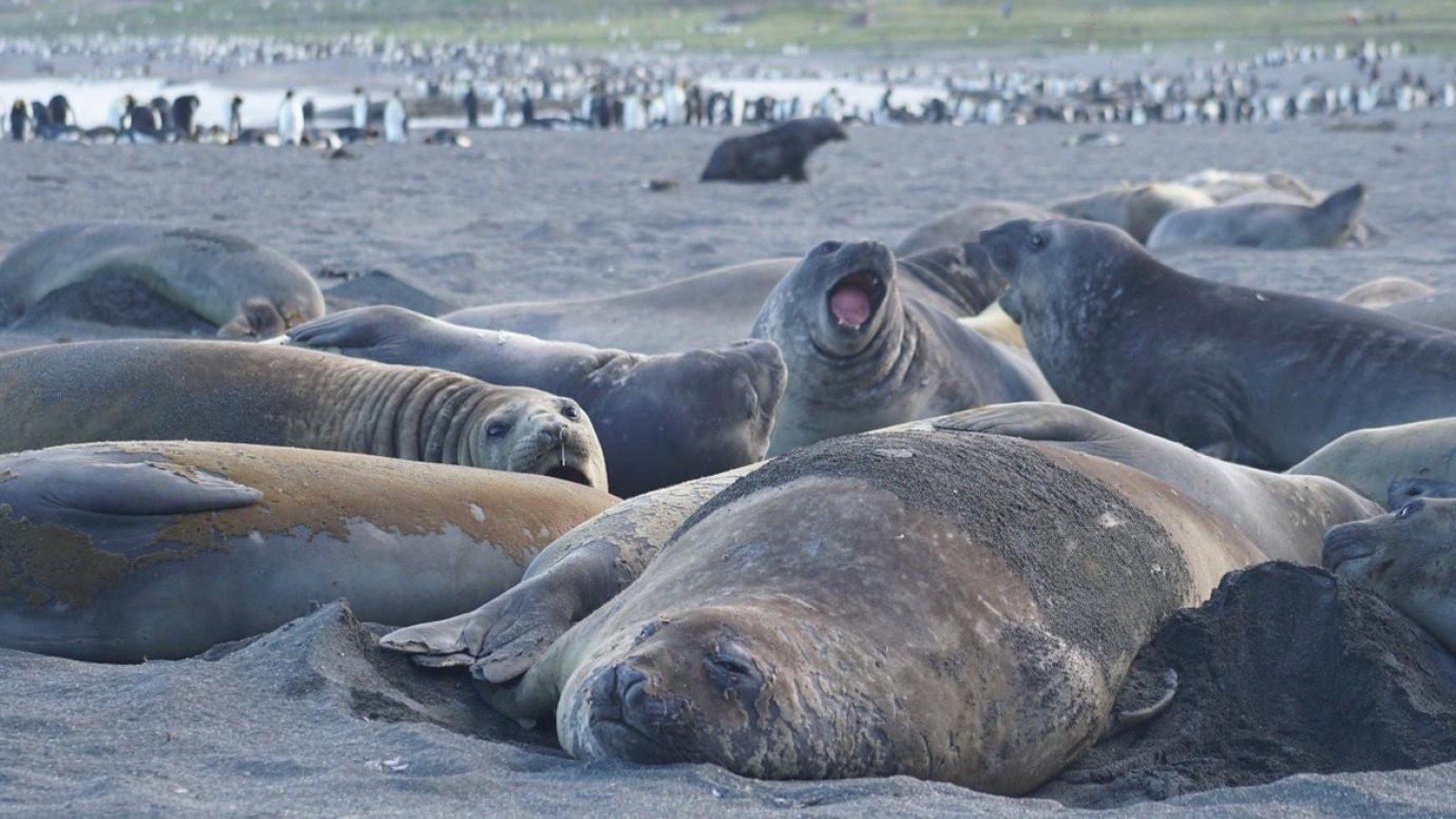
Scattered across the beach and surrounding slopes, king penguins stood in small groups or moved purposefully between the sea and their nesting areas. Their striking orange and gold markings contrasted vividly with the muted tones of the landscape. Guests spent time quietly observing penguins preening, calling, and interacting, while several large southern elephant seals rested along the shoreline. Massive bulls lay motionless near the water’s edge, while females and juveniles dozed or shifted lazily in the sand. Curious Antarctic fur seals also made appearances, darting along the edges of the landing site and keeping a watchful eye on our activities.

The landing at Right Whale Bay provided a relaxed and rewarding introduction to South Georgia’s extraordinary wildlife. Expedition staff guided guests along designated routes, sharing information about penguin life cycles, seal behaviour, and the island’s complex history of exploitation and recovery. With time to explore at a comfortable pace, guests were able to fully appreciate the atmosphere of the place before returning by Zodiac to the ship.

During lunch, the ship repositioned along the coast toward our afternoon destination, Salisbury Plain, one of South Georgia’s most iconic wildlife sites. As we approached, the scale of the colony became evident even from offshore, with the shoreline appearing alive with movement.

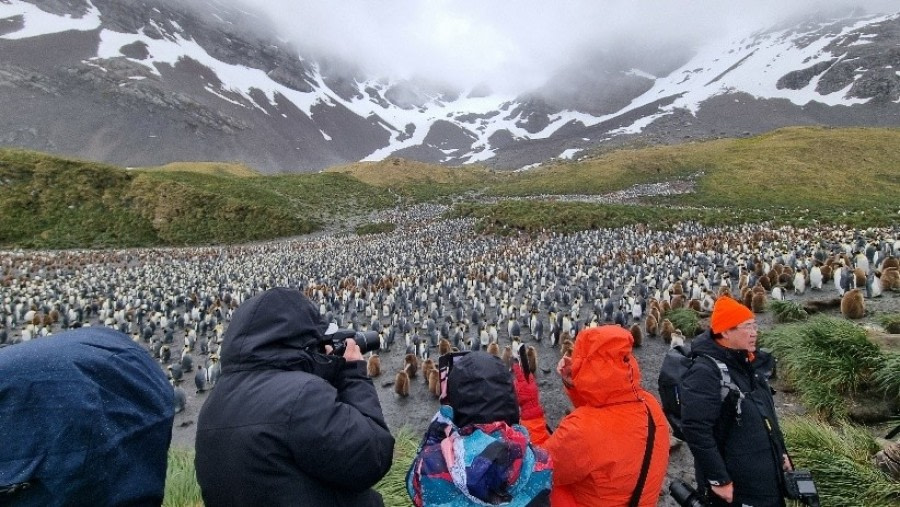
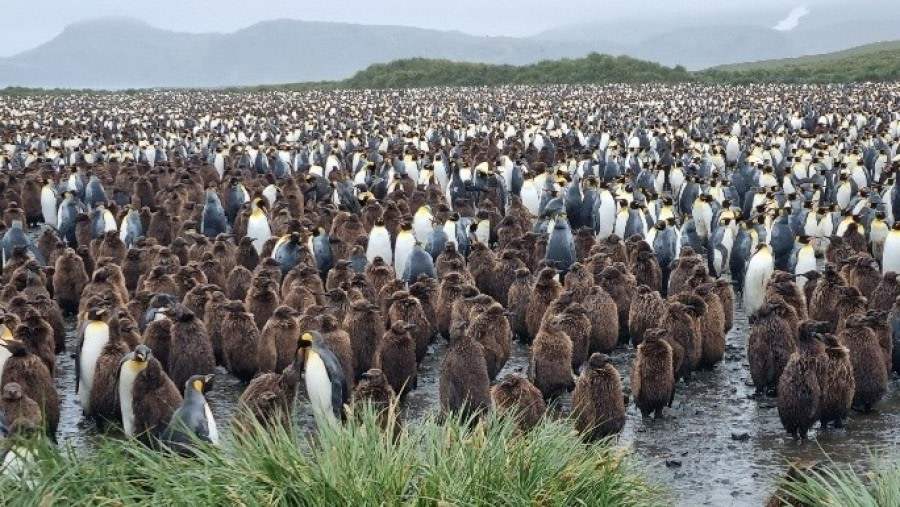
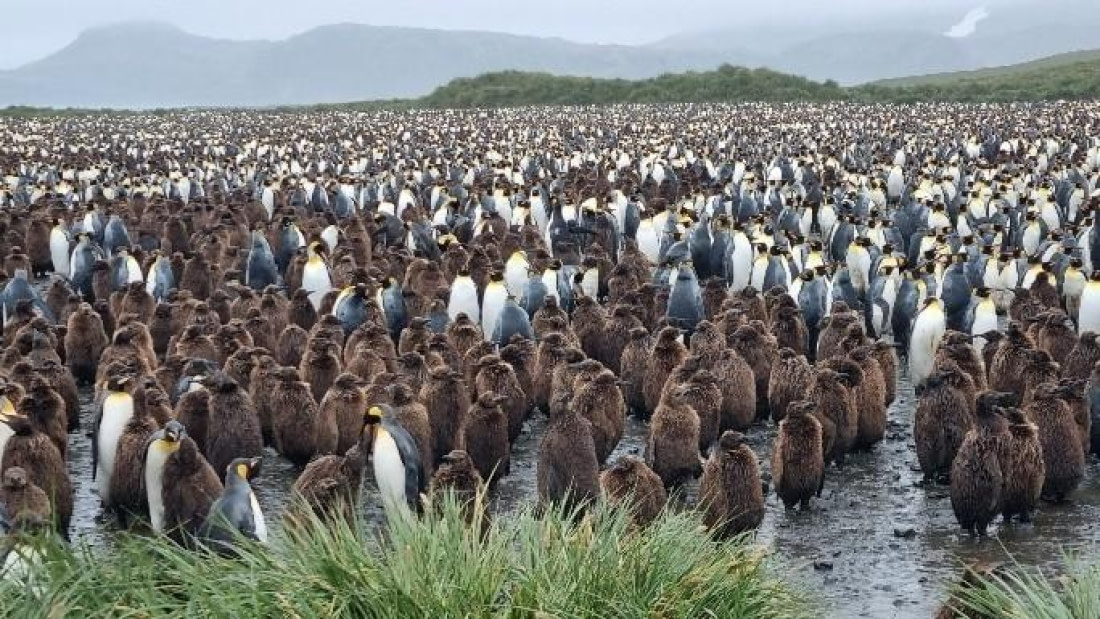
Zodiac operations resumed in the afternoon, bringing guests ashore at Salisbury Plain under increasingly grey skies. Upon landing, we were immediately immersed in a vast colony of approximately 60,000 breeding pairs of king penguins, accompanied by thousands of chicks in various stages of development. The constant chorus of calls filled the air, creating an unforgettable sensory experience.

Walking routes were carefully established to allow safe movement through the colony while minimizing disturbance. Penguins crowded the landscape in all directions, adults standing shoulder to shoulder, chicks clustered together in crèches, and long lines of penguins commuting between the colony and the sea. Brown, fluffy chicks stood out among the sleek adults, patiently waiting as parents returned from foraging trips.

As the landing progressed, a steady rain began to fall. Soon, everyone was thoroughly wet, from waterproof outer layers to camera gear. Despite the conditions, spirits remained high. Guests embraced the experience with good humour, taking photographs and simply standing in awe of the sheer abundance of wildlife around them. The rain added a raw, elemental atmosphere to the scene, with mist drifting across the hills behind the colony and water beading on penguin feathers as they continued their daily routines, seemingly unaffected.

Elephant seals were again present along the beach, lying contentedly among the penguins, while fur seals moved energetically through the shallows. Expedition staff remained on site throughout the landing, helping, ensuring safety, and sharing observations about penguin behaviour and the ecological significance of Salisbury Plain.

Eventually, with the rain continuing and guests soaked but smiling, the decision was made to conclude the landing. Zodiacs ferried everyone back to the ship, where warm drinks and dry indoor spaces provided welcome relief. Conversations buzzed with excitement as guests shared impressions of their first day in South Georgia, many describing Salisbury Plain as one of the most extraordinary places they had ever visited. The evening was dedicated to biosecurity preparations ahead of the next day’s operations. Guests carefully cleaned boots, outerwear, backpacks, and camera equipment, removing any seeds or organic material to ensure compliance with South Georgia’s strict environmental regulations. The cleaning stations were busy as everyone worked together to protect this fragile ecosystem. Though tired from a long and eventful day, guests approached the task with enthusiasm and care, fully aware of the importance of preserving South Georgia’s unique environment. As the ship settled for the night offshore, the sense of accomplishment was strong. From the gentle introduction of Right Whale Bay to the overwhelming wildlife spectacle of Salisbury Plain, December 17 marked a remarkable beginning to our time in South Georgia, one that would surely remain a highlight of the voyage.
Eventually, with the rain continuing and guests soaked but smiling, the decision was made to conclude the landing. Zodiacs ferried everyone back to the ship, where warm drinks and dry indoor spaces provided welcome relief. Conversations buzzed with excitement as guests shared impressions of their first day in South Georgia, many describing Salisbury Plain as one of the most extraordinary places they had ever visited.

The evening was dedicated to biosecurity preparations ahead of the next day’s operations. Guests carefully cleaned boots, outerwear, backpacks, and camera equipment, removing any seeds or organic material to ensure compliance with South Georgia’s strict environmental regulations. The cleaning stations were busy as everyone worked together to protect this fragile ecosystem. Though tired from a long and eventful day, guests approached the task with enthusiasm and care, fully aware of the importance of preserving South Georgia’s unique environment.

As the ship settled for the night offshore, the sense of accomplishment was strong. From the gentle introduction of Right Whale Bay to the overwhelming wildlife spectacle of Salisbury Plain, December 17 marked a remarkable beginning to our time in South Georgia, one that would surely remain a highlight of the voyage.

Day 8: Grytviken & St. Andrew’s Bay

Grytviken & St. Andrew’s Bay
Date: 18.12.2025
Position: 54°17.3’S, 036°28.9‘W
Wind: Var 5
Weather: Cloudy
Air Temperature: +5

Today was a very exciting day for many as we planned to visit two unique places. The first stop was Grytviken. Grytviken was once a working whaling station, active from 1904 to 1964. In that time its estimated that over 175,000 whales were caught and brought there to be processed. The whales were used to make all sort of products such as oil, margarine, soap, and their baleen plated were even used to make corsets.

Before we could go ashore, we first had an inspection from the government officer who came to check our rat prevention measures and look at our equipment. Meanwhile, Will and Emily from the South Georgia Heritage trust who look after and run the museum came on board to give us a presentation about the work that the trust does. The government officer then checked the first ten passengers going ashore to make sure their boots, bags, and coats were clean. We scored 100% in the biosecurity check, a perfect result which was so satisfying after we had spent so much time cleaning our belongings. This meant the rest of us could head to the shore without being checked. It was amazing to see Grytviken; a place steeped in history. We walked around the old whaling station. We explored the church which had Christmas decorations up and we could ring the bell. We enjoyed visiting the post office and the museum shop to get some souvenirs and Christmas presents. We spent time looking in the museum which had lots of artefacts and specimens to look at from the whaling era, Shackleton’s Endurance Expedition, and the flora and fauna of South Georgia.

Many of us opted to go on a guided tour led by one of the museum staff where we learnt more about what life was like for the whalers.

We also had the privilege of visiting the grave of Sir Ernest Shackleton and his right-hand man Frank Wild. Here Chloe and Wei read an emotional tribute to Shackleton, and we toasted to who his memory with a dram of whiskey, one of his favourite drinks.

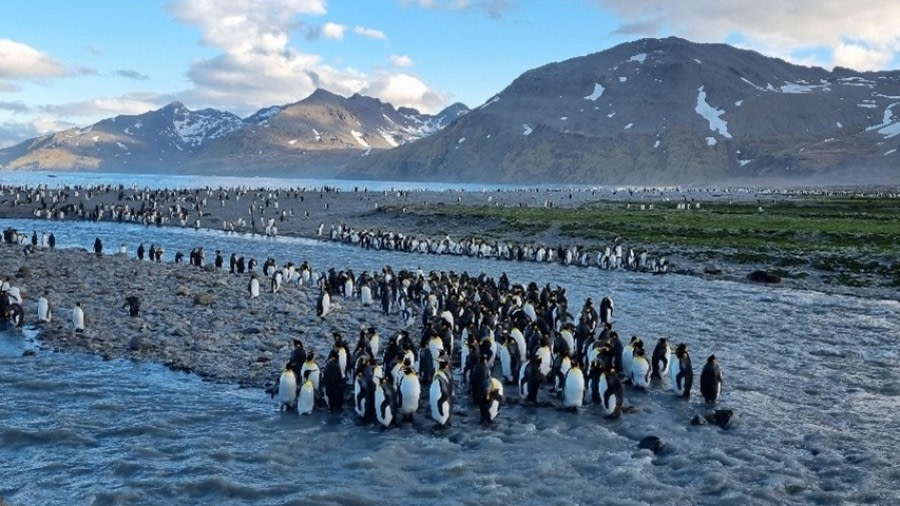
After a thought-provoking morning, we went back to the ship and repositioned to St Andrew’s Bay. This bay is home to the biggest colony of King penguins on South Georgia where the number estimate is around 400,000 individual penguins. We set off across the grassy plain from the beach landing site. On route we could see lots of elephant seals resting, Antarctic fur seals running around, and of course lots of king penguins. Koen and the dive team tried to get everybody across the river crossing. Some days it is possible to cross the river, which is made up of rain and melt water from the glacier, but others it’s just too fast and high to be able to cross. Unfortunately, today was a day where it was unsafe to cross, so instead the expedition team made a route out to see the glacier. Because we couldn’t make it to a high viewpoint of the main penguin colony, instead on the way back to the ship all the returning zodiacs cruised along the shore in front of the colony, so we could view it from the water instead. This was a great alternative as the evening light was beautiful, and we could see all the thousands of chicks and adults in the soft sun set light.

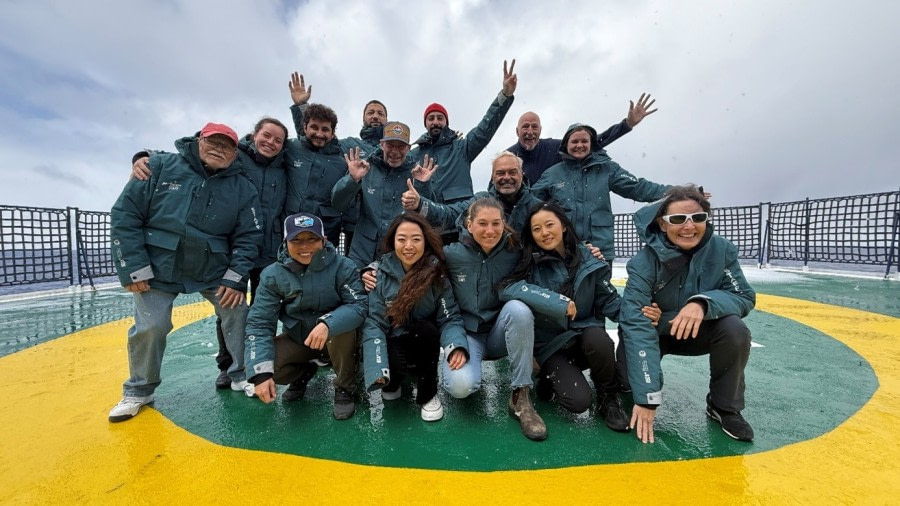
When we returned to the ship we had a lovely surprise. The hotel department had arranged for us to have a barbeque outside on the helideck. It was wonderful to dine outside whilst watching the huge king penguin colony in the distance and seeing sheathbills and giant petrels flying over us. We partied into the night, dancing on the helideck and soaking up the landscape.

Day 9: Fortuna Bay & Hercules Bay

Fortuna Bay & Hercules Bay
Date: 19.12.2025
Position: 54°08.9’S, 036°47.9‘W
Wind: NW3
Weather: Cloudy
Air Temperature: +5.3

We woke up to another sunny day in South Georgia. Today we were going to visit Fortuna Bay, another huge king penguin colony. The weather was surprisingly warm and many of us began our walk in just a couple of layers. We landed on the beach in a fairly big swell and set off across the grassy plain towards the colony. First, we had to weave our way through some patched of tussock grass where there were lots of very small Antarctic fur seal pups hiding, playing, and sleeping. Some lucky passengers even witnessed the birth of a fur seal pup. It was a beautiful walk, and we could see amazing geology on our right with steep cliffs and waterfalls running down them. We followed a river which was full of moulting penguins standing at the edges. On the way we saw some skuas nesting on the ground and their tiny fluffy chicks. We followed the poles marking the route and began scaling a small hill. Just that little bit of elevation gave us a wonderful view over the colony. The sounds of both adults and chicks almost deafening once again. It was a photographer’s dream, but by now we had seen so many king penguins many of us just stopped to look and listen and soak up the incredible sight of them all.

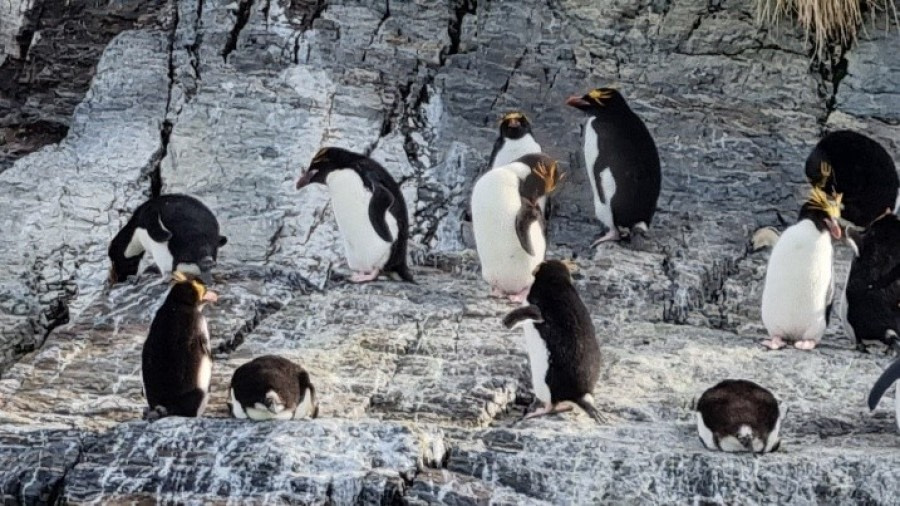
We had a short transit to our afternoon activity location. The guides were excited to show us a little harbour called Hercules Bay. We did a fantastic zodiac cruise here. Shortly after lunch we disembarked into the zodiacs and set off around the bay. The highlight of this cruise was seeing a new species of penguin for the first time, the Macaroni penguin. These are the most numerous species of penguin in the world and yet it is quite hard to see them because they nest on remote and wild sub-Antarctic islands, often at the top of steep slopes. They had beautiful bright orange crests on their heads and red bills. We were able to get great views of them coming in and out of the surf and jumping up onto rocks. They were calling and sleeping and occasionally squabbling with each other.

We carried on along the coast where we found a big haul out of elephant seals, lots of fur seals resting on the rocks, and a spectacular waterfall. The whole bay had a Jurassic Park feel about it, with tall tussock grass covered cliffs and steep rocky slopes. We spent a lot of time watch beautiful light-mantled albatross soaring above us. They nest here in the tussock grass, and we waited patiently for one to land so we could see where its nest was.

Another highlight of the cruise was discovering a blonde fur seal. Around one in a thousand Antarctic fur seals are leucistic giving them a white, blonde colouration.

There were so many interesting things to look at on the cruise that some boats stayed out for around three hours. Some opted to head back and get a drink and enjoy the scenery from the bow and outside decks. In the evening after dinner, we had a lot of photos to start sorting and editing and lots of things to talk about in the bar.

Day 10: Gold Harbour & Cooper Bay

Gold Harbour & Cooper Bay
Date: 20.12.2025
Position: 54°37.5’S, 035°56.1‘W
Wind: SE2
Weather: Partially Cloudy
Air Temperature: +4.7

This morning was another beautiful start, perfect for making the most of our last day in South Georgia. We were woken by Chloe’s cheerful voice announcing that all was going well so far, and the Expedition Team was heading ashore to check out the landing site. Although the forecast predicted 90% cloud cover, we were ready to embark on the zodiac shuttle to the shore.

The team found a gap in the wildlife and managed to land at the far northern end of the beach, near the rocky outcrops. It wasn’t the easiest landing; as we neared the disembarkation zone, we had to brace ourselves for a large swell and fast waves. The marked route was shorter than usual due to the packed beach. After steering clear of a pile of young elephant seals, king penguins, and fur seals, we crossed a stream to occupy a small area at the beach’s edge, overlooking a dense king penguin colony. We were lucky to spot gentoo penguin chicks hiding in the tussac grass.

Beyond the colony stretched rolling hills of moraine and steep cliffs. Above these hills, the glacier terminated in a dramatic hanging glacier, remarkably, this glacier only reached the shoreline as recently as 1984.

The wildlife here was spectacular, with a wide range of behaviours on display. We saw male elephant seals jousting, pups suckling, ‘teenage’ elephant seals play fighting, and curious young king penguin chicks pecking at the seals.

After lunch, we set off south towards Cooper Bay, where we planned a zodiac cruise. The landscape began to shift as we moved from the sedimentary rock layers of the east to the igneous rocks of the island's southern part.

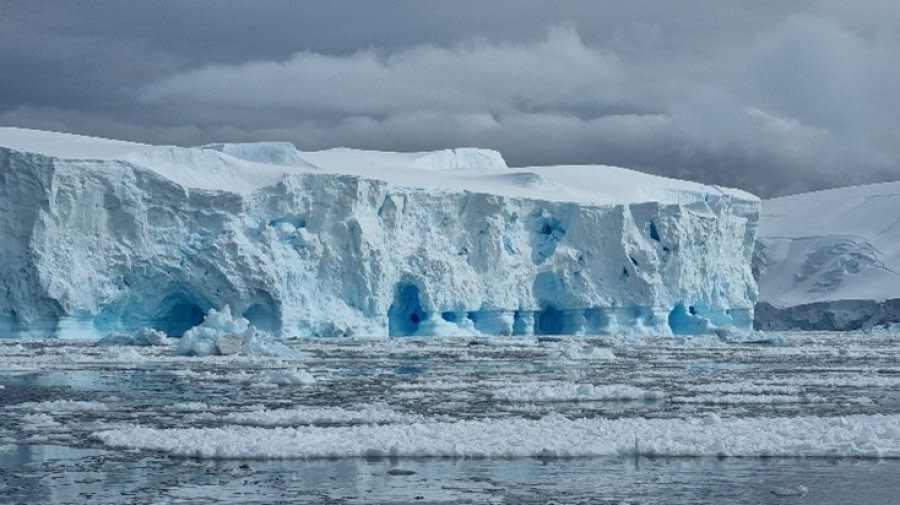
Cooper Island protects the bay, which would otherwise be fully exposed to the Southern Ocean. This bay also hosts an iceberg graveyard, where large icebergs from the Weddell Sea ice shelves come to melt. The currents from the Weddell Sea carry these icebergs along the Antarctic Peninsula’s eastern side toward South Georgia. The icebergs we saw had likely broken off from larger tabular icebergs.

In the zodiacs, we carefully navigated through narrow channels between spurs of rock along the bay’s eastern side. Here, gentoo penguins and fur seals were enjoying the kelp forests that lined the rocky shore. Every time we spotted a gentoo, we eagerly raised our binoculars, hoping for a macaroni penguin. After spotting several gentoo penguins, our teamwork paid off, and we found some macaroni penguins close enough for the small boats to approach. The icing on the cake was our first sighting of chinstrap penguins, spotting the distinctive black line under the chin of the chinstrap penguins, which gave them their name.

Some of the boats even had the chance to spot one South Georgia pipit, one of the few non-seabirds of the region and the only songbird in Antarctica.

Captain Per expertly maneuvered the Ortelius close to some icebergs, allowing us to enjoy an up-close encounter. We were all so tired that, even with the stunning scenery, we stood almost silently, savouring the dramatic coastline as we departed South Georgia.

This coastline was different from the parts of South Georgia we had visited so far. Its geology resembled that of the western Antarctic Peninsula, where dramatic, heavily glaciated mountains rise straight from the sea. As Cape Disappointment appeared over our starboard quarter, we set our course with optimism toward the Antarctic Peninsula.

Day 11: At sea towards Antarctica

At sea towards Antarctica
Date: 21.12.2025
Position: 56°22.9’S, 040°09.7‘W
Wind: NW5
Weather: Foggy
Air Temperature: +3.8

Today was a full sea day as M/V Ortelius continued her journey south from South Georgia toward Antarctica. With the Scotia Sea stretching endlessly around us, the day offered a welcome opportunity to learn, prepare, and settle into the rhythm of life at sea as we edged closer to the White Continent.

After breakfast in the dining room, guests were invited to choose between two morning lectures offered simultaneously in different languages. In the lecture room, Aitana introduced us to the fascinating world of ice, explaining how sea ice, glaciers, and icebergs form, move, and shape polar environments. At the same time, in the bar, Wei welcomed Mandarin-speaking guests with an introduction to Antarctica, setting the scene for the extraordinary landscapes, wildlife, and experiences that lie ahead.

Later in the morning, Gary gathered us in the bar for an engaging lecture on the life history of the emperor penguin. From their remarkable breeding cycle through the Antarctic winter to their extraordinary adaptations to cold and endurance, the talk offered insight into one of Antarctica’s most iconic species. The lecture was translated into Mandarin, allowing everyone onboard to share in the story of these resilient birds.

The afternoon focused on preparation for our upcoming landings. Beginning at 14:00, we were called in groups to the bar to complete the final mandatory biosecurity checks. Outerwear, backpacks, muck boots, tripods, and walking sticks were carefully inspected and cleaned to ensure that no non-native species would be carried into Antarctica.

As the day continued, the atmosphere onboard remained relaxed. At 16:30, we gathered in the bar for happy hour, followed shortly by the South Georgia Heritage Trust auction. This lively and enjoyable event raised funds to support conservation and heritage projects on South Georgia, reminding us of the lasting importance of protecting the places we have already visited.

To close the night, a delicious plated dinner was served at 19:30, and later in the evening many guests returned to the bar for movie night. The National Geographic documentary Endurance told the extraordinary story of Sir Ernest Shackleton’s expedition and the recent discovery of his lost ship — a fitting film as we sail through the same Southern Ocean that once tested the limits of early explorers, and with POPCORN!

Day 12: –At sea towards Antarctica

–At sea towards Antarctica
Date: 22.12.2025
Position: 58°52.9’S, 047°43.8‘W
Wind: NW3
Weather: Partially cloudy
Air Temperature: +3.3

The Scotia Sea continued to treat us kindly today, allowing M/V Ortelius to cruise peacefully south toward the Antarctic Peninsula. With gentle seas and steady progress, the ship provided the perfect setting for a restful night, and many of us woke feeling refreshed and ready for another full day at sea. There was no wake-up call this morning, and guests made their way to the dining room at a relaxed pace to enjoy a generous breakfast while watching the ocean slide past the windows.

The morning began with a choice of photography lectures, offered simultaneously in two languages. In the bar, Koen delivered an engaging English presentation on photographing Antarctica, sharing practical advice on composition, light, and storytelling in polar environments. At the same time, QB hosted a Mandarin lecture in the lecture room, focusing on capturing the frozen wilderness through the lens. Together, these talks highlighted how photography can be both a creative pursuit and a powerful tool for conservation, helping us document and share the fragile beauty of the Antarctic world.

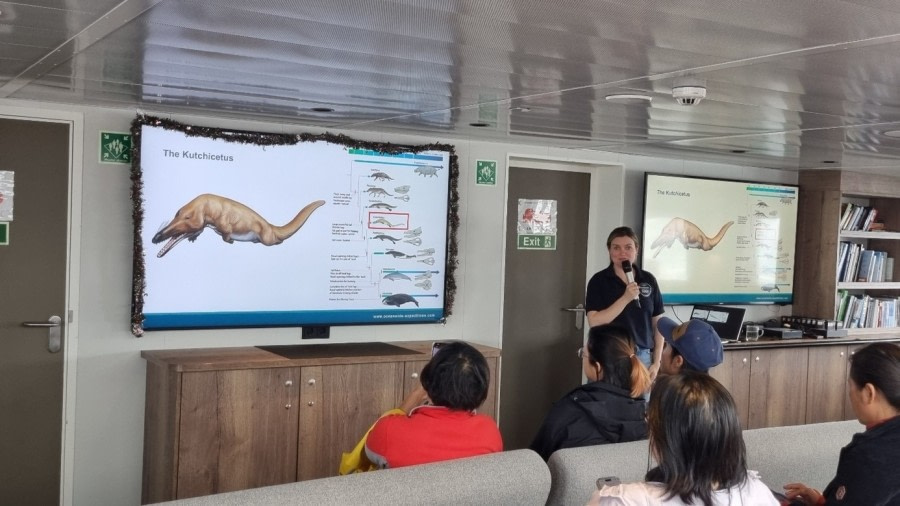
Late in the morning, the lounge filled once again as Jess, affectionately known as our “whale lady”, took us on a fascinating journey through the evolution of whales. Her lecture explored how mammals evolved from land-dwelling ancestors into the giants of the modern oceans, weaving together genetics, fossil evidence, and historical discoveries. Jess’s passion and clear explanations revealed the hidden stories behind these magnificent animals, reminding us of the extraordinary adaptability of life and the quiet magic that nature holds over vast stretches of time.

After lunch in the dining room, the afternoon shifted to a smaller, more intimate scale of discovery. Chloe welcomed guests to the bar, where she had set up a microscope and plankton samples collected from South Georgia. Peering into this secret world, we discovered intricate shapes, delicate colours, and constant motion, life forms that are rarely seen but form the foundation of the Antarctic marine ecosystem. Many guests were visibly amazed, struck by how much beauty and complexity exists beyond what the naked eye can perceive.

At 4:00 pm, as guests enjoyed afternoon tea and sweet treats prepared by the hotel team, Kevin invited us back to the bar for a historical lecture on the Belgian Antarctic Expedition. He told the story of Adrien de Gerlache and the ship Belgica, the first expedition to overwinter in Antarctic waters after becoming trapped in pack ice. Kevin explained why so many Belgian names appear on maps of the Antarctic Peninsula and introduced notable figures from the expedition, including Roald Amundsen, whose polar career would later make history. The talk offered a thoughtful reminder of the courage, uncertainty, and endurance that defined the earliest Antarctic explorers.

Before dinner, the expedition team gathered everyone together for the daily recap. Expedition Leader Chloe revealed the exciting plan for the following morning: an early arrival at Elephant Island, with hopes of visiting Point Wild. She explained the island’s significance as part of Ernest Shackleton’s legendary story, setting the stage for what promises to be a deeply meaningful day ahead. As Ortelius continued her steady course southward, anticipation grew throughout the ship. More ice, more stories, and the raw beauty of Antarctica await us. With every nautical mile, the sense of adventure deepens, and we look forward to discovering what this remarkable continent has to offer next.

Day 13: At sea towards Antarctica

At sea towards Antarctica
Date: 23.12.2025
Position: 58°52.9’S, 047°43.8‘W
Wind: NW3
Weather: Partially cloudy
Air Temperature: +0.7

After leaving South Georgia we got more than 2 days at sea on our way to the White Continent. South Georgia had been amazing but quite intense at the same time, so we welcomed some time onboard. However, after 2 days at sea we were ready for new adventures!

This morning, we arrived at a very famous location in the history of polar exploration. When we woke up it was still foggy, but soon the fog lifted and Point Wild slowly emerged in front of us. Point Wild is part of Elephant Island and it’s the location where 22 of Shackleton’s men waited for more than 3 months to be rescued. Seeing where the men had managed to survive put a shiver through many of us as the conditions and environment were very challenging and inhospitable. It’s hard to imagine how Shackleton’s men dealt with the cold, wet clothing, little shelter, and a monotonous diet of seals and penguins. And these were probably not even the biggest challenges; the mental part must have been even more difficult. Not having any information or knowledge about Shackleton’s progress and whether they would be rescued or not must have been nerve wrecking.

Unfortunately, the conditions this morning were challenging. Catabatic winds coming down from the glacier, drifting brash ice and 2-meter swells made it unsafe to leave the ship so instead we gazed at this inhospitable environment from the outer decks. An iceberg prevented us from sailing further in, so it was also not easy to see the bust of captain Pardo who came to rescue Shackleton’s men. However, this didn’t spoil our morning as it became very clear how brave these men had been, and we could all imagine the hardship of survival.

To make us feel a bit warmer, the expedition team surprised us with hot chocolate with rum and whipped cream on the top deck. With some jolly Christmas songs on the speaker and free rum refills morale was high and we started dancing in the snow and cold winds! What a fabulous morning!

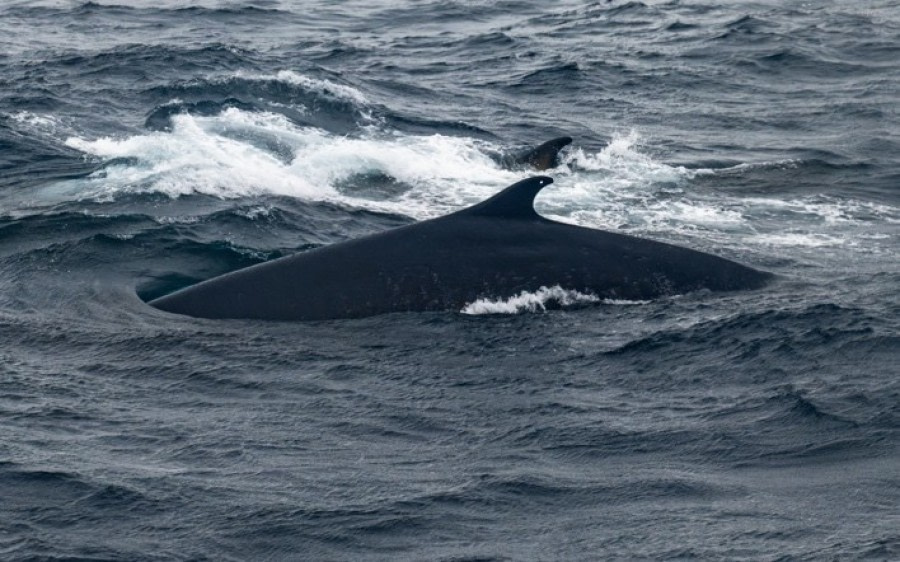
Around 11 AM we started sailing further south. We went around Elephant Island and soon we passed an area where often large congregations of fin and humpback whales can be observed. Today was one of those days. Jess made an announcement during lunch, but she assured us not to rush or run as there were enough whales for everyone as we could see many blows all the way to the horizon. We had some close encounters with fin whales while large flocks of Cape Petrels were escorting our beautiful M/V Ortelius. What a spectacular morning it had been.

To get into the spirit of Christmas some of us had requested the expedition team to play Home Alone in the bar and so they did. Funny how a movie made 35 years ago still brings so much joy and laughter.

Chloe also brought joy and laughter when she passionately presented the second part of her lecture about plankton and krill. Today she talked about the Secret Life of Zoo plankton. It was once again interesting and inspiring and delivered with passion.

After a delicious dinner some of us went outside to enjoy an amazingly calm and clear evening. Surrounded by more and more giant icebergs and a setting sun it was the perfect ending to a wonderful day. Antarctica here we come!

Day 14: Gourdin Island & Brown Bluff

Gourdin Island & Brown Bluff
Date: 24.12.2025
Position: 62°34.3’S, 057°46.4‘W
Wind: SE4
Weather: Partially Cloudy
Air Temperature: +0.8

The Antarctic sun hung low in the sky, painting the frigid waters in strokes of gold and pale blue, as our zodiac glided away from the expedition ship on the afternoon of December 24, Christmas Eve, a day that would gift us memories etched into the very fabric of our polar adventure. The air, crisp and sharp with the scent of sea ice, carried the faint, briny chorus of penguins, an unmistakable soundtrack to our journey at Gourdin Island, a small, ice-fringed haven off the Antarctic Peninsula’s west coast, renowned for its thriving seabird colonies and unspoiled polar landscapes.

As we approached the island, the shoreline erupted into a flurry of black and white: Adélie, Chinstrap, and Gentoo penguins, the triumvirate of Antarctic penguin species that call this stretch of ice and rock home. We navigated the zodiac slowly, careful not to disturb their bustling territories, and watched in quiet awe as groups of penguins waddled down to the water’s edge, paused for a split second as if summoning courage, then launched themselves off the rocky ledges in clumsy yet endearing leaps. Beneath the surface, their awkwardness vanished, they transformed into sleek, graceful swimmers, darting through the icy currents, chasing krill, and weaving around each other in playful synchrony.

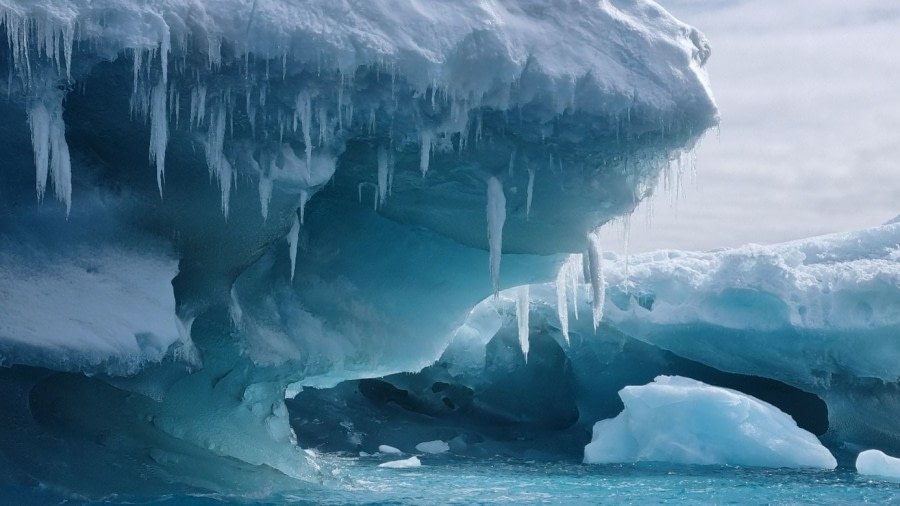
The real magic, though, was in the journey between the penguin colonies. We threaded our way through a maze of giant icebergs, their jagged peaks glistening in the sunlight, some tinted emerald and sapphire by the compressed ice within. One leopard seal was lazing on a flat expanse of iceberg nearby. We drifted closer, keeping a respectful distance, and observed it.

In honour of Christmas Eve, our expedition team had added a special evening landing at Brown Bluff to our itinerary. After a warm, hearty meal that chased away the chill of the afternoon cruise, we suited up again, our gear clinking with anticipation, and boarded the zodiacs once more, bound for the dramatic volcanic cliff that rises sharply from the sea, its rust-coloured rock contrasting vividly with the surrounding white snow.

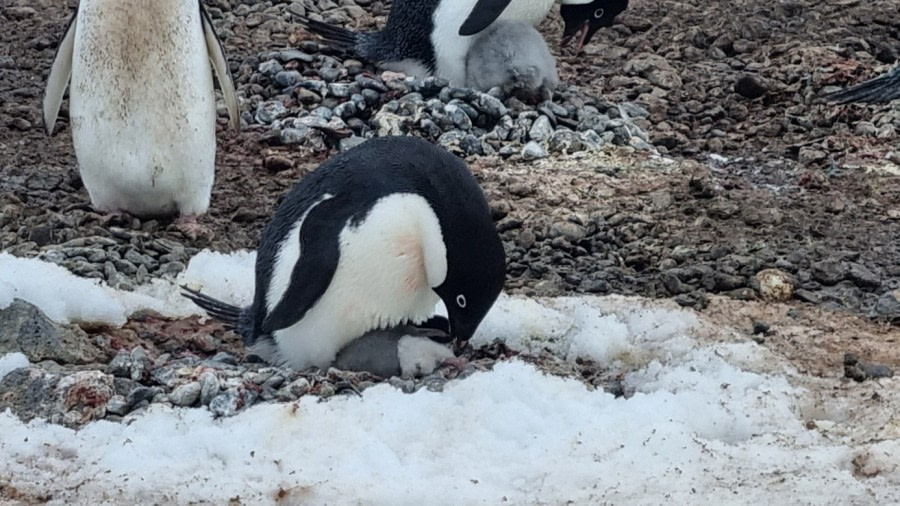
What made this landing even more extraordinary was that it marked our first true step onto the Antarctic Continent, a milestone that sent a thrill of awe through each of us as we set foot on the snow-dusted ground. Brown Bluff is famous for its dense penguin rookeries, and as we walked along the paths, we were surrounded by the Adélie and Gentoo penguins, paired with the high-pitched peeps of their fluffy, down-covered chicks, huddled together in stone nests to stay warm against the biting wind.

But the penguins were not the only stars of the show. The air was alive with other seabirds: skuas circling overhead in search of unguarded eggs or vulnerable chicks; kelp gulls, perched on rocky outcrops, their calls echoing across the bluff; and the charming Snowy Sheathbills, their pure white plumage blending seamlessly with the snow, hopping about the edges of the rookeries in search of scraps.

As we boarded the zodiac to head back to the ship, we looked over shoulder one last time, at Brown Bluff fading into the twilight, at the penguins still bustling about their nests, at the sea ice glinting in the fading light. This was not just a travel adventure, it was a Christmas Eve miracle, a reminder of how precious our planet’s polar regions are, of the fragile, delicate balance that sustains life in one of the harshest environments imaginable. On this quiet, unforgettable night in Antarctica, surrounded by the wild beauty of Gourdin Island and Brown Bluff, we felt a deep sense of gratitude, gratitude for the chance to witness this magic, gratitude for the resilience of the polar wildlife, and gratitude for the quiet, awe-inspiring moments that make traveling to the ends of the Earth worth every shiver and every sacrifice.

Day 15: Christmas Day at Deception Island

Christmas Day at Deception Island
Date: 25.12.2025
Position: 63°11.9’S, 059°51.8‘W
Wind: E4
Weather: Overcast
Air Temperature: +6.8

Merry Christmas from the frozen southern frontier! December 25 dawned with a crisp, wind-kissed clarity, setting the stage for a day of unparalleled Antarctic wonders cantered on Deception Island, a volcanic caldera nestled in the South Shetland Islands, famous for its unique horseshoe shape and dramatic polar landscapes. Our adventure kicked off at first light, as our expedition ship navigated the narrow, towering passage known as Neptune's Bellows, the only gateway into Deception Island’s sheltered inner bay. Flanked by steep, black volcanic cliffs dusted with snow, this natural channel feels like a portal to another world; the water churns gently against the rock walls, and the air hums with the quiet thrill of entering a place few humans get to explore.

Once through Neptune's Bellows, we cruised the inner bay, where the polar scenery unfolded like a delicate ink wash painting. Snow-blanketed volcanic slopes rolled down to glassy, steel-grey waters, every contour softened by a pristine white layer that glowed in the pale Antarctic sun. The calm of the present belied the island’s turbulent past, and our guide pointed out the ghostly remains of Whalers Bay, a historic site where early 20th-century whaling stations once stood, their rusted boilers and crumbling buildings now half-buried in snow, silent witnesses to a bygone era of industrial exploitation. To see these relics juxtaposed against the island’s unspoiled beauty was a poignant reminder of Antarctica’s fragile balance between history and wilderness.

After a hearty Christmas lunch aboard the ship, we set off for our next adventure: a landing at Telephone Bay. The highlight of this stop was a 4-kilometer circular hiking trail that wound its way up the island’s volcanic ridges, offering ever-expanding views of the caldera. As we trekked, the crunch of snow under our boots mingled with the raucous cries of seabirds overhead, flocks of kelp gulls and skuas wheeling through the air. When we reached the trail’s highest point, we were rewarded with a breathtaking panoramic view of Deception Island: the curving sweep of the caldera, the glint of inner bay waters, and the distant outline of snow-capped peaks beyond. Down on the pebbly shore below, a Weddell seal lay sprawled in lazy repose, its plump body rising and falling with slow, contented breaths, while a handful of Chinstrap penguins waddled and darted about, their playful antics providing endless entertainment.

We returned to the ship for a sumptuous Christmas special dinner, complete with festive treats that felt like a warm hug amid the cold, a reminder of the holiday cheer we carried with us to the ends of the Earth. But the day’s magic was far from over. After dinner, our expedition team member Jess host a Christmas Antarctic trivia contest, a spirited game that brought everyone together in cozy camaraderie. Split into teams, we pored over 40 carefully crafted questions, testing our knowledge of polar wildlife, geology, and expedition history. Laughter echoed through the lounge as we debated answers and celebrated small victories, and when the scores were tallied, the top three teams were awarded bragging rights (and a few polar-themed souvenirs). More than just a game, it was a joyful way to revisit the incredible moments we’d shared so far, weaving our collective experiences into a tapestry of shared memories.

The ship sways gently in the bay, and the distant glow of Deception Island fades into the night. Today was more than a Christmas celebration, it was a testament to the wonder of Antarctica: a place where volcanic history meets pristine wilderness, where festive joy mingles with the quiet awe of standing in one of the most remote corners of the planet. It was, without a doubt, a perfect Christmas Day!

Day 16: Cierva Cove & Palaver Point

Cierva Cove & Palaver Point
Date: 26.12.2025
Position: 64°07.7’S, 060°59.2‘W
Wind: WNE3
Weather: Cloudy
Air Temperature: +0.4

Our final day of operations in Antarctica unfolded under exceptionally favourable conditions, offering a memorable and fitting conclusion to our journey on the White Continent. After weeks of exploration, learning, and shared experiences in one of the most remote regions on Earth, the Antarctic Peninsula seemed determined to bid us farewell in the best possible way. The morning began with a zodiac cruise in Cierva Cove, a location renowned for its dramatic scenery and rich wildlife. As we arrived, we were greeted by almost ideal weather: very little wind, calm seas, and excellent visibility. These conditions allowed the surface of the water to become a perfect mirror, reflecting towering icebergs and snow-covered peaks with remarkable clarity. The stillness of the bay created a peaceful atmosphere, inviting guests to slow down and fully absorb the surroundings. One of the most distinctive features of Cierva Cove is the presence of the Argentine Primavera Station, quietly positioned along the shoreline. During the Zodiac cruise, guests had the opportunity to observe the station up close, its colourful buildings reflected clearly in the glassy water. Around the station, gentoo penguins were seen moving between the shoreline and their nesting areas. Guests watched as the gentoos porpoise through the water, climbed out onto the rocks, and waddled purposefully along well-worn penguin highways. These close observations provided an excellent contrast to the surrounding ice-dominated landscape and highlighted the adaptability of wildlife living alongside a human research presence. As the Zodiacs continued to navigate through the bay, wildlife encounters continued to delight. Resting peacefully on a floating ice floe, a leopard seal was spotted fast asleep. Known for its powerful hunting skills and agile movements, the seal appeared completely undisturbed by our presence. Guests were able to observe its distinctive spotted coat, large head, and relaxed posture, offering a rare glimpse of this apex predator in a moment of rest. Adding to the excitement of the morning, a humpback whale made a brief appearance in the cove. Although only seen for a short time, its presence was unmistakable. A few distant blows and graceful surfacing reminded us that these waters are rich feeding grounds during the austral summer. Even fleeting encounters with whales leave a lasting impression, and guests were thrilled to witness these giants of the Southern Ocean as part of our final Zodiac activity. Following a successful morning on the water, we returned to the ship to prepare for our afternoon plans. After lunch, the vessel repositioned to Palaver Point, where we would conduct our final landing of the expedition. The sense that this was our last opportunity to step ashore in Antarctica added a layer of significance to the afternoon. Once ashore at Palaver Point, guests were welcomed by a lively chinstrap penguin colony. Many penguin chicks were present, busily moving between their parents and neighbouring nests. Their fluffy appearance and curious behaviour provided countless moments of delight and excellent photo opportunities. Observing the interactions within the colony, adults guarding their young, chicks calling out, and penguins navigating the rocky terrain, offered a fascinating glimpse into the daily life of Antarctic wildlife during the breeding season. The landing allowed time not only for wildlife observation but also for quiet reflection. Guests explored the area at their own pace, taking in the stark beauty of the landscape, the sounds of the colony, and the feeling of standing at the edge of the Antarctic Peninsula. For many, this moment marked the realization that their long-anticipated Antarctic journey was ending. As the afternoon progressed, guests returned to the landing site and boarded the Zodiacs for the final time. Yet Antarctica had one last surprise in store. On the journey back to the ship, the Zodiacs encountered four humpback whales actively feeding in the bay. The whales surfaced repeatedly, their massive bodies rising effortlessly from the water as they lunged through schools of krill below. This encounter quickly became one of the highlights of the entire voyage. Guests watched in awe as the whales moved through the bay, sometimes close enough to hear their blows. The calm sea conditions allowed for excellent viewing, and the feeding behaviour offered a rare and intimate look at these magnificent animals at work. Smiles, quiet laughter, and moments of stunned silence filled the Zodiacs as everyone took in the spectacle. The timing could not have been more perfect. After days of exploration across ice, sea, and shore, this extraordinary whale encounter served as a powerful farewell from Antarctica itself. It felt as though the continent was offering a final gift, ensuring that the last memories carried north would be unforgettable. As guests returned to the ship for the final time, there was a shared sense of gratitude, for the weather, the wildlife, the crew, and the opportunity to experience such a remote and pristine part of the world. From calm waters and mirror-like reflections in Cierva Cove, to playful penguin chicks at Palaver Point, and finally to feeding humpback whales in the bay, the day encompassed everything that makes Antarctica so special. With this exceptional final day, our Antarctic operations ended. It was a perfect ending to an extraordinary journey, one that will remain with us long after we leave the icy shores behind.

Day 17: Drake Passage

Drake Passage
Date: 27.12.2025
Position: 61°43.9’S, 063°02.2‘W
Wind: SW4
Weather: Slight
Air Temperature: +1

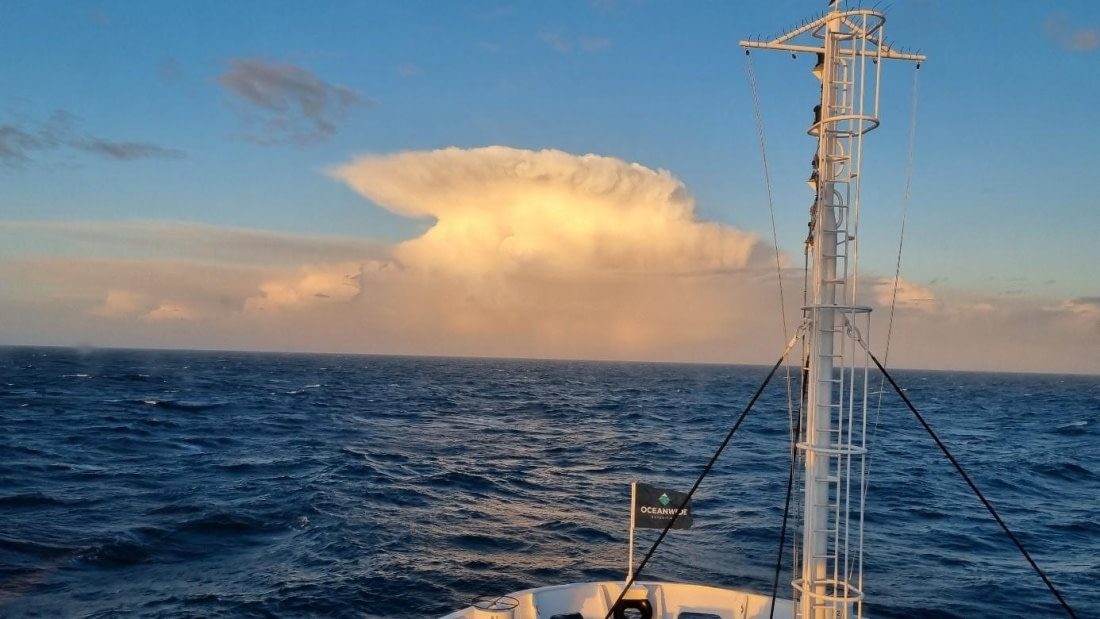
After leaving the Antarctic Peninsula and Palaver Point, we are now heading toward the legendary Cape Horn and Ushuaia. But, before we get there, we must first navigate the (in)famous Drake Passage. As many seasoned travellers know, the Drake Passage can either be a calm “Drake Lake” or a rough and wild “Drake Shake.” Fortunately for us aboard, today it’s closer to a “Drake Lake,” with only gentle 2.5- to 3-meter swells and minimal wind. Cruising along steadily at 12 knots, we are making good progress toward Cape Horn.

The excitement from yesterday’s humpback whale sightings is still fresh in everyone’s minds, as those majestic creatures truly were the cherry on top of this incredible voyage.

The day began without a wake-up call, allowing everyone to sleep in a bit, before enjoying a delicious breakfast. Afterward, passengers took time to savour the last views of the stunning Antarctic landscape, snapping their final pictures, and soaking in the experience before we head back to more familiar shores.

We then gathered for some fascinating lectures. Jess kicked things off with an engaging talk on the vital role whales play in the ocean ecosystem. These magnificent creatures are not just a marvel to observe but are essential to the health of our planet, helping regulate everything from ocean nutrients to the climate.
Next up was Gary, our experienced guide, who shared stories from his remarkable adventures, including the time he overwintered in Antarctica. A rare feat accomplished by only a handful of people, his tales of survival and solitude were both humbling and inspiring.
After a hearty lunch (yes, hamburgers!), many of us settled in for a short nap. Then Dr. Elmar, our onboard physician, gave an insightful talk about scurvy, a disease that claimed the lives of over 2 million sailors during the age of early exploration. It wasn’t until the 1930s that the cure was discovered, and the solution turned out to be surprisingly simple: eating more oranges or taking Vitamin C!

Svatava followed with a lecture about the important role dogs played during the Heroic Age of Antarctic exploration. More than just companions who pulled sledges, these dogs helped lift the spirits of early explorers during long, harsh winters, providing much-needed morale on the coldest and most remote of expeditions.

Throughout the day, the bridge made occasional announcements about whale sightings, mostly humpback whales, but also a small group of fin whales, which kept everyone’s spirits high. As the day wound down, we gathered for a plated dinner, and then it was time to relax. We settled in to watch the classic film Happy Feet in the lecture room, all while slowly making our way in the direction of the much-anticipated Cape Horn.

Day 18: Drake Passage

Drake Passage
Date: 28.12.2025
Position: 57°47.5’S, 066°26.3‘W
Wind: SW6
Weather: Partially Cloudy
Air Temperature: +7

After a calm night on the infamous Drake Passage, we were woken up by an unfamiliar voice. This morning it wasn’t Chloe wishing us a wonderful day, instead it was 8-year-old Lilian from Hong Kong who told us to get up and enjoy breakfast followed by a beautiful piece of classical music. Although we will miss Chloe’s voice, it was nice to hear a future expedition leader speak to us so confidently and enthusiastically. The wakeup call was one of the auctioned items for the South Georgia Heritage Trust and Lilian did a fantastic job.

Outside the weather was sunny and the seas were calm, perfect to enjoy a relaxed breakfast. However, soon after QB invited us to the bar to join her lecture on climate change illustrated with photographs. Climate change is an important topic globally, but more so in the polar regions where decreasing sea ice has an accelerating effect to the warming up of our planet.

During our adventure we had a small group of divers on board that explored the underwater worlds of the Falkland Islands, South Georgia and Antarctica. The divers and dive team carried with them a lot of camera gear, and they compiled a presentation and short slide show from all the footage they recorded. It’s incredible how much life there is below the surface both in terms of plant life, invertebrates and also large mammals such as fur and leopard seals. The footage of the leopard seal was fantastic.

After lunch Koen invited us to the bar to hear and see what other adventures Oceanwide has to offer in the Polar regions. From polar bears to remote trips in the Weddell Sea, Oceanwide has a wide variety of expeditions and activities, and Koen was speaking excitingly about them.

Koen was so enthusiastic that seemingly he lost track of time. However, the captain helped us out here. As we had been making good progress, the captain had decided to sail past the infamous Cape Horn. The southernmost tip of South America and famous for its unpredictable weather, strong winds and massive waves and swells. It’s an area where many ships sank trying to conquer the challenging conditions, but where nature couldn’t be beaten. Although we were not allowed to approach closer, it was still a spectacular moment seeing this famous place. We were accompanied by lots of sea birds and here and there we spotted dolphins. Fantastic!

At the end of the afternoon, it was time for Captain’s Cocktail. Captain Remmert spoke inspirational words and thanked us for sailing with him and Oceanwide Expeditions on our strong yet beautiful M/V Ortelius. Chloe thanked all departments and her team, and then it was time for the slide show. Aitana had been working hard on creating a slide show with highlights from the trip. She had done an incredible job and some of us shed a small happiness tear while watching it. Time had flown by during our trip, and it was amazing to see how many fantastic places we had visited, the overwhelming amounts of wildlife we had seen, and the wonderful landscapes and icebergs that came with it. What a fantastic journey!

Our Head Chef Ivan prepared one last dinner for us, and it was delicious as always. The restaurant was buzzing with laughter and excited chatter while we slowly entered the Beagle Channel on our way to Ushuaia. After dinner we went outside to enjoy some milder temperatures and a beautiful sunset. Good night, everyone! This adventure ended way too soon!

Day 19: Disembarkation Ushuaia

Disembarkation Ushuaia
Date: 29.12.2025
Position: 54°48.5’S, 068°17.9‘W
Wind: Var 1
Weather: Overcast
Air Temperature: +7

Our final wakeup call was made by Chloe, and we were asked to leave our big luggage in the corridor at 07:30, so the expedition team could take them all down for us and on to the pier. time. It was amazing how quickly ten days has whizzed by. We headed for breakfast and said goodbye to the dining room team who took such good care of us throughout the trip. We gathered our belongings and headed to the gangway to say goodbye to the crew, staff, and new friends we had made. Some of us hopped straight on the bus to the airport to head home, while others set off to explore Ushuaia and continue travelling in Patagonia. We got to see breathtaking landscapes of South Georgia; beaches packed with various wildlife, elephant seal babies being curious, fur seal bulls fighting and protecting their harems, king penguins getting off the water. And of course, young king penguins being cute and hilarious. We got to see colonies of all 3 different Brushtail penguins, several times we had an up-close encounter with Humpback whales. This trip really reminded us of the power of nature, and we saw firsthand just how wild and rugged Antarctica is. The highlights of this trip will stay in our thoughts for many years to come. This trip really reminded us of the power of nature, and we saw firsthand just how wild and rugged Antarctica is. The highlights of this trip will stay in our thoughts for many years to come.

Total distance sailed on our voyage: 3423 nautical miles

Most southern point sailed: 64° 08.5’ S, 061° 45.8’W

On behalf of Oceanwide Expeditions, Captain Remmert Koster, Expedition Leader Chloé Maréchal, Hotel Manager Volodymyr Cherednychenko and all the crew and staff of M/V Ortelius, it was a great pleasure and a privilege travelling with you!

Details

Tripcode: OTL25-26
Dates: 11 Dec - 29 Dec, 2025
Duration: 18 nights
Ship: m/v Ortelius
Embark: Ushuaia
Disembark: Ushuaia

Have you been on this voyage?

Aboard m/v Ortelius

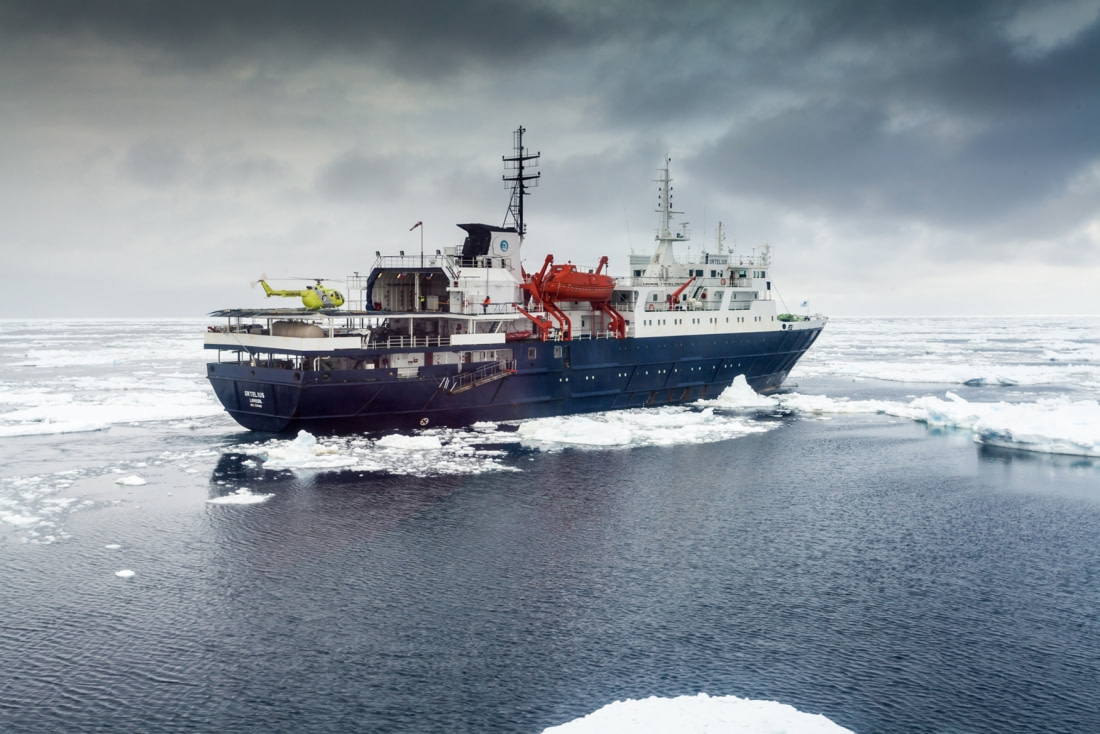
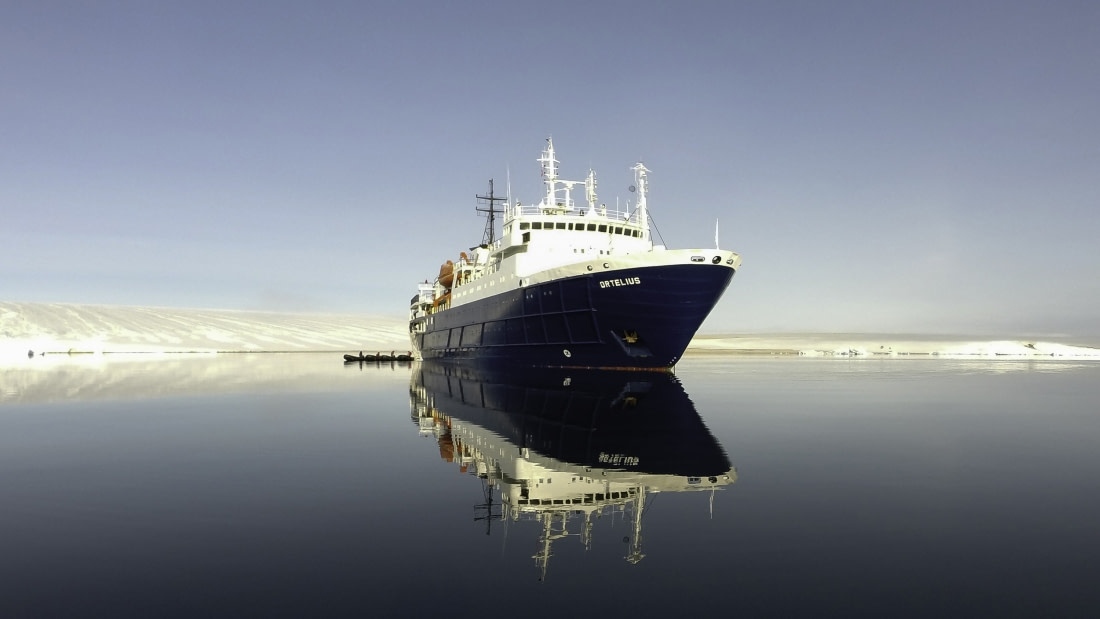
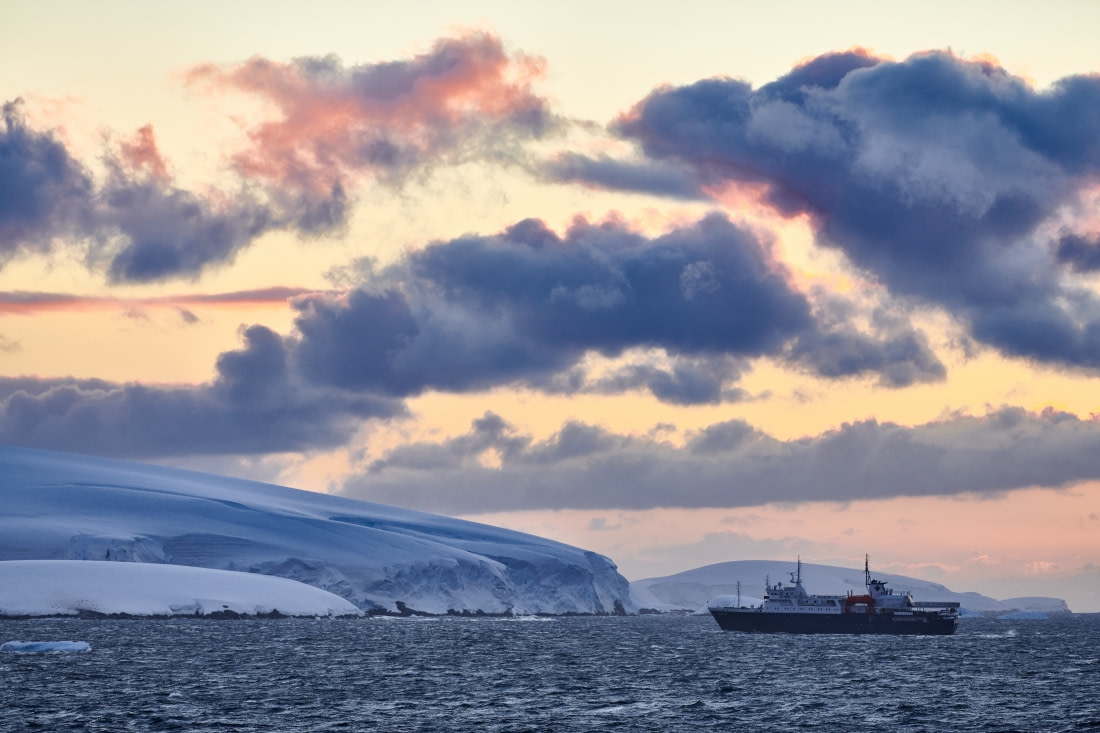
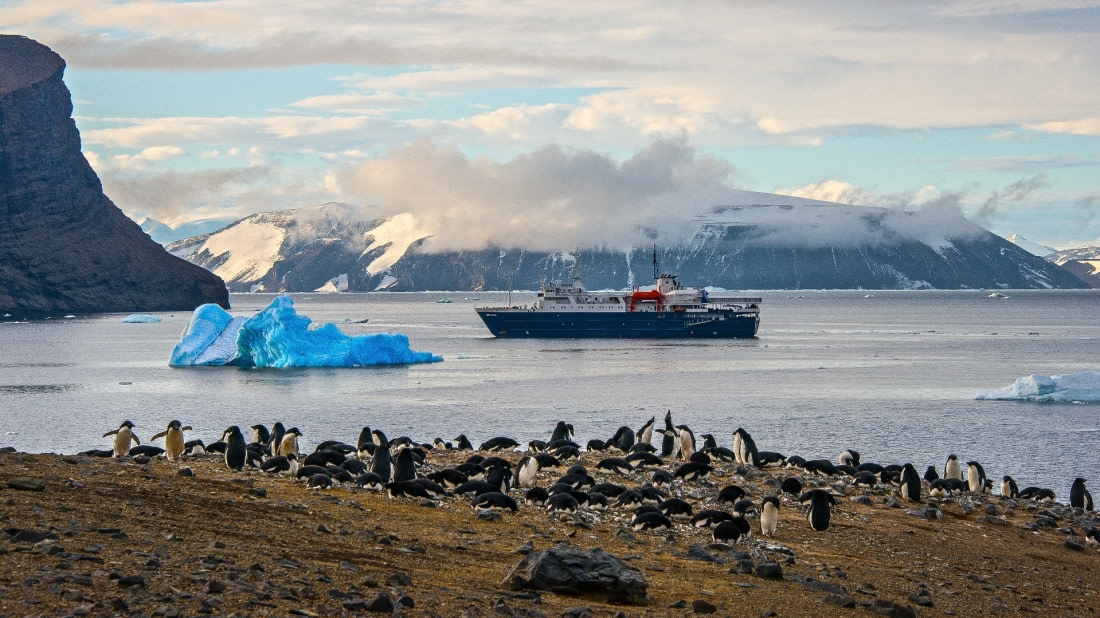
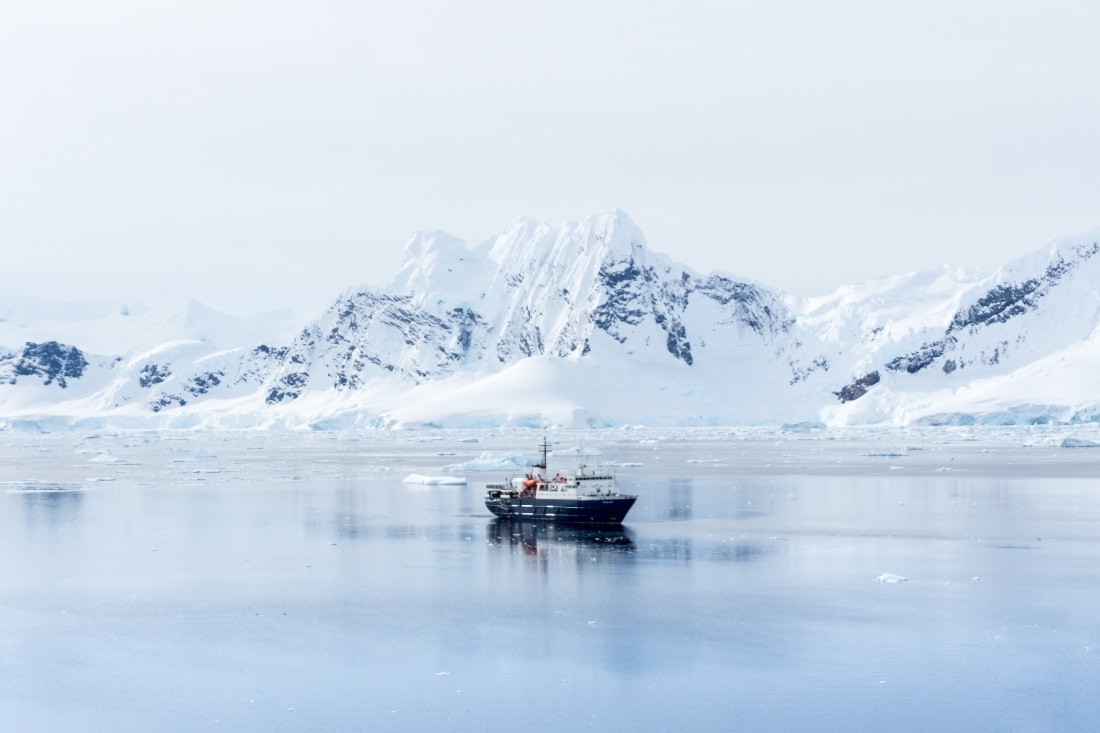
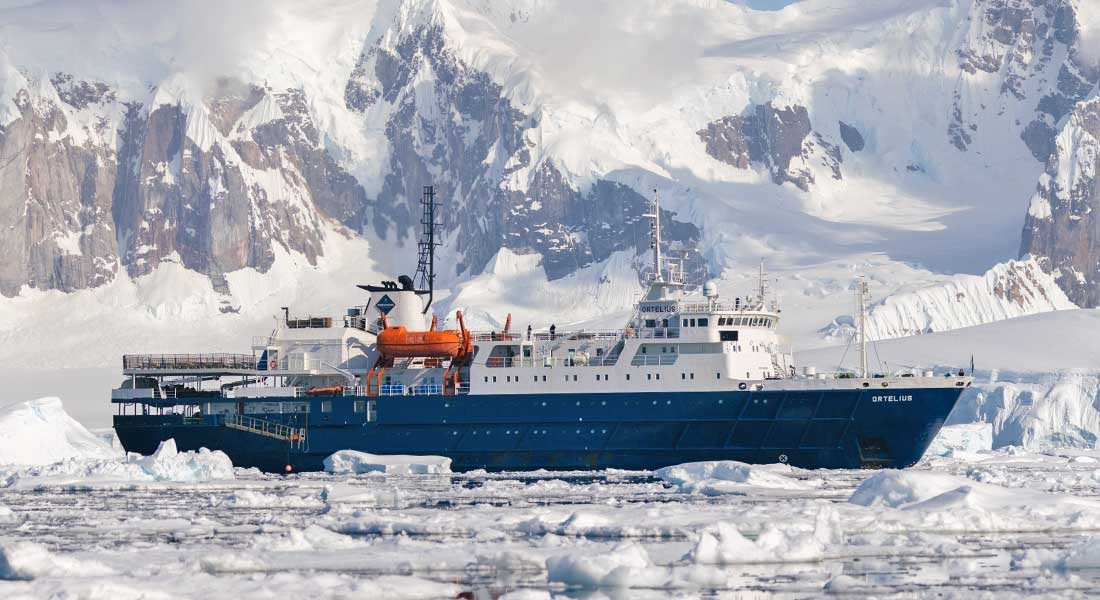
The ice-strengthened Ortelius is thoroughly outfitted for polar exploration and, when necessary, helicopter flights.

More about the m/v Ortelius »
Loading