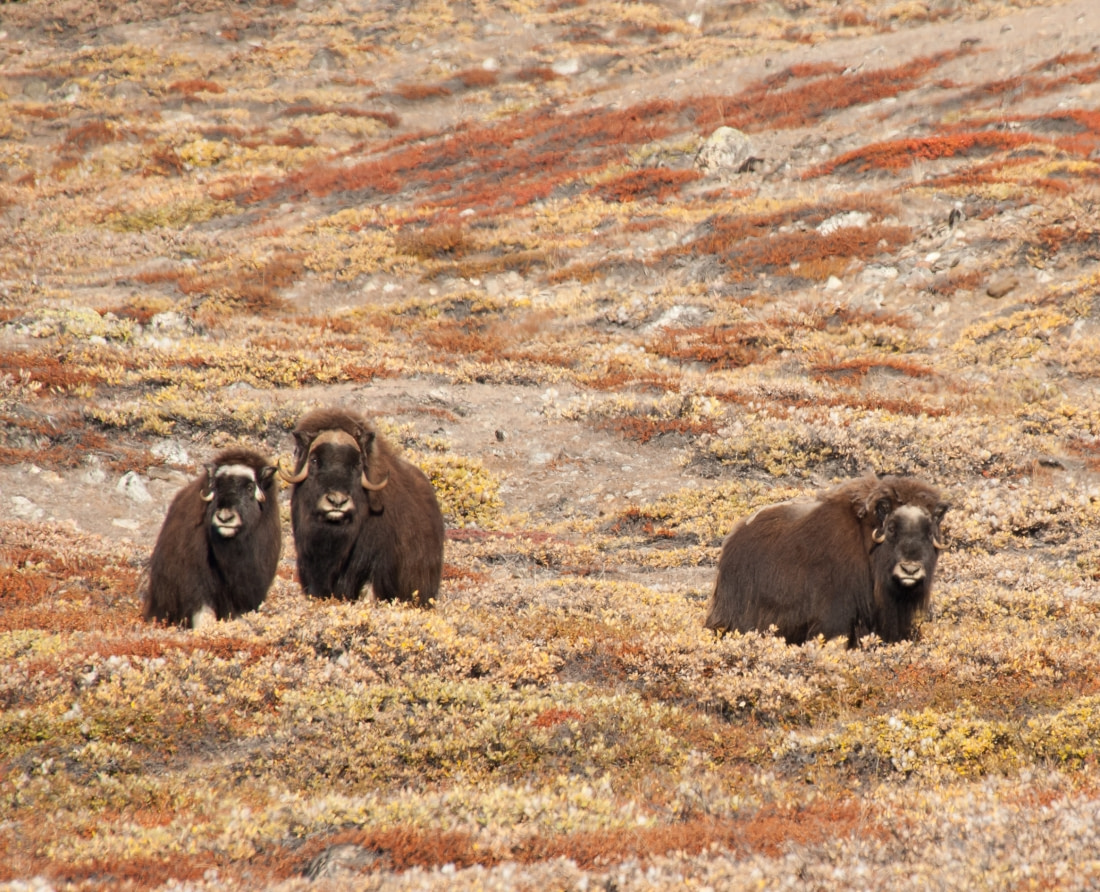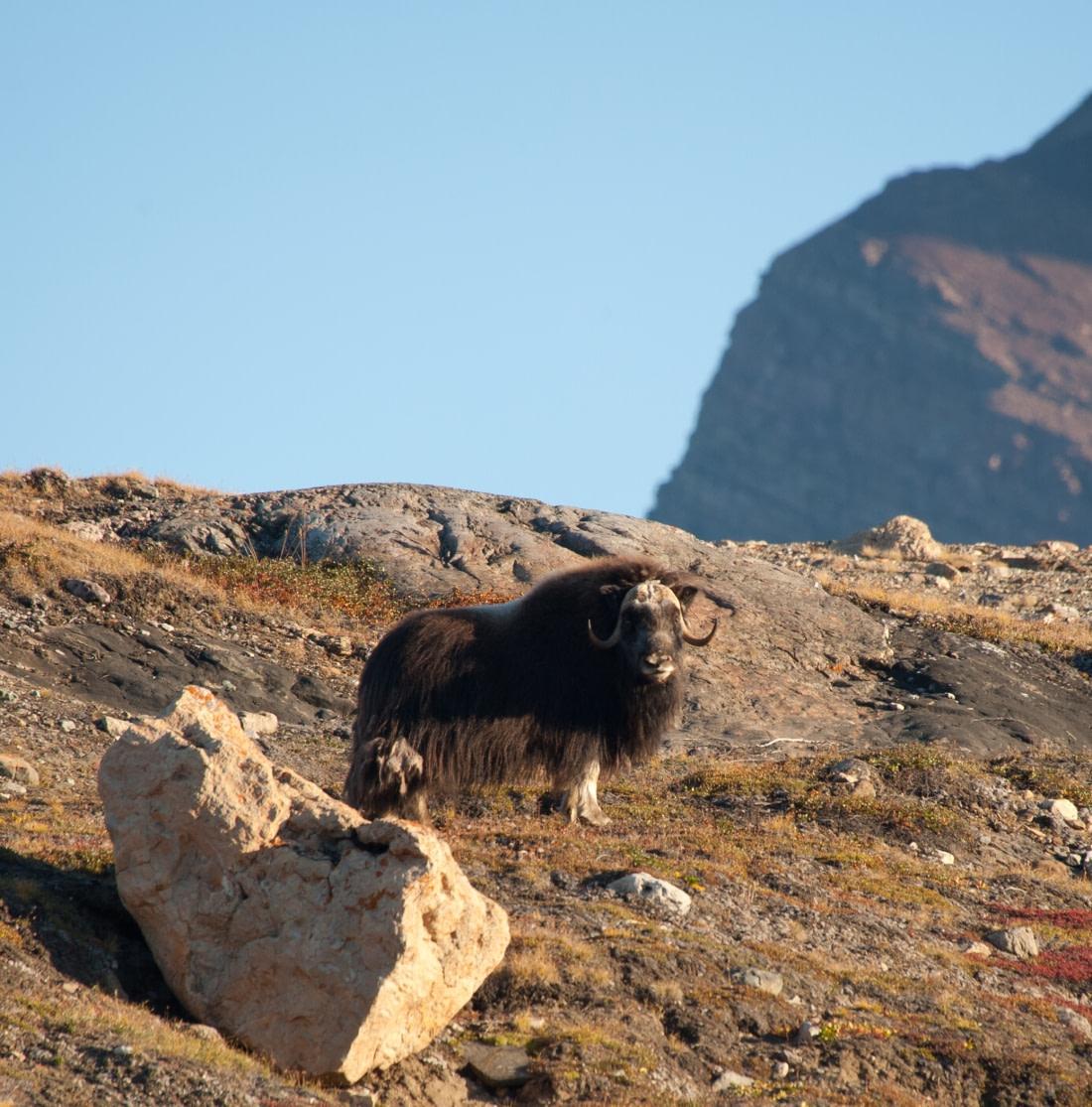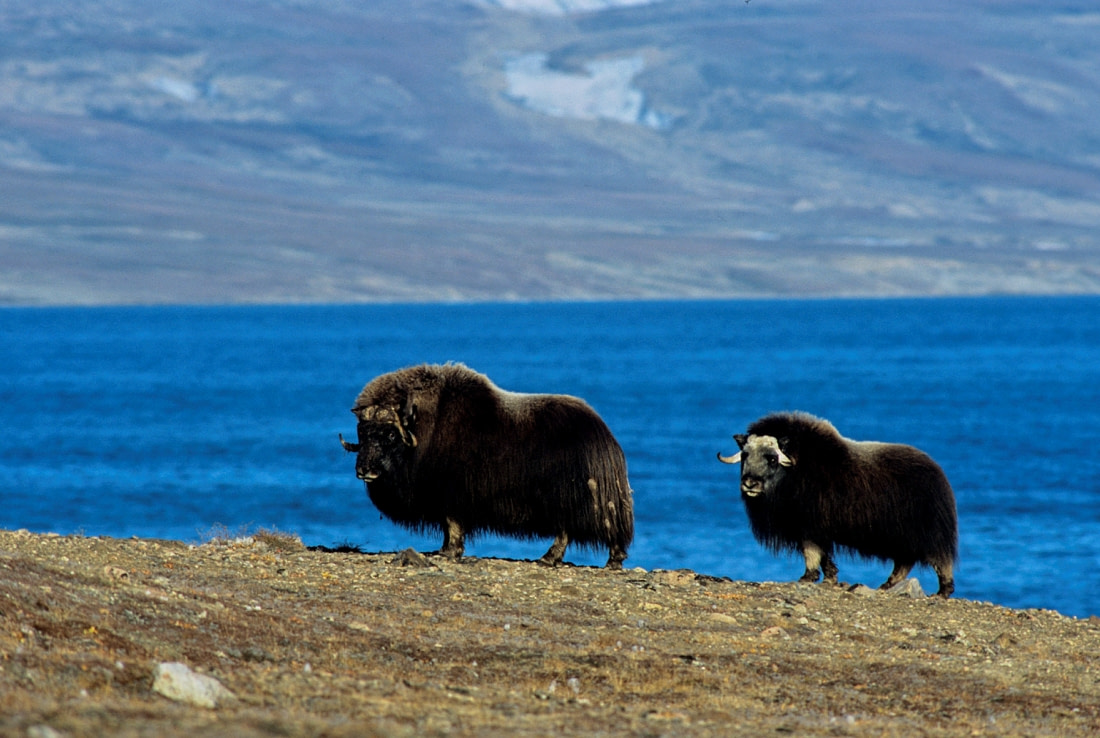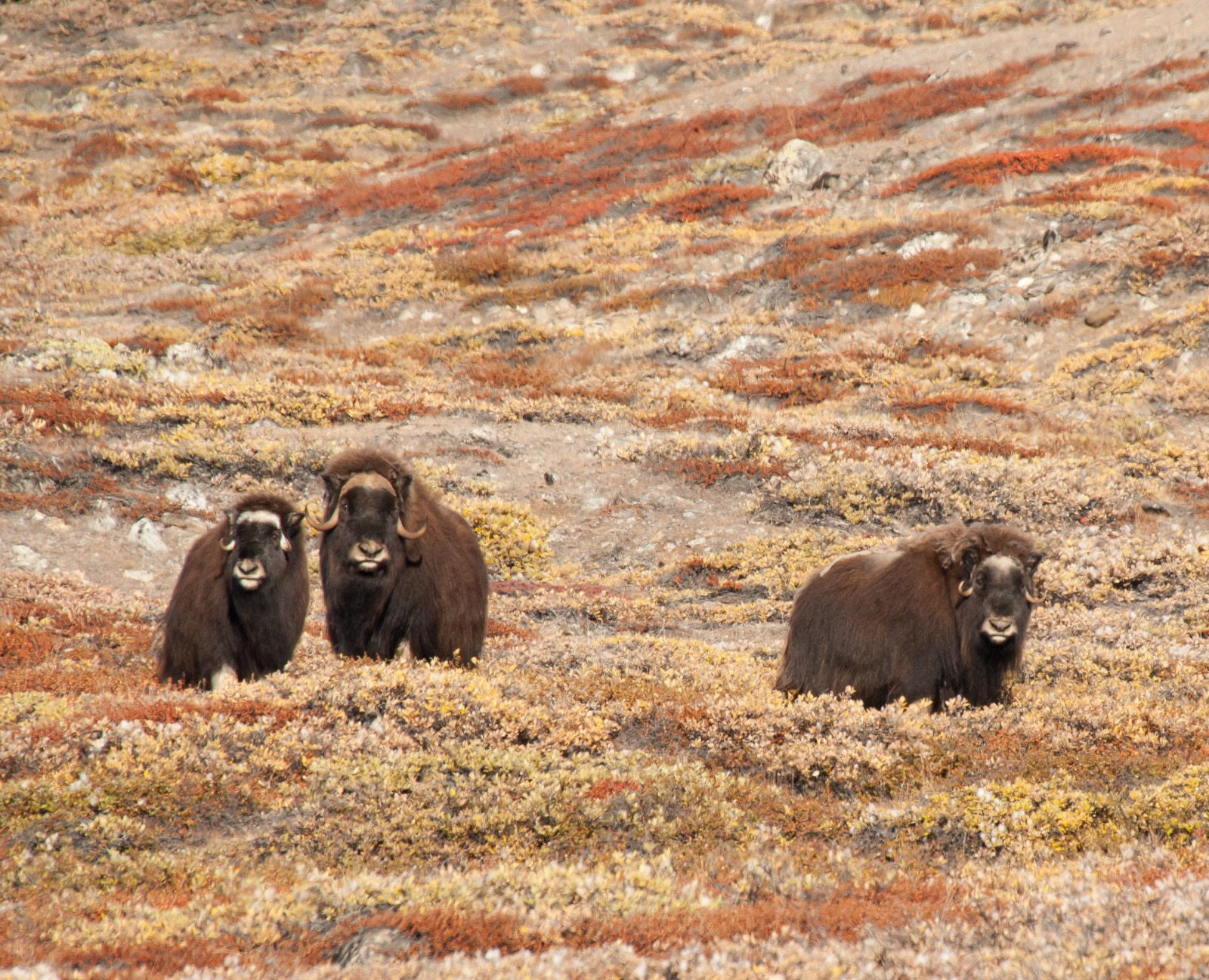
Name: Musk Ox (Ovibos moschatus)
Length: 1.5 metres (height at shoulder)
Weight: 285 kg average
Location: Arctic
Conservation status: Least Concern
Diet: Grass, willows, lichens, moss
Appearance: Black, gray, brown, very rarely white
How do Musk Oxen forage?
Musk Oxen move with the seasons, relocating themselves to areas where the snow is thinnest so it requires less energy to dig through to get to plants.
Are Musk Oxen social?
Musk Oxen herd together. In the winters the herds range from about 12 to 24 members. In the summer the herds spread out a bit, reducing in numbers to about 8 to 20.
The Oxen have 2 separate hierarchies – one for males and one for females. They do not hold territories but do mark their trails with their pre-orbital glands – scent markers secreted from slits descending from their eyes.
The dominant Oxen in the hierarchies get first choice of the best food sources. They’ll chase off contenders by roaring, pawing the ground, and by lowering their heads and rushing.
Males will further show their dominance over other lesser males by treating them like females – kicking at them like they do at females during mating season and even sometimes mock-mounting them.
When threatened Musk Oxen will form a defensive circle, horns outwards, with the bulls as the first line of defense.

How fast can Musk Oxen move?
Musk Oxen can run at speeds up to 60 km per hour.
What are Musk Oxen mating rituals like?
Females reach sexual maturity at 3 years, males at 5.
Mating season arrives around the beginning of July. Males will clash by repeatedly charging at each other and ramming their heads until one male capitulates. The winner creates a harem of about 6 females; the loser will go off with a small sub-herd of elderly and non-dominant males (returning to the larger herd if threatened by predators).
The dominant males herd their harem’s females in the sense of shepherds herding sheep, making sure none can leave. They’ll kick at the female with their forelegs in order to calm them before mounting.
The harems and bachelor male herds will re-congregate around the end of the summer months to form one larger unified herd again.
Once pregnant, the females take over, becoming aggressive and making the decision as to how far the herd’s grazing will take it within a day. The pregnancy lasts about 8 ½ months, the calves being born from April through June.
Calves are able to move with the herd on their own within a few hours of being born. They’ll feed on their mother’s milk for about 2 months, slowly being weaned after that as they learn to feed on their own.
How long do Musk Oxen live?
Musk Oxen live up to about 20 years in the wild.
How many Musk Oxen are there today?
Estimates range from 80,000 to 125,000.

Do Musk Oxen have any predators?
Musk Oxen’s main predator is the Arctic Wolf, which accounts for up to half of the Oxen’s deaths due to predation. Grizzly bears and polar bears are also known to attack the Oxen, mainly to go after the young and elderly.
7 Magnificent Musk Oxen Facts
- Musk Oxen get their name from their strong smell given off by males during the mating season.
- Musk Oxen have 2 layers of fur – the outer layer (called “guard hairs”) and the inner layer of shorter hairs called “qiviut” that fall out for the summer season.
- The under-layer can be used to spin a form of wool that is 8 times warmer than a sheep’s wool – one of the warmest natural fibers in the world.
- Musk Oxen and Caribou are the only hooved mammals in the Arctic to survive the end of the Pleistocene Era which came to a close about 10,000 years ago.
- Musk Oxen have a pocket of air between their skull and their brain so males don’t turn their brains to mush during the mating season’s contests.
- Musk Oxen became extinct in the northern reaches of North America in the late 1800s. The population was renewed with 34 Oxen shipped over from Greenland in the 1930s.
- Musk Oxen are more closely related to goats and sheep than any other sort of animal.