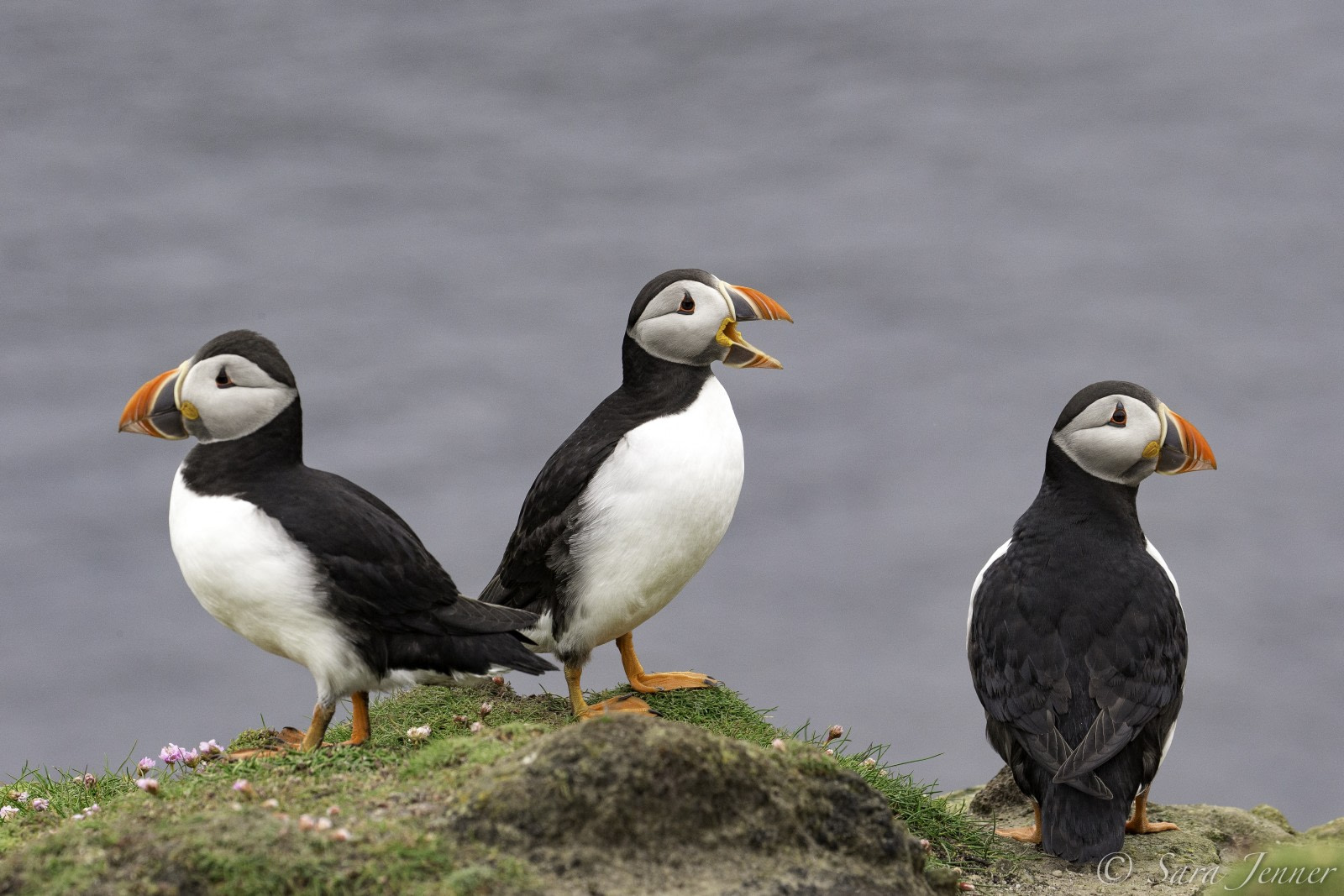
Name: Atlantic Puffin (a.k.a. the Common Puffin) (Fratercula arctica)
Length: 26-29 cm long, 50 cm wingspan
Weight: 320-480 grams
Location: North Atlantic shorelines, moves as far south as Morocco and New York in the winter
Conservation status: N/A
Diet: Fish and zooplankton.
Appearance: The Atlantic puffin has a black body with a white belly. They have white faces with colourful (red, yellow, and orange) beaks.

What do puffins eat?
Puffins are one of the few birds able to carry multiple small fish crosswise in their beaks, thanks to a unique hinge to their beaks, which allows the top half and the bottom half to meet at different angles, instead of slicing only straight up. The puffin’s rough tongue can hold the fish against the spine of the bird’s palate, while it opens its beak to catch more fish.
A puffin can dive for up to a minute, although they generally stay under for only about 30 seconds. While underwater, they steer themselves with outstretched wings, almost appearing to fly, while its feet act as a rudder. They can dive as deep as 60 metres.

What is the puffin’s social structure?
A group of puffins is known by a range of names – a colony, a puffinry, a circus, a burrow, a gathering, or an improbability.
Puffins are very social birds, forming immense colonies together. The largest documented colony is made up of Atlantic Puffins, located in the Westmann Isles, part of Iceland. In 2009 scientists estimated there were 4 million individual birds, with 1 million nests between them.
When aggravated, a puffin will puff itself up, spreading its wings and opening its beak and stamping its feet to make itself look more fearsome. In an actual fight, the two opponents will lock beaks and then beat at each other with their wings and feet.
In order to display that they don’t want to cause any trouble, a puffin passing a fellow puffin’s burrow will duck its beak down to its chest, moving rapidly past, indicating that it’s just passing through.
The puffin guarding its burrow will often have a soldier-like stance, standing erect, with its head down, making slow and exaggerated movements with its feet.
When a puffin first lands after flight it will often display another “I don’t want any trouble” stance – this time with one foot in front of the other and its wings wide open. This allows it to join the community and not be chased off of solid ground after a long flight.
How fast can puffins move?
Puffins flap their wings up to 400 times a minute when flying, making the wings a blur. They can achieve flying speeds of nearly 90km an hour.

What are puffin mating rituals like?
Puffins mature sexually around 4 or 5 years old. The puffins’ famous brightly coloured beaks come into play during breeding season (April to August), then is shed after the season is over, revealing the duller “real” bill underneath.
Once paired off, puffins will generally stay with the same mate for life, returning to the burrow they dug together for subsequent mating seasons. The burrows are dug into soft soil, or are made from pre-existing holes in rocky shorelines. In some cases puffins have been known to commandeer rabbit burrows.
The male and female will rub their beaks together, a practice known as “billing.” Egg-laying season starts as early as April in more southern colonies, lasting into June for more northern groups.
Puffins lay one egg. If that initial egg is lost early enough in the breeding season, then sometimes a couple will produce another. The eggs are white, and both parents take turns incubating it with their brood patch – a patch of featherless skin on their underside that allows heat to be transferred.
The egg hatches somewhere between 36 and 45 days. The parents then take turns flying out to catch multiple fish to bring back to the baby, which is known as a “puffling.” Puffins are one of the few birds that bring food back whole instead of eating it and then regurgitating it into the baby’s mouth.
The baby is finally able to leave the burrow after 34 to 60 days.
How long do puffins live?
Puffins live for about 20 years in the wild. The oldest known puffin lived to be 36 years old.
How many puffins are there today?
Estimates vary from 12 to 14 million worldwide.

Do puffins have any predators?
The Great Black-backed Gull is the greatest predator Puffins face in the natural world. The Gulls are big enough to pick Puffins out of the air or their burrows. Fox and rats are further threats from nature. Herring Gulls don’t hurt the adult puffins themselves, but will often steal their food, sometimes right out of their beaks.
Humans have had a great impact on various Puffin colonies through the years. Puffins were (and still are) a source of food, and their skins, with feathers intact, were traditionally sewn together to make a waterproof cloak or coat. Overfishing and pollution have also taken their toll on Puffin colonies.

4 Profound Puffin Facts
- Puffins are sometimes referred to as “Sea Parrots” or “Clowns of the Sea.”
- About 60% of the world’s Puffin population live on or near Iceland.
- Scientists aren’t yet sure how Puffins navigate back to their home burrows every year after long months at sea.
- Fratercula arctica means “little brother of the north,” given to puffins because their black and white plumage resembles the costume of certain orders of monks.