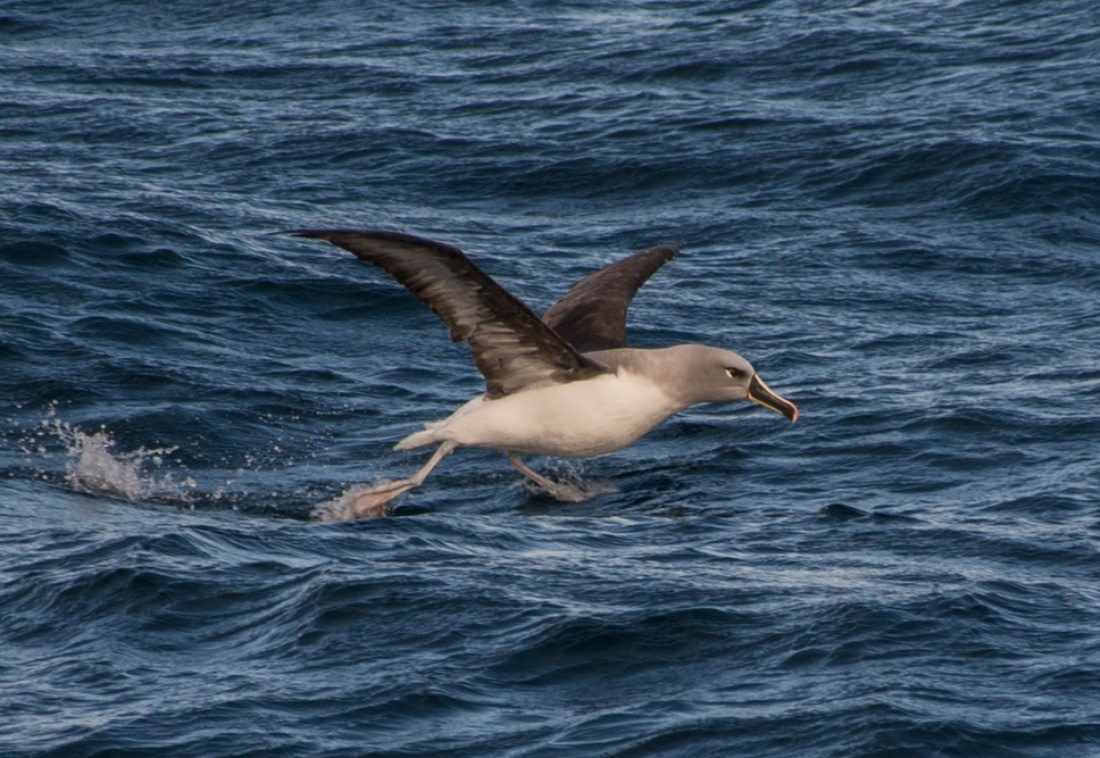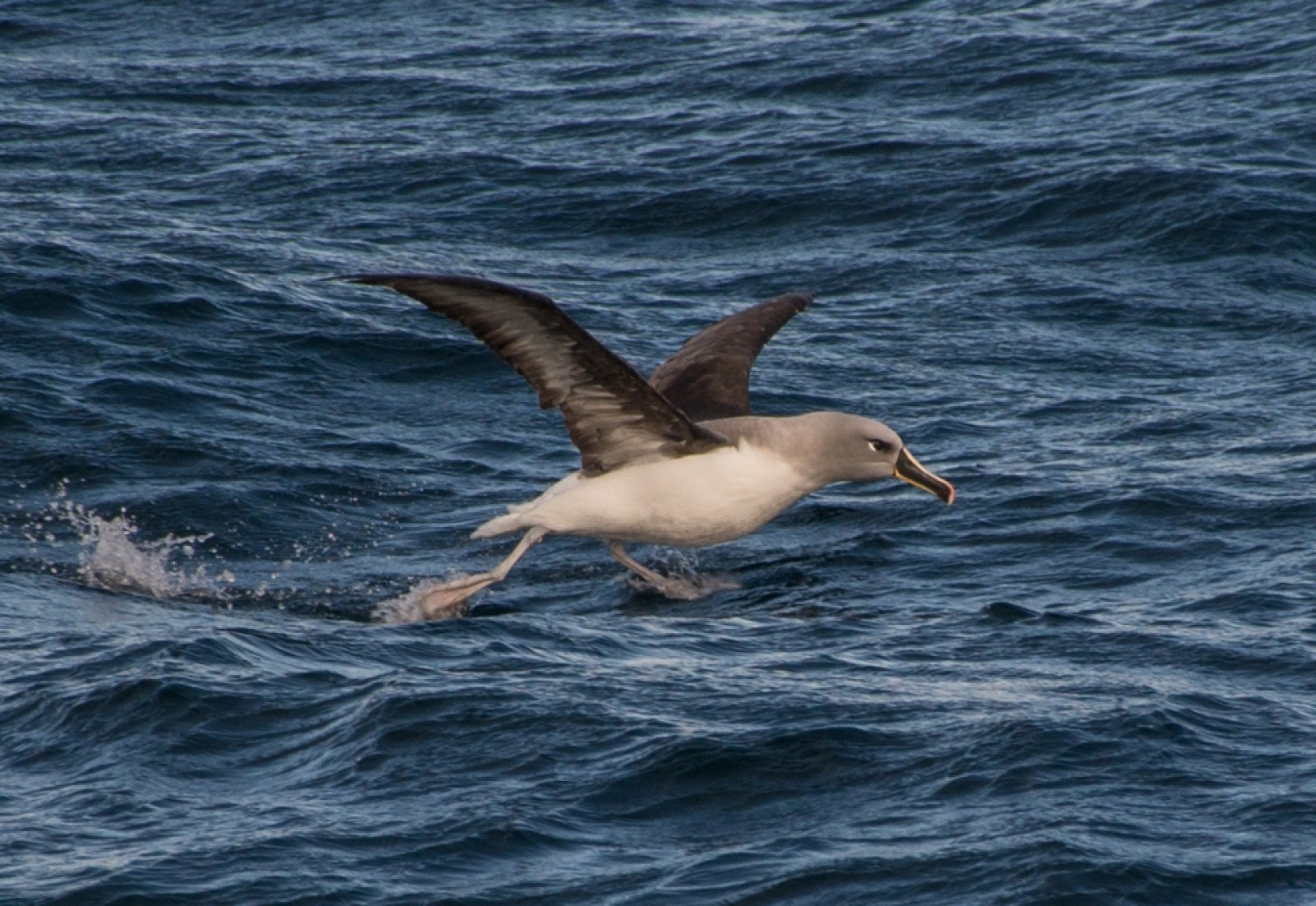
Name: Grey-headed Albatross, Grey-headed Mollymawk (Thalassarche chrysostoma)
Length: 80 cm.
Weight: 3 to 4.5 kg.
Location: Circumpolar across the southern oceans.
Conservation status: Endangered.
Diet: Squid, fish, crustaceans, carrion, cephalopods, lampreys.
Appearance: White body and chest. Light grey head, back, and tail feathers. Dark grey wings. White crest under the eye. Black bill with a golden outline along the top and bottom, hooking into a pinkish tip. White underwings with black forward edge.

How do Grey-headed Albatrosses feed?
Grey-headed Albatrosses generally feed in the open ocean (as opposed to over continental shelves). While they prefer to pluck food from just under the water’s surface they can also, on occasion, dive as deep as 7 metres.
They will fly long distances to feed, even during breeding season, sometimes making trips as long as 13,000 km.
Are Grey-headed Albatrosses social?
Grey-headed Albatrosses tend to be solitary while at sea.
How fast do Grey-headed Albatrosses fly?
Grey-headed Albatrosses can fly at speeds reaching up to 127 km per hour.

What are Grey-headed Albatross birthing rituals like?
Grey-headed Albatrosses create breeding colonies across the islands of the southern Oceans like South Georgia, Islas Diego Ramirez, Kerguelen Islands, and so on.
The cone-shaped nests are built on cliffs or steep slopes with grass and mud. A single egg is laid around the middle of October. The incubation period lasts about 70 days, the incubation duties mainly performed by the male. A successful breeding pair of adults will skip the next year’s season, returning the following year after that to breed again.
The chicks fledge about 41/2 months after hatching. They will become fully pelagic (live entirely at sea) for the first 6 or 7 years of their lives before finally returning to the breeding colonies. Even so, they may not actually breed for several more years after that.
How long do Grey-headed Albatrosses live?
Grey-headed Albatrosses live about 35 years.
How many Grey-headed Albatrosses are there today?
There are an estimated 250,000 Grey-headed Albatrosses in the world (2004 numbers).

Do Grey-headed Albatrosses have any natural predators?
Grey-headed Albatrosses don’t really have any natural predators due to the remoteness of their breeding grounds. The main threat to their numbers comes from food availability; in particular how far they have to fly to get food during the breeding season.
7 Great Grey-headed Albatross Facts
- Grey-headed Albatrosses nest further south than any other mollymawk.
- Chrysostoma comes from two Greek words khrusos meaning “gold” and stoma meaning “the mouth”, referring to the birds’ bills.
- Unlike most other types of Albatross, the Grey-headed Albatross tends not to follow fishing vessels.
- The Guinness World Records stated that the Grey-headed Albatross is likely the world’s fastest horizontal flyer.
- Albatrosses don’t have hind toes – they don’t need them since they live at sea.
- Albatrosses spend the majority of their lives in the air.
- A Grey-headed Albatross can circumnavigate the globe in just a little over a month.