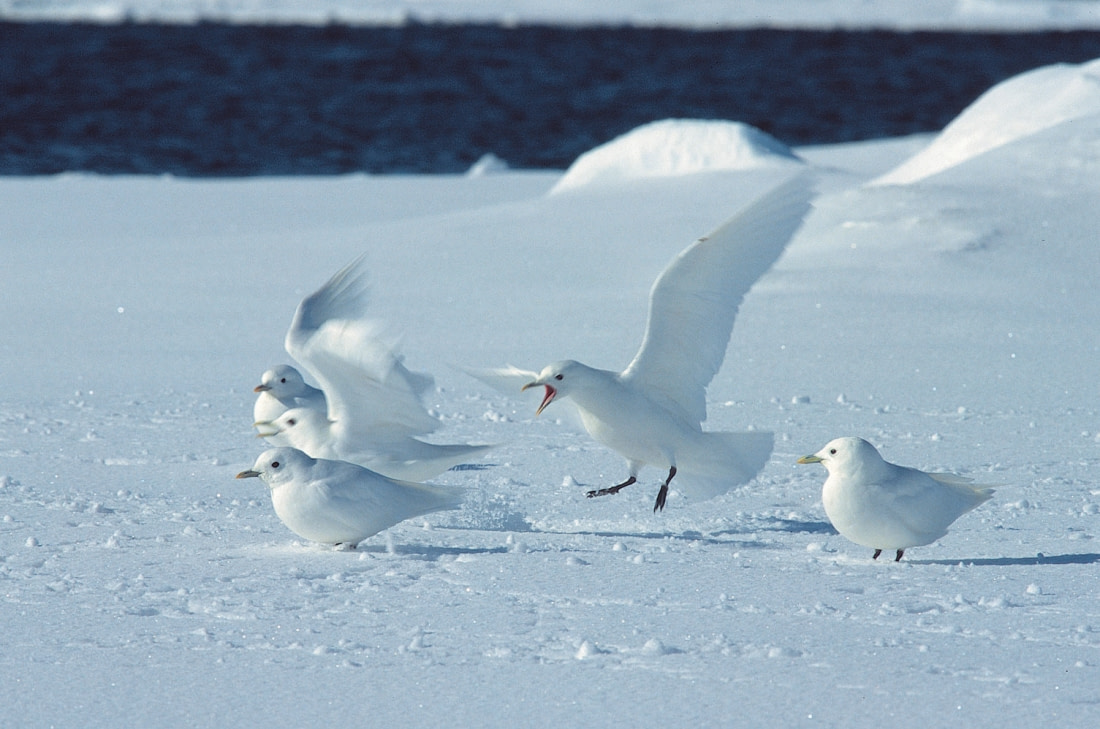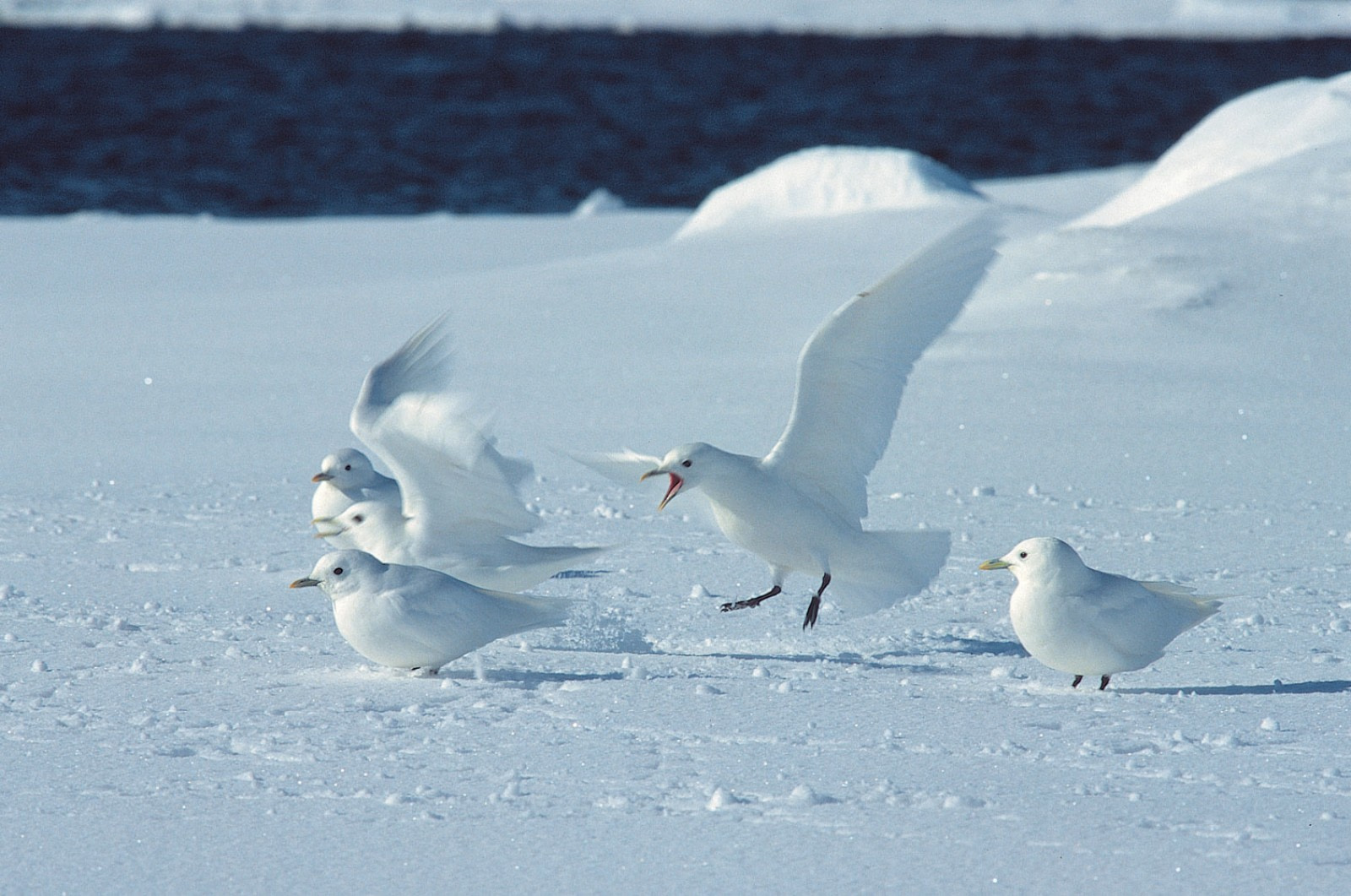
Name: Ivory Gull, Goéland Sénateur, Mouette Blanche, Gaviota Marfil (Pagophila eburnea).
Length: 40-45 centimetres.
Weight: 450-700 grams.
Location: The Arctic.
Conservation status: Near Threatened.
Diet: Crustaceans, rodents, fish, bird eggs and chicks, carrion.
Appearance: White. The bill is blue with a yellow tip. Black legs.
How do Ivory Gulls feed?
When hunting, Ivory Gulls will hover and then plunge down into the water to snatch fish. They are also scavengers and opportunistic feeders. They are known to follow Polar Bears in hopes of picking at the Bears’ kills. They will even eat the placentas and fecal matter of Seals and Polar Bears.

Are Ivory Gulls social?
Ivory Gulls tend to congregate in nesting colonies. The largest is believed to be in Russia, which hosts approximately 4,500 breeding pairs.
What are Ivory Gulls birthing rituals like?
Ivory Gulls breed between the end of June and August. They generally form colonies of anywhere from 5 to 60 breeding pairs. They create nests out a wide variety of materials – algae, down, driftwood, feathers, lichen, grass, mud, and seaweed. They locate their nests along gravel banks of smaller streams, on cliff edges, and stone ridges located near ice caps. The female will lay 1 to 3 brown or olive-coloured eggs in a single clutch. Incubation takes around 25 days with the parents taking turns staying with the eggs. The young chicks are mainly white with black spots across their bodies. These spots will be replaced with pure white plumage when they reach their second year.
How many Ivory Gulls are there today?
As of 2012 Birdlife International estimated the world population of Ivory Gulls to be anywhere between 19,000 and 27,000 birds. The regional breakdown goes:
- Russia – 2,500-10,000
- Severnaya Zemlya Archipelago – 4,000
- Franz Josef Land and Victoria Island – 8,000
- Greenland – 4,000
- Canada – 500-700

Do Ivory Gulls have any natural predators?
Ivory Gulls are prey to Polar Bears, other birds (their young and their eggs), and the Arctic Fox. The Gulls also have an ongoing disagreement with Moose which tend to eat the larger examples of their nests.
7 Interesting Ivory Gull Facts
- Pagophila means “Lover of sea ice” and Eburnea means “Ivory-coloured.”
- Ivory Gulls are pellet-casters, like some species of Owl. This means they create pellets of bones and furs of their prey (mainly lemmings in the case of the Gulls) and spit them back up.
- Ivory Gulls are amongst the species that live the furthest north of any species of bird on Earth.
- Ivory Gulls only move as far south as they need to in order to keep out of the near-complete darkness during the Arctic winters.
- Ivory Gull habits and populations are extremely difficult to study due to their remote locations and the fact that they are spread out across multiple countries.
- The Canadian population of Ivory Gulls is plummeting, by up to as much as 85% since the 1980s. Scientists aren’t sure if the Gulls are literally dying off or if they’re moving to other locations.
- Ivory Gulls have the highest concentration of PCBs and DDTs in their eggs of any birds in the world.