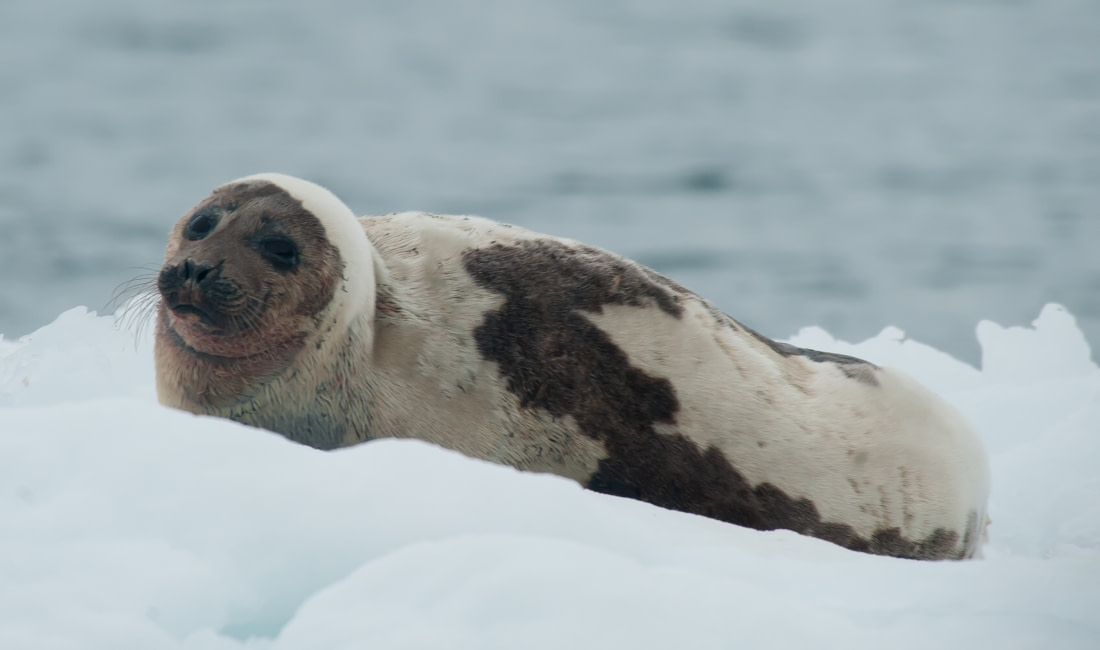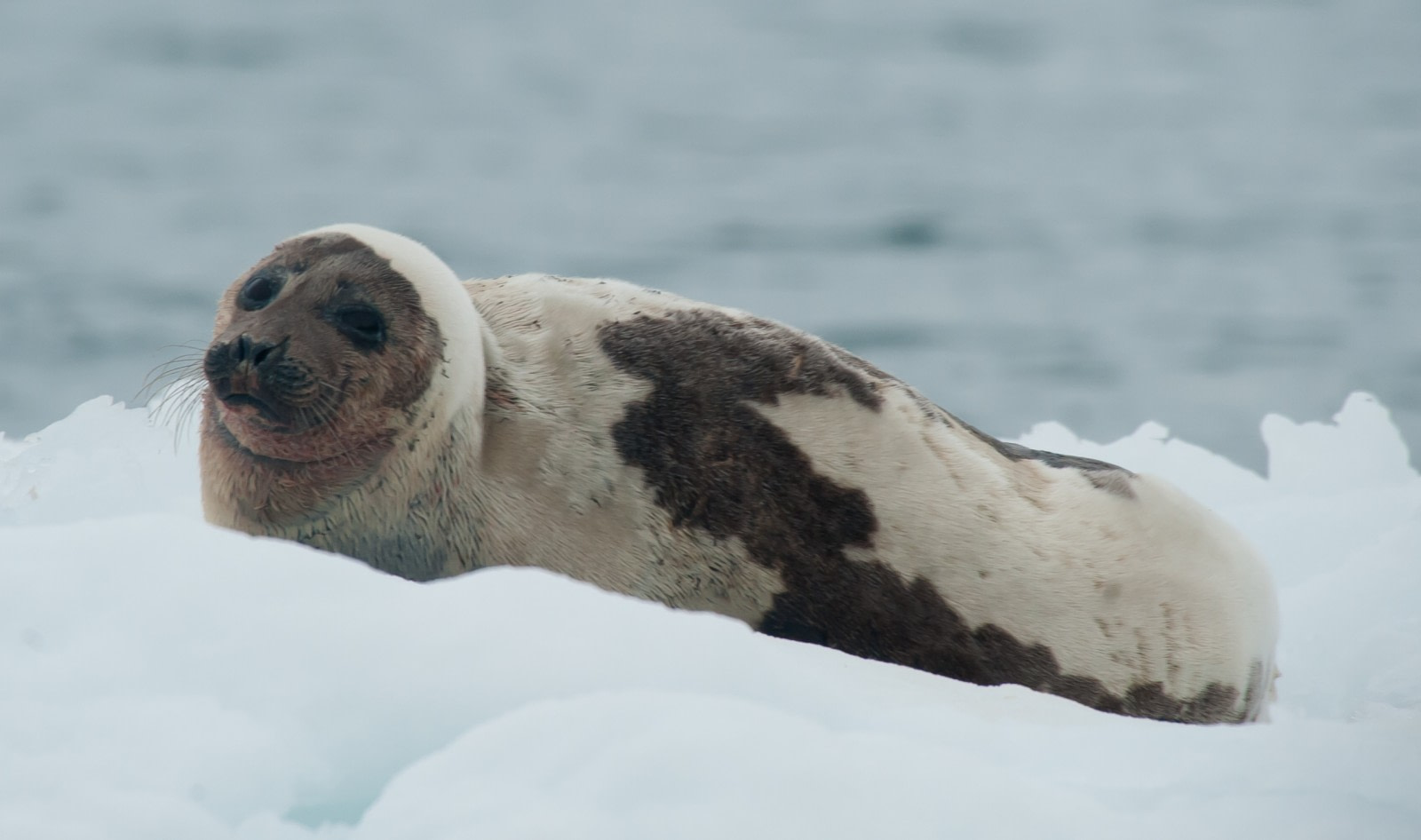
Name: Harp seal or saddleback seal (Pagophilus groenlandicus)
Length: 1.7-2 metres (5.5- 6.5 feet)
Weight: 120 to 150 kg (265-330 pounds)
Location: Arctic Ocean, Labrador Sea, Barents Sea
Conservation status: Least Concern
Diet: Fish and crustaceans
Appearance: Harp seals display variations in their appearance throughout their lifespan. When first born, they have a white, fluffy coat. In adolescence, they have a silver-gray coat spotted with black. Only in adulthood do they get their distinctive black harp (or wishbone-shaped) markings.
How do harp seals hunt?
Harp seals are extremely agile swimmers, able to catch a wide variety of fish and crustaceans. They can stay underwater for 15 minutes. A thick layer of blubber keeps them warm and serves as a source of nutrition when food resources are scarce. Harp seals have proportionally large eyes, giving them excellent vision. When underwater, their nostril slits close. They then use their vibrissae (whiskers), which are sensitive to touch and possibly even to vibrations from moving prey, to hunt. Harp seals are known to dive less frequently than other seal species. They also generally hunt in shallower waters.
Are harp seals social?
Harp seals are very social during mating season, forming large land-based colonies. They often travel and hunt in large pods made up of dozens or hundreds of other harp seals. They have a wide variety of calls, some for warning other seals off, others for attracting mates.

What are harp seal mating rituals like?
Harp seals migrate south in the winter. While males court females on land, the actual mating occurs in the water. Male harp seals fight for mating rights by biting and beating each other with their flippers. Dominant males will mate with several different females. The pregnancy lasts about 11 months, and pups are born around February. The pups are born with white fur, weigh about 11 kg (24 pounds), and are around 80 cm (31 inches) long.
The nursing period only lasts about 10 days, during which a nursing harp seal will not feed. The pups grow quickly, fattening up to nearly 40 kg (88 pounds). Harp seal mothers then abruptly leave to commence mating, leaving the pups behind. Pups become sedentary to conserve their fat stores, but they can lose up to half their body weight during this period. After seven or eight weeks of this, they learn to swim and hunt on their own.
Harp seal pups go through six distinct stages:
- “Yellow-jacket” – The pups’ white coats are stained yellow by placental fluids when they are born.
- “White-coat” – The iconic nursing stage, when pup coats lose their yellowish tinge, becoming completely white.
- “Ragged-jacket” – The harp seal pups start to molt, losing their white fur and revealing their adult silver-gray skin underneath.
- “Beater” – Now that they are completely silver-grey, pups start “beating” at the water with their front flippers in order to learn how to swim.
- “Bedlamer” – The young harp seals are now in the sea.
- Adult – Male harp seals reach maturity at about 7 years of age; females, about 5.
How long do harp seals live?
Harp Seals live about 25-35 years in the wild.

How many harp seals are there today?
Based on estimates from 2015, there are about 4,500,000 mature harp seals in the world.
Do harp seals have any predators?
Harp seals are prey for orcas, Greenland sharks, and polar bears.
Seven super harp seal facts
- Harp seals are sometimes called “saddlebacks” due to the saddle-shaped markings on their backs.
- Mother harp seals can identify their own young out of the thousands of other pups in a colony by their scent.
- Seals that wander away from the herd are referred to as vagrants.
- After being weaned, harp seal pup teeth will not grow if they do not feed.
- Harp seals only spend significant amounts of time on land during the mating and birthing season. The rest of their lives are spent in the water.
- The annual migration to and from the mating grounds can add up to 5000 km (3,100 miles) for harp seals.
- Their binomial name, Pagophilus groenlandicus, means “ice-lover from Greenland.”