• Página principal
  • Bitácoras de los viajes
  • OTL29a26, trip log, Remote Weddell Sea Explorer incl. South Georgia - South Sandwich Islands - Neuschwabenland - Larsen Ice Shelf - Paulet and Devil Island - Elephant Island, incl. helicopters

OTL29a26, trip log, Remote Weddell Sea Explorer incl. South Georgia - South Sandwich Islands - Neuschwabenland - Larsen Ice Shelf - Paulet and Devil Island - Elephant Island, incl. helicopters

by Oceanwide Expeditions

Galería de fotos

Bitácora

Day 1: Ushuaia. Embarkation Day

Ushuaia. Embarkation Day
Fecha: 22.01.2026
Posición: 42°44.8’S, 064°59.2‘W
Viento: SW3
Clima: Cloudy
Temperatura del Aire: +12

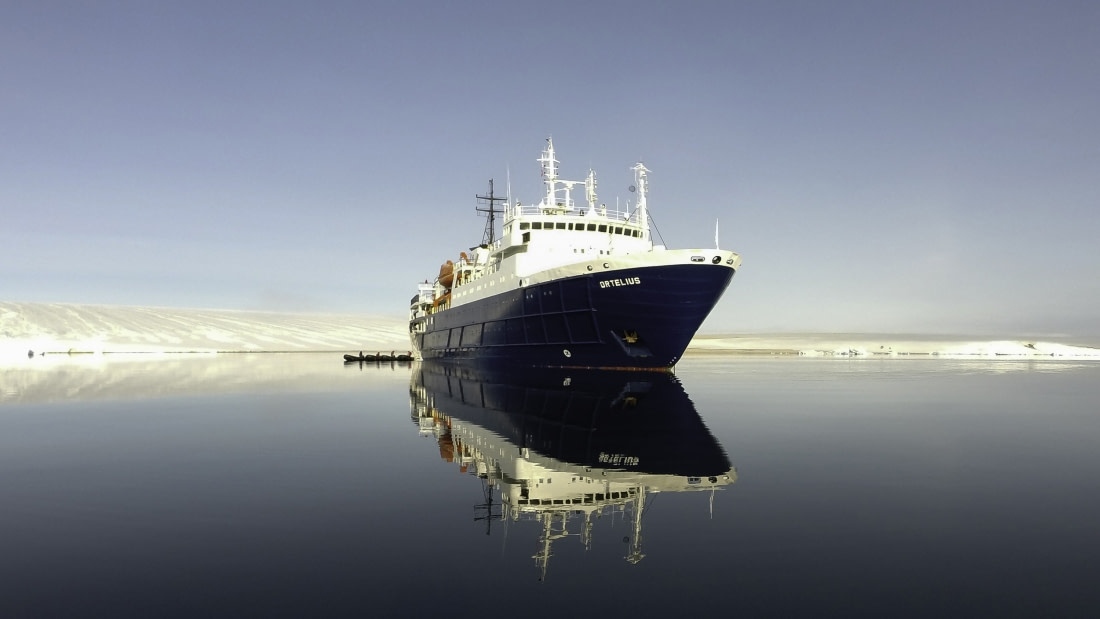
At around 2pm, after travelling from many different parts of the world over several days, we made our way along the pier in Ushuaia to find the Ortelius. Some of us had spent a few days in Argentina exploring Buenos Aires and Ushuaia, while others had arrived shortly before embarking. On the pier, we met some of the expedition team, and we looked up at the ship, our home for the next month.

Once we were shown to our cabins and had a chance to explore the ship. We were then invited to the lounge to watch the mandatory safety briefing. After this, we were informed that our three helicopters and the pilots and engineers from DAP Helicopters would be arriving soon from Ushuaia Airport. We watched from the top deck with excitement as all three helicopters arrived.

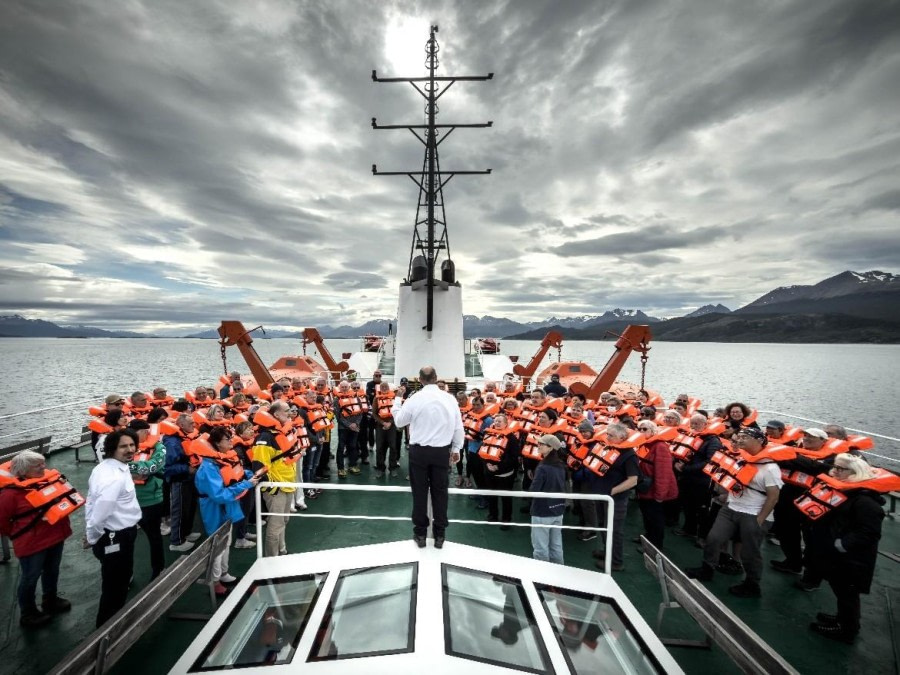
We then had an abandon ship drill so that we would know where to muster and where the lifeboats are in an emergency.

We enjoyed the views of the Beagle Channel, it was a beautiful evening, and we even saw some whales and dolphins. We gathered in the lounge before dinner to meet our Expedition Leader Chris. Chris informed us about what to expect from our long voyage and introduced us to the rest of the Expedition Team. We were also introduced to Hotel Manager Ingrid and Captain Remmert who toasted to our voyage together. We went to the dining room where we met the restaurant team and enjoyed a buffet dinner before relaxing in the bar, unpacking our cabins, or heading straight to bed after a busy day.

Day 2: Sea Day, sailing towards South Georgia

Sea Day, sailing towards South Georgia
Fecha: 23.01.2026
Posición: 54°41.1’S, 061°48.7‘W
Viento: VAR 1/2
Clima: Overcast
Temperatura del Aire: +8

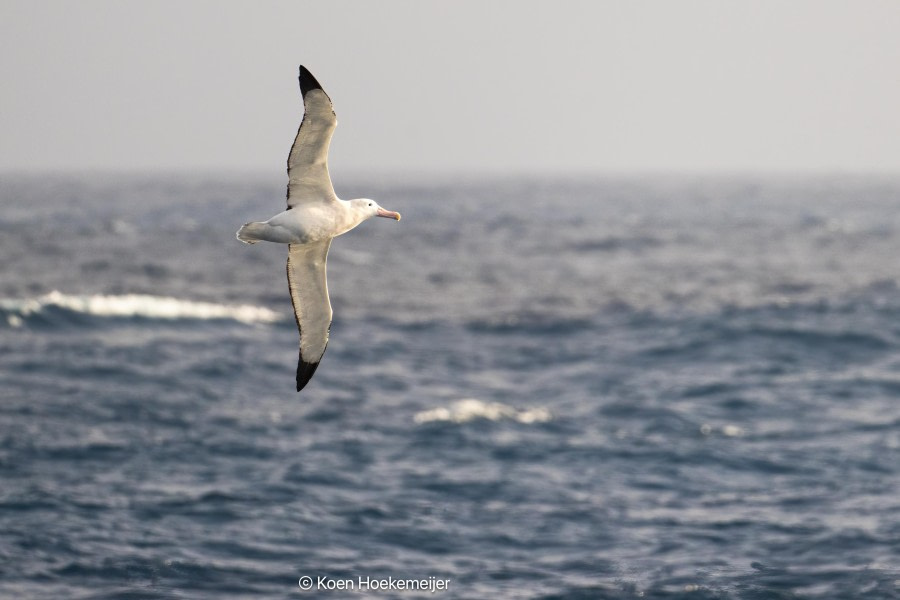
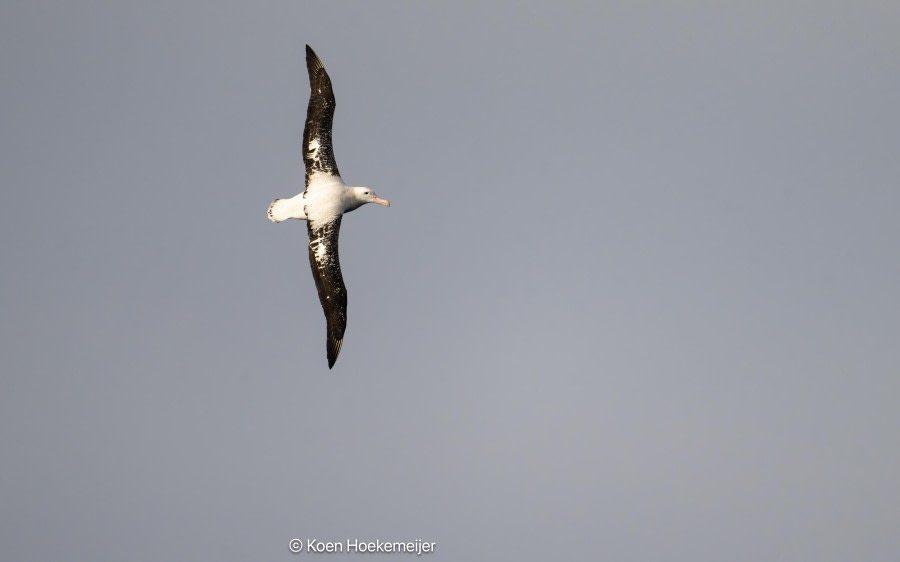
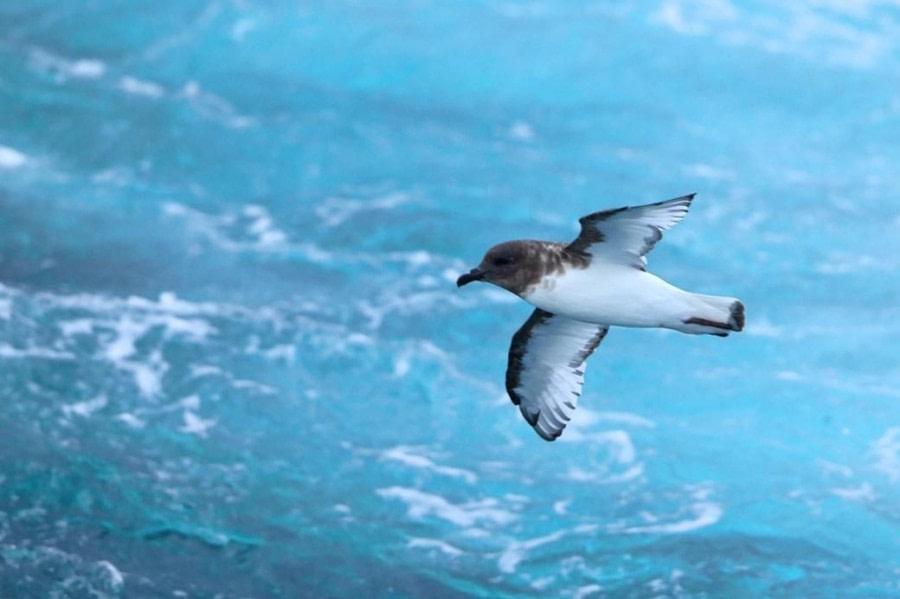
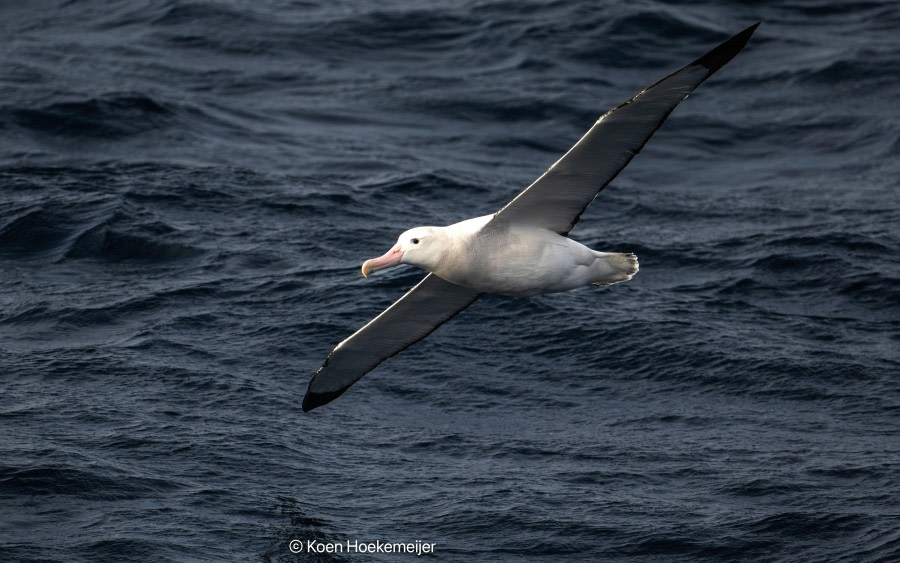
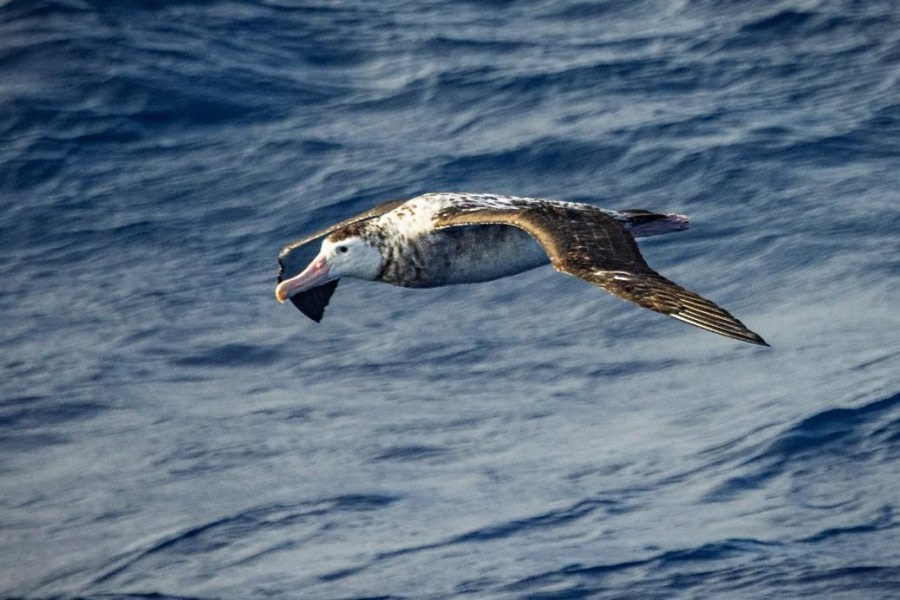
This morning, we woke up very excited to experience the first full day of our expedition on Ortelius. The bird watchers among us were up early to see many wonderful seabird species such as the Southern royal albatross, the giant petrel, the Wilson’s storm petrel, and the amazing wandering albatross with the biggest wingspan of any seabird.

Not long after breakfast we were invited for what would be the first of many lectures on this journey. Today Jess told us about the species of Cetaceans (whales, dolphins, and porpoises) that we have the possibility of seeing on this trip and gave us some hints and tips on how to spot them.

We spent a lot of time outside or on the bridge enjoying the seascape and the birds and the remarkably calm weather. In the afternoon Koen gave us a talk which included ten tips to improve your wildlife photography skills. We were amazed to see some of his beautiful photographs from Antarctica, and it got us very excited about the animals we might encounter on this trip.

Before dinner we gathered for the first of our daily recaps. Chris told us about the plan for tomorrow and Jess demonstrated how the lengths of the wingspans were of the different seabirds we had seen during the day. Bill then talked to us about ‘Looking Seeing and Thinking’ and advised us on how best to enjoy our visit to Antarctica.

We gathered in the dining room for a lovely plated dinner before heading to the lounge to chat, play games, and look through our photos of the day. 

Day 3: At Sea, sailing towards South Georgia

At Sea, sailing towards South Georgia
Fecha: 24.01.2026
Posición: 53°34.5’S, 053°01.9‘W
Viento: NW6 3
Clima: Overcast
Temperatura del Aire: +7,3

Time to wake up…not just from an excellent night’s sleep but waking up to a gentle rocking reality…we have at long last really started the dreamed about voyage. Motored out of the security of the port of Ushuaia into the Beagle and the next morning now on the high seas bound for weeks of exciting icy adventures first in South Georgia, next Sandwich Islands, then Antarctica before heading north again and home to extol to everyone the virtues of the Oceanwide Polar Product.

A superb breakfast was followed by the first activity at 9.15…a mandatory IAATO lecture and video delivered by our Oceanwide Expeditions leader Chris. This was followed by the Zodiac briefing and an explanation of the different lifejackets used for cruising and landings. Plus, a description of the boats and film of the correct method of getting in and out at landings.

Next the South Georgia visitor briefing was an interesting and excellent introduction to the environmental issues on the island and the strict controls to ensure compliance. The very successful public funded rat eradication scheme had ensured that the island was now free of rats and in the following years this had resulted in a noticeable rise in the ground nesting bird population. General fundraising continues with the emphasis on restoration of the building and habitat.

At 11.30 we descended to deck 3 “lecture theatre where, after much playing around with different thick socks and trying out various sizes of footwear, we were issued with our black neoprene rubber muck-boots. These extremely comfortable high-quality items of footwear are considered essential footwear for polar adventure activities. Throughout the day our binocular-festooned bird enthusiasts scanned the skies and recorded ever sighting…there was much excitement and camera clicking on the bridge when they spotted Wandering Albatross, Southern Royal, Sooty Shearwater, Antarctic Prion and a Soft Plumaged Petrel.

At 2 pm we had the mandatory South Georgia pre-landing fun session in the lounge. It was like a “find a seed or alien species in your garments boots and kit competition’. Various vacuum cleaners borrowed from the hotel department were deployed by guides in the lounge and the machines noisily sucked every seam and sand-laden pocket and seed-covered velcro straps on the equipment before being carefully inspected and signed off by our eagle-eyed Expedition Leader. At the regular recap session before the evening meal, Chris give us an outline of the next day activities and lecture programme and 24 hour weather forecast for this area. So ended another Oceanwide Expedition day…the excitement was mounting!

Day 4: At Sea, sailing towards South Georgia

At Sea, sailing towards South Georgia
Fecha: 25.01.2026
Posición: 52°17.6’S, 044°27.2‘W
Viento: NW 5/6
Clima: Fog
Temperatura del Aire: +6,9

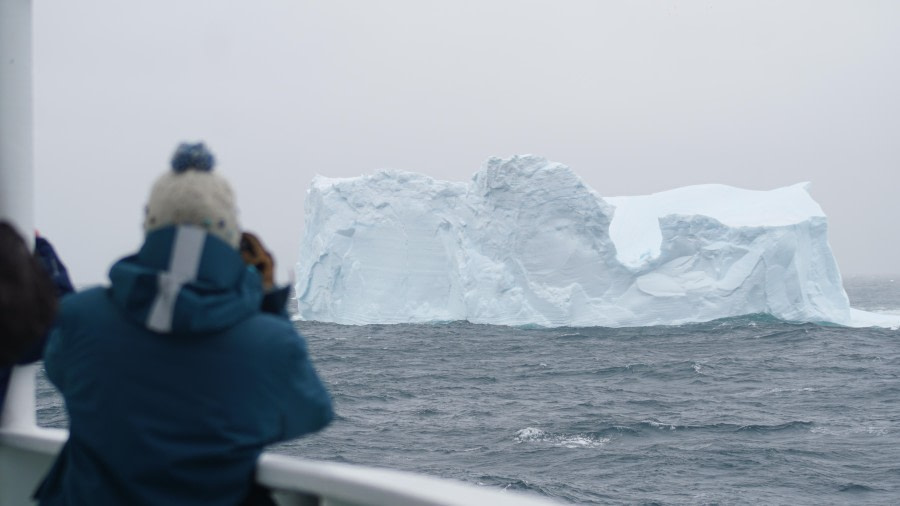
The day began with an atmospheric, mystical morning. Thick fog surrounded us as we sailed along the Antarctic Convergence, making our way toward the South Georgia Maritime Zone and the legendary A23a iceberg.

Shortly after breakfast, Bill invited us to the bar for a lecture on the history of whaling—an intense and detailed deep dive into the gritty realities of the whaling era. Outside, the day remained calm, with only a few species of birds gliding through the fog.

After lunch, Chloe welcomed us back to the bar for her lecture Penguins: Flightless Wonders. The talk sparked real excitement among the guests—soon it would be the first encounter with these remarkable birds for many, and a much-anticipated reunion for others.

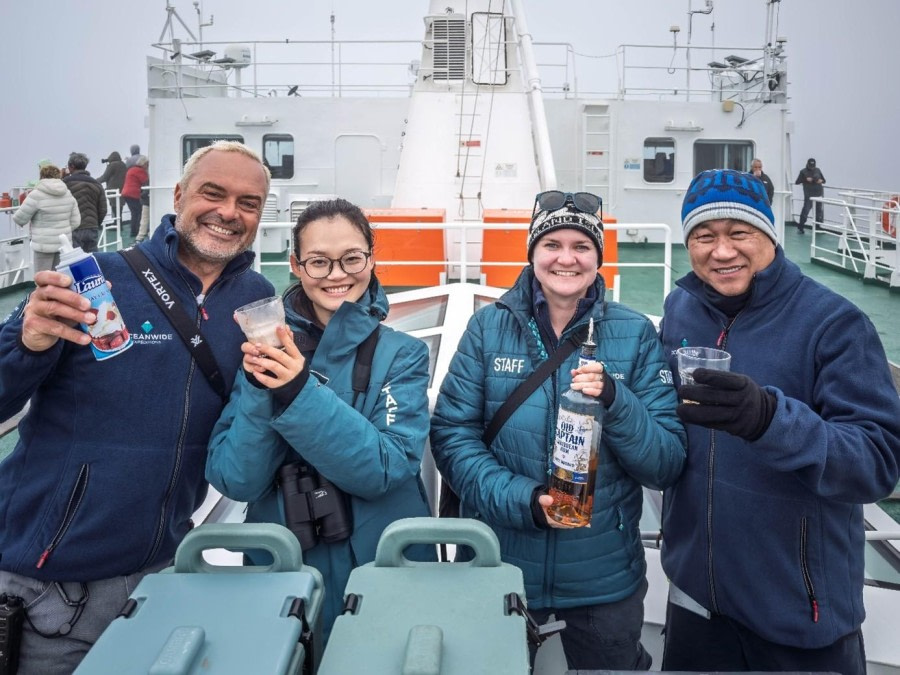
Later, Chris announced that A23a lay just six nautical miles ahead, though it was still hidden from view. While we searched for the largest floating object on Earth, the hotel staff and expedition team kept us warm with hot chocolate (with a kick) topped with whipped cream. Soon, we began to hear thunderous sounds as waves crashed against the iceberg, and the ship started to roll gently from the backwash.

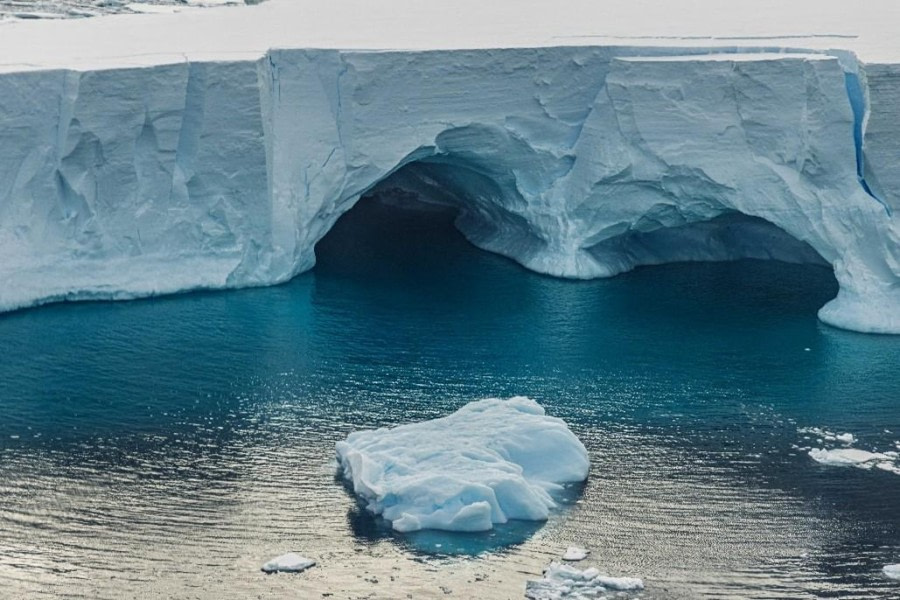
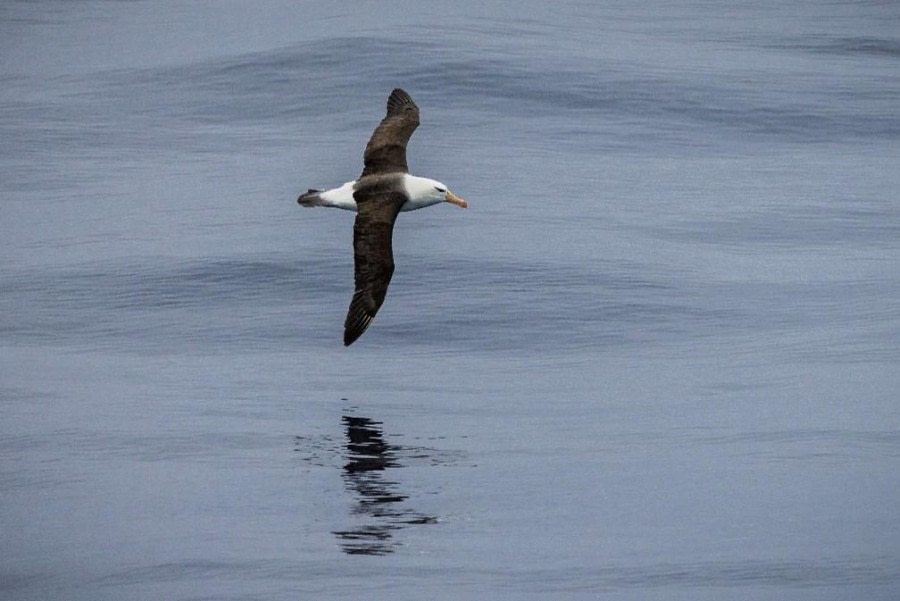
Then, a sliver of fog lifted. The colossal iceberg appeared on our port side—an extraordinary sight. The remaining fog only added to the drama. Black-browed albatrosses, grey-headed albatrosses, prions, and petrels filled the air, flying between us and A23a. Just before we altered course, the fog thinned even more, revealing several ice caves carved into its face.

A beautiful, mysterious afternoon spent sailing among one of nature’s true marvels.

The day ended with recap and briefing in the bar, where Chris outlined the plans for our first day in South Georgia, followed by a delicious plated dinner. Three sea days behind us—and we are finally ready to explore South Georgia.

Day 5: Elsehul and Right Whale Bay

Elsehul and Right Whale Bay
Fecha: 26.01.2026
Posición: 54°00.8’S, 037°58.5‘W
Viento: NNE4
Clima: Fog
Temperatura del Aire: +7,6

The word ’excited’ was an understatement as we got up in the morning to approach South Georgia, the first land we had seen for three days. The very thick fog meant that we couldn’t actually see the land until we were right next to it. We arrive at our morning destination just before breakfast. Through the mist we could just about make out the rocky shoreline and occasionally we could see Antarctic fur seals leaping from the water.

We started to embark onto the zodiacs, driven by the expedition team. We were both excited and lightly nervous as for some of us it was the first time travelling in power boats like this. We set off blindly into the mist in the direction of the shore. Almost straight away we were amazed to find a nest colony of Macaroni penguins. Their nest site was high up on the cliff surrounded by tussock grass, but many of the macaronis were at the water’s edge jumping in and out of the surf. Their yellow crests really stood out and we had fantastic views of them.

We followed the coast where we found many king penguins, the second largest penguin species. A lot of them were moulting, making them look fluffy and comical. We found some groups of gentoo penguins too and some of the boats spotted the South Georgia pipit, the only songbird we could see on our voyage and one that is endemic to South Georgia. There were lots of seals occupying the beaches and the rocks. We could see the Antarctic fur seals playing in the shallows and the much larger Southern elephant seals resting and moulting.

It was a very misty, rainy, and windy cruise. We headed back to the ship to get warmed up and have some lunch.

In the afternoon, we arrived at Right Whale Bay. The fog was even thicker than it was in the morning, and we left the ship without being able to see the shore. The beach suddenly appeared out of the mist, and we landed at a spot that was covered with life. There were fur seals and king penguins everywhere. We slowly walked along the beach, soaking up the sites and sounds of our first landing.

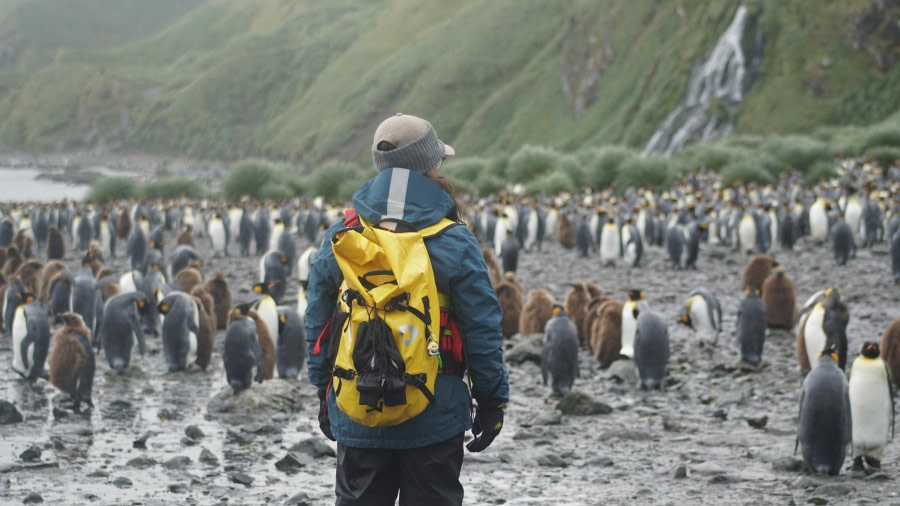
We came to a little hill covered in tussock grass. When we reached the top, we were speechless, as we came face to face with thousands of king penguins. We looked down over a huge colony which included beautiful adults with vibrant yellow patches on their heads, and adorable brown chicks that were rotund and fluffy. We spent hours admiring the penguins, watching how they interacted with each other, laughing at the humorous way they walked like people, and trying to capture their beauty through our cameras to share it with friends at home.

We could see skuas and giant petrels flying over the colony, looking for scraps or perhaps some easy prey. There were a lot of seal carcasses on the beach from both adults and pups, a sign of the bird flu which is still very much present in South Georgia.

The fog opened up a little during the afternoon but towards the end of the landing it closed in on us again. We returned to the ship so delighted to have done a full day of activities in South Georgia. The mist made for atmospheric photos and our first experience of a penguin colony was magical.

Day 6: Fortuna Bay and Godthul

Fortuna Bay and Godthul
Fecha: 27.01.2026
Posición: 54°08.8’S, 036°48.5‘W
Viento: N5
Clima: Overcast
Temperatura del Aire: +6,9

We awoke to a beautiful sight of Fortuna Bay, the destination for our morning activities. The wind was fairly strong already, but that didn’t stop us from getting into the zodiacs and arriving on the shores of where the famous Sir Ernest Shackleton once stood. This shoreline of South Georgia was part of the route Shackleton and his men traversed through to eventually reach Stromness whaling station, where they finally sought help and refuge. It was an incredible feeling to trace some of the footsteps of the Boss himself.

Fortuna Bay wasn’t just teeming with history, but wildlife too. We were greeted by numerous Antarctic fur seal pups, playing in the crashing waves as we clumsily got out of the zodiac. Keeping a five-meter distance was extremely hard as these curious pups just wanted to investigate us! Most of these little dark brown fur seal pups were about 1- 2 months old, where they were born between mid-November and late December.

They suckle high fat milk from their mums for their first week of life and then are left ashore for the next four months, where their mums will alternate between foraging and nursing. We could hear the goat-like cries of the pups answered by the haunting calls of the mums, sometimes separated by hundreds of metres of ground to cover to find each other again. We witnessed numerous mum and pup pairs nursing which was just too sweet! By the end of April, these pups will be fully weaned and no longer attended by their mums and will be ready to start foraging by themselves. Some of the juvenile fur seals from previous seasons were a little feisty and we had to remain vigilant from ones sneaking up behind us! They may be small, but their teeth are riddled with bacteria that would cause a very nasty infection if it pierced through our clothing. But for most of the time, these cheeky seals were just trying to act tough and backed away when we showed them who was boss.

The seals weren’t the only stars of the show. Numerous king penguins riddled the shoreline, some returning from their foraging trips, others departing, and others standing sullenly as they endured their catastrophic moult of last season’s plumage. The number of king penguins increased at the end of our walking route, which was the location of their breeding colony. Approximately 5,000 pairs of king penguins call Fortuna Bay home, and due to the penguin’s long breeding cycle, the colony here is always occupied with both adults and chicks. We got to witness some of these gorgeous brown fluffy chicks (that almost resembled a kiwi fruit!) and hearing their high-pitched calls was just adorable. We even got a glimpse of some bulges in the adult penguin’s brood patches above their feet, which were carefully containing individual eggs soon ready to hatch.

Upon walking back towards the landing site, we heard a few crackling noises coming from a nearby iceberg that had grounded near the shoreline of the bay. And sure enough, those cracks gave way to a huge calving! A large chunk of the iceberg came crashing down into the water, creating a ginormous splash and subsequent wave heading straight for the shore. Luckily our Ortelius and zodiacs were far enough way, but we spotted many king penguins and fur seals scrambling up the beach to escape the waves’ wash. It was surreal to see!

Back on board during our transit to our next location, the weather changed dramatically. With over 50 knots of wind, the outside decks soon closed, and the sea was dotted with white caps. After hearing all about the Beaufort scale with Gez a few days ago, we really started to understand how quickly the sea state can change. Despite the blistering wind and wave action, we spotted multiple humpback whales, porpoising fur seals, and giant petrels soaring around the ship. We couldn’t believe how many whales there were! One after the other was spotted in almost every crest and trough in the distance. Unfortunately, due to this weather, our Plan A for a landing at St. Andrews Bay was cancelled as it would have been impossible to safely operate zodiacs. As we tried for Plan B, a landing or zodiac cruise at Ocean Harbour, the conditions persisted and the next plan had to be made.

Finally, we found a sheltered bay out of the elements, and we came to Plan C! The afternoon gave us a landing at Godthul, a small, protected bay with steep tussac-covered cliffs that would allow us to stretch our legs and climb up to a viewpoint of a scenic lake. The sun was shining and we were delighted! Plan C wasn’t too much of a consolation prize at all! The keen climbers braved the fur seal- riddled tussac and made it to the top of the mountain and were greeted with incredible views looking down at Ortelius in the bay below. The keen wildlife lovers who remained on the beach got to witness a leucistic (lacking pigment) gentoo penguin, and the endemic South Georgia pipit and South Georgia pintail. All in all, it was a fantastic afternoon!

We were then treated to more humpback whale sightings back on board and enjoyed another scrumptious dinner by the hotel team. Another day in paradise waited!
Day 7: Grytviken

Grytviken
Fecha: 28.01.2026
Posición: 54°17.7’S, 036°28.8‘W
Viento: N4
Clima: Overcast
Temperatura del Aire: +3,7

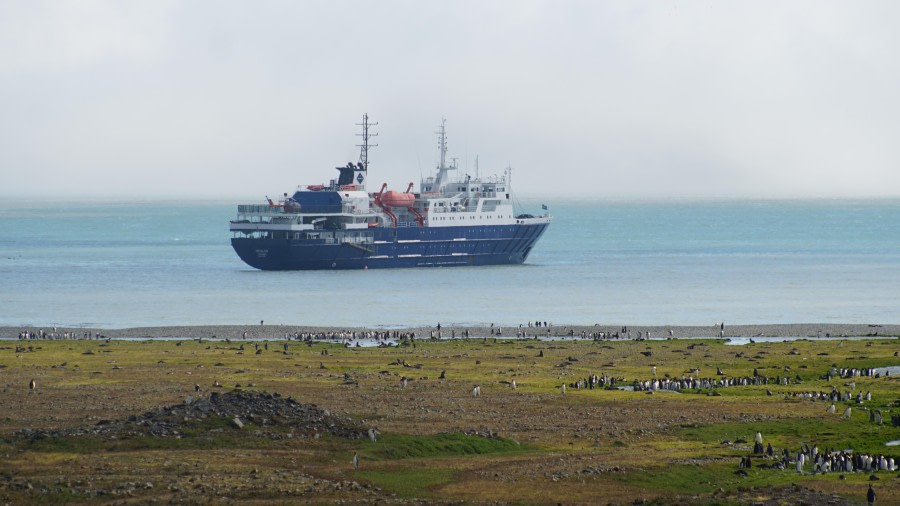
We woke up with Ortelius calmly anchored in Cumberland East Bay, our destination for the day was the “city” of Grytviken—the only settlement in South Georgia. The morning was calm, and the sounds of fur seals echoed off the mountain cliffs as they carpeted the beaches of Grytviken.

During breakfast, the team picked up the government officer at King Edward Point, where the base is located, along with two staff from the museum. They boarded the ship to conduct a thorough inspection for any foreign species we might potentially carry onto the island. An introduction to the work of the South Georgia Heritage Trust was later presented in the bar by the museum staff Rachel and Emily. We were very pleased to learn that all our hard work cleaning our gear and the ship had paid off: we received a 100% score and were cleared to go ashore.

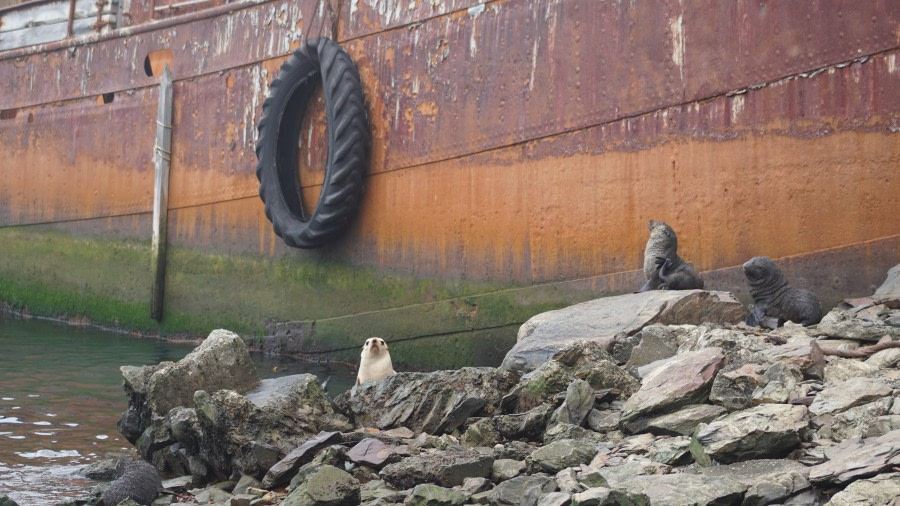
We began the morning at the museum and post office, where many gifts were bought and postcards sent. Walking tours were hosted by the local staff, introducing us to the whaling station and its operations from back in the day. Tucked away at the back stood a beautiful little church. From there, we took a short walk along the coast, passing many young and curious fur seals, eventually reaching the graveyard where Sir Ernest Shackleton is laid to rest. Steven gave a memorial speech, followed by a toast with Shackleton whisky.

Upon returning to the ship, lunch awaited us—prepared by the hotel team on Deck 7 out on the open deck. A delicious soup and sandwiches, followed by mouth-watering brownies, accompanied our slow sail away from South Georgia.

Later, Chloe invited us all to the bar for a lecture about seals. We now know everything about these curious little nibblers we’ve encountered over the past three days. As we set course for the South Sandwich Islands, we encountered a large pod of seals and numerous humpback whales feeding in the shallow waters around South Georgia—a spectacular farewell to a truly majestic island.

Day 8: At sea, Zavodovski Island

At sea, Zavodovski Island
Fecha: 29.01.2026
Posición: 55°35.4’S, 030°25.6‘W
Viento: WSW8
Clima: Overcast
Temperatura del Aire: +3,2

Life on board Ortelius had settled into a familiar and comforting rhythm. Meals, lectures, and quiet observation flowed seamlessly into one another, and by this day many of us found ourselves drawn to the bridge, gazing out over the Southern Ocean. For many, it was a time of reflection, particularly after the deeply moving visit to Grytviken the day before. Standing where the great explorers once stood and paying respects to Ernest Shackleton left a lasting impression that carried into the following day.

Our daylight hours were enriched by a series of engaging lectures. Steve spoke about Shackleton’s early life, his relentless ambition, and the experiences that shaped him during the Heroic Age of Antarctic exploration. We learned of his marriage to Emily Dorman, whose steady presence supported a man constantly drawn toward risk and discovery. Shackleton’s expeditions were marked by extraordinary challenges, and while many failed to achieve their original objectives, his ability to bring his men home against overwhelming odds cemented his legacy. It is this human-centered approach to leadership—placing the welfare of his crew above all else—that has led Shackleton to be widely regarded as one of the greatest leaders in exploration history.

Later in the day, Allan delivered a compelling lecture on the South Sandwich Islands. Discovered in the late eighteenth and early nineteenth centuries, this remote arc of islands was formed by powerful tectonic forces beneath the ocean. Allan also outlined the complex political history between Britain and Argentina, including Operation Matchstick in the 1970s, when British forces destroyed an Argentine scientific base on Thule Island, reaffirming British control in the region. Even in such isolation, human history has left a distinct footprint.

At approximately 6:00 p.m. local time, Ortelius passed south of Zavodovski Island. Conditions outside were severe: 4.2-metre waves, winds gusting to 35 knots (around 40 mph), an air temperature of just 1°C, and a wind chill of roughly –16°C. Guests braving the elements on Deck 6 experienced their first true taste of the Antarctic environment in all its raw intensity.

Mount Curry, the island’s dominant peak, rose steeply from the sea but remained shrouded in cloud. This active stratovolcano, reaching 551 meters, releases sulfurous gases from fumaroles near its summit and is one of the reasons Zavodovski is often referred to as the “world’s smelliest island.” The reputation is well deserved, and as we passed to the south, the pungent smell of penguin guano was unmistakable.

Zavodovski Island is home to an estimated 1.3 million breeding pairs of chinstrap penguins, the largest chinstrap colony anywhere on Earth. Combined with volcanic heat that keeps parts of the island free of snow, the island supports an astonishing concentration of wildlife, providing a powerful conclusion to a day defined by reflection, learning, and the untamed nature of the Antarctic.

Day 9: Saunders Island, Thule and Cook Islands

Saunders Island, Thule and Cook Islands
Fecha: 30.01.2026
Posición: 58°37.3’S, 026°40.0‘W
Viento: WNW5
Clima: Overcast
Temperatura del Aire: -0,5

We woke at 4:00 a.m., long before dawn, to be on the bridge as we passed Saunders Island and sailed straight into Cordelia Bay in the remote South Sandwich Island chain. The early hour only highlighted the guests’ commitment—sleepy eyes, thermoses clutched tight, and an unmistakable sense of anticipation as everyone chose discovery over comfort. Visibility was good on the water, though the dramatic volcanic peaks remained veiled in fog, hinting at the raw power of this place. Saunders Island itself is a restless world: an active stratovolcano crowned by Mount Michael, one of the few volcanoes on Earth known to host a persistent lava-lake. Uninhabited and rarely visited, it sits isolated in the Southern Ocean, shaped by fire, ice, and relentless weather.

The morning lecture onboard was delivered by Gez, our guide from Wales, who unraveled the forces behind the volatile conditions we were experiencing. He explained how global weather systems are driven by convection, with warm air rising and cooler air sinking, setting the atmosphere in motion. He also described the Coriolis effect, which deflects moving air due to Earth’s rotation and gives storms their spiraling structure, and katabatic winds—cold, dense air accelerating downslope under gravity, a defining feature of polar environments. With this insight, the changing conditions outside took on new meaning.

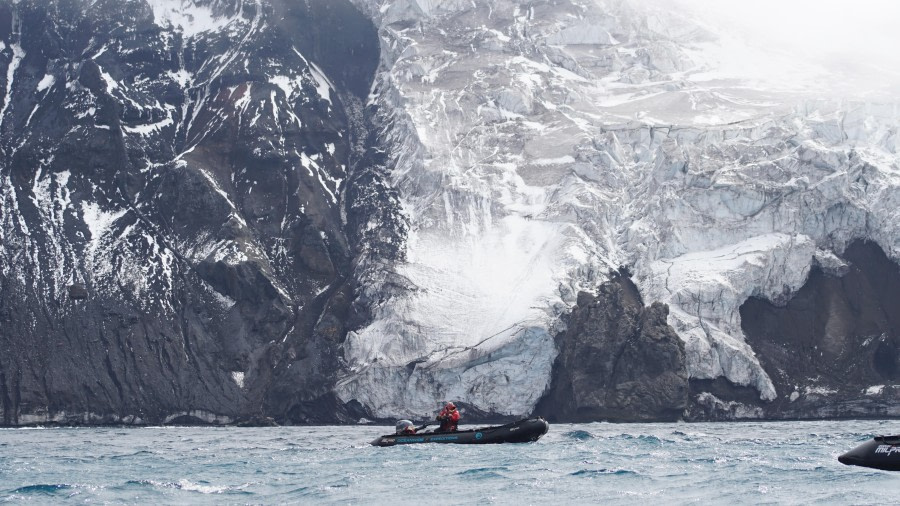
In the afternoon, a miraculous weather window opened as we entered the flooded volcanic caldera between Thule and Cook Islands. This dramatic location was once home to the Argentine scientific base Corbeta Uruguay. Guests may remember Operation Matchstick, the British operation in 1982 that reasserted control of the area, after which the base was destroyed. From the zodiacs, the remains of the station were clearly visible, a stark reminder of human presence in this harsh landscape. Wildlife thrived here too, with chinstrap penguins lining the shores and fur seals hauled out among the rocks, completely at ease in their elemental world.

As the zodiac cruise came to an end, Ortelius lay in the center of the caldera, exposed and away from the shelter of the mountains of Thule Island. The ship’s growing list told us that conditions were worsening. After 2.5 hours on the water, the weather window abruptly closed. Visibility dropped to just a few hundred meters as we climbed back onboard, and the mountains that had encircled us only moments before vanished into thick, rolling clouds. This was only the second zodiac cruise ever conducted at this remarkable location.

The afternoon recaps included Aitana, who spoke about weather forecasting. Having worked for a leading meteorological company, her talk was very insightful. She explained how satellite images, weather stations, ocean buoys, and weather balloons are all used to input data into mathematical weather models.

Jess also gave an insightful and visual talk on the size of various marine mammals. Comically, it became apparent that we would not be able to fit a blue whale into the ship’s lounge. Her modelling of the Blue Whale took her outside and onto the ship’s deck, she was forced to talk to us through the window which made everyone laugh.

That evening, we crossed 60° south latitude, the internationally recognized boundary that defines the beginning of Antarctica. With hearts full of wonder and an appetite for adventure growing stronger by the day, we turned southward once more, pressing on toward the sheet ice and the promise of what lay ahead.

Day 10: At sea, sailing towards Antarctica

At sea, sailing towards Antarctica
Fecha: 31.01.2026
Posición: 62°29.4’S, 024°10.3‘W
Viento: SW6/7
Clima: Overcast
Temperatura del Aire: -0,1

We continued our navigation south from the South Sandwich Islands toward Antarctica under favorable sea conditions. The ocean remained calm throughout the day, with a gentle rolling motion that provided a comfortable rhythm on board.

In the morning, guests attended the helicopter safety briefing, an important step in preparation for upcoming operations. Safety procedures, flight protocols, and expectations were clearly explained, and helicopter flight numbers were assigned. Excitement was high across the ship as anticipation built for the days ahead.

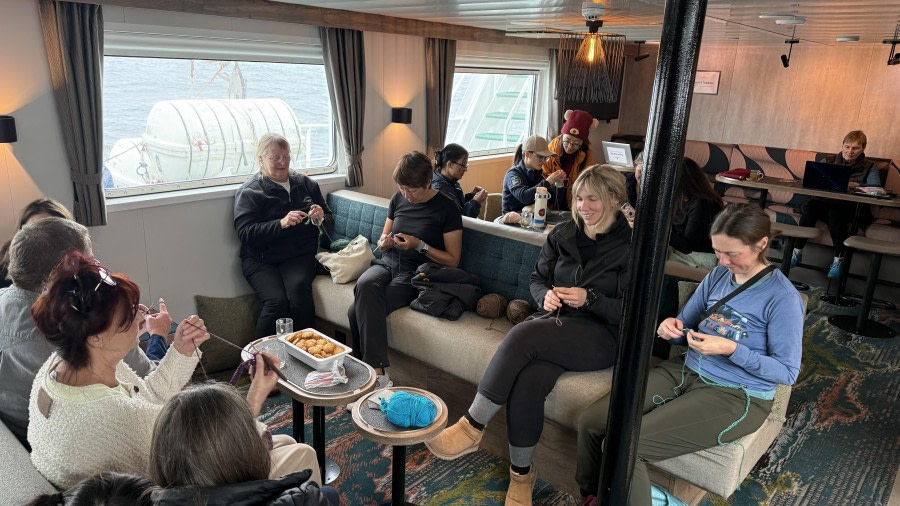
The afternoon took on a relaxed and social tone. During Crafternoon, Chloe and Aitana hosted a crochet session, offering guests the chance to learn a new skill and unwind together. The galley complemented the activity by preparing a selection of freshly baked cookies, enjoyed by all.

Later in the afternoon, Werner led an informative session on smartphone photography, sharing practical tips to help guests improve their images and make the most of their phones when documenting the expedition.

The day concluded with the daily recap and briefing, followed by dinner. In the evening, guests gathered to watch the documentary Ring of Fire, which explores the discovery of a lava lake on Saunders Island in the South Sandwich Islands, a fascinating insight into one of the most remote and geologically active regions on Earth. A calm and productive day at sea, marked by learning, sharing moments, and growing anticipation as we continue our journey toward Antarctica.

Day 11: At sea, sailing towards Antarctica

At sea, sailing towards Antarctica
Fecha: 01.02.2026
Posición: 66°41.9’S, 018°29.1‘W
Viento: SW5
Clima: Cloudy
Temperatura del Aire: -1,2

Another beautiful day awaited us, starting with a wake-up call announcing that we’d soon be crossing the coordinates of 66° 33’ - the Antarctic Circle. This invisible boundary can sometimes define the ‘true’ Antarctica for some, as temperatures this far south plummet, and places become harder to reach. The atmosphere up on the bridge was buzzing as Allan counted us down to the second we crossed the coordinates, and the captain blew the horn to celebrate another significant milestone of our voyage. We really started to feel remote!

Mid-morning we were treated by Steve, our guest lecturer, once again to share his wealth of knowledge and passion for polar history, this time talking about the incredible journeys during the exploration of the Weddell Sea.

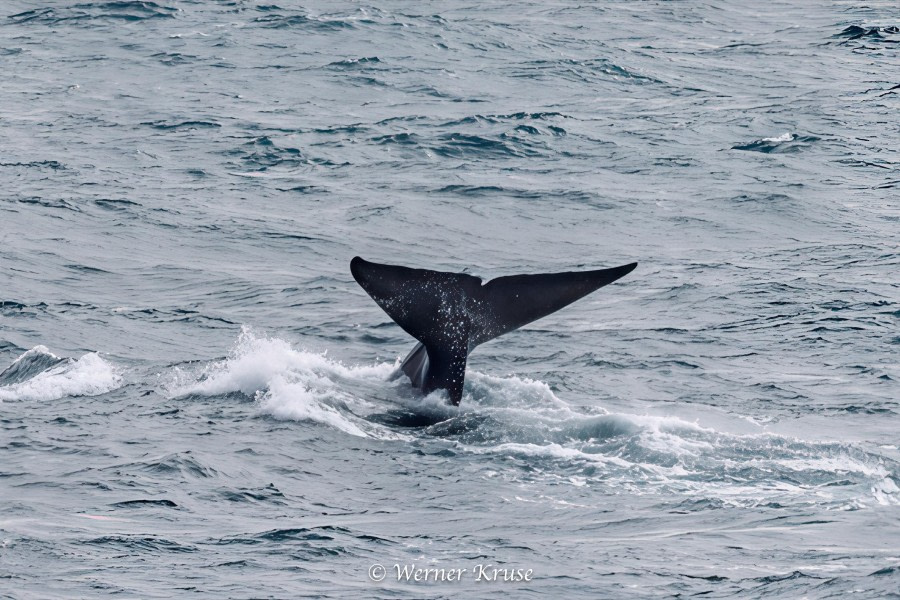
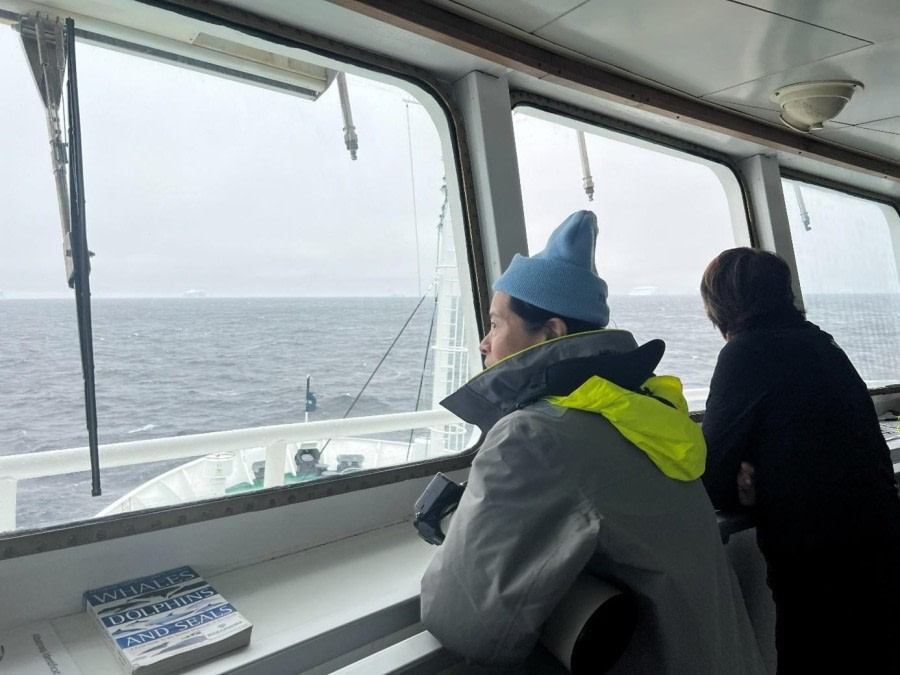
Up on the bridge, we spotted a large blow from a whale in the distance, and it looked like it was travelling northward, so we were hopeful we’d catch a glimpse of it again soon. One cruised past the bow very quickly and closely, and we heard “fin whale, 11 o’clock!”, but this species of whale is known to be quite speedy (reaching up to bursts of 45 km per hour!!) and often regarded as the ‘greyhounds of the sea’. As the excitement spilled out onto the decks at this close encounter, another blow was spotted, and this one much larger, which could only mean one thing – the elusive blue whale! After confirmation from photographs by our guest Rob, and whale expert Jess, we had indeed spotted a blue whale! The excitement grew and grew, and soon enough everyone was out on decks with binoculars and cameras in hand. Over the course of the next 30-60 minutes, we had spotted three more blue whales, and a couple of fin whales. We were just so overwhelmed at the size of these creatures. These whales can reach up to 33 m in length, making them not only the largest living animal today, but the largest animal to ever exist! Albeit we probably only glimpsed ¼ of the animal itself, as the majority of the body is underwater, but it was still impressive. We did, however, get to witness a truly magical sight, the blue whale’s fluke! Seeing a blue whale is one thing but seeing them in Antarctica where their populations were almost decimated and are still recovering is another, and to top it off with seeing these graceful beauties take a dive and see the sheer size of their tail was just the icing on the cake.

Our afternoon consisted of a mandatory drill for our upcoming helicopter operations, so we knew exactly how it worked, what to wear, and what to expect. It was a full rehearsal, as if we were going out in the helicopters for real. It was really reassuring having all this information and practice before our big day of flying! We were all so excited to get up in the air!

Later in the afternoon, the expedition team on bridge watch counted an additional four more blue whale blows in the distance, giving us a total count of NINE blue whales!! For some of the expedition team, it was their very first blue whale sighting, so we soon began to appreciate just how rare and fortunate this experience was.

We went to bed eager with anticipation for tomorrow’s potential helicopter flights. Another day in paradise!

Day 12: Neuschwabenland

Neuschwabenland
Fecha: 02.02.2026
Posición: 70°27.6’S, 010°55.3‘W
Viento: WSW5
Clima: Partial Cloud
Temperatura del Aire: -1,3

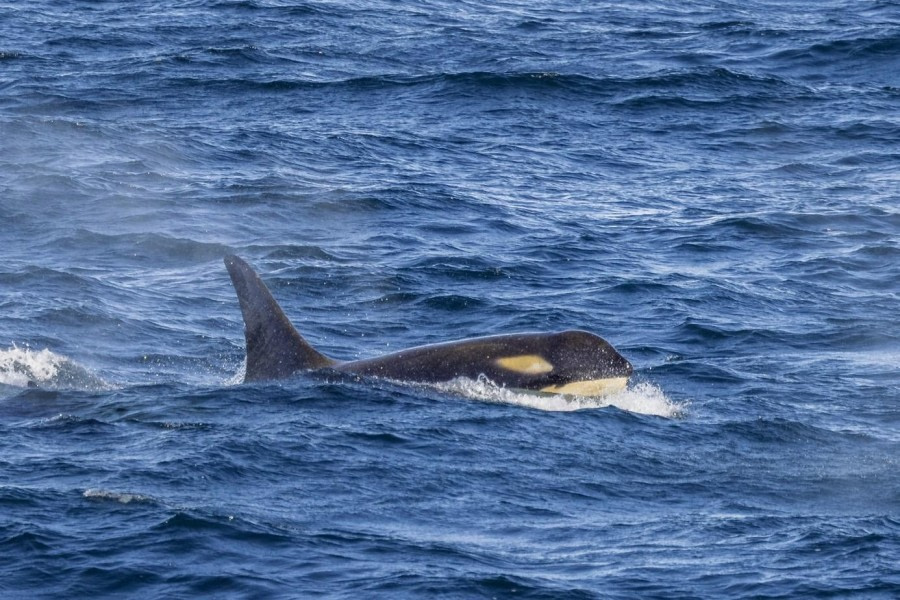
This was to be an exciting day, but it started slowly.  Much organisation was required to arrange the flying groups and deploy the mass of equipment required for the landing area…to say nothing of the preparation of the helicopters. The rotor blades were carefully removed from the hanger and bolted onto the drive unit at the top of the first helicopter. Eventually we received a call to action and almost as if it were a cue, a simultaneous   This was an immediate distraction as everyone rushed to the side of the vessel camera in hand shout…’whales!’   They were immediately identified as Orca. No possibility of this being a mistake as a large number of large black dorsal fins were seen cutting at speed through the water. Much agitated activity as the darted backwards and forwards obviously feeding.

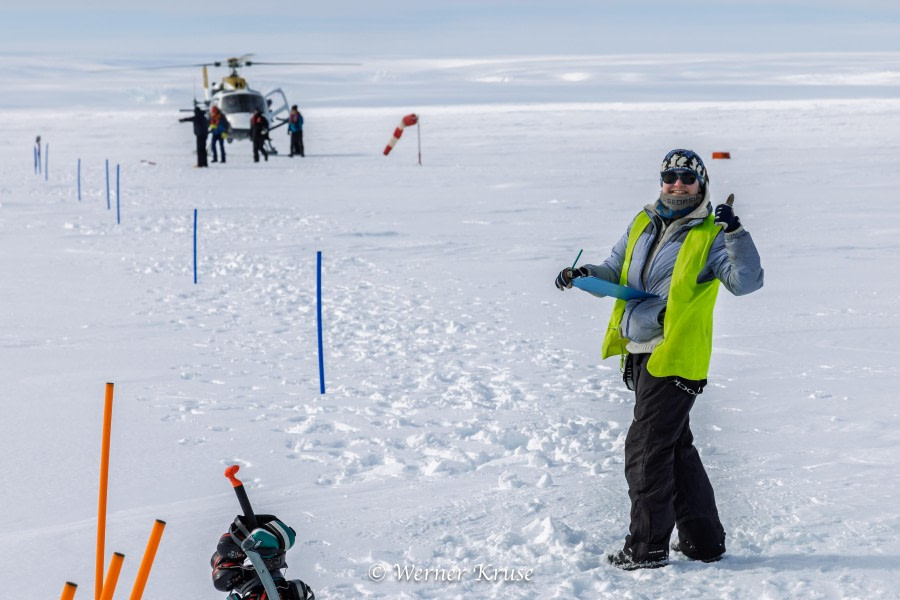
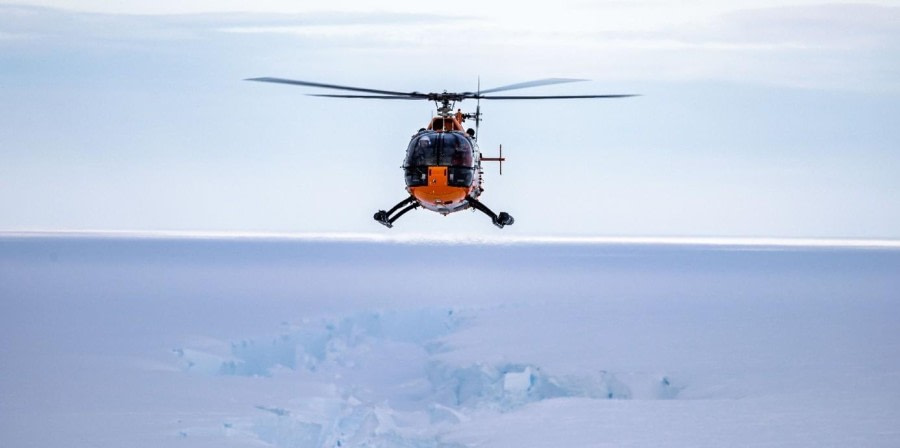
First flight off the helideck was Chris, Lucas and Gez on a scouting mission to find a suitable landing area and once selected, to check it for crevasses. The first task was to mark out a safe perimeter and erect as large dome tent as a base and emergency shelter.  Then the shuttle flights began. Life jackets issued and checked and group of 4 or 5 led to the helicopter-deck to board the machines and be strapped in by the DAP mechanics.

The organisation was seamless well thought out, the guide team with designated roles ensured a smooth flow. Everyone was excited and delighted at the superb views as we flew in across the sea and ice.  The guide team looked like lonely small dots on the vast plain of pristine ice.  The pilots landed at the designated zone and it was only a short walk indicated by a line marker poles to the free roaming area. It was hard to believe that we were standing on the Antarctic mainland for the first time. Certainly, as we had been warned by Chris ….it was cold. Very cold!

A few minutes without gloves was certainly very uncomfortable. The wind was blowing as forecasted at about Force 4 to 5  WSW,  generating a very noticeable wind chill factor. The scenic flights from the ship to the shore gave the DAP pilots an opportunity to demonstrate their superb highly professional flying skill, swooping over the ice and tracking along the crumbling startlingly white cliffs, the sea was a beautiful turquoise along the very edge of the ice shelf. 

The pilot’s faces had ear to ear grins…clearly, they were in their element…the experience was fun, serious fun!

The return flights were just as smooth and gave everyone an opportunity to photograph Ortelius as it gradually changed from being a small speck on the horizon to an aquatic ‘airfield’ and our extremely comfortable temporary home.  The rest of the day was in spent in groups editing thousands of photographs and chatting about this magnificent unique Weddell Sea experience.

Day 13: Riiser-Larsen Ice Shelf

Riiser-Larsen Ice Shelf
Fecha: 03.02.2026
Posición: 72°14.3’S, 016°00.1‘W
Viento: NW3
Clima: High Clouds
Temperatura del Aire: -5

After a day when helicopter flights had already been one of the great highlights of the expedition, just when we thought nothing else could surprise us, the day found us sailing further South into the depths of the Weddell Sea. The goal of the day was clear: among the countless icebergs surrounding us, there was one thing we were still missing — the Emperor Penguin.

At 9:06 in the morning, our first wildlife encounter was a Minke Whale and a Blue Whale. They were spotted from the bridge and followed for several minutes at position 72°11′97″S, 17°10′26″W. After breakfast, around 10:00, Chris gave an engaging lecture about glacial ice and frozen seas, a great opportunity to understand their technical differences and how these environments are formed.

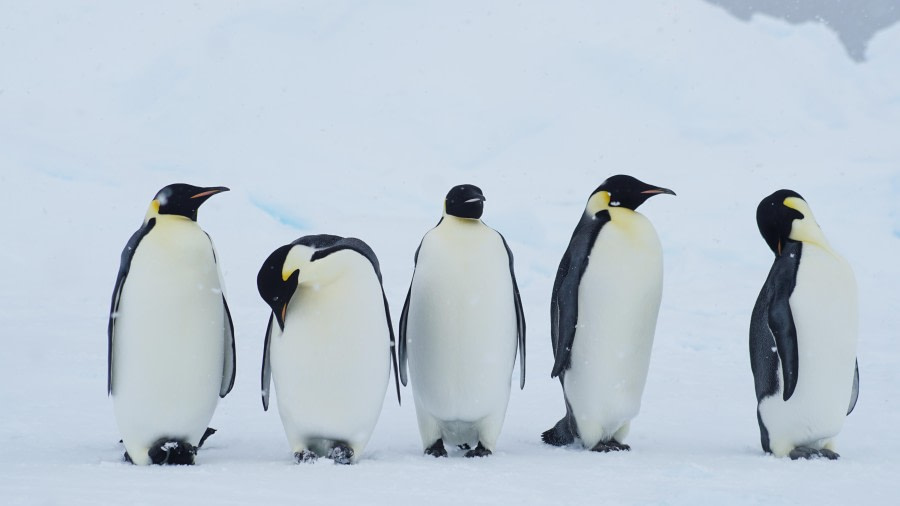
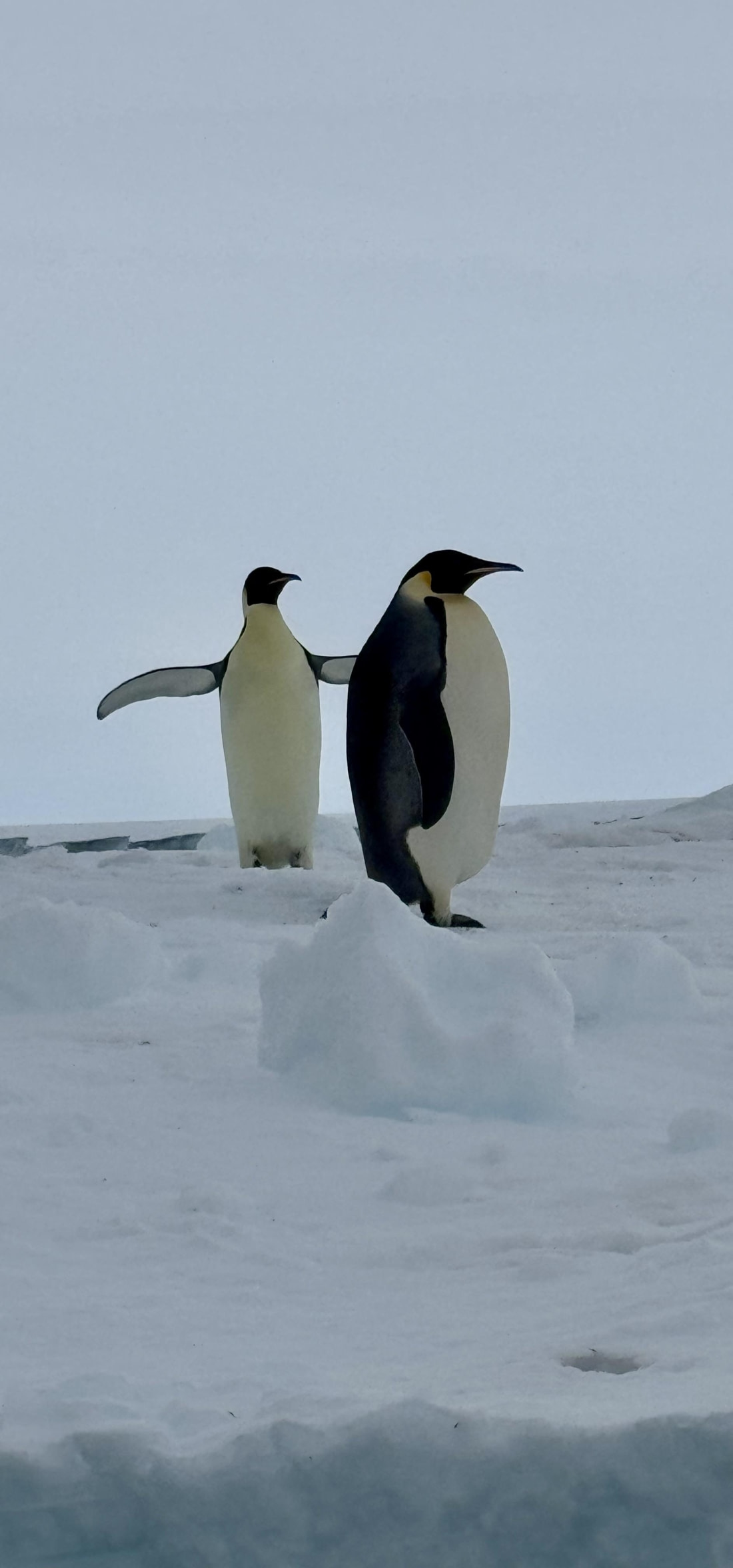
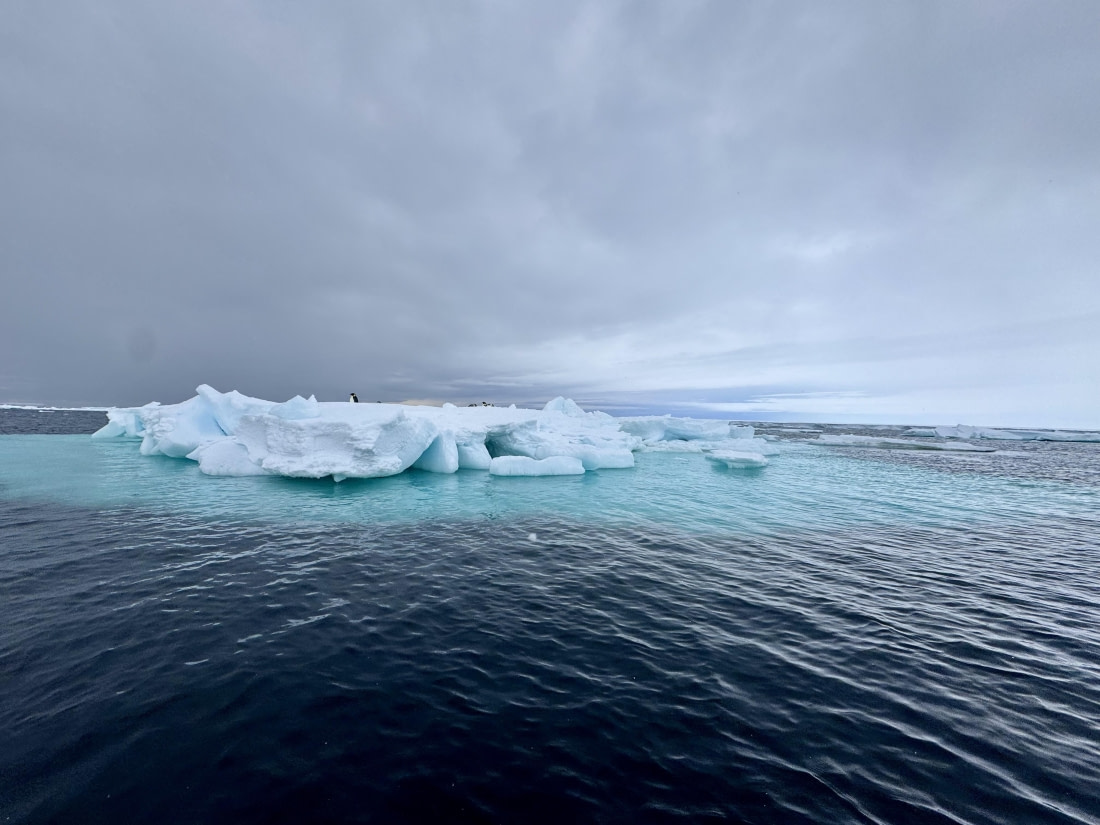
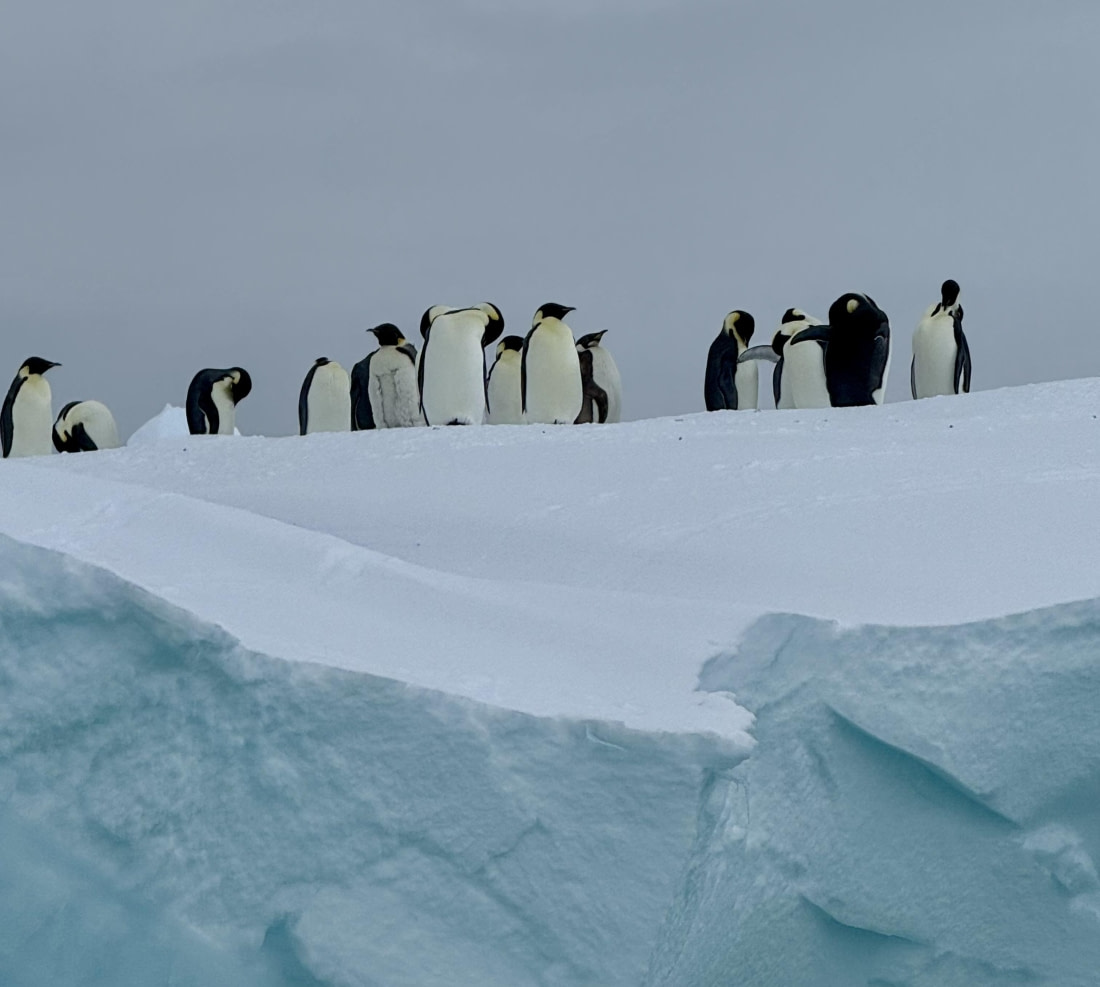
Around 11:30, the first Emperor Penguin was spotted on a small floating iceberg off the port side of Ortelius. Although many people were watching, Nick was the first to see it and kindly shared his photo with everyone — to our collective surprise and excitement. It felt like a promising sign. Just moments later, from the bridge, we spotted many more emperors, along with seals and a Giant Petrel. Excitement spread quickly, and the announcement was clear: eat lunch as fast as possible, because a Zodiac cruise was coming up!

Departure time was set for 13:00, and everyone was ready on deck 4. As soon as we moved away from Ortelius, we reached a series of small icebergs where we found our first large group of Emperor Penguins. This marked the beginning of countless photos and videos. The deep blue of the water combined with the dark sky created a stunning contrast, and no one could stop capturing the best shots of the day.

As we continued exploring the area, we discovered more groups of Emperor and Adelie Penguins. One of the most surprising moments came when we noticed that one of the colonies was sharing and ice flow with several seals. Chris observed something unusual about one of them and called Chloe over to confirm. As soon as she got a closer look, she confirmed it — a Ross Seal, an extremely rare sight. For Chris, it was only the second time he had seen one in all his years of exploration. Everyone was thrilled by the news (especially Chloe!).

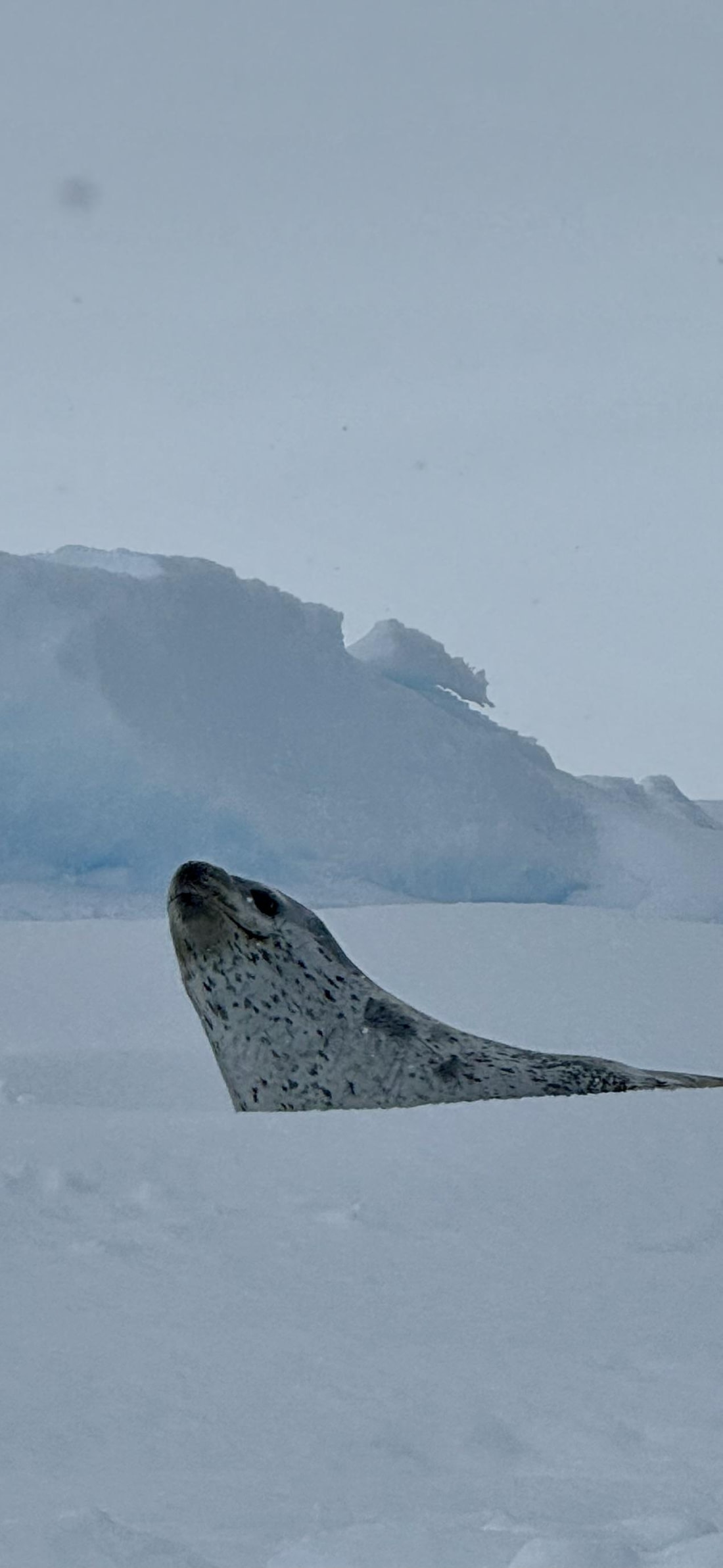
As if that wasn’t enough, after spending quite some time in the area, two Minke Whales appeared and began swimming around the Zodiacs, circling us and adding even more magic to an already incredible day.Still eager to explore, we moved on toward other icebergs. Soon after, a radio call announced the sighting of a Leopard Seal. A massive animal, resting on an ice floe, it impressed us all with its sheer size.

We returned on board around 16:00 and continued sailing south, watching the sun’s colours reflect over the vast bay and the drifting icebergs. The sunset was simply unforgettable.

No one could quite believe everything we had experienced that day. Back on board, everyone was eager to review photos and relive the moments. It was truly one of the best close encounters with Antarctic wildlife. During the daily recap, Chris even mentioned that for Allan, after 34 years of Antarctic exploration, this had been his very first Ross Seal sighting.

We all agreed it would be another day to remember. After yet another excellent dinner on board, the evening continued with relaxed conversations in the bar and lively dice games with the pilots.

Day 14: At Sea, sailing South

At Sea, sailing South
Fecha: 04.02.2026
Posición: 74°07.7’S, 023°00.1‘W
Viento: VAR1
Clima: Partial cloud
Temperatura del Aire: -0,7

Good morning expeditioners!

After yesterday’s amazing day with the Emperor penguins, Crabeater seals, Minke whales and the rarely seen Ross Seal, we were then heading further south. And that meant that we would spend the day onboard. But that was more than OK as it gave us time to process the wonderful impressions our expedition had given us so far, and look at our photographs and videos as well.

Ingrid woke us up for breakfast and after breakfast the expedition team had scheduled a number of onboard activities.

Gez had worked hard creating a full-on treasure hunt with riddles, clues and questions. Straight after breakfast he invited us to pick up our Shackleton’s Imperial Trans-Antarctic Expedition Quiz Book. As Gez said; “Let the search begin”. What a great and fun initiative!

Soon after, our guest lecturer Steve welcomed us to the bar for a lecture about Shackleton’s Endurance Expedition. Steve is probably the most knowledgeable Shackleton expert in the world and this morning he treated us once again with an in depth and detailed lecture about this remarkable explorer. After lunch Steve continued his lecture in the form of a workshop where it was possible to have more extensive discussions and time for questions.

Chloe and Aitana clearly had sparked big enthusiasm for onboard knitting. Since their workshop, more and more of us were spotted knitting and it was lovely to see. No one on this adventure will have cold ears or a cold head anymore with all the new beanies and headbands that were made.

At 16:15 it was lovely Jess who invited us to the bar for her lecture about the evolution of whales. It was very interesting to see how whales evolved into the gentle giants of the ocean that they are today.

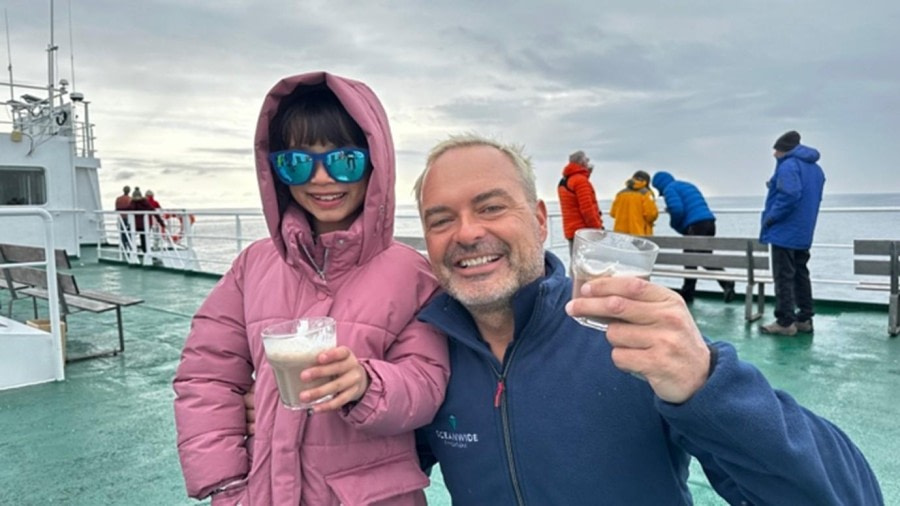
And talking about whales, we continued to spot them! So far, we had possibly spotted 8-10 blue whales and today we also spotted quite a few minke whales. And where better to observe these beautiful blubbery creatures than from the top deck while enjoying a cup of hot chocolate. The weather had been lovely and although it was cold, it was fantastic to be outside so far from home.

The day had passed quickly and after recap it was time for another delicious dinner.

After dinner many of us spent time in the bar, whereas others decided to sleep early. Let’s see how far south we are tomorrow! Good night, everyone.

Day 15: Vahsel Bay

Vahsel Bay
Fecha: 05.02.2026
Posición: 78°05.5’S, 036°09.7‘W
Viento: Var 2
Clima: Cloudy
Temperatura del Aire: -6,6

What an incredible day!

Today was another day of helicopter landings. Everyone had been hoping for good weather since yesterday. Chris's announcement this morning said it would be cold, and everyone should dress warmly. We were reaching Vahsel Bay, the highest latitude landing point of our voyage, and everyone was excited. Many people went to the bridge early this morning to take photos of the latitude and longitude, wanting to record this important moment. This is not only the southernmost point we've reached on this voyage, but also the southernmost latitude record reached by any passenger expedition ship this Antarctic season. Our ship has broken its own record set last year, becoming the southernmost expedition ship company to reach the southernmost point for the second consecutive year!

Today's activities were in the order of group 4,3,2,1,8,7,6,5. Since we had already done a helicopter landing, everyone was familiar with the procedures, and when the activity announcement was made, everyone proceeded in an orderly manner, and everything went very smoothly and efficiently. Before landing, the pilot gave us a scenic flight, taking us up and down the ice shelves and between crevasses – it was incredibly exciting!

The scenic flight was wonderful, and the pilot's flying skills were commendable. After the flight, everyone disembarked on the ice shelf, took photos with the sign, some were lying down, some were sitting, and some were jumping. After all the passengers had disembarked, some crew members arrived by helicopter. They were also very excited and happy. This experience was unprecedented for them as well.

In the afternoon, Gez led a workshop where everyone learned some survival skills. At 4 pm, assistant expedition leader Allen showed us a lecture about sledge dogs. From that we know how crucial the role dogs have played in human Antarctic expedition history. They are loyal, reliable, strong, and resilient; without them, the history of human expeditions in Antarctica might have been very different. Dogs truly are man's best friend!

Day 16: Luitpold Coast, Sea Ice Landing

Luitpold Coast, Sea Ice Landing
Fecha: 06.02.2026
Posición: 76°47.2’S, 031°02.6‘W
Viento: NE5
Clima: Overcast
Temperatura del Aire: -6,6

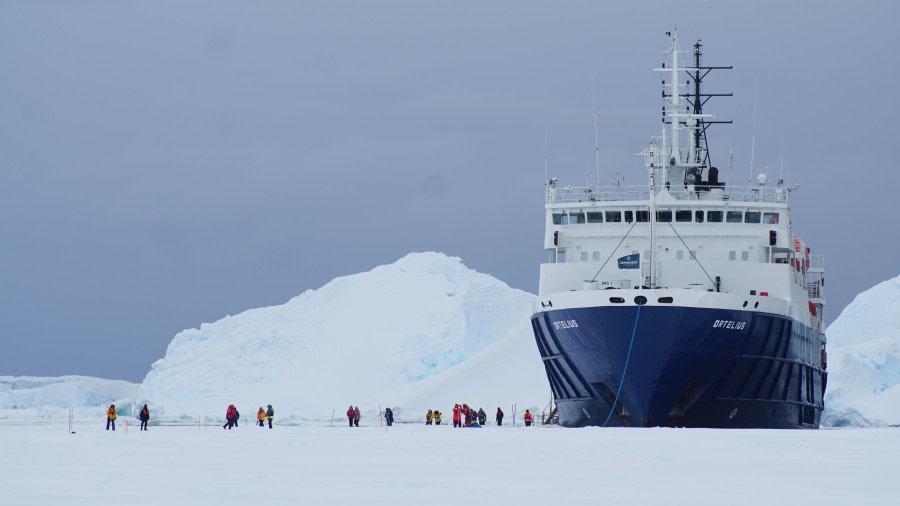
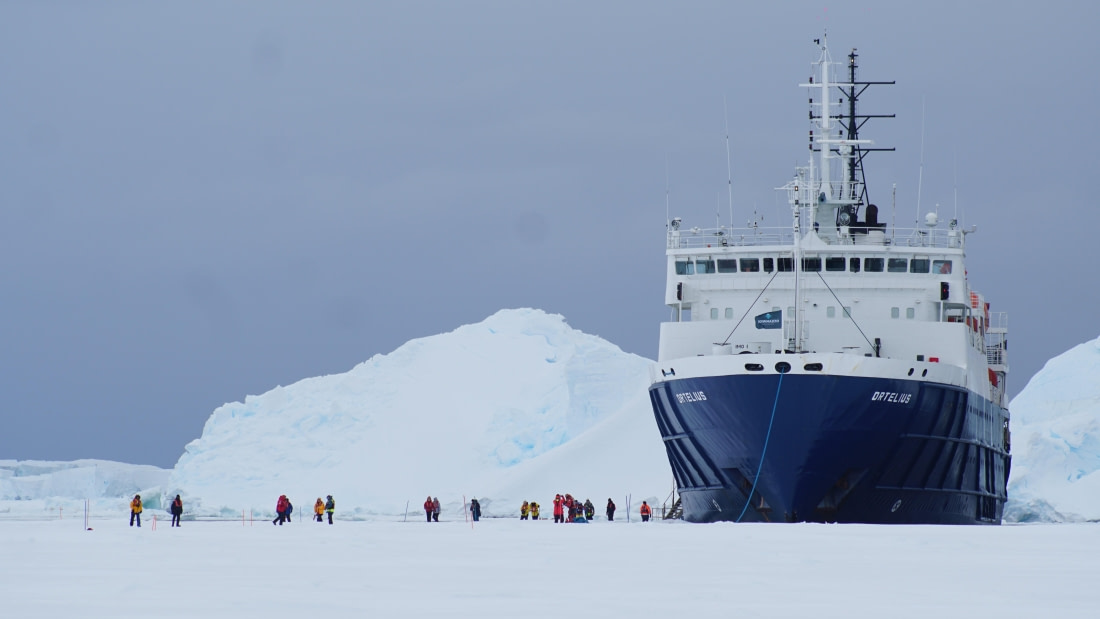
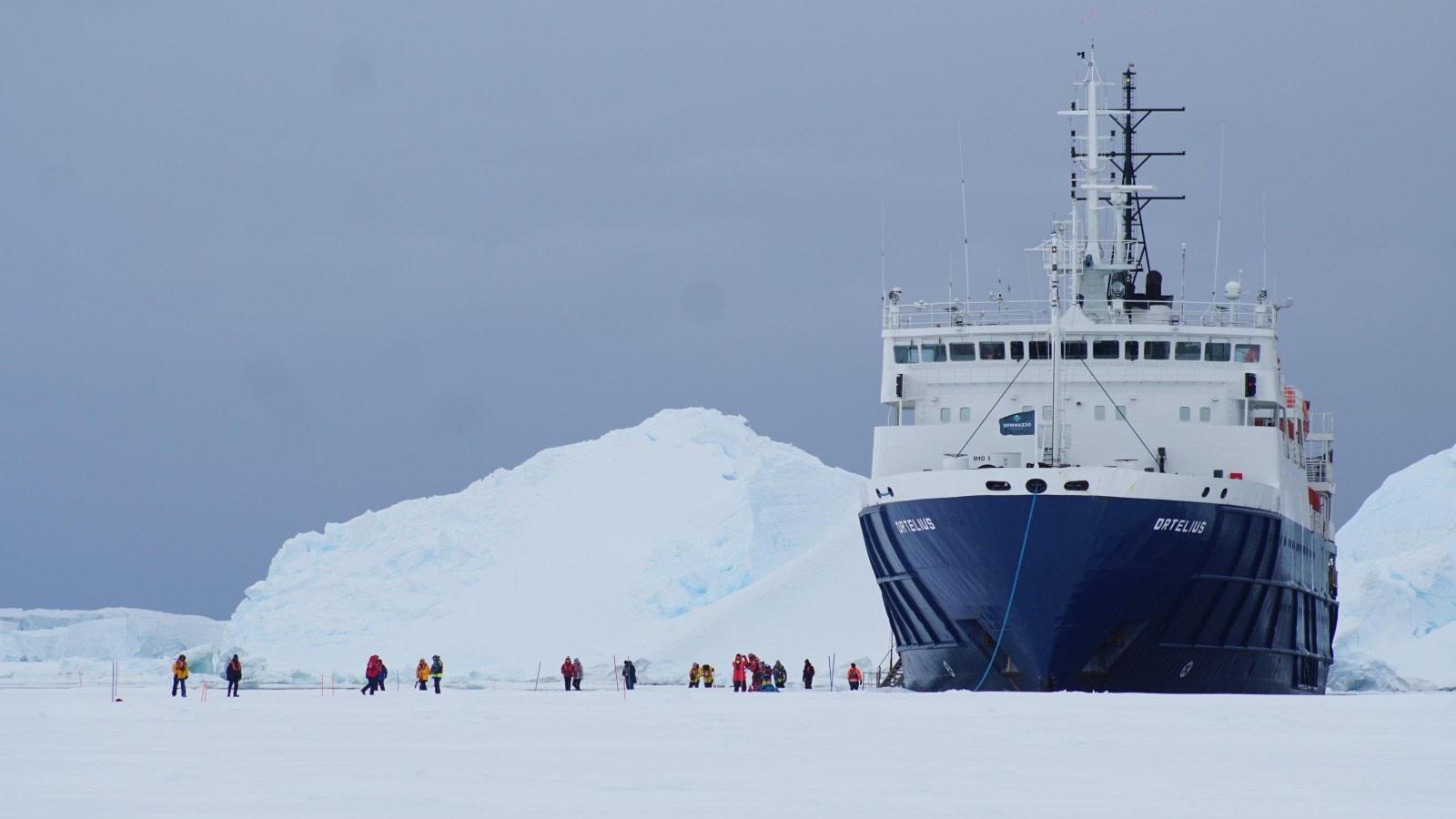
The day was spent operating in the sea ice off the coast of the Luitpold Coast. Planned helicopter operations were not possible due to weather conditions, and the Expedition Leader and the Captain made the decision to position the ship directly alongside stable sea ice. With the vessel securely parked, the gangway was deployed, allowing guests to step onto the Antarctic sea ice for a full morning.

Before guests disembarked, the expedition team went ahead to assess and secure the area. Wildlife sightings quickly followed, including several crabeater seals resting on the ice, a curious emperor penguin approaching the group, and a small number of Adélie penguins moving through the area. Birdlife included sightings of a snow petrel and a South polar skua flying overhead. Along the edge of the ice, some lucky guests also observed minke whales patrolling the edge of the ice.

Guests spent the morning exploring the sea ice, enjoying the rare opportunity to walk in this dynamic environment, take photographs, and observe wildlife at close range. As the day progressed, increasing swell began to affect the ice conditions, and the Captain made the call to conclude operations and recall all guests safely back on board. The sea ice excursion was a great success and a highlight of the voyage so far.

During the afternoon, Gez hosted a hands-on survival workshop, sharing practical skills and insights relevant to polar environments. This was followed by a fascinating lecture from Allan on the history and importance of sled dogs in Antarctica, offering both historical context and personal perspective.

The day concluded with dinner on board, followed by the first part of the film Shackleton, enjoyed with popcorn, a fitting way to end a full and memorable day in the Antarctic sea ice.

Day 17: Stancomb-Wills Glacier

Stancomb-Wills Glacier
Fecha: 07.02.2026
Posición: 73°42.6’S, 024°11.9‘W
Viento: Var 5
Clima: Partial Cloud
Temperatura del Aire: -3

We woke up to find beautiful bright and clear skies. The helicopter pilots and engineers agreed that it was perfect weather for a scenic flight over and around the Stancomb-Wills Glacier. The staff and crew set about preparing for flights during breakfast and shortly afterwards the first flights were ready.

Two zodiacs were also launched so that we could have some guests out on a zodiac cruise while others were taking their scenic flight. The flights were extraordinary. We could see many Emperor penguins from the air on icebergs and flows, and we could see the patterns made by their tracks through the snow. We flew over beautiful brash ice and the towering glacier which looked as if it could calf at any minute. The people on the very first flight even saw Arnoux’s beaked whales from the helicopter. It was also a thrill to look down on Ortelius from above. Our floating home looked so small in the vast icy landscape.

Meanwhile those of us on the zodiac cruise were having a wonderful time. We admired emperor penguins on icebergs at eye level. The highlight for many this morning was finding a juvenile Adelie penguin inside a little ice cave in one of the icebergs!  The weather was beautifully calm, the ocean at times was like a mirror, giving us opportunities for beautiful pictures of ice.

In between activities we managed to grab some lunch. After all the excitement of the morning it was time to relax in the lounge, and Aitana gave the second instalment of her lecture about her time working onboard a research vessel.

We gathered for the recap. We were so tired yet satisfied by the day’s events and many hours were spent looking through our photos, processing all the beautiful sights and experiences we had. 

Day 18: At sea

At sea
Fecha: 08.02.2026
Posición: 70°17.4’S, 024°56.7‘W
Viento: SW9/10
Clima: Overcast
Temperatura del Aire: -1

Today would be our first day of potentially five sea days ahead of us until we reached dry land again. Some of us were frightened by the sheer thought of this, others seemed relieved to finally catch up on some rest! No wake-up call was needed, and a leisurely morning was enjoyed. The seas, however, had a mind of their own, and rolled little Ortelius in their crests and troughs, so we had to be very careful making our way around, always keeping one hand for the ship.

After breakfast we gathered in the bar with Chris to hear all about his time at New Zealand’s Antarctic research station in the Ross Sea region, Scott Base. Chris spent two summer seasons down at the base working as a field trainer, where his duties involved teaching field staff and visiting scientists on how to live and work in the harsh polar environment. These duties ranged from setting up traditional polar tents, how to avoid hypothermia, how to use primus stoves for cooking, crevasse rescue, logistical support for field camps and many more jobs that are essential for managing a successful Antarctic season. The skills and experience Chris gained from his time in the Ross Sea were evidently invaluable for his present career as an Expedition Leader.

Afterwards, we were joined by Gez and Lucas in the bar for a workshop on crevasse rescue, in which we got to learn some new knots, ways of belaying rope and carabiners, and the techniques involved in creating a pulley system in case someone fell into a crevasse while out in the field.

After lunch, Werner hosted a workshop for beginner photo editors for an introduction to photo editing. After many days full of snapping photos, our memory cards were beginning to fill, and it was a great chance to sift through and edit them with the help of Werner’s keen eye and expertise. For those interested in getting a little crafty, Aitana and Chloe gathered some crochet supplies and hosted a little workshop on the basics of crocheting. By the end of the session, we were seeing some great stitching, so we would soon be onto our next project- crocheting our very own Antarctic penguin or seal!

In the afternoon, Chloe invited us to the bar for a presentation about the ecological importance of sea ice. Chloe told us all about how not only sea ice was formed, but how Antarctica essentially doubles in size over the winter as the ocean around the continent freezes. The size of this froze ocean expanse changes, however, from year to year, depending on atmospheric and ocean conditions such as the El Nino Southern Oscillation, the Coriolis effect and ocean warming. Therefore, the extent of Antarctic sea ice isn’t always the same, which can have effects on the polar environment not just for the wildlife, but for maritime operations as well. We learnt that numerous Antarctic species rely on sea ice one way or another during their lives, they may depend on it for breeding, resting, moulting or spending their early life stages hidden in the sea ice rafts as baby krill. We often hear about krill being the ‘keystone’ species here in Antarctica, but we have a newfound appreciation for sea ice now. Without sea ice, there is no substrate for ice algae to grow on, which is what the krill feeds on by scraping the underside of the sea ice in the austral winter and spring before the ice starts to break up.

We were treated by another scrumptious dinner in the dining room and reflected on yet another magical and educational day in the beautiful Southern Ocean.

Day 19: At sea, heading North

At sea, heading North
Fecha: 09.02.2026
Posición: 65°27.6’S, 028°56.9‘W
Viento: SW9
Clima: Cloudy
Temperatura del Aire: -6,6

Good morning, Ortelius expeditioners. Today we woke up to an ocean that was showing us some of its stormy moves. Although the waves were not extremely high, Ortelius was still moving quite a bit and with wind speeds of more than 40 knots and regular snow showers, it provided for a true Southern Ocean experience. Today would be a day of travelling further around the Weddell Sea ice so we had lots of time to witness the power of the ocean. We saw big waves crashing on icebergs, we saw waves crashing on the bow and we could hear the wind howling around the ship. A perfect day to spend inside a warm and comfortable ship.

This morning Allan shared fascinating stories about his time onboard the Kapitan Khlebnikov back in 2004. The Kapitan Khlebnikov was a Russian Ice Breaker that made it deep into the Weddell Sea trying to reach several Emperor Penguin colonies to conduct research. Allan shared fascinating insights and some of his photos were simply wonderful and definitely very cute when it came to photos of the Emperor chicks. Although onboard an icebreaker, back then they didn’t make it further south than 76’S. Just sayin’ ;).

After Allan, it was time for Gez and Lucas to continue their crevasse rescue workshop. It was great to see the interest of many of us in this workshop where we got to play with ropes and knots and where we learnt simple things that can make the difference between life and death.

After lunch Werner continued his photo editing workshop. Today he went into the endless possibilities of Adobe’s Lightroom and shared some very useful tips, tricks and workflows that could help us get so much more out of our photos. It’s quite stunning what you can do with your images and how much better they can get with some small adjustments. 

Then it was Jess again who informed us how important the role of whales are in our ecosystem. Jess is not shy of talking about poop and death, so she was really in her element today. She talked about the importance of whale poop being an oceanic fertilizer and with whales being very large creatures, their contribution is significant and important. Whales also take out CO2 from our atmosphere and store that in their body where it will stay forever. Once a whale dies it falls down to the ocean floor where their corpses will be processed by many small creatures that feast on their remains. The world is definitely a better and healthier place with more whales in it and therefore it is good to see that more and more people enjoy whale watching all over the world.

In between lectures games were played, some of us were reading and of course many of us continued our new crochet and knitting hobbies ;).

After dinner we enjoyed seeing part 2 of the Shackelton Movie. Although we knew the story well, it was still captivating and entertaining to see the motion picture.

The motion of the ocean had made many of us quite tired so after the movie ended many decided to sleep early.

Good night!

Day 20: At sea

At sea
Fecha: 10.02.2026
Posición: 61°18.5’S, 033°43.3‘W
Viento: SE6
Clima: Overcast
Temperatura del Aire: -2

Another day of still voyaging north after our record-breaking landing at Wahsel Bay. Only now as Ortelius ploughs on at a steady 13 knots are we beginning to realise just how far south we had sailed. The trip down had been punctuated by numerous adventures, cruising in zodiacs and landing while this was day after day steadily covering the ground. The guides and officers were seeing whales regularly so each loudspeaker announcement brought photographers to the rail.

First lecture of the day was Steven with his detailed and harrowing account of trials and tribulations of the ‘Ross Sea Party’. Fortunately sea conditions had changed, the lurching and rolling of our vessel had been converted overnight into a relatively calm sea.

Lucas and Gez delivered another well-attended avalanche rescue workshop in the lounge. The complex pulley system created looked a bit like a large version of the complicated knitting that Jess, Chloe and a number of passengers were engaged in…so many people were totally absorbed in this knitting group created by our Spanish craftswoman guide Aitana.

Bill continued adding detail to the increasingly complex chart of our voyage. Positions and our route north are marked alongside numerous small illustrations and the names of all passengers, crew, guides and creatures seen. A fantastic reminder of a fabulous voyage.

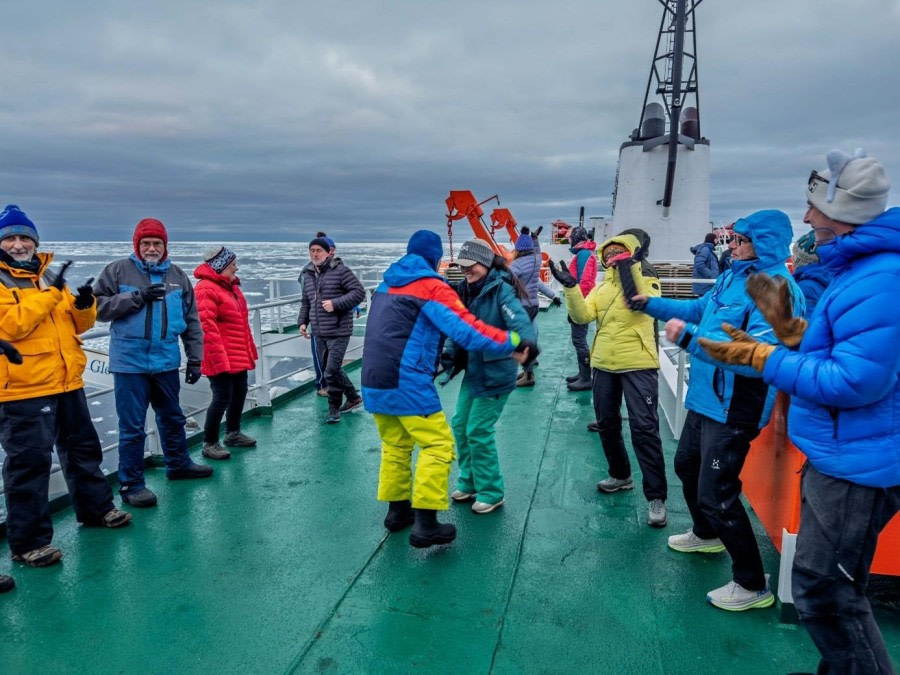
By late afternoon we were excited when the weather changed from fuzzy mist in the morning to clear to the horizon. A glimmer of white, a long line of ice on our port side gradually changed into an inviting mass of floes. Ortelius closed nearer to this vast expanse of gentle undulating white shapes, and nudged into it with banging and scrapping sounds to add atmosphere. A few penguins hopping on and off floes alongside the ship and relatively near , a young elephant sea lazed on a larger chunk of ice. What better a place to have a barbecue? The hotel staff laid out benches and tables and carried up an assortment of dishes and drinks then the festivities began. It was certainly cold on deck but once the music started the more energetic of us started dancing providing the others with entertainment. As the evening progressed the moves became trickier. Our senior guide Bill appeared in his yellow wellies and garish tartan outfit joining Miel our doctor dressed in a walrus outfit for some wild dancing. Much fun was had by all …the time did not really matter as the clocks changed this evening so we were all gaining an extra hour of sleep.

So ended another terrific day on this fantastic totally memorable voyage.

Day 21: At sea

At sea
Fecha: 11.02.2026
Posición: 60°44.5’S, 040°47.9‘W
Viento: NW5
Clima: Rain/Fog
Temperatura del Aire: +2

Today was a Sea Day, and we were on route to the South Orkney Islands.

This morning, Alex, a guest on the ship, gave a lecture about protecting the ocean with a focus on Krill. Through this lecture, we learned that although krill are small, they are a vital link in the marine food chain, providing a food source for many marine animals, both large and small. The stable krill population plays a crucial role in the recovery of whale populations. However, many countries still come to Antarctica to harvest krill for various purposes, some of which sound utterly absurd. On this journey, we not only experience the unique scenery of Antarctica but also learn a great deal about its ecosystem, wildlife, and the challenges they face. What we can do is start with ourselves, promoting conservation, refusing krill products, and setting an example to influence others and contribute to protecting the ocean.

At 11:00 AM, the crevasse rescue workshop continued, with groups 1 and 2 participating today. After lunch, photography guide Warner also organized a workshop for guests who wanted to learn video editing; many friends who wanted to edit their videos and photos taken in Antarctica participated. At the same time, Koen also invited all the guests who won bids at the South Georgia Heritage Trust auction to complete the payment, and everyone seemed to be very satisfied with their auction results.

Later, Aitana gave a lecture on ocean currents, which was very engaging. She introduced the role of the Antarctic Circumpolar Current in global ocean currents. Through her lecture, we learned that seawater from the Mediterranean region can be detected in the Antarctic Ocean, and that the salinity and temperature of seawater vary at different depths. Seawater from different parts of the world can also converge in the same body of water – all results of ocean currents. It was incredibly surprising and fascinating!

Today's briefing introduced tomorrow's activities. Tomorrow's plan was to go to the South Orkney Islands, and the activities will start very early, around 4 am. After several days at sea, everyone was eager to disembark and participate in activities, so everyone went to bed early to be well-rested for tomorrow morning's activities.

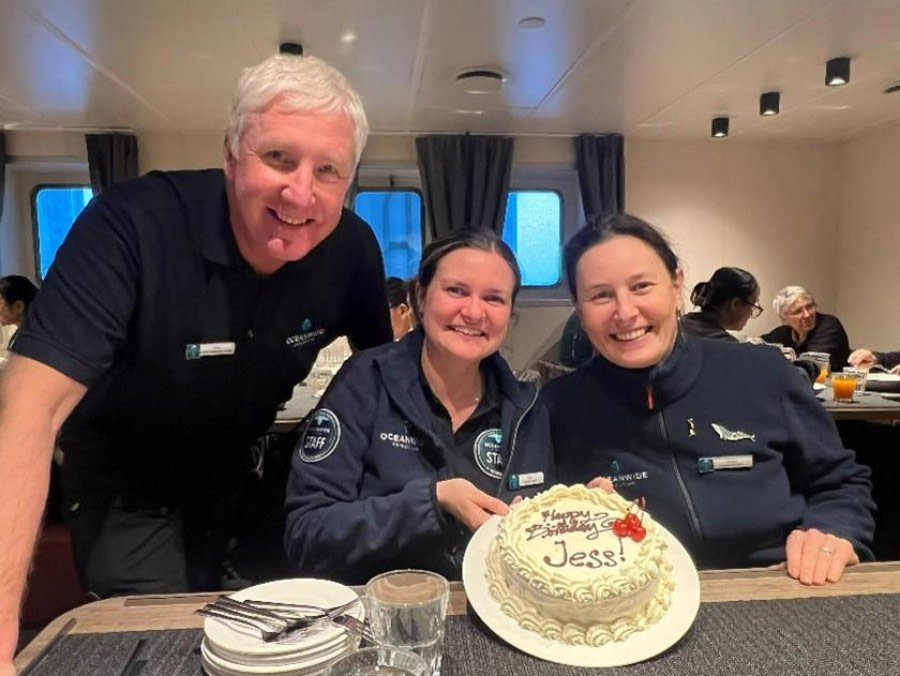
Also today was Jess’s birthday as well, Happy birthday to this lovely girl!!

Day 22: Shingle Cove, South Orkney Islands

Shingle Cove, South Orkney Islands
Fecha: 12.02.2026
Posición: 60°45.9’S, 045°49.5‘W
Viento: SSE8
Clima: Overcast
Temperatura del Aire: -0,6

Today the ship started to stir a lot earlier than usual. At 4am the expedition team were up on the bridge assessing the conditions at the South Orkney islands. We were aiming for Shingle Cove, a small beach landing which offered a rocky walk up to see Adelie penguins on their nests. The expedition team set off at 4.30am in two zodiacs and disappeared into thick fog. We waited a long time for them to return. In the meantime, we munched on pastries in the bar and drank coffee to help us adjust to the early start. We heard an announcement from Marlene to say she had heard from the team onshore and sadly there would be no landing this morning. The team were met with a very sorry sight onshore. Where the Adelie penguins once stood with their nests was now empty. All of the nests and penguins had gone and there were many remains of dead adults and chicks scattered on the ground. It was a very sad mystery indeed, and the team speculated that this was perhaps a result of bird flu or maybe a bad weather event. Due to the dangerously thick fog and the mass mortality event, plus the weather being due to deteriorate meant that we moved on towards Elephant Island. Some of us quickly returned to our beds while other stayed awake enjoying the fog and atmosphere. We could see some gentoo and chinstrap penguins porpoising around us and some beautiful snow petrels and storm petrels soaring in and out of view.

During the mid-morning, we watched an episode of Frozen Planet 2, a beautiful BBC documentary about the coldest places on earth. Chloe then gave us a talk about the seabirds we have seen on our journey so far and may continue to see when we head back across the drake passage.

There was some excitement on the bridge during the day as the fog lifted and we watched beautiful icebergs pass by and some fin whales and humpback whales swam by.

After a later lunch we enjoyed a fun lecture from Bill and Hotel Manager Ingrid who told us all about the inner workings of Ortelius and what goes on behind the scenes.

Day 23: Point Wild, Elephant Island

Point Wild, Elephant Island
Fecha: 13.02.2026
Posición: 61°05.3’S, 054°32.2‘W
Viento: S6
Clima: Partial Cloud
Temperatura del Aire: +1,7

We awoke with cautious optimism as we approached Point Wild, one of the most challenging landing sites in Antarctica. Conditions here are rarely favorable, and landings are often prevented by swell and wind. Our Plan A had been a scenic helicopter flight, with Plan B a Zodiac cruise and, if conditions allowed a landing too.

Early morning weather ruled out scenic flight operations, and we shifted to Plan B. Fortunately, the day revealed itself to be calm and remarkably clear. With the swell manageable and winds light, guests boarded the Zodiacs and we began our approach.

Landing at Point Wild requires precision and patience. Only two Zodiacs could land at a time, and timing between waves was critical. Even our Expedition Leader had never landed here before; Allan, with 32 years of guiding experience, was the only team member who had previously set foot on this historic shore. The expedition team executed the operation flawlessly, with special recognition to the “catchers” who steadied boats and assisted guests safely ashore.

Against the odds, we made it.

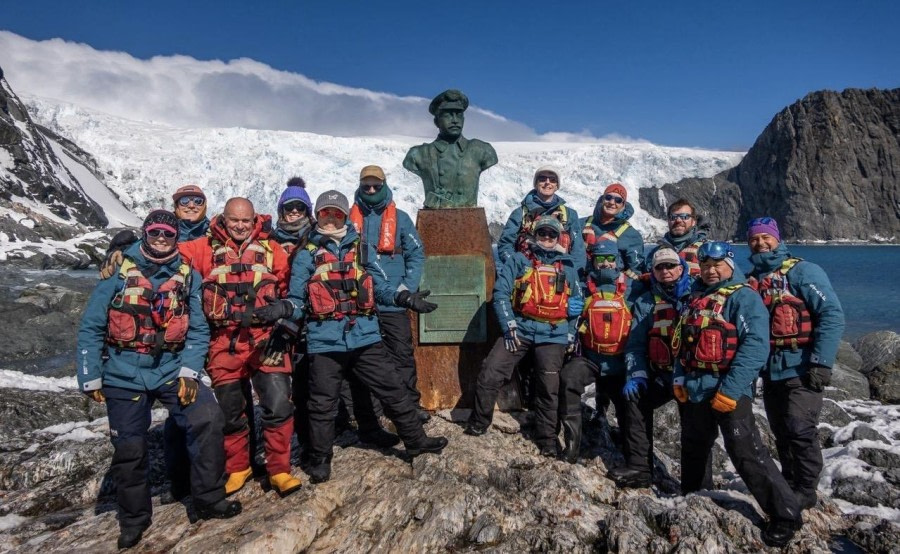
Standing on the narrow spit of rock where Ernest Shackleton’s men waited nearly four months for rescue was a powerful and emotional experience. Many guests took quiet moments to reflect on the endurance and hardship endured here in 1916. The landing was brief but deeply meaningful.

In the afternoon, a species identification workshop and crafternoon were planned; however, nature had other ideas. As we departed Elephant Island, an extraordinary spectacle unfolded: approximately 150 fin whales were observed feeding in the surrounding waters. Guests lined the decks in awe as blows appeared in every direction and whales surfaced in coordinated feeding activity — an unforgettable scene.

At 16:00, Allan delivered a compelling lecture on the Swedish Antarctic Expedition of 1901–03, sharing the dramatic story of endurance, shipwreck, and survival that unfolded in these same southern latitudes.

The day concluded with our evening recap and dinner, as guests reflected on an extraordinary sequence of events: a rare landing at one of Antarctica’s most storied sites, an emotional connection to polar history, and one of the most impressive whale encounters of the voyage.

An unforgettable day in every sense.

Day 24: Cape Green & Brown Bluff

Cape Green & Brown Bluff
Fecha: 14.02.2026
Posición: 63°38.2’S, 056°34.6‘W
Viento: WSW6
Clima: Partial Cloud
Temperatura del Aire: +5,1

Happy Valentine’s Day! As we entered the dining room for our early morning breakfast, we were showered with love with all of the beautiful decorations displayed all over the walls and tables. The hotel team sure knows how to create a sense of home, especially us many of us were away from our loved ones.

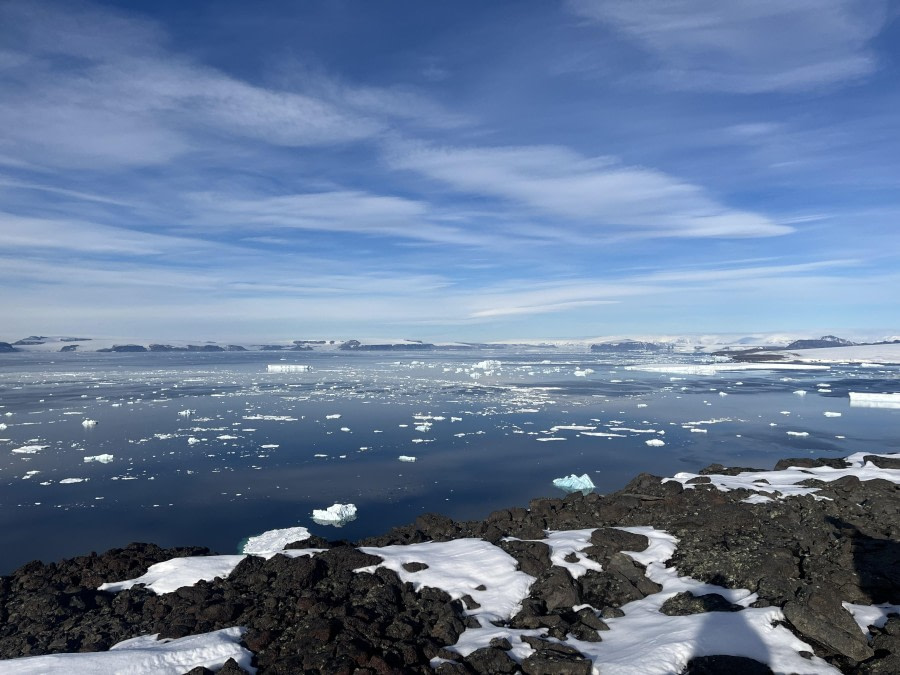
Excitement brewed over breakfast as we listened to the dulcet tones of Chris notifying us that the weather was favourable for one last round of scenic helicopter flights. We were ecstatic! This morning, we would be flying over towards a headland called Cape Green in the Antarctic Sound region of the Antarctic Peninsula, the skies were clear, the sun was shining, and the water was like a mirror, we couldn’t have asked for better conditions. The first flight left around 8 am, which navigated through countless icebergs, floating sea ice floes and then upwards towards the volcanic brown bluffs of the northerly part of the Antarctic continent. We landed on Cape Green, an area full of loose volcanic rocks riddles with interesting lichen beds. It felt like walking on the moon! Although the sun was shining and it wasn’t too cold, the wind was quite intense, so we were careful to stay within the boundary and not get too close to the edge! We saw skuas soaring above, icebergs drifting southward in the distance, and nearby islands such as James Ross, Devil and Vega Islands towards the southwest. It was crazy to think that just over a week ago, we were south of where we were looking, deep in the Weddell Sea! We had really covered some distance on this voyage.

After an adventurous morning flying and rock hopping, we were treated with a scenic transit to our next destination, Brown Bluff. Tabular icebergs and impressive volcanic islands dotted the horizon, with some sea ice floes hosting Adelie penguins and even a leopard seal was spotted! However the weather then decided to take a little turn, and the wind speed at our proposed afternoon destination had picked up to 40 knots, making zodiac operations unfavourable and unsafe. Sadly, the landing was changed to a zodiac cruise instead in some nearby sheltered cliffs. But this is the nature of expedition cruising! Sometimes you have to be prepared for Plan B, C and even D! Nonetheless, we ventured out in the wind chop, some of us getting a little splashed, and zodiac cruised along some more of this spectacular volcanic geology. We spotted numerous seabirds soaring around, Antarctic terns, skuas, southern giant petrels, cape petrels and the adorable Wilson’s storm petrel dancing on the surface. As we ventured closer to the coastline, we observed both gentoo and Adelie penguins, and even the odd Antarctic fur seal! The wind was increasing, however, and it was soon time to head back to Ortelius. After a bit of a bumpy ride back, we were soon warm and dry again with the comfort of a hot chocolate and biscuits in the bar, and smiles of delight as we reflected on adventurous day spent in Antarctic Sound.

Day 25: At sea, towards Ushuaia

At sea, towards Ushuaia
Fecha: 15.02.2026
Posición: 62°40.6’S, 062°21.4‘W
Viento: N8
Clima: Rain
Temperatura del Aire: +3,4

Good morning, everyone, good morning, Drake Passage!

After our fantastic last day yesterday in Antarctic Sound, we woke up in the notorious Drake Passage this morning. We had left early in the evening and overnight we crossed the Bransfield Strait and from there on we would sail onto the Drake Passage back to Ushuaia.

The weather forecast hadn’t been great, and our bridge team had informed us that we would see bigger waves and more movement of the ship around 09:00. Perfect timing as that offered us a good night’s sleep and a good appetite for breakfast! Indeed after 09:00 we could feel the increased motion of the ocean and many of us decided to lie down in bed. Others were reading or chatting in the bar whereas many of us enjoyed looking at our photos and videos from this incredible adventure.

Around 10:30 it was Bill who started his lecture on “Paintings of the Sea”. As a former art teacher, Bill has a keen eye for the meaning and symbolism of art and his views on several sea themed paintings was interesting and eye-opening. Bill discussed many artworks with us and with his usual passion and devotion he kept us engaged till the end.
 

After lunch Jess led a workshop on how to identify several animal species. During this wonderful expedition we saw many bird, whale and seal species among others. However, immediately identifying them needs some knowledge and training as the differences are often subtle and not easy to see. It can be a little discoloration in the bill with bird species, whereas Weddell Seals and Crabeater seals have different facial shapes. The Weddell having a cat like face, whereas the Crabeater has a more dog shaped face. With whales we look at dorsal fins, colors and patterns on the skin and backsides of the tails.

At 16:15 Koen shared personal stories from his time as a whale watch guide in both Iceland and the Kingdom of Tonga. End 2017 Koen decided to leave his corporate career to pursue a career as a guide and he started with this job in Tonga in 2018. Koen shared what his life was like in these beautiful countries and what it was like to be close to humpbacks and even snorkeling next to them in the ocean. During his very first time in the water, Koen told us that he was lifted out of the water by a whale while he was sitting on its nose, wonderful.

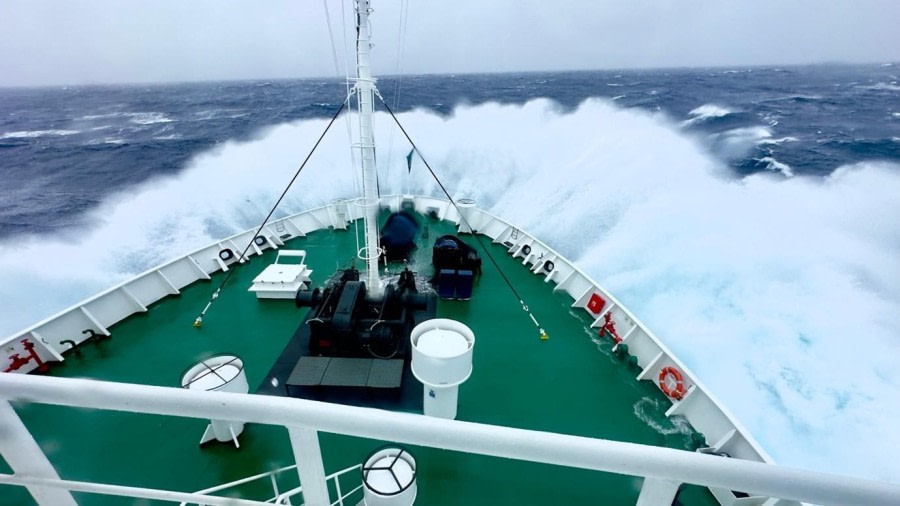
Then it was time for our recap and dinner followed shortly. Jess gave us an overview of the whale species we had seen and Aitana gave us a great explanation about how katabatic winds work. The winds we were so familiar with having been buffeted by them on our zodiac cruise the day before. Chloe then gave us a fun visual bird quiz. The ship had been rolling and bouncing off the waves all day long and with the wave height further increasing to above 5 meters, many of us gathered on the bridge to catch some large waves crashing on the bow for a video to show back home.

Day 26: At sea, The Drake Passage

At sea, The Drake Passage
Fecha: 16.02.2026
Posición: 58°40.2’S, 062°32.5‘W
Viento: NW7
Clima: Overcast
Temperatura del Aire: +6,8

Today is Drake Passage Day. The wind and waves didn’t stop after a bumpy night, and the ship was still rocking noticeably. Many guests chose to stay in their cabins to rest, and the restaurant and bar were much quieter than usual.

In the morning, Aitana gave a lecture on whether the Earth has a heart. Her lectures always make people think, reflecting on the characteristics of our planet and how they are inextricably linked to our lives, yet we usually neglect to pay attention to them. If we hadn't participated in this trip, would we have consciously paid attention to or learned about these things in our daily lives? Therefore, travel is not just about witnessing beautiful scenery and experiencing nature, but also about learning, understanding, reflecting, and acting.

We spent a lot of time on the bridge looking for wildlife, but it was a quiet day for whales and birds. The usual friends like Giant petrels and storm petrels made an appearance and we enjoyed quietly chatting on the bridge.

In the afternoon, Chole and Aitana organized a workshop where everyone learned to knit in their spare time, which was also a pleasure. Later, at 4:15 pm, historian Steve shared the story of Shackleton, providing a deeper understanding of the legendary explorer's experiences and personality.

In the evening Chloe gave us an in-depth recap about krill fisheries in Antarctica and Gez gave us a really fun quiz called Penguins...Wow..but How?!

Today is also Chinese New Year. Li from China, briefly explained the significance of the Chinese Lunar New Year—a time for family reunions. However, we met in faraway Antarctica. Although we are not related and had never even met before boarding, after a month together, we all got to know each other and developed a deeper understanding. Whether happy or not, it's all fate, a destiny's arrangement.

Today is the last day of the Year of the Snake, and tomorrow is the first day of the Year of Horse. We wished everyone on board a prosperous and lucky Year of the Horse.

Day 27: The Drake Passage & Beagle Channel

The Drake Passage & Beagle Channel
Fecha: 17.02.2026
Posición: 55°54.0’S, 065°32.8‘W
Viento: ESE2
Clima: Overcast
Temperatura del Aire: +4,9

Today we woke up to realise it would be our last full day on board Ortelius and that tomorrow we would be in Ushuaia again after all this time.

Chris invited us to the lounge to learn about future trips that Oceanwide offer. It was quite exciting and tempting to learn about the trips offered in the Arctic where you can see polar bears and walrus and to learn about the more unusual trips offered like the Atlantic Odyssey.

In the morning Allan invited us to his lecture titled The Curius Case of Admiral Byrd’s Antarctic Snow Cruiser. This was so entertaining due to the story’s absurdity but also Allans excellent storytelling style.

In the afternoon Steve gave us a final history workshop and the keen army of new crocheters worked hard to finish their projects with Aitana and Chloe. There were now many new woolly penguins and head bands in the world.

There was also a hugely fun dumpling making workshop which Li set up and our Mandarin speaking passengers showed many of us how to make a dumping.

In the afternoon as we were positioned near the entrance to the Beagle Channel we waved goodbye to our helicopter pilots and engineers.

Before dinner we met in the lounge for one final and special recap. A few of us put on our best clothes for the Captain’s Farewell Cocktails. We were given a drink before toasting to a very successful voyage with Captain Remmert. Ingrid and Chris gave us some final information about disembarkation and Chris then formally thanked all the departments on the ship for their hard work. We then had a special treat from Werner who had been working hard throughout the trip to produce a slideshow of our journey that included photos and videos of our experiences. It was quite emotional and surprising to look back at all the things we had done and achieved over the last month on Ortelius. This reliable and versatile ship had helped us to achieve many expedition ‘firsts’ and we went to dinner will a real spring in our step.

Day 28: Disembarkation, Ushuaia

Disembarkation, Ushuaia
Fecha: 18.02.2026
Posición: 54°48.5’S, 068°17.9‘W
Viento: Var 2
Clima: Overcast
Temperatura del Aire: +9

It was quite remarkable to realise that we had been away for almost a whole month. We arrived back in Ushuaia, where we had been 27 days before. The experiences we had on this journey were unique. The list of highlights was huge. For many it was their first time seeing and stepping foot on the Antarctic continent. Landing at Elephant Island is such a rare event for the Expedition ship industry and so many guests, staff and crew were amazed by the opportunity to stand where Shackleton’s men survived for almost four months, awaiting their rescue. Reaching extremely far South in the Weddell Sea and breaking the years record. Seeing landscapes from the water and the air that were unlike anywhere we had ever been before. And meeting some of the incredible inhabitants of Antarctica and the Southern Ocean including blue whales, orcas, humpback whales, emperor penguins, albatross, crabeater seals and the remarkably rare Ross seal. We went for our final breakfast and said farewell to the Hotel and Restaurant team who had kept us so well fed and cared for. We then gathered our belongings and reluctantly walked down the gangway onto the pier where we said goodbye to the expedition team and our many new friends.

Total distance sailed on our voyage: 6216 nautical miles

Most southern point sailed: 78° 05.60’ S, 036° 08.43’W

On behalf of Oceanwide Expeditions, Captain Remmert Koster, Expedition Leader Chris Long, Hotel Manager Ingrid van de Loo and all the crew and staff of M/V Ortelius, it was a great pleasure and a privilege travelling with you!

Detalles

Código del viaje: OTL29a26
Fechas: 22 ene. - 18 feb., 2026
Duración: 27 noches
Barco: El Ortelius
Embarque: Ushuaia
Desembarque: Ushuaia

¿Ha estado en este viaje?

A bordo El Ortelius

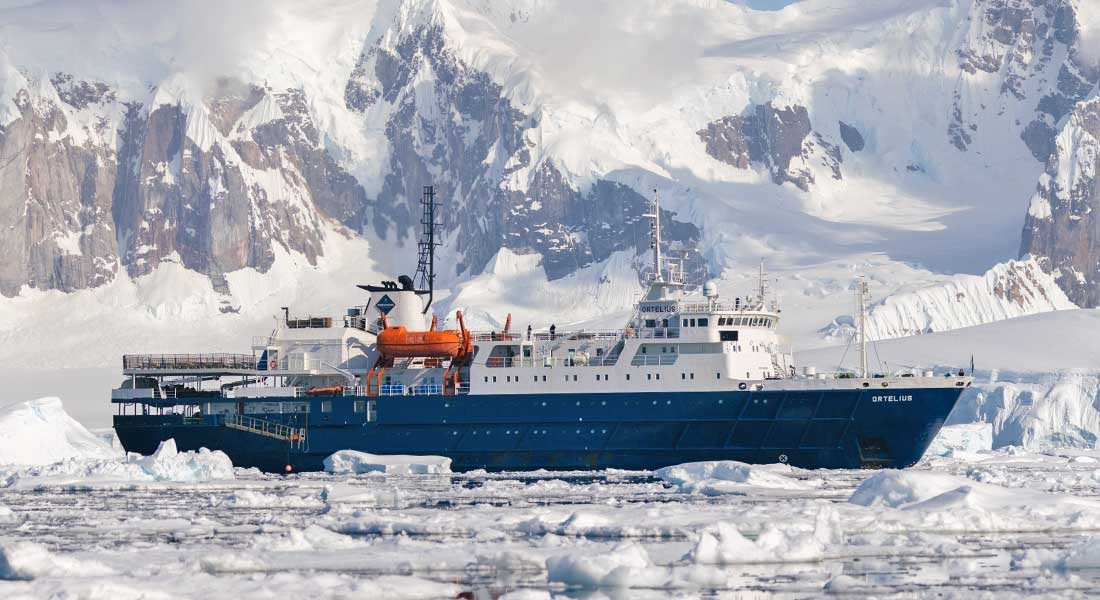
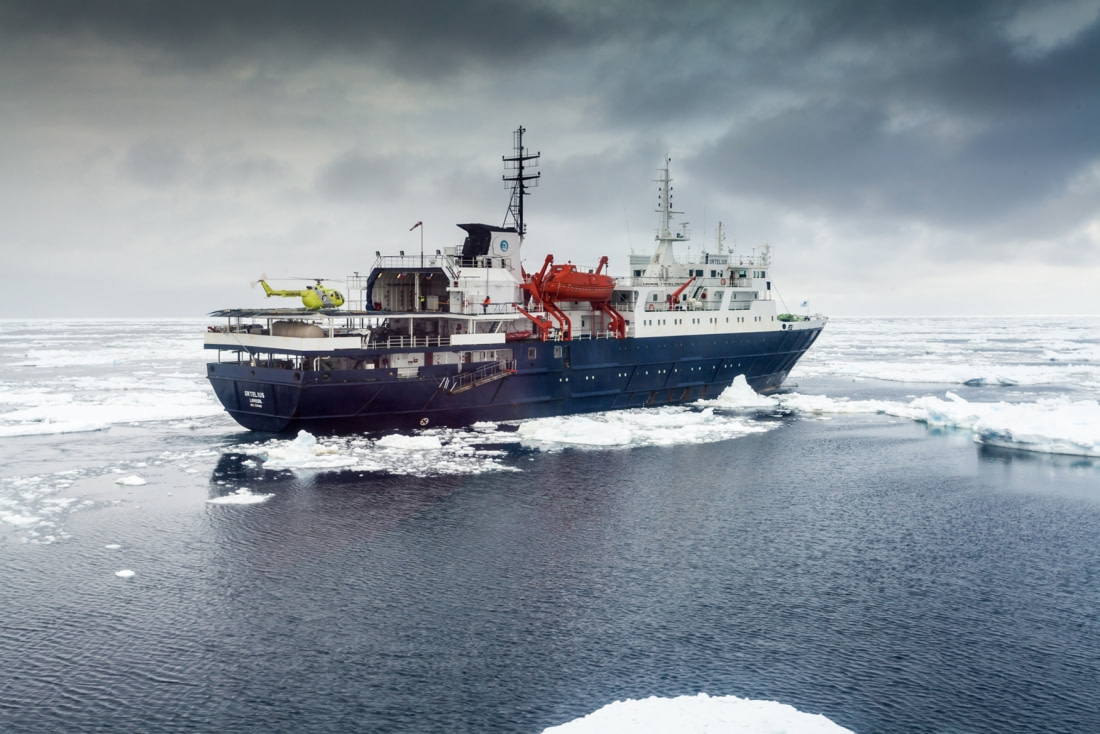
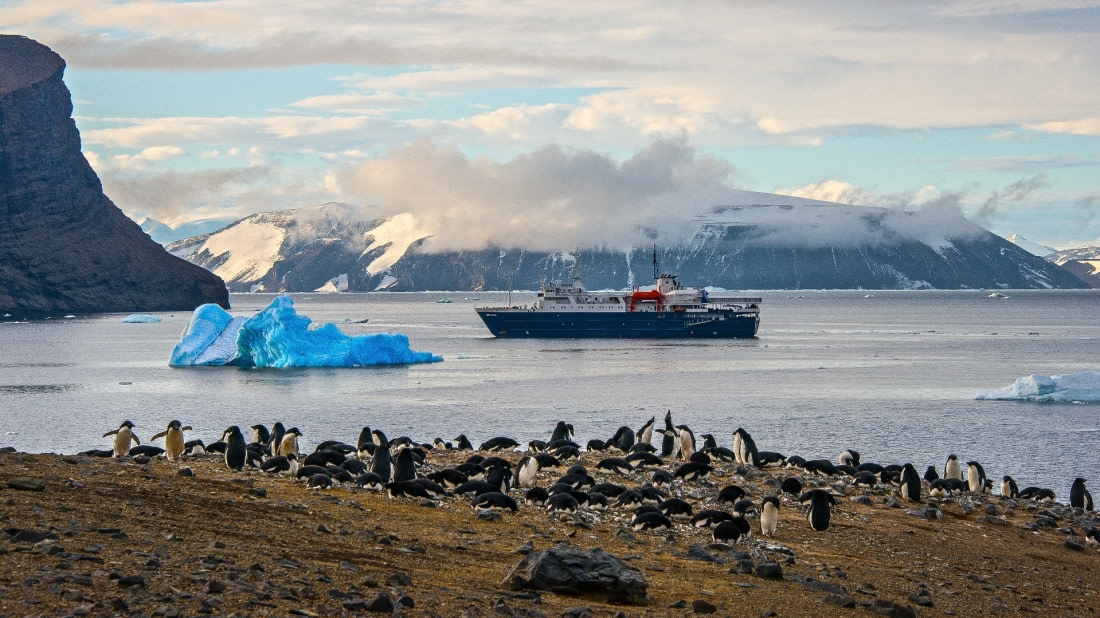
El Ortelius, reforzado para navegar en el hielo, está completamente equipado para la exploración polar y, en caso necesario, para vuelos en helicóptero.

Más información El Ortelius »
Loading