Ortelius Heads North to the Arctic – or does she?
“Why are we going around in circles?” Only one recently embarked passenger voiced the question that the other 99 were thinking. Our expedition ship Ortelius had just left the dock on her first voyage of the season when she slowly turned a full circle not once, but twice. It seemed as if the ship was not completely certain in which direction to travel, her nose testing the wind. To a certain extent that was the truth of the situation. We knew our destination to Svalbard and therefore the direction of travel should be north: but our ship didn’t know this, yet.
New lecture facilities installed during dry dock
For the preceding three weeks, Ortelius and her crew had been alongside at the ship yard in Hansweert, The Netherlands, for the annual docking period. It’s a hectic time of maintenance, replacement, refurbishment, testing and decorating. Safety systems are up dated, passenger and crew accommodation improved, new lecture facilities installed. Old equipment, walls and doors had been removed and new installed. Most of these items contain steel and of course steel is magnetic.
We have GPS – do we still need a compass?
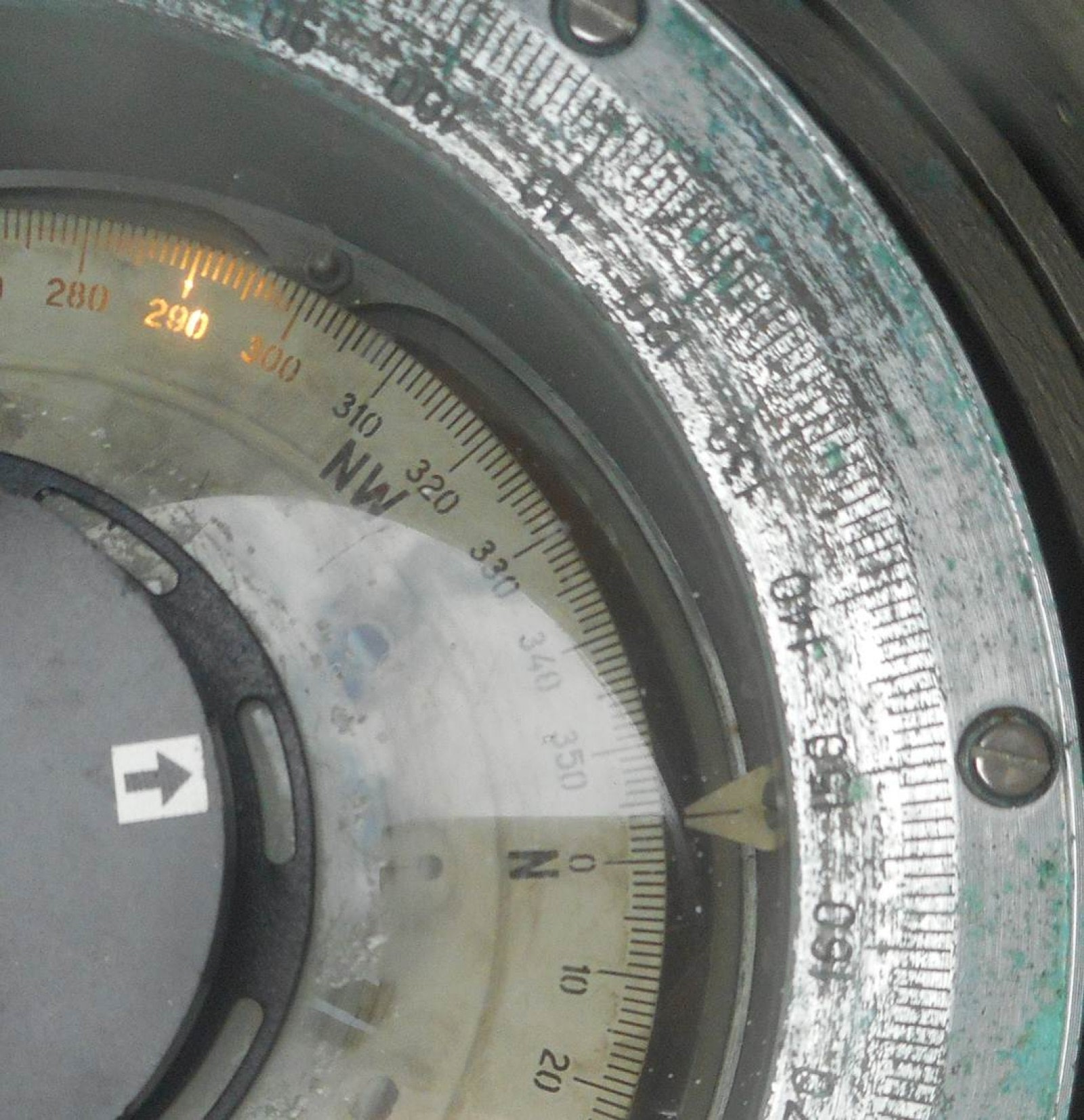
Steering by the compass might sound old school in these days of GPS and satellite, but every ship is required to have one, as you never know when you might need to use it. The compass points to the magnetic north pole, but can be rendered inaccurate when surrounded by magnetic material, such as our steel ship and all her contents.

Magnetic compass display aboard Ortelius © Oceanwide Expedition
Not many children want to be a Compass Swinger when they grow up…
A “Compass Swinger” (that’s a real profession by the way) was embarked for the first 30 minutes of the voyage and under his direction Captain Ernesto Barria turned the ship through a full 360 degrees in order that the compass could be “compensated” for all the changes in the metal fabric of the vessel. The Swinger adjusts the large steel balls sitting either side of the binnacle, as these ferrous balls are the compensators. A second circuit was made to confirm the adjustment and then we were off. North, by the now very accurate compass, to the Arctic and the midnight sun.
Soul of the Ship
Victor Hugo, the French romantic author, spent many years in the Channel Islands where he became acquainted with sea-farers and their ways. He described the compass as the “Soul of the Ship”, which is still true today. Our compass is mounted centrally, atop the wheel house, in pride of place. Even if modern technology reduces our dependency on the magnetic needle, having a sense of direction is key to the raison d'être of any ship.

Electronic compas aboard Ortelius © Oceanwide Expeditions
So important were compasses to early mariners that the penalty for tampering with the instrument was to be pinned to the mast with a dagger. Hugo, as campaigner against capital punishment, would not have approved.
Recommended Reading
Alan Gurney’s book Compass: A Story of Exploration and Innovation chronicles the misadventures of those who attempted to perfect the magnetic compass. Gurney, who also wrote about early explorations towards Antarctica, pens a scholarly and well researched book that none-the-less remains readable.
By Jim Mayer
Assistant Expedition Leader and Author Shackleton – A Life in Poetry