• Accueil
  • Triplogs
  • OTL24-25, trip log, Weddell Sea - In search of the Emperor Penguin, incl. helicopters

OTL24-25, trip log, Weddell Sea - In search of the Emperor Penguin, incl. helicopters

by Oceanwide Expeditions

Galerie de photos

Journal de bord

Day 1: Embarkation Day, Ushuaia

Embarkation Day, Ushuaia
Date: 01.12.2025
Position: 54°48.7’S, 068°17.8‘W
Le vent: ESE4
Météo: Cloudy
Température de l'air: +15.7

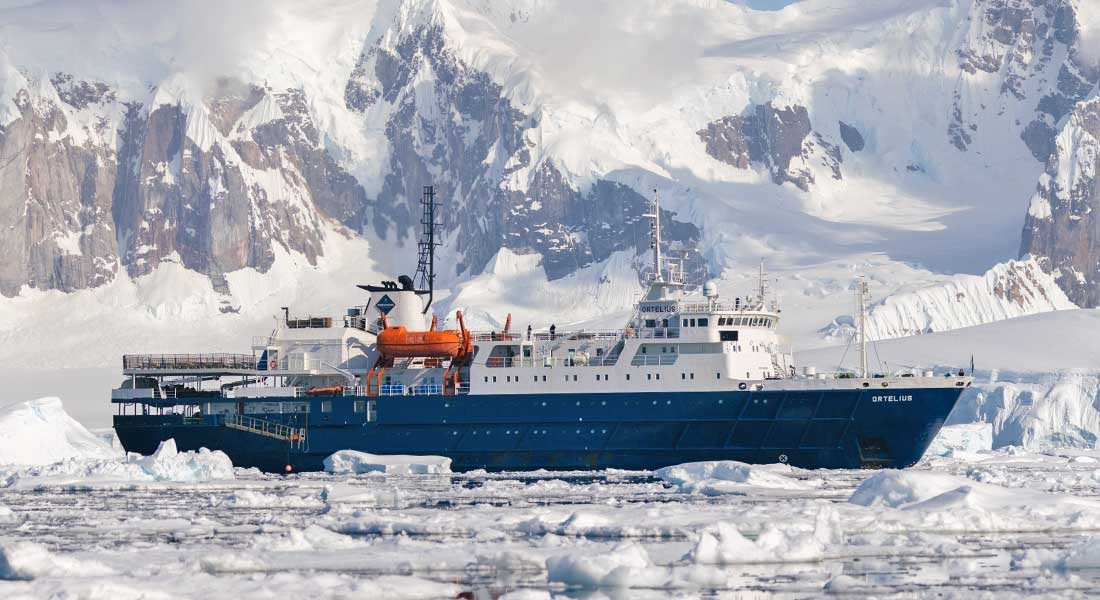
Most of us arrived yesterday in Ushuaia and enjoyed a good night sleep in a hotel in town. After exploring Ushuaia in the morning, we made our way down almost to the end the pier to embark on our new home, the MV Ortelius, for the next eleven days. While boarding we’ve met some of the guides and after checking in we were brought to our cabins by one of the stewards from the hotel department and found our luggage already there. We got acquainted a little with the ship and found the tea and coffee station in the lounge on deck 6.

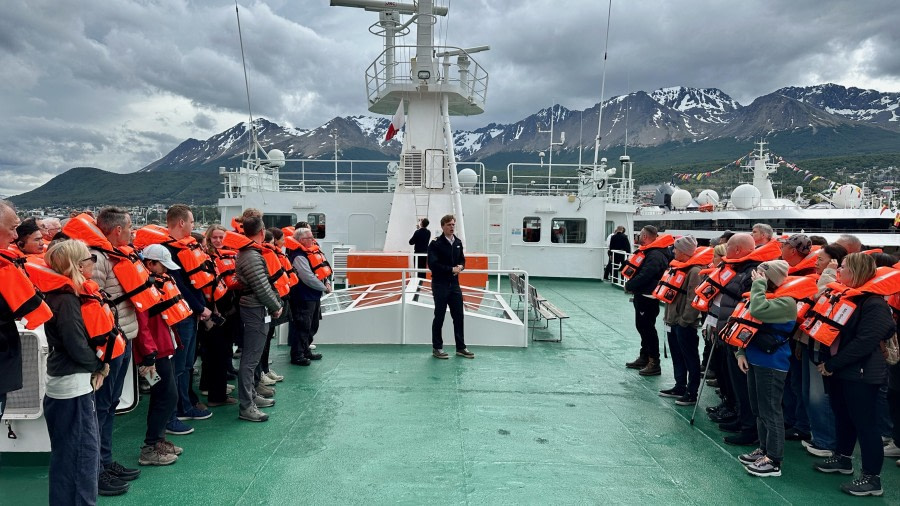
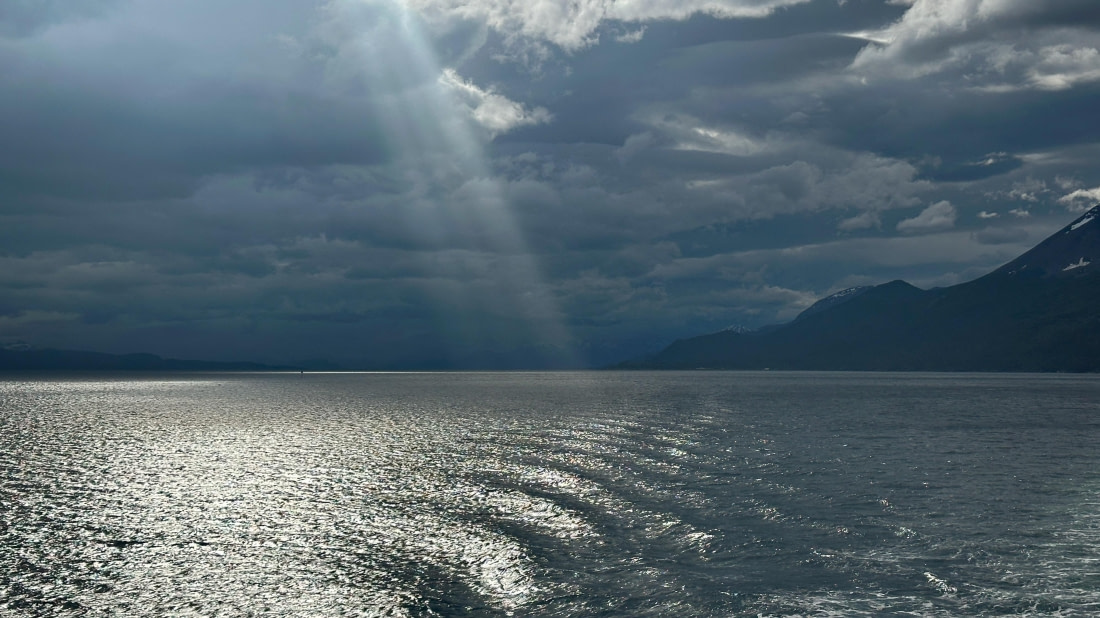
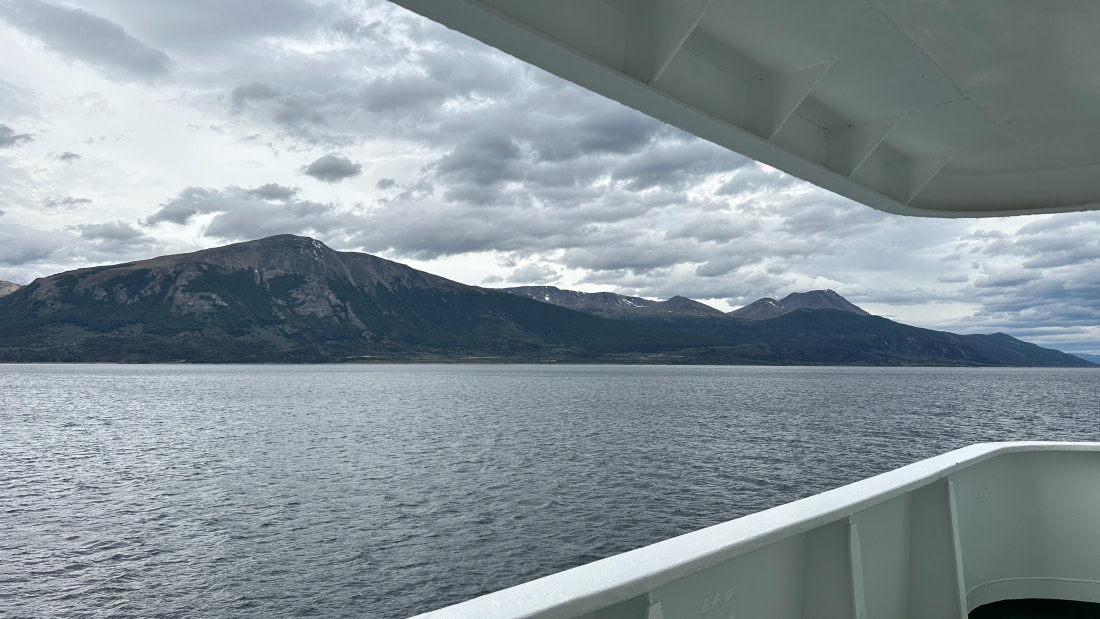
This is where we all were welcomed at 15:15 for to receive a brief introduction to your new home aboard MV Ortelius, followed by a mandatory safety briefing and lifeboat drill. We stayed out on deck as the vessel was leaving the pier and enjoyed the views, when we set sail into the Beagle Channel under a beautiful, dramatic cloudy sky.

At 16:45 we were asked to join our Expedition Leader Pippa and her Expedition team in the lounge again for Captain’s cocktail. We were handed a glass of prosecco or orange juice and were treated with an array of lovely snacks. Captain Remmert Koster welcomed us on board and raised our glasses to a good voyage. After that the expedition and helicopter team came up to introduce themselves. And followed not much later by another mandatory meeting, the Zodiac & IAATO Briefing on the zodiac operations and our behaviour ashore in Antarctica.

We then were invited to come down to deck 4, where the dining room doors had opened. We enjoyed a delicious dinner prepared by the galley team.

Many of us were tired from travelling and from the anticipation of beginning our exciting journey and headed to our cabins for an early night. Others stayed up to watch the sun go down and enjoy the birds and scenery of the Beagle Channel and enjoyed a drink at the bar with our new ship mates.

Day 2: Sailing towards Antarctica

Sailing towards Antarctica
Date: 02.12.2025
Position: 57°23.7’S, 065°08.1‘W
Le vent: NW5
Météo: Partly cloudy
Température de l'air: +6

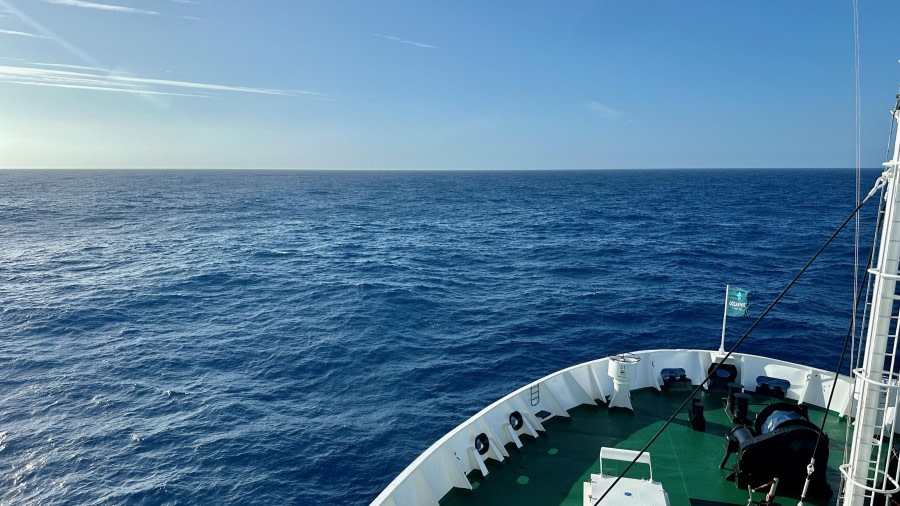
This morning, we were excited to wake up to our first full day of the journey. The Drake Passage was surprisingly smooth given the approaching front looming in from the west.

The keen birdwatchers were thrilled to spot some exciting Southern Ocean birds throughout the morning including three types of albatrosses, the Light Mantled, Grey Headed Albatross and Black browed. Also, the Southern Giant and Blue Petrel, Fulmar and the elegant Antarctic Prion. Some of us were also very lucky to spot a few penguins. They saw Rockhoppers, Macaroni and even a King Penguin was seen. As well as a Fin Whale!

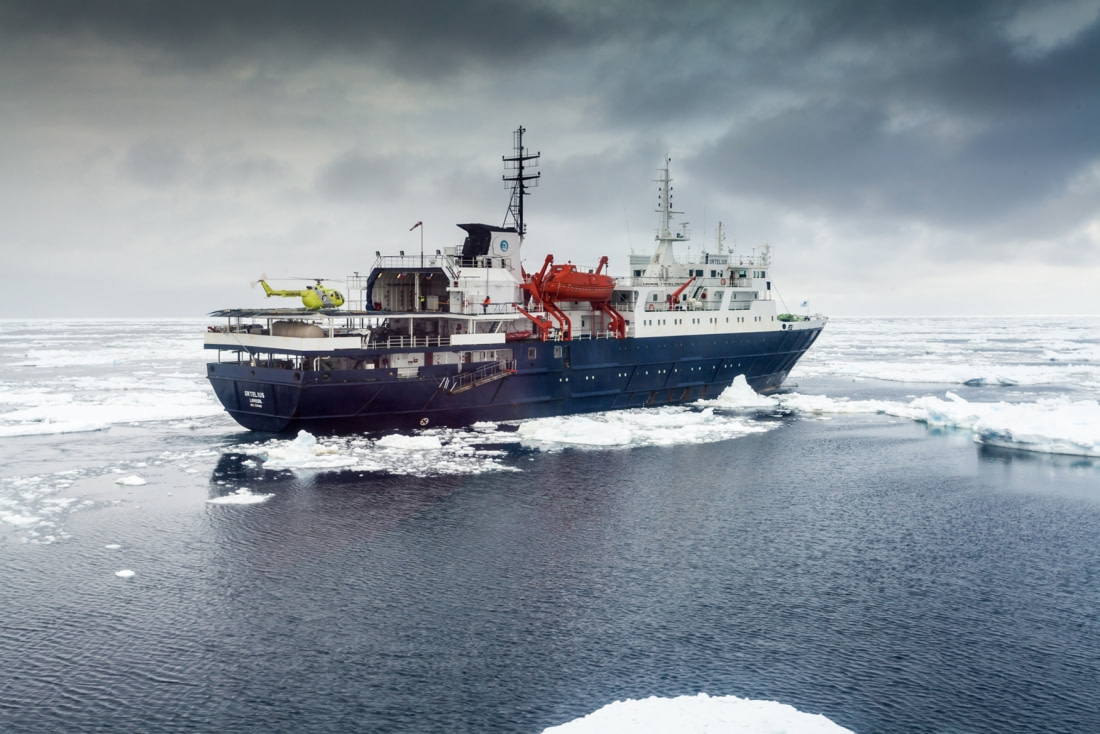
After a great breakfast, Expedition Leader Pippa and Assistant Expedition Leader George invited us to the lounge on deck 6 to receive a briefing about helicopter operations, so that all would go smoothly on the day of operations.

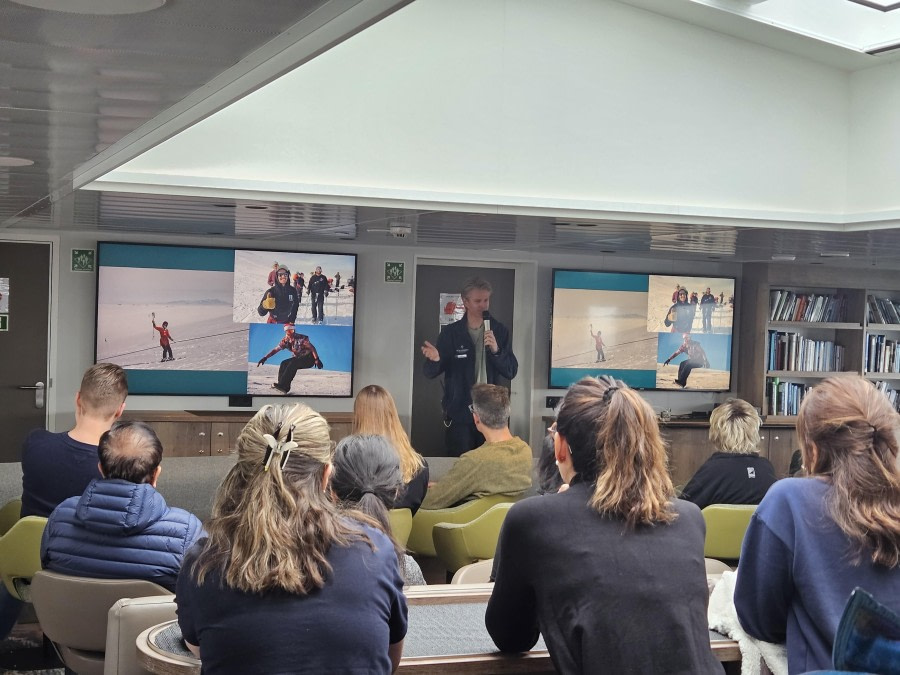
Then Expedition guide Gary then gave a wonderfully entertaining and informative talk about penguins, giving us an introduction to the species we would hopefully come across. He also shared his extensive knowledge about their behaviour and biology which helps them to survive in Antarctica.

After lunch we headed down to lower deck 3 and collected our Muck boots plus any spare hire equipment. We also received our helicopter cards with our individual number to use on the day of operations. Despite the rocking and rolling, which made some of us seasick, everybody turned up. This was then followed by our practical Helicopter training where we performed a ‘dry run’ of operations which cemented the theory we learned in the morning. Simultaneously, we completed our IAATO Biosecurity checks so that we would not bring any unwanted diseases, pests or exotic species to Antarctica. A busy afternoon but now we were set for our adventures ahead!

Just before dinner Pippa informed us about the plans for tomorrow, that we would be visiting the remarkable Deception Island. This was followed by a very informative recap where Pippa, this time, explained us about the dynamic Antarctic Convergence Zone, while Gary took us into the wonders and mechanics of soaring seabirds and Saskia recounted a fantastic story of finding Longitude at sea back in the 1700’s.

During a lovely plated dinner, prepared by Head chef Ivan and his gally team, we got the chance to get to know each other some more. Our ship MV Ortelius chugged southbound and later that evening around 21:00 we crossed the 60° Southern Latitude and now officially sailed into the Antarctic waters.

Day 3: At sea and Deception Island

At sea and Deception Island
Date: 03.12.2025
Position: 62°25.9’S, 062°06.4‘W
Le vent: NE5
Météo: Overcast / fog
Température de l'air: +0.6

This morning, we woke up to another misty morning as we continued southbound towards the South Shetland Islands, on our way to the unique caldera of Deception Island. Many early birders were fortunate to witness some more beautiful soaring albatrosses as well as several petrels including Blue, White-Chinned, Wilson’s, Pintado and a Black-bellied.

After breakfast we were invited by Expedition guide Beth to join her in the lounge up on deck 6 for her lecture on “Antarctic Ice”. Where she told us all about the many forms of ice that we would encounter on our voyage towards the Weddell Sea. Not much later we saw our first iceberg popping out of the fog. Later that morning Expedition guide Jess taught us some interesting facts and the differences between the whales, dolphins and porpoises around the Antarctic Continent in her lecture “Whales of the Southern Ocean”.

As we continued sailing south and enjoying lunch in the dining room on deck 4, it began to snow quite heavily. It felt quite appropriate somehow, sailing down in these higher latitudes.

Some took it easy in the cabins to ride out the increasing swell and some managed to read, chat or play cards in the lounge. Because we would still be on land during normal recap hours just before dinner, we were called to the lounge at 14:30 already. To join our Expedition Leader Pippa and hear about the plans for tomorrow already and a little reminder on Whaler’s Bay, where we would land later today. Beth followed up with an interesting presentation on the geological history of this fascinating island, Deception, which almost on cue appeared on the horizon through the fog.

Just before 16:00 we were invited up to the bridge to witness the impressive passage through Neptunes Bellows with the large cliffs on either side. Just 2.5 metres below the surface, in the middle of the passage, lies Ravn Rock. But the experienced Bridge Team, under the command of Captain Remmert Koster, manoeuvred our Ortelius smoothly past it. Quite impressive!

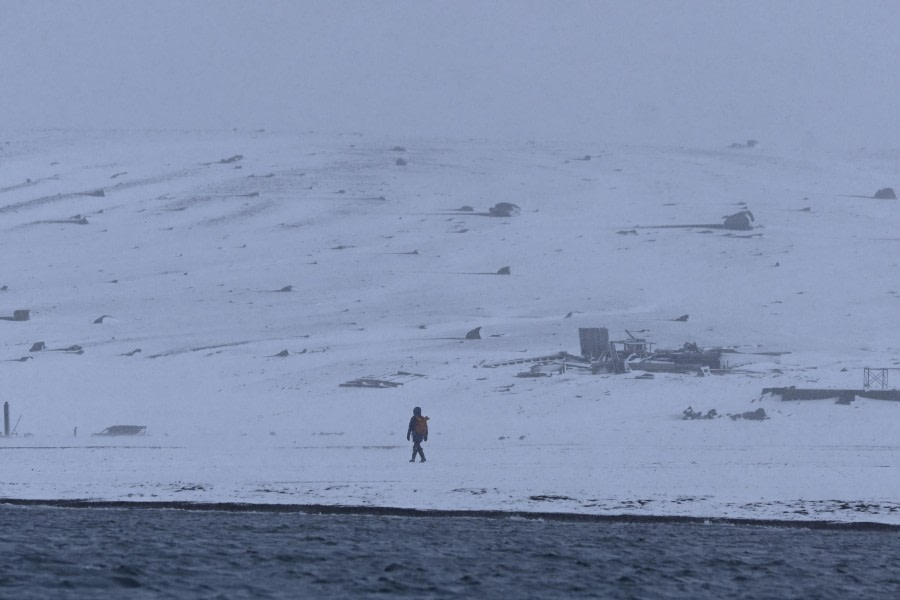
At 15:45 we headed towards the gangway to get ready for our first landing on this trip at Whaler’s Bay. It was cold and windy – a real Antarctic blizzard. We wrapped up warm. It was wonderful to be greeted by curious Gentoo and Chinstrap penguins and walk around the historic buildings and infrastructure of the early 1900 whaling era and later to be used by the British Antarctic Survey as part of operation ‘Tabarin’ in 1944, to collect meteorological data for allied shipping in the South Atlantic during World War II. In 1967 and 1969 the volcano became active again and with the eruption destroyed a lot of the buildings and artifacts of the whaling era, many graves and existing scientific stations, including the Chilean base. A thick layer of snow covered the black beaches; this combined with the fog and many shades of white and grey made Deception Island look almost magical. The wind picked up just in time for our ride back to the vessel and we were glad to be back in the warmth of the ship.

At 19:30 our hotel manager Volodymyr called that dinner was ready, and the dining room team were waiting for us to welcome us. Everybody was hungry after our afternoon in the cold outside and enjoyed the great food before settling in for the evening.

Day 4: Kinnes Cove and sea ice landing

Kinnes Cove and sea ice landing
Date: 04.12.2025
Position: 63°17.9’S, 056°36.9‘W
Le vent: Var 2
Météo: Cloudy
Température de l'air: -1

“The ice was here, the ice was there, the ice was all around. It cracked and growled and roared and howled, like noises in a sound.”

These words are from an epic saga titled ‘The Rime of the Ancient Mariner’ by English poet Samuel Taylor Coleridge. There are no better words to describe the scene that greeted us this morning as Pippa’s wake-up call echoed around the ship. “Good morning, everybody. Welcome to the Antarctic Sound.” Overnight Ortelius had crossed the turbulent waters of Bransfield Strait and found wonderfully calm conditions off the end of the Antarctic Peninsula. Our destination was Kinnes Cove near the west end of Joinville Island, but it was still a couple of hours away given the ship’s reduced speed through the ice.

After breakfast we were encouraged to spend time on the bridge or outer decks, to enjoy the world of ice all around us. Several colossal tabular icebergs dwarfed our ship, leaving many observers quite speechless. It was around 09:30 by the time Ortelius came to a halt at Kinnes Cove. Ten Zodiacs were quickly launched by the deck crew, and we were soon boarding them for two hours of exploratory cruising in the area. As we headed out across the sea, lots of penguins were seen porpoising through the water as they made their way towards land. It quickly became obvious that we were in for a special penguin encounter.

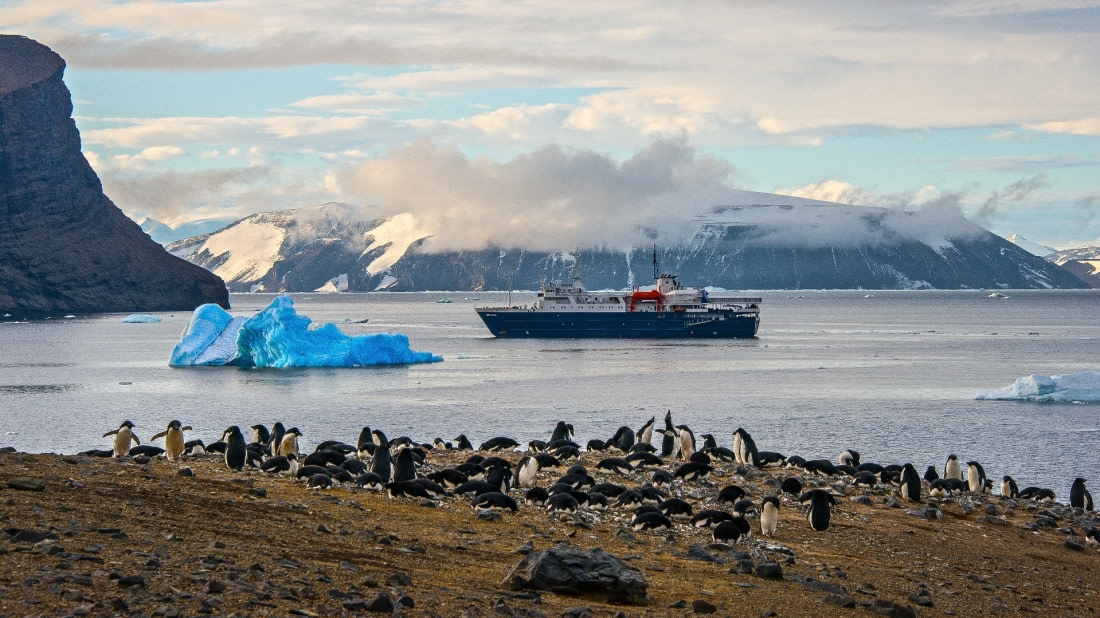
The principal point of interest at Kinnes Cove is a large colony of Adelie penguins, thought to number between 20,000 and 25,000 breeding pairs. Scattered among them is a much smaller number of Gentoo penguins, estimated to be in the region of 450-500 breeding pairs. The zodiacs went off in different directions, always sticking together in pairs for safety reasons. Each pair wrote their own adventure, but ultimately all zodiacs at some point cruised along the coastline near Madder Cliffs where the main concentration of penguins was busy going about their business. Many penguins were on nests, sitting very tight on their precious eggs, as Kelp Gulls and Brown Skuas patrolled overhead looking for an opportunity to steal them. The penguins guarded their eggs with their lives because they are very close to hatching time.

Here and there Snowy Sheathbills could be seen at the water’s edge or up among the penguin colonies, looking for opportunities to feed. These unusual pigeon-like birds have a varied diet and will eat absolutely anything, making them true survivors in this hostile environment. Their unsavory feeding habits have gained them the unfortunate nickname of “Sh*t Chickens”, because a large part of their diet is the guano/feces of other birds and animals. They are the only land bird that breeds in Antarctica, and therefore the only Antarctic bird that does not have webbed feet. Also referred to occasionally as ‘Antarctica’s Ugly Duckling’, they are the most humble and under-appreciated bird in Antarctica.

Two hours passed very quickly, and soon it was time to head back to Ortelius. On the way back, zodiac drivers took the opportunity to ‘play’ a little in the ice and show us what remarkable, tough and versatile boats the zodiacs are. This was a lot of fun. Adelie penguins rested on icefloes, providing some fantastic final photo opportunities. No sooner were we back on board, and lunch was announced. The hot meal went down a treat, returning some much-appreciated warmth to our chilled bodies. Meanwhile, Ortelius headed deeper into the Antarctic Sound.

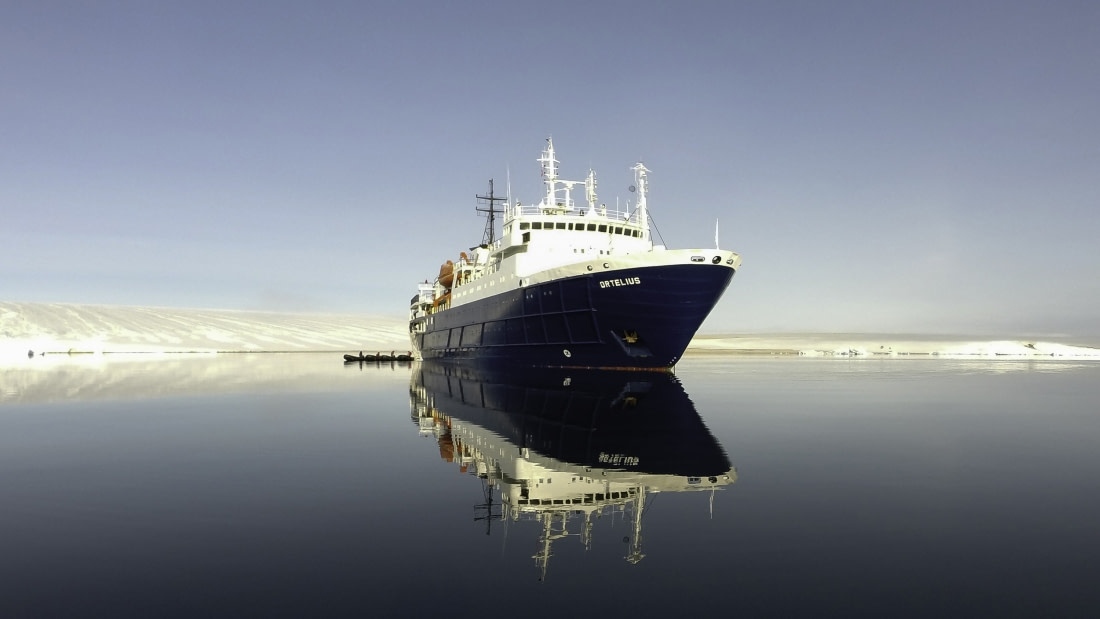
The early part of the afternoon was spent navigating through ice, heading for a location called Active Sound. Conditions were sublime, with icebergs, mountains and birds in flight reflected in a glassy calm sea. It was a fabulous time to be out on deck. Pintado Petrels glided around the ship while Adelie penguins porpoised their way home. In the midafternoon we came up against an expanse of fast ice which stretched deep into Active Sound, the narrow channel between Joinville and Dundee islands.

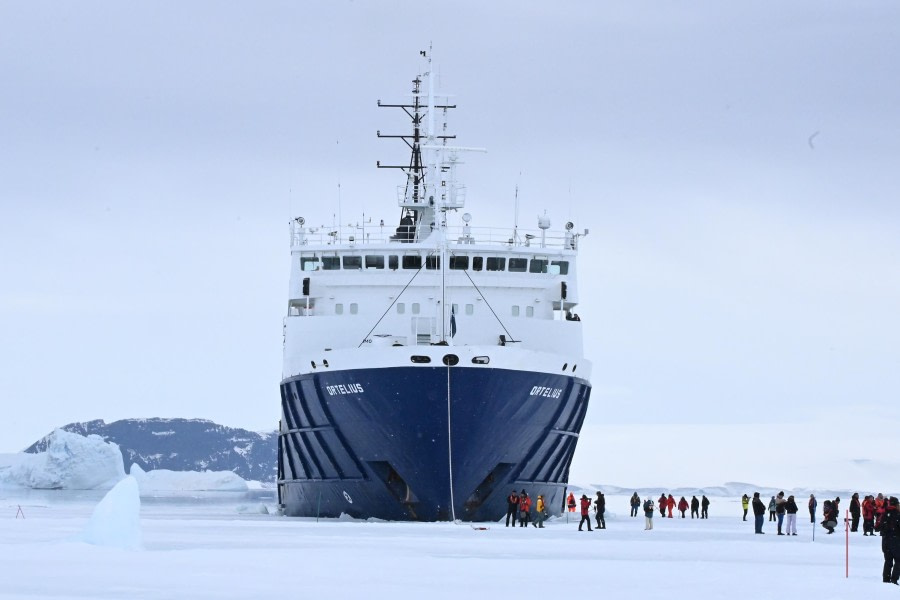
Captain Remmert drove Ortelius into the edge of the ice and powered ahead until the ship was securely “garaged”. A gangway was lowered, and the expedition staff went out on the ice to determine its condition. Word soon came back, that it was all very safe, and we were offered the unique opportunity of taking a walk on the ice. The ship had 160 meters of water under her keel, and we had just half a meter of ice under our feet. The guides marked a 1km safe route for us to follow, which terminated near a picturesque iceberg that was trapped in the ice. Adelie penguins tobogganed across the ice, providing wonderful photo opportunities as they sped towards the ship for a closer look at the strange contraption. Nearby on Dundee Island we could see the brightly painted buildings of Petrel Station, which belongs to Argentina. There were signs of activity by the base personnel, and the faint noise of their machinery drifted across the ice. All too soon, it was time to return to the ship. Many reluctantly left the ice. A briefing on the next day’s activities was delivered by Pippa, and then it was time for dinner.

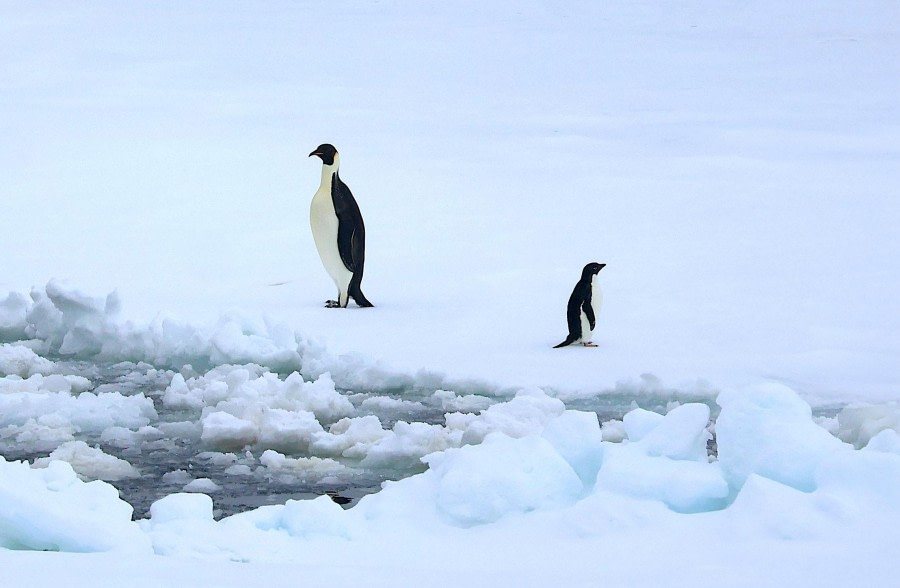
Ortelius remained in her parking spot over dinner, allowing those who ate quickly (or skipped dinner altogether) the opportunity to spend some time out on deck taking in the spectacular surroundings. At around 20:30 it was announced that a large penguin had been spotted on an icefloe some distance from the ship. The decision was made to leave the fast ice and see if we could get a closer look. But it unfortunately disappeared in the water.

Day 5: Sailing through the Antarctic Sound

Sailing through the Antarctic Sound
Date: 05.12.2025
Position: 63°38.6’S, 056°13.2‘W
Le vent: NE4
Météo: Overcast
Température de l'air: -1.4

This morning, we were woken by our Expedition Leader Pippa with tabular icebergs surrounding the vessel and penguins purposing through the open water around us, creating trails of ripples in the glassy water as they went. In the wake-up announcement we were also notified that some Orcas had been seen briefly at a distance. Having navigated as far as this lead would take us last night, it was time to fire up the engine again and start meandering further south. We followed the leads where there were breaks in the ice and pushed our way through bands that blocked our way.

Firstly, we headed north slightly, with Rosamel Island appearing ahead of us. This allowed us to steer to port and find another lead further west that we could follow south again. As the bridge team carefully navigated us through the ice, we enjoyed the conditions out on deck, watching the variety of wildlife that call this place home. We saw plenty of Giant Petrels resting on the ice between meals. It is impressive to see these birds taking off as they appear quite unbalanced when walking so, they need to put out their large wings. Eventually, they face the wind, flap and stride along the surface below, stretching their legs into large steps with their huge, webbed feet leaving imprints in the snow.

There were a number of dead crabeater seals providing a feast for the Giant Petrels. These were easy to identify as a congregation of birds often surrounds the rare meal left out on the ice. As we peered through our binoculars, we could identify a surprising number of white morph giant petrels. These are thought to make up less than 1% in Antarctic colonies.

There were a number of announcements throughout the morning of these wildlife encounters. One which was a highlight for some was the Antarctic Petrel which is often found amongst the more ubiquitous Cape Petrels. We also had many Snow Petrels, who nest on the surrounding volcanic cliffs. These are considered special to see, however, in this Weddell Sea area we have seen many.

We were making good progress south and, although it was cloudy, we could see some of the islands to the south. By 10:00 it was time to begin some scenic flights before the poor visibility came in, as was forecast for early afternoon.

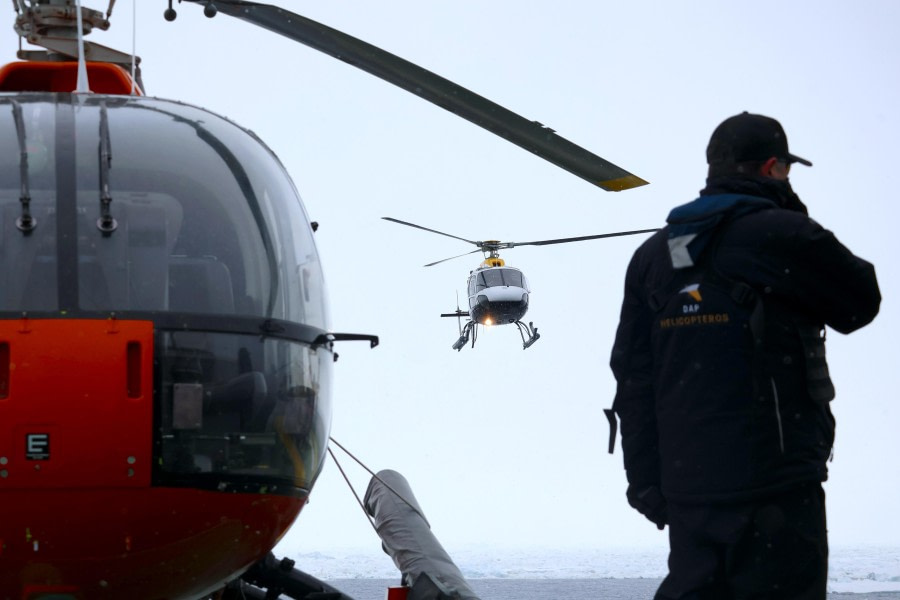
It was very exciting getting all geared up and heading to the lounge when our groups were called. We moved forward in the departure lounge, eventually making it to the front row where we would be the next ones to head out. The helicopters, Romeo, Tango and Victor, each set off up in the air, taking the groups to explore the surrounding icebergs, islands and vast open landscape. It was truly spectacular to look down on tiny Ortelius nestled in the endless ice of the Weddell Sea which stretched out, fractured and contorted, reaching the Paulet, Dundee and Jonassen Islands.

By 12:15 the visibility was closing in and snow began to fall on Ortelius’s decks. The pilots called it off as these conditions are not safe to fly. However, they were eager to keep an eye on how things changed with the hope that we could restart again soon. After a delicious lunch from our galley team and a small break, looking hopefully out of the window, it was time to get going again. Unfortunately, only two flights took off, meanwhile the others lined up patiently in the departure lounge. The flights returned but this time it was final, the visibility was not good enough for safe operations so we would pause until the weather improved. This would most likely be the following morning according to the forecast.

Those who had flown excitedly shared videos and photos as the snow fell on the outer decks. During the afternoon, the time allowed for Allan to give a wonderful talk on an incredible journey that took place in this very area. We listened with disbelief, captivated by how Allan told the story of this remarkable Swedish expedition, led by Otto Nordenskjöld in 1901-03.

The keen spotters amongst us spent hours on the bridge in search of what life there was in this remote and harsh southern extremity of the world. After hearing about the men of the Nordenskjöld Expedition, we reflected on what a privilege it was to visit these waters in the comfort of a ship like Ortelius.

Finally, we had a recap of the day where Sam and Gary shared with us some insights into sea ice formation and the icebergs that we have been seeing down here. A lovely dinner filled us up nicely before we headed to bed ready for an early start tomorrow.  

Day 6: Scenic flights Weddell Sea / zodiac cruise fast ice edge Dundee Island

Scenic flights Weddell Sea / zodiac cruise fast ice edge Dundee Island
Date: 06.12.2025
Position: 63°37.5’S, 056°43.5‘W
Le vent: ESE5
Météo: Overcast
Température de l'air: -0.1

“Good morning, good morning” came the wake up call this morning. It’s a funny feeling to be excited about a wakeup call at 06:00. But the early morning call meant that the sky was clear enough to fly. As promised, the first flight of the day took off from our cozy ship at 06:30. We spent the morning getting the second half of everyone up in the air for a run around the local icebergs. The weather held all morning, so we managed to finish getting everyone up for their first experience with seeing this beautiful landscape from the sky. Each flight was about 20 minutes of flying low over the ice, circling the ship, and flying up close to some of the massive tabular icebergs dotted around the seascape. There was even a bit of ‘Star Wars’ flying up and over a large canyon between two pieces of a recently split iceberg. Exciting for all.

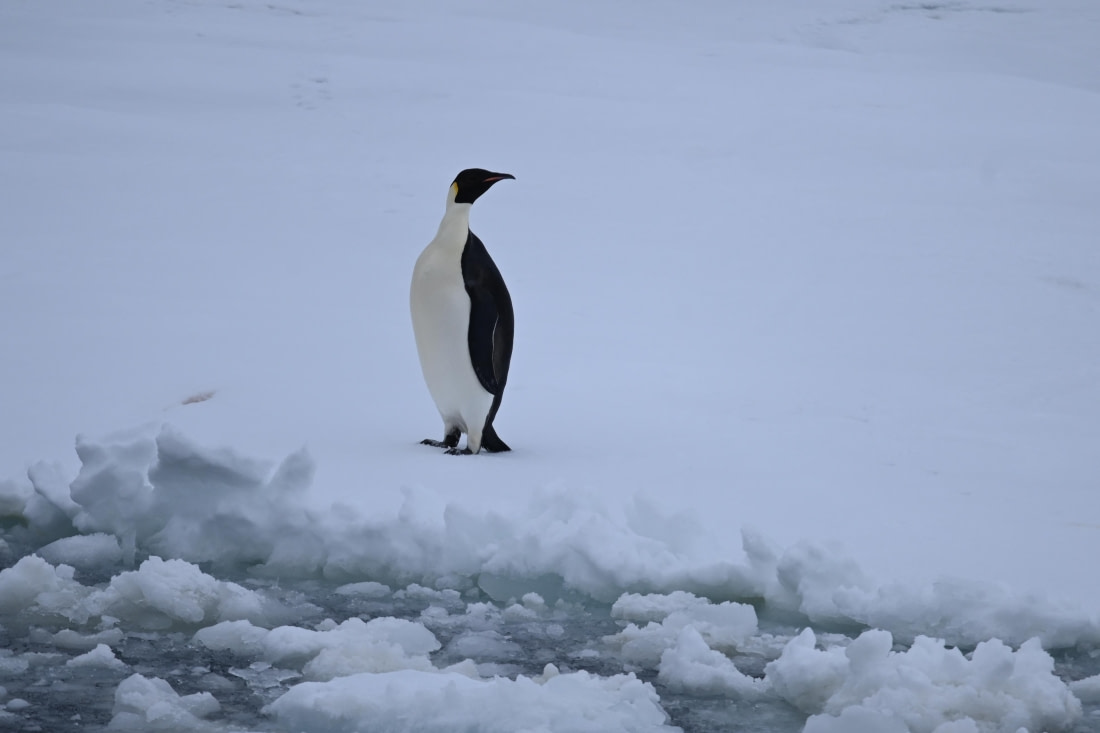
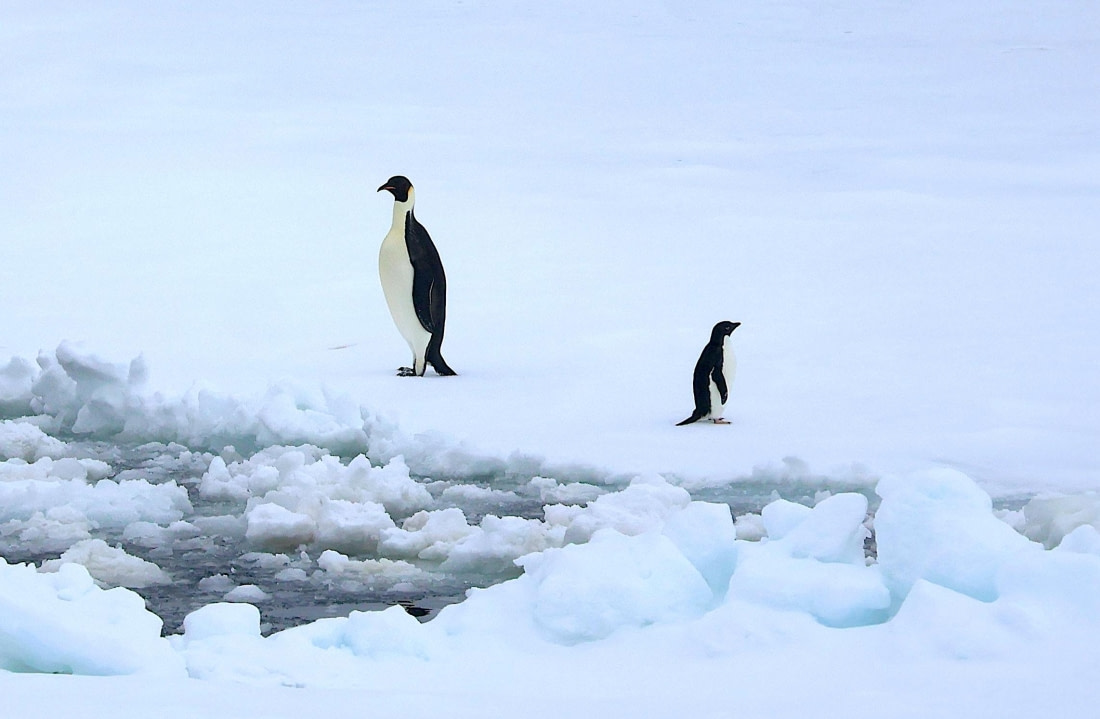
Once the flights were finished, the new ice chart indicated that Brown Bluff seemed to be open enough for us to attempt a landing, so we headed off to see for ourselves. Meanwhile, some Expedition guides and crew were keeping a sharp eye out for Emperor Penguins out on the sea ice while we motored towards Brown Bluff. George, in the meantime, gave us a run down on the geopolitics of Antarctica. It turned out that George needed to rush through the last part of his talk because Jess spotted an Emperor Penguin on an ice floe. That was the best view we’ve had so far on the trip. One was spotted last night from a great distance, but this one stood proudly on the floe while the captain deftly maneuvered quite close so we had excellent views. Eventually the penguin decided to take a swim and disappeared into the water.

From that point it was clear that Brown Bluff was blocked by too much ice, so instead we headed towards the east side of Antarctic Sound for a zodiac cruise near Petrel Station. We had plenty of Adelie Penguins on the edge of large ice floes, as well as Antarctic terns, shags and Cape Petrels. There were also plenty of fine icebergs to inspect along the way.

As we came in from our cruise, the hotel staff had been busy preparing for an outdoor barbecue on the top deck behind the bridge. But first a quick briefing on our plans/hopes for tomorrow. Unfortunately, the weather forecast has deteriorated over the last little while. We still had some optimism that we may have an opportunity, but from such a distance, it seemed unlikely that we would have a long enough window of visibility for 13 hours of helicopter operations. We then went up to deck 7 to enjoy a fantastic buffet of barbecue delights as well as glühwein and other free drinks. Quite a few braved the cold temperatures for a full Antarctic barbecue, including music to dance to and warm up to while many others opted for the comfort of the lounge to eat their meal.

As things were winding down, the remains of the barbecue celebration moved inside, along with the music. And then the call came from the bridge - Orcas! What a fantastic punctuation to a pretty busy day. We had a group of about 20 Type B Orcas swimming in the open water around the ship. At times they came right alongside so that they were within a body’s length of the side of the ship. Some of us had to come back up from our cabins after having retired for the night, but most came up for an unprecedented display of Orca activity. That lasted for a good while, but eventually, as the light faded, everyone headed down to their cabins to rest for tomorrow. High hopes of a miraculous weather change but certainly looking forward to a bit of flying around the north end of the Weddell Sea.

Day 7: Scenic flight & ships cruise Antarctic Sound

Scenic flight & ships cruise Antarctic Sound
Date: 07.12.2025
Position: 63°32.8’S, 056°26.3‘W
Le vent: Var 2
Météo: Cloudy
Température de l'air: -0.2

Today was an unforgettable day that brought us a rollercoaster of emotions. We woke up to head for an early morning briefing about the plans for today in the lounge. Here, Pippa confirmed that, as we suspected, the weather was not suitable for flying a long distance to Snow Hill today. It was sad to receive this news, but everyone understood and trusted the expertise of the pilots who said it was just not safe to fly.

We began preparations for doing some scenic flying in the helicopters instead. However, the wild nature of Antarctica had other plans for us, and there was a call to say that there was another pod of orcas outside. We raced up to the outside decks from breakfast to find an unbelievable scene. There was a large pod of orcas, and they were hunting penguins!

We could see Gentoo penguins, that looked tiny compared to the orcas, swimming and jumping for their lives. The sea was so calm that we could see the orcas and the penguins clearly under the water, racing along under the surface, the penguins were leaping from the water to try and gain some speed, and they would suddenly try to change direction to outsmart the orcas. Sometimes the orcas would catch the penguins and let them go again. It looked like the adults in the group were teaching their young how to catch the penguins and the calves were seen playing and joining in. Eventually the orcas killed and began to eat a penguin right next to the ship. It was such an incredible spectacle to witness this behaviour. Something that guides like Gary, who have been working in Antarctica for thirty years, had never seen before.

With a spring in our steps, we began our scenic flying operations. Everyone was excited to take to the skies again and see the icebergs and the surrounding islands and fast ice of the Weddell Sea from the air. The pilots gave us such an exciting ride too, surprising us with a few tricks in the air to make us laugh. Some passengers saw seals resting on the sea ice that we had walked on a couple of days ago and even the orcas were spotted again from the helicopters.

We had lunch and quickly returned to the decks and the bridge to enjoy the navigation back through the Antarctic Sound. We watched in awe as Captain Remmert and the bridge teams weaved through larger ice flows. We had some great views of Weddell seals and a Crabeater seal and the orcas were spotted again in the distance.

In the afternoon the Expedition Team invited us onto the bow for a treat. We enjoyed some homemade hot chocolate from the galley with some cream and a little rum to warm us up. We soaked up the atmosphere on deck as we weaved our way through the thick ice, enjoying the birds and the amazing views of the mountains.

We continued enjoying the views throughout the afternoon. At the evening recap, Pippa told us the plans for tomorrow. Jess gave us some more information about the orcas we had seen, and Gary talked to us about ice navigation.  

Day 8: Halfmoon Island and Yankee Harbour

Halfmoon Island and Yankee Harbour
Date: 08.12.2025
Position: 62°39.4’S, 059°22.9‘W
Le vent: VAR2/3 4
Météo: Cloudy
Température de l'air: +1.1

During the night our vessel made a steady crossing of the Bransfield Strait, rolling gently in the long southern swells as we left the Antarctic Sound behind and approached the first islands of the South Shetlands. By dawn, the low cloud that had followed us overnight began to lift, and the morning light revealed the familiar rugged silhouettes of Livingston and Greenwich Islands on the horizon.

Conditions were good when we arrived in the vicinity of Half Moon Island, a narrow, crescent-shaped piece of land nestled in the shadow of Livingston Island. As breakfast ended, the water around us lay surprisingly smooth, reflecting the muted colours of the sky. It was, as many guests remarked, a rare and beautiful Antarctic morning—bright, crisp, and full of promise.

Half Moon Island is best known for its chinstrap penguin colony, and the birds did not disappoint. Their distinctive white faces, sharp black bands beneath the chin, and impossibly expressive movements make chinstraps one of the most charismatic species in the region. As we approached the beach, their calls—part bray, part trumpet—echoed off the stony slopes. The colony was a hub of activity: adults waddled to and from the sea, others busily rearranged pebbles on their nests, and pairs frequently erupted into enthusiastic greeting displays. Many guests lingered long at the colony, watching the birds’ antics. A Weddell seal rested lazily on a snowbank higher up the slope, undisturbed by us passing by and at the beach we found a young Elephant seal hauling out.

Before returning to the ship, however, the morning held one more highlight—and for some, the most memorable moment of the entire voyage: the polar plunge. On the sheltered beach, staff prepared a safe entry point for the volunteers. The water measured just 2°C, cold enough to shock even the most seasoned ocean swimmers. One by one, twenty brave guests stepped forward, each cheered on by a lively audience. Some approached the water slowly, taking a moment to steel their nerves; others charged forward with impressive determination. We headed back to the ship with feelings of exhilaration and relief. It was a fitting finale to a wonderful morning on Half Moon Island.

During lunch the vessel raised anchor and began the short transit to Yankee Harbour, tucked into the south side of Greenwich Island. The harbour is naturally sheltered by a sweeping gravel spit, making it historically one of the region’s most reliable anchorages. Today, however, the weather began to remind us that Antarctica rarely remains gentle for long. As we approached, the wind increased steadily: first 20 knots, then 30, and eventually gusts building up to 44 knots. Conditions remained within safe operational limits, but it was clear that the afternoon landing would require coordination and skill.

Thankfully, our experienced Zodiac drivers were more than equal to the task. Working together with the bridge and expedition staff, they ensured that every transfer from ship to shore was conducted with care. Guests boarded with the assistance of the crew, and the boats moved swiftly through the choppy water, spray occasionally flying over the bows. Despite the wind, the operation ran smoothly, and soon the first groups were stepping onto the beach.

Here we were greeted by a lively gentoo penguin colony. Compared with the morning’s chinstraps, the gentoos presented a slightly more relaxed demeanour—their bright orange bills and distinctive white headbands giving them a gentle, almost curious appearance. Many were tending to nests built neatly from small stones. Others trekked back and forth along penguin highways between the colony and the water’s edge. Their movements were as endearing as ever, sometimes purposeful, sometimes comically hesitant as they navigated uneven stones or paused to assess their surroundings.

The wind roared across the harbour, but within the natural curve of the spit, guests found plenty of shelter, allowing for comfortable wildlife viewing. Across the water, glacier faces rose steeply, their crevasses and blue shadows highlighted under the afternoon light. Every now and then a gust swept across the bay, briefly filling the air with fine spray, yet the mood remained light and enthusiastic. Guides shared the history of Yankee Harbour’s use by early sealers and pointed out the geological features shaped by centuries of ice movement. Eventually, as the afternoon wore on, it was time to return to the ship. Once all were aboard, we set a course away from the South Shetland Islands, the ship rising and falling gently as we left Yankee Harbour behind.

Dinner was served as we began to reposition northward, and conversation throughout the dining room reflected the fullness of our final day on the Antarctic continent: the serene beauty of Half Moon Island, the thrill of the polar plunge, the rugged winds of Yankee Harbour, and the ever-present sense of discovery that had accompanied every moment. After the meal, many guests gathered in the lounge for a documentary screening about the discovery of Shackleton’s Endurance. The film’s images—ghostly timbers preserved in icy darkness—seemed an appropriate complement to the day’s atmospheric conditions and the long history of exploration in these waters.

As the documentary ended and guests drifted off toward their cabins, there was a quiet understanding that today had marked the conclusion of our Antarctic landings. The continent had given us a remarkable final day—wildlife, weather, adventure, and reflection all woven together. With the South Shetlands fading behind us and the ship’s bow pointing towards the open ocean, our last day in Antarctica came to a close, leaving each of us with memories that would endure long after the journey home.

Day 9: Drake Passage

Drake Passage
Date: 09.12.2025
Position: 60°09.4’S, 042°12.8‘W
Le vent: NE 7
Météo: Overcast
Température de l'air: +2.8

It was a leisurely start to the day as Ortelius continued her journey northwards across the mighty Drake Passage. Pippa’s wakeup call revealed that we were experiencing 50 knots of wind from the north-east, which was 180 degrees from where the winds normally prevail in this region. The movement of the ship was quite lively and enough to keep many people in their bunks, ensuring that there were quite a few empty seats at breakfast. Despite the wind and swell, Ortelius maintained good speed towards Ushuaia.

For those who ventured up to the bridge, the ship was in company with the usual bird life for these latitudes – petrels, prions, fulmars, and of course a variety of albatrosses. Chief amongst the latter was several Light-mantled, Grey-headed and Black-Browed albatrosses which flew around the ship before disappearing into the fog and rain. The ease with which these remarkable birds roam the Southern Ocean is really humbling. The widespread adoration for albatrosses is hard to put into words, especially when we consider the mariner’s legend that every albatross carries the soul of a sailor lost at sea. It is the bird of good omen for all who work upon the oceans of the World. It seemed appropriate to once again quote English poet Samuel Taylor-Coleridge (1772-1834), and his epic work ‘The Rime of the Ancient Mariner’……

“At length did cross an Albatross, through the fog it came.

As if it had been a Christian soul, we hailed it in God’s name”.

At 09:30 Expedition Leader Pippa kicked off the lecture program for the day with her talk about Whaling in Antarctica. Illustrated with some graphic images from the ‘golden years’ of whaling - which saw the near annihilation of whales - Pippa left her audience with a collective determination that this should never happen again. Next up at 11:30 was Gary, who gave a talk about Adelie penguins. A renowned penguin expert, Gary, shared his extensive knowledge and passion for these charismatic little penguins which we had been fortunate to see in large numbers in the pack ice.

After lunch we were called to the Lecture Room on Deck 3 to return our Muck Boots, helicopter cards and dry bags, if we had borrowed one. Then, for many there was the opportunity to enjoy a little siesta, with the motion of the ship gently rocking everyone into a relaxing sleep. Conditions outside had improved dramatically with a drop in the wind and blue skies overhead. At 16:00, Expedition Guide Allan’s lecture paid tribute to the unsung heroes of Antarctic exploration, the humble, hard-working Huskies. Without the dedication and sacrifice of these remarkable animals, our knowledge of Antarctica would not be where it is today. For almost 5 decades they were the engines of exploration and research.

At 18:00 we gathered in the bar for the daily recap and briefing on the next day’s activities. Then dinner was served, followed by another movie night in the bar. This was a showing of the delightful, animated penguin classic, ‘Happy Feet’. Our very own Gary Miller was chief penguin consultant on the project, and it was brilliant to hear an introduction to the movie by Gary before it started. And so, ends the first day of our return journey across the Drake Passage.

Day 10: Drake Passage

Drake Passage
Date: 10.12.2025
Position: 56°10.1’S, 065°32.3‘W
Le vent: NNW 4
Météo: Partly cloudy
Température de l'air: +6.8

Good morning! We have made good speed overnight, the waves have treated us well sailing our way up to the northern part of the Drake Passage, where we are now. We have 30 knots of wind, and it is 5°C outside. We felt that we are getting closer to the Austral summer of South America again. Our Ortelius still rocked a little, so we had to make our way carefully down to the dining room for breakfast.

At 09:30 half of us, who were not feeling seasick, gathered in the lounge on deck 6 to listen to Sams lecture ‘Living in Antarctica’. Where he shared his story with us when he overwintered and stayed for 14 months in Antarctica, at Scott Base in the Ross Sea region.

As the day progressed the sea got calmer, because we came into the shelter of Tierra del Fuego. At 11:30 it was time to head back up to the lounge again to listen to Saskia’s lecture on the Belgian Antarctic expedition. Where she told the moving story of the first pure scientific expedition to Antarctica in 1897 led by the Belgian Commander Adrian de Gerlache de Gomery. It is an astonishing story where the ship became trapped in ice and was forced into an unplanned over-wintering, the very first in Antarctica. This resulted in the majority of the crew going mad. Among the crew, and one who kept his head throughout the whole ordeal, was a young Roald Amundsen.

Lunch was called at 12:30 and around the same time we spotted land and could see Cape Horn in the distance on port side of the ship. Many of us were lingering on deck and getting closer to land we could smell the trees again and see the different colours of green and brown of the mainland.

At 15:00 it was time to settle in at George’s talk about the future of Antarctica with regard to geopolitics. With lots of passion he wanted us to explore with him the future challenges and opportunities for Antarctica. It was thought-provoking to think about what the future holds for this unique and special continent. For a brief moment he got interrupted by a pod of Dusky dolphins that were seen from the bridge. All of us went out to enjoy this moment and came back in to hear the end of his story.

When we entered the Beagle Channel, several times we saw American Sea Lions popping their heads up and look at us sailing in. The sun came out, but there was also the almost famous cloud cover of puffy cumulus hanging over the mountain ranges. As the westerly winds hit the continent the air rises and leaves almost every time these different layers of picture-perfect clouds. Another curious pod of Dusky dolphins came to say hi and we saw the general birds that always hang around when we come back to Tierra del Fuego; like Imperial Cormorants and Shooty Shearwaters.

Having reached the entrance to the Beagle Channel also meant the helicopters departed the ship to reach Ushuaia. We all stood on the upper deck behind the bridge to wave them off.

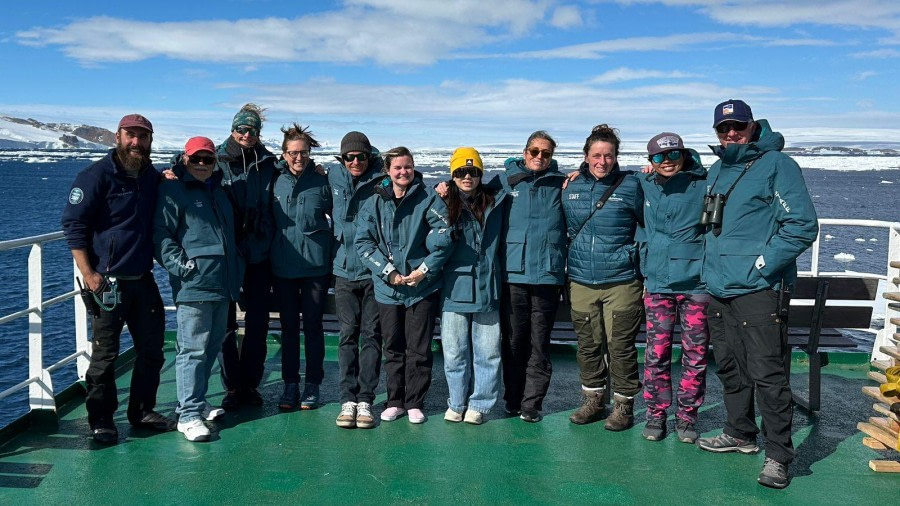
Then it was time to head in and join the Expedition team in the lounge for a Farewell Toast to our voyage by Captain Remmert Koster. After the last details for tomorrow, explained by Pippa, she asked for an applause for the teams from the deck, engine room and bridge who helped make this expedition to a success. Then she asked her expedition team to come forward so we could thank them as well. Then the trip slideshow was shown, put together by Jess. She had been working on producing a slideshow of photographs and videos, with contribution from the team, of our journey which we could take home and show to our friends and family.

We gathered in the dining room for a final plated dinner and enjoyed getting the chance to meet and thank all the hotel department, galley team, and dining room team.

Day 11: Disembarkation Ushuaia

Disembarkation Ushuaia
Date: 11.12.2025
Position: 54°48.5’S, 068°17.9‘W
Le vent: Var 1/2
Météo: Overcast
Température de l'air: +8

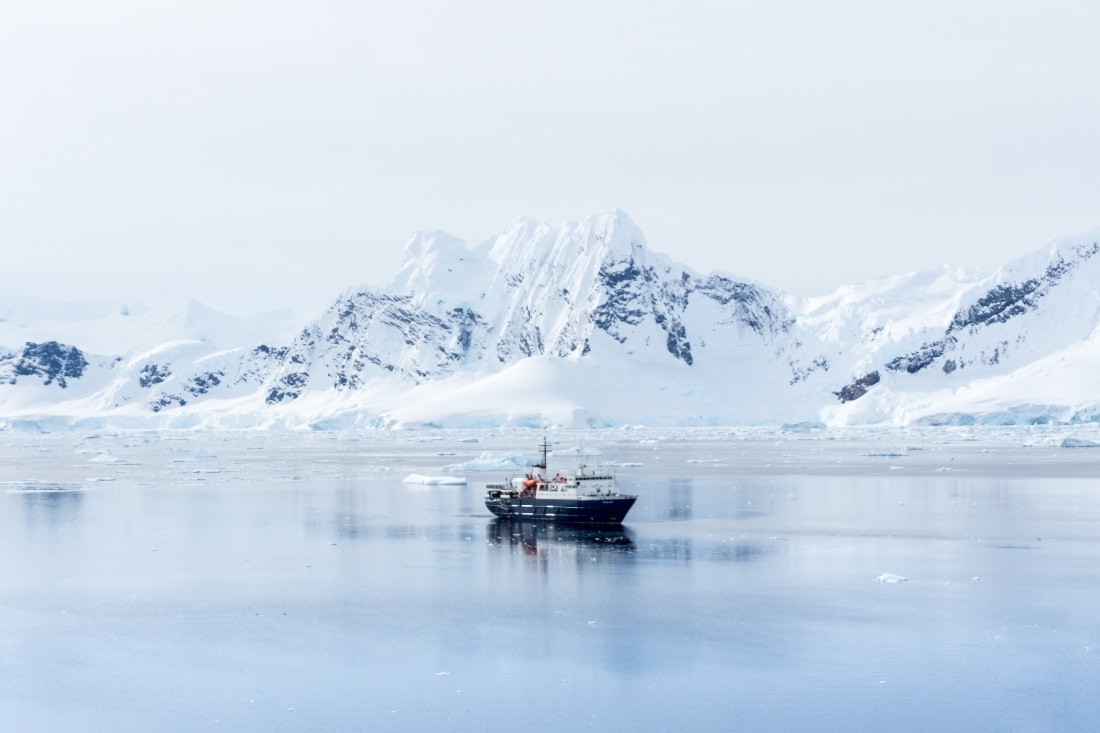
Our final wakeup call was made by Pippa, and we were asked to leave our big luggage in the corridor at 07:30, so the expedition team could take them all down for us and on to the pier. time. It was amazing how quickly ten days has whizzed by. We headed for breakfast and said goodbye to the dining room team who took such good care of us throughout the trip. We gathered our belongings and headed to the gangway to say goodbye to the crew, staff, and new friends we had made. Some of us hopped straight on the bus to the airport to head home, while others set off to explore Ushuaia and continue travelling in Patagonia. This trip really reminded us of the power of nature, and we saw firsthand just how wild and rugged Antarctica is. How the force of the compacted sea-ice in the Weddell Sea could also get a grip on our ship, like in the several history lectures told on board. The highlights of this trip will stay in our thoughts for many years to come. We got to see Antarctica from the sky, a unique perspective on this incredible landscape. We got to see colonies of all 3 different Brushtail penguins, twice we had an up-close encounter with one of the most impressive apex predators, the Orca. Once passing by the ship just after barbecue and the next morning the unbelievable sighting of them hunting Gentoo penguins. And of course, we had the very special encounter of the beautiful Emperor penguin on the icefloe.
Total distance sailed on our voyage: 1574 nautical miles

Most southern point sailed: 63° 50.7’ S, 056° 031.1’W

On behalf of Oceanwide Expeditions, Captain Remmert Koster, Expedition Leader Pippa Low, Hotel Manager Volodymyr Cherednychenko and all the crew and staff of M/V Ortelius, it was a great pleasure and a privilege travelling with you!

Détails

Code du voyage: OTL24-25
Dates: 1 déc. - 11 déc., 2025
La durée: 10 nuits
Navire: m/v Ortelius
Embarquer: Ushuaia
Débarquement: Ushuaia

Téléchargements

Avez-vous participé à ce voyage ?

À bord m/v Ortelius

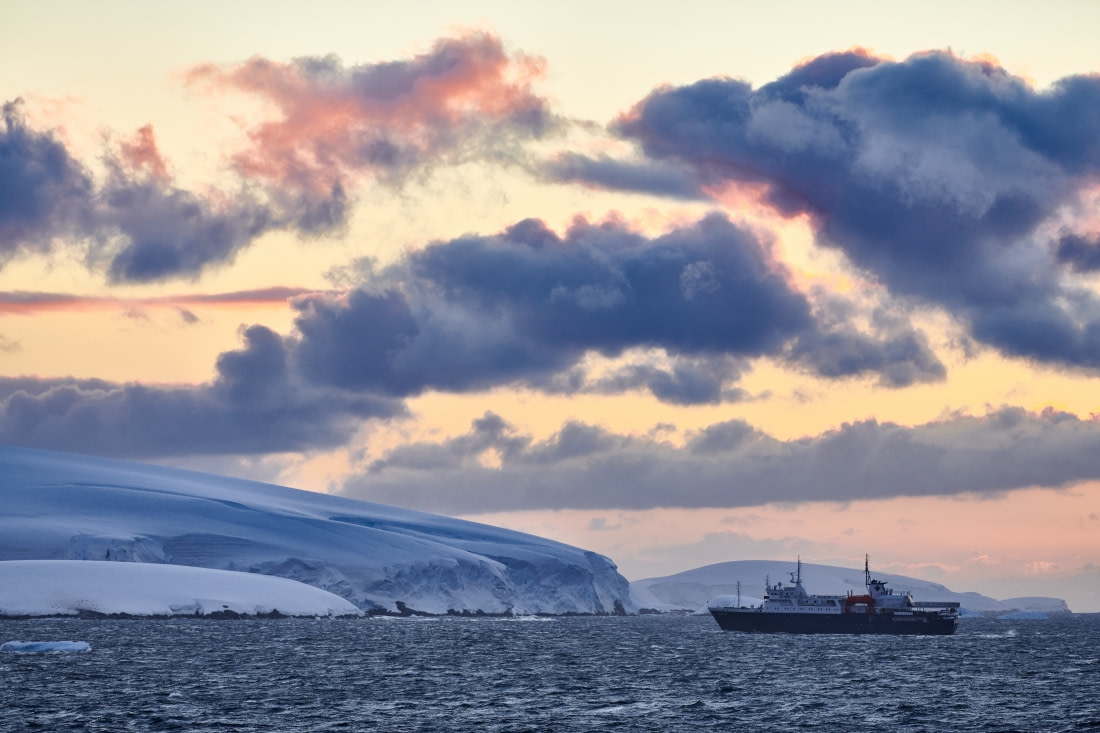
L'Ortelius, renforcé contre la glace, est parfaitement équipé pour l'exploration polaire et, le cas échéant, pour les vols en hélicoptère.

En savoir plus sur la m/v Ortelius »
Loading