HDS30-26, trip log, Antarctica - Whale watching - Discovery and Learning Voyage

by Oceanwide Expeditions

Galerie de photos

Journal de bord

Day 1: Ushuaia, Embarkation Day - Setting sail for Antarctica

Ushuaia, Embarkation Day - Setting sail for Antarctica
Date: 10.03.2026
Position: 54°48.5 S, 068°17.9 W
Le vent: N3
Météo: Partially cloudy
Température de l'air: +11

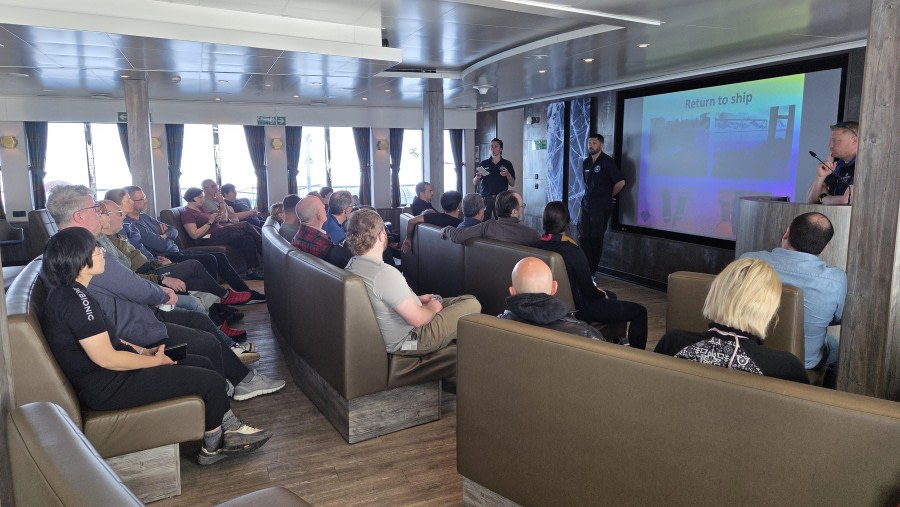
Our journey began in Ushuaia under warm and windy skies, the kind that felt like a quiet blessing before heading towards the icy continent. With the mountains framing the harbor and the town buzzing softly behind us, we stepped aboard Hondius full of anticipation. Once on board, we made ourselves at home in our cabins, checking that all our luggage had arrived and beginning to settle into what would soon feel like our floating world. The Observation Lounge on Deck 5 quickly became a welcoming hub, with the gentle clink of cups and the comfort of tea and coffee easing us into the rhythm of ship life. In the late afternoon, we gathered in the Observation Lounge for the mandatory safety briefing with the Expedition Leader and Chief Officer. Practical and reassuring, it reminded us that adventure at sea always comes with responsibility. Soon after, the emergency alarm echoed through the ship, and we returned to our cabins to collect our life jackets, completing our first drill together as a crew and community.

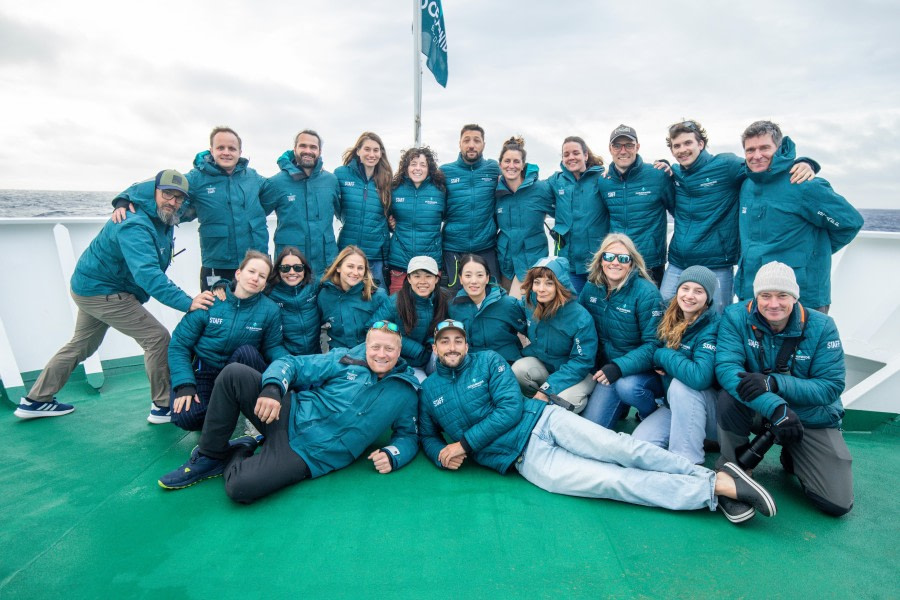
As early evening approached, we were invited back to the Observation Lounge for the Captain’s Cocktails. With drinks in hand, we listened to a warm welcome from the Hotel Manager and Expedition Leader, who introduced life on board and outlined the exciting days ahead. Meeting the Expedition Team made the journey suddenly feel very real. It was a gentle, perfect beginning to our Southern Ocean adventure.

Day 2: Drake Passage - At Sea sailing towards Antarctica

Drake Passage - At Sea sailing towards Antarctica
Date: 11.03.2026
Position: 56°55.0’S / 065°43.5’W
Le vent: NNW4
Météo: Partially cloudy
Température de l'air: +10

Today began not with an alarm, but with Pippa’s bright, buoyant voice carrying through the ship—an invitation to wake as we pressed steadily southward into the vastness. There was a subtle charge in the air, an unspoken awareness that something extraordinary had begun. This was no longer just a voyage; it was the threshold of Antarctica.

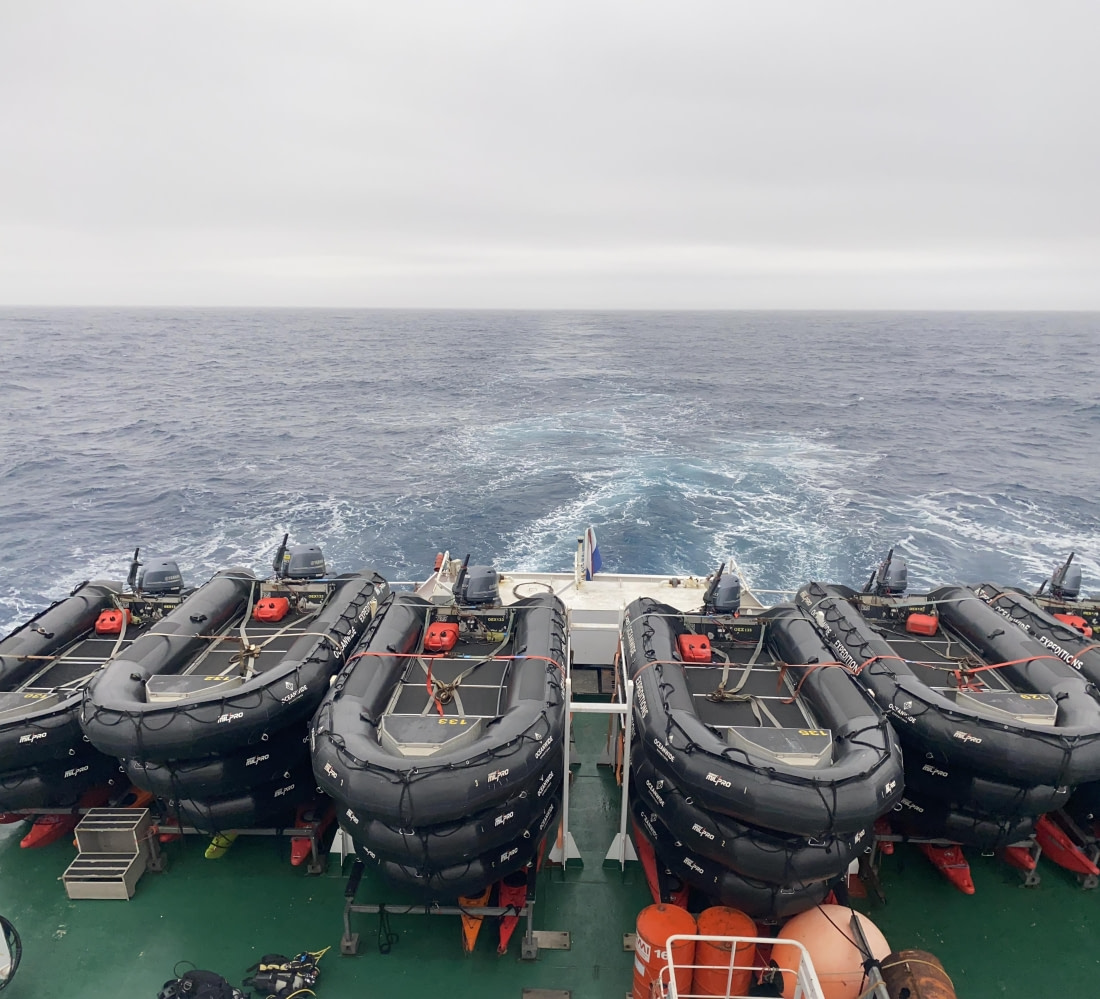
After breakfast, we assembled for the mandatory Zodiac and IAATO briefing—our initiation into the delicate balance of exploration and preservation in one of the most untouched places on Earth. Beyond the windows, the Drake Passage—so often feared for its fury—lay disarmingly calm, its waters rolling in long, gentle swells. It felt as though the Southern Ocean itself had chosen to welcome us.

The ship carried us smoothly toward the Antarctic Peninsula, a two-day crossing that offered both times to prepare and space to absorb the magnitude of where we were headed. Below deck, the divers gathered for their own briefing, readying themselves for encounters in the cold, silent world beneath the surface.

By mid-morning, Mark drew us into the lives of the seabirds that traced our path—albatross, petrels, and more—transforming distant shapes on the horizon into purposeful, living stories. Each sighting thereafter felt like recognition rather than chance.

Lunch hummed with energy, conversations alive with anticipation. Then, in the afternoon, we were called deck by deck to collect our expedition boots—small but tangible symbols that this journey was becoming real, step by step.

The momentum carried on as Joyce welcomed us into the world of whales and dolphins, her passion igniting vivid imaginings of towering flukes and fleeting breaths in the polar mist. Not long after, Juan shifted our gaze once more, offering a photographer’s perspective on these stark, luminous landscapes—encouraging us not just to see, but to truly observe.

As evening drew in, we gathered again at Pippa’s invitation for our first official recap. Plans unfolded, insights deepened, and the shape of the days ahead began to take form. Dinner followed—a well-earned, deeply satisfying close to a day rich with discovery.

Later, some of us lingered in the lounge, a quiet camaraderie settling in over drinks and shared excitement. Outside, the sea remained calm, the horizon endless. And as night wrapped itself around the ship, we slipped closer to Antarctica—carried forward by anticipation into the unknown.

Day 3: Drake Passage - At Sea sailing towards Antarctica

Drake Passage - At Sea sailing towards Antarctica
Date: 12.03.2026
Position: 61°20.4’S / 064°09.8’W
Le vent: NNW4
Météo: Foggy
Température de l'air: +5

Today marked our second full day crossing the infamous Drake Passage. And while some passengers struggled with the consequences of swell, the sea treated us kindly enough, allowing the ship to settle into its rhythm while we continued southward.

Sometime during the day we crossed the 60 degrees South latitude, an invisible but meaningful line: the official boundary of the Antarctic Treaty area. From that point onward, we entered what is considered Antarctic territory – a psychological milestone as much as a geographic one. Antarctica was no longer a distant destination; it had become our direct environment.

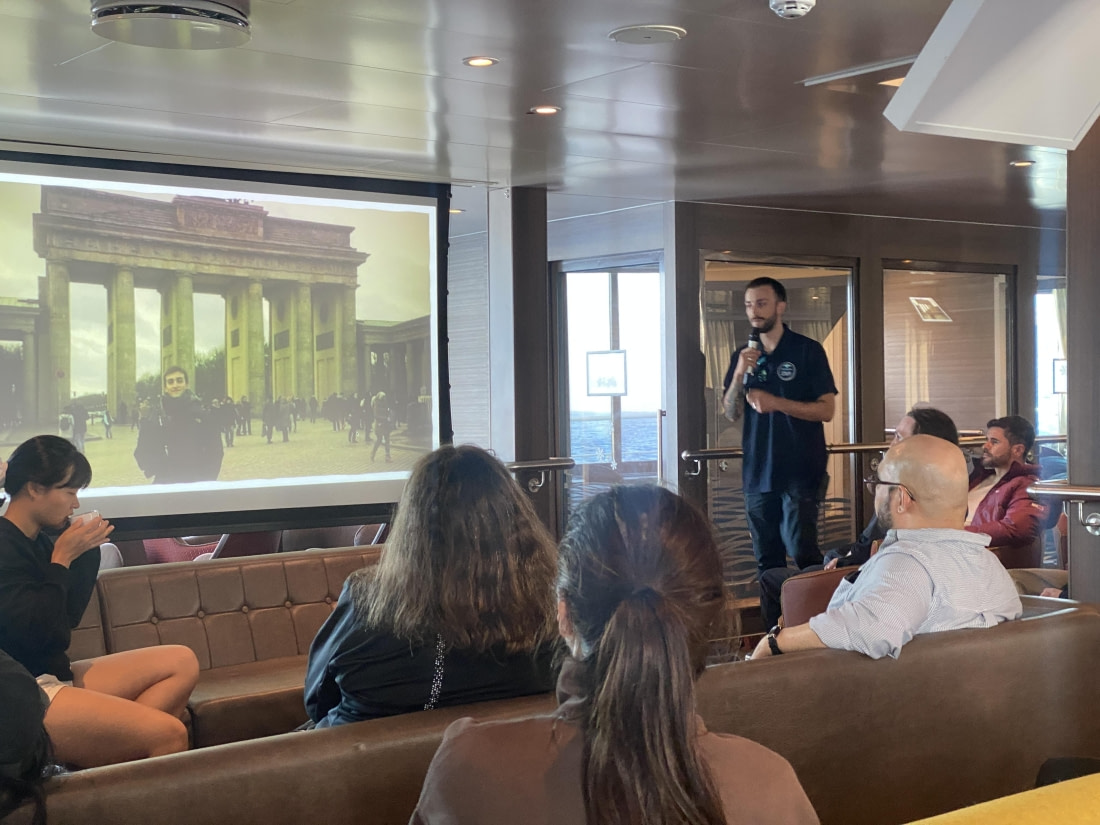
The day was filled with lectures preparing us for what lies ahead. Lucia spoke about penguins, introducing us to these adorable ice dwellers, and the remarkable ways they survive in this extreme environment. Jakob followed with a talk on ice — its many forms, how glaciers behave, and the processes that shape the Antarctic landscape. Georg then presented the possibilities for longer hikes on land, expeditions beyond the immediate landing sites.

Later in the day Lucas gave a lecture on astronomy, focusing on the southern sky and the aurora australis. The talk was proceeding smoothly until a sudden commotion outside interrupted it: a whale had appeared alongside the ship, moving quickly as if in determined transit. Within seconds the audience collectively decided that real-time wildlife took precedence over theoretical stars, and the lecture room emptied almost entirely as everyone hurried out on deck to watch.

Beyond the talks, today also brought practical preparations. We learned how to clean and disinfect our boots and gear, an important biosecurity step for anyone treading Antarctic soil. It is a reminder that Antarctica’s ecosystems are fragile and that visiting them carries responsibilities.

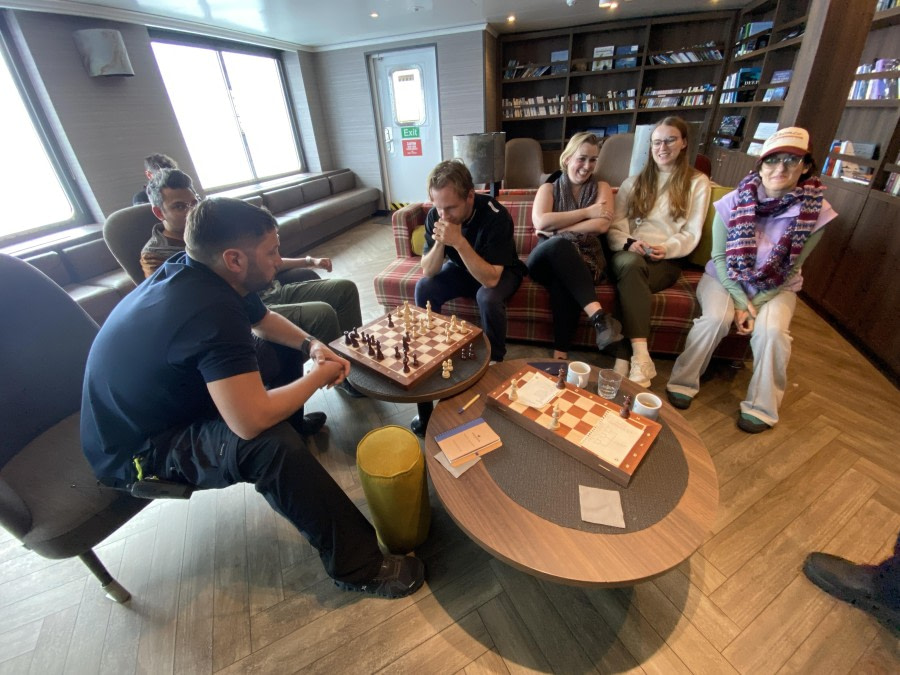
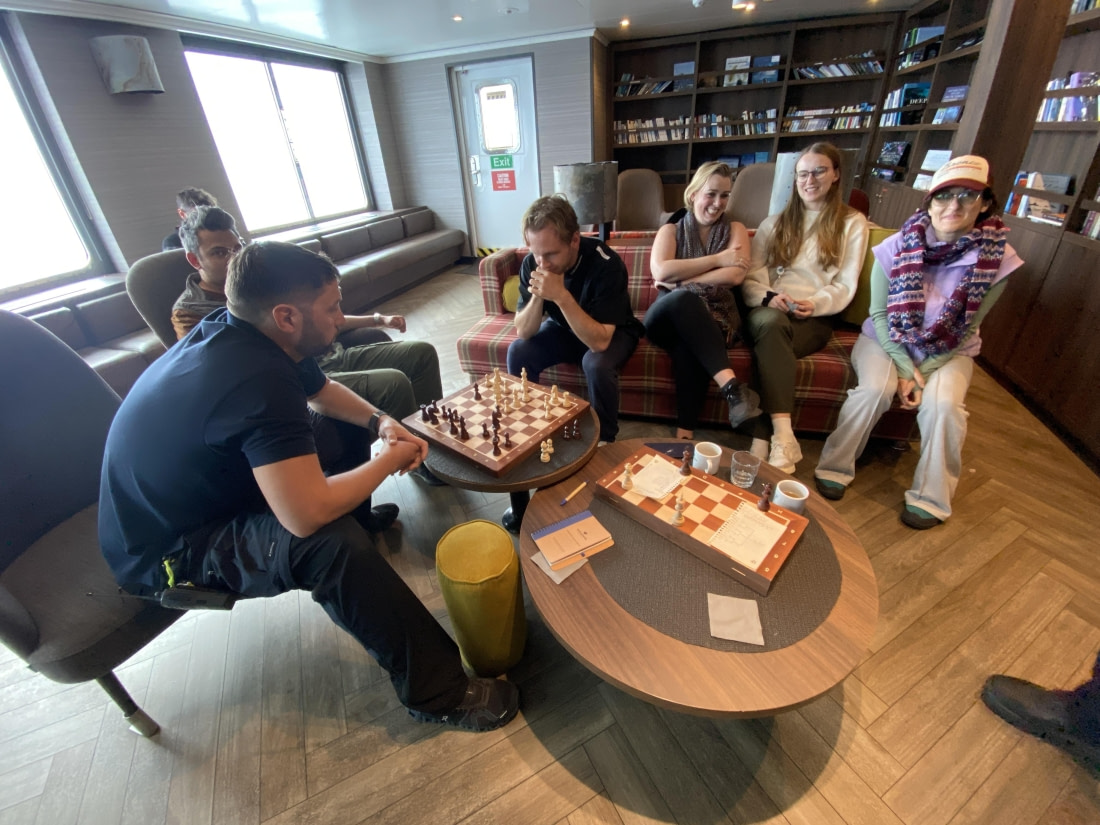
Throughout the afternoon and evening the ship sailed through thick fog. The world outside narrowed to a grey horizon, the sea and sky blending together so completely that distance became difficult to judge. Yet rather than dampening the mood, the fog seemed to heighten anticipation. Somewhere beyond that veil lay the landscape we had all come to see. Meanwhile, on board the camaraderie grew, with the first legs of the International Hondius Chess Tournament being played, sailor’s stories exchanged and grog being administered to some queasy newcomers.

The feeling on board is that when the fog finally lifts, it will reveal an entirely different world. And tomorrow morning, when we wake up, we will finally see Antarctica

Day 4: Danco Island and Damoy Point

Danco Island and Damoy Point
Date: 13.03.2026
Position: 64°43.4’S / 62°36.7’W
Le vent: SSW3
Météo: Cloudy
Température de l'air: +3

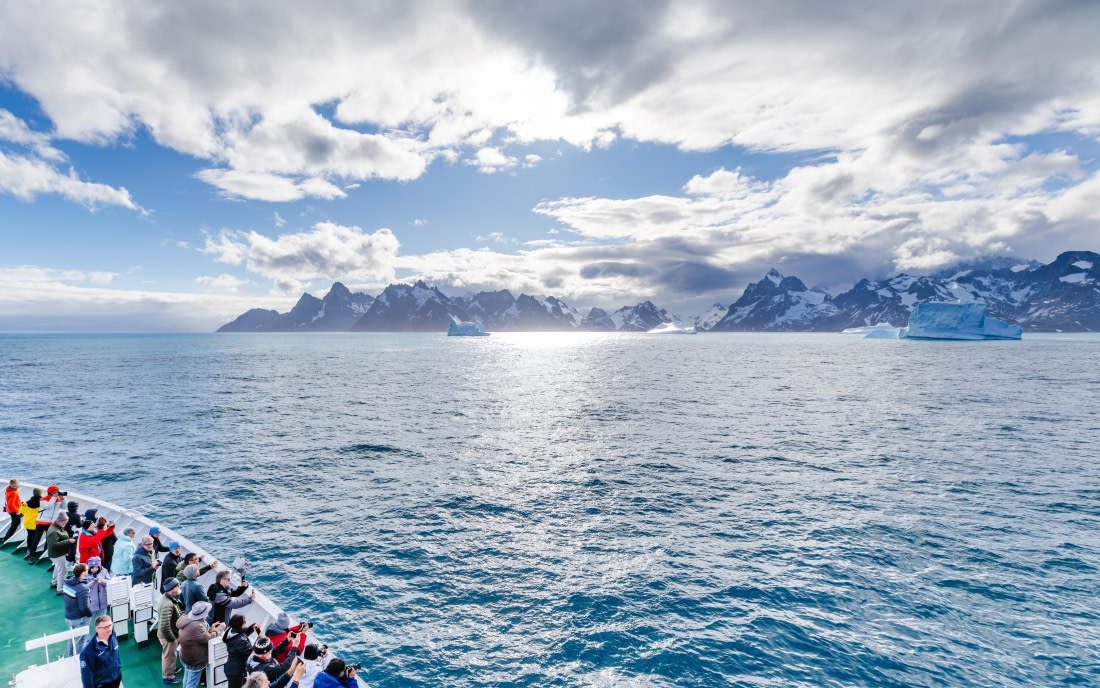
After two days of crossing the Drake Passage, this morning we were woken up by the happy voice of our expedition leader Pippa, that we had arrived in Antarctica. We sailed into the Errera channel on our approach to Danco Island. We were surrounded by high mountains, some with sheer bare cliffs. And everywhere we looked we saw massive glaciers. Dark clouds were hanging over the surrounding islands and the mainland on our portside, but the soft light was beautiful. We were all ready to step foot on land for the first time, which we did after breakfast.

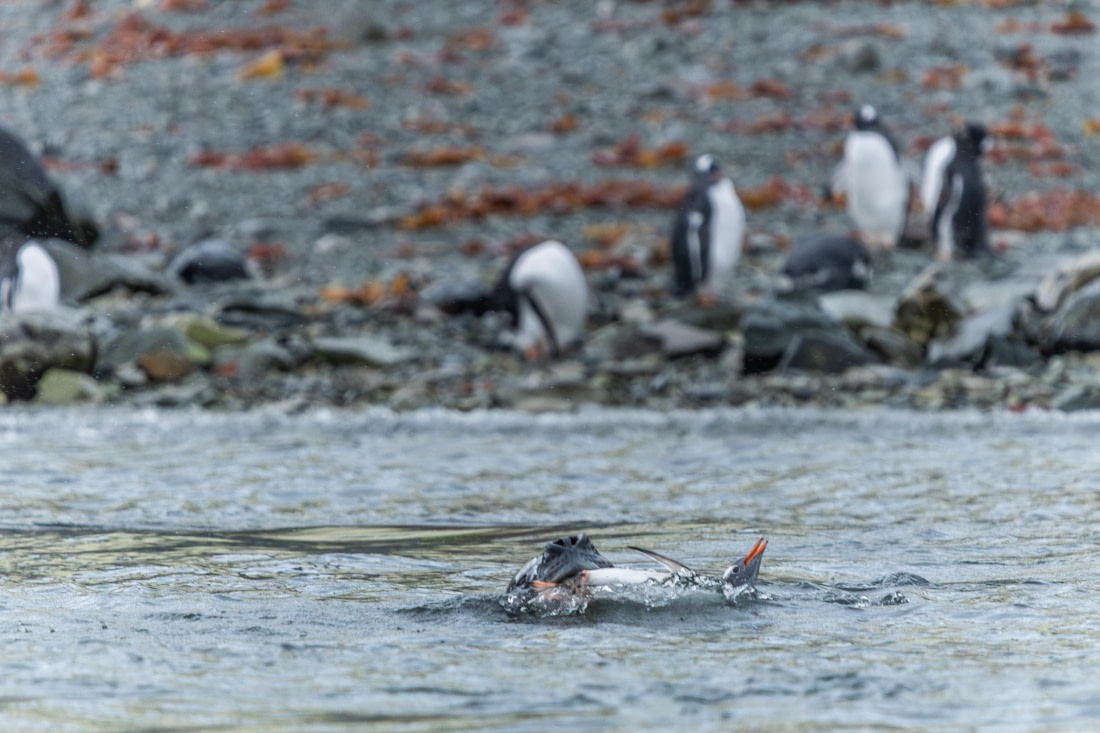
For our first expedition day we got excited. We all dressed up warmly, wore our boots and put on our life jackets and went down to deck 3, where we would enter the zodiacs from the shell doors. Some of us were going on a long hike up to the top of Danco Island with our hiking guides Paul and George. They went out first. Then the logistical puzzle began, because only a maximum of hundred guests is allowed on a landing in Antarctica. Therefore, the expedition team would bring half of us to land, and the other group made a zodiac cruise. We wouldn’t have to worry about anything; we only had to enjoy and remember the time we had to be back at the landing site. Arriving shore we were welcomed by Pippa, who explained where we could go to explore. The beach was occupied by many Gentoo penguins who didn’t seem to be bothered at all by us being there and just went on minding their own business.

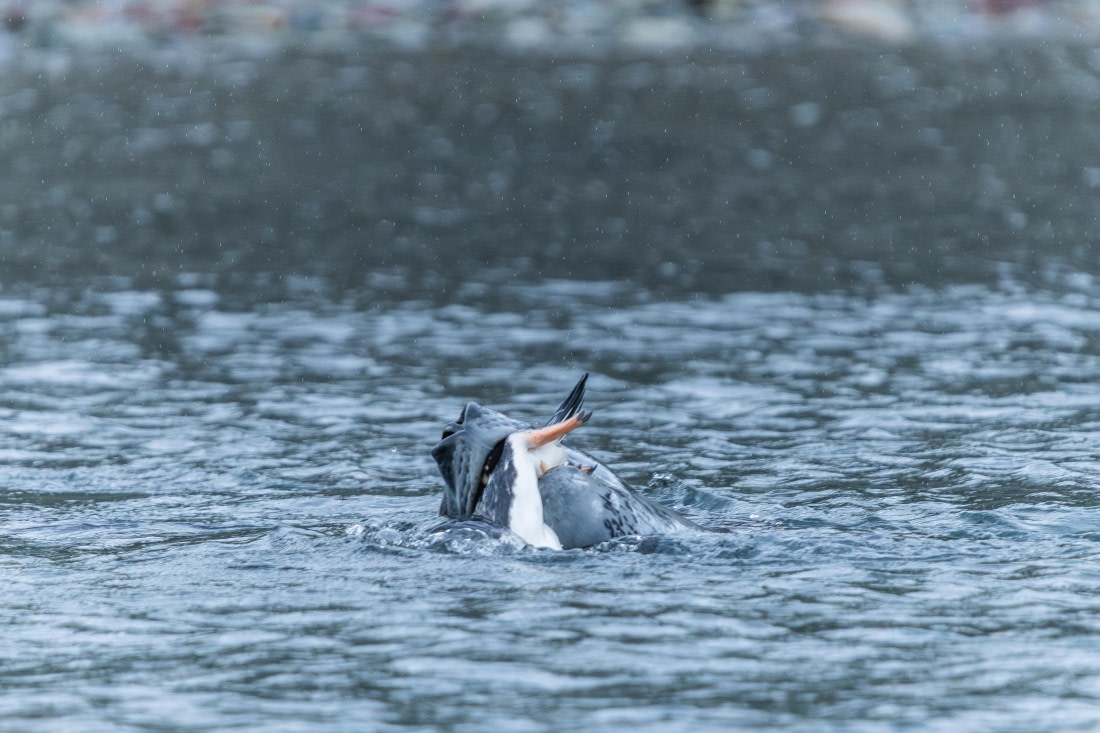
This was already super exciting, but it got quickly topped by an amazing sight right there in front of the beach where we just had landed. A leopard seal feeding on one of the penguins. The zodiac cruisers were also called back to witness how the seal played with the penguin, then let him escape and briefly after grabbed again, and finally after half an hour or so was skinned by being violently flipped left to right. Some would say it is sad for the penguin, which it is, but it is also nature and a sight that is not witnessed that much. Even for the expedition guides this wasn’t a sight they’d seen much. Then during the zodiac cruise, we saw two other leopard seals making the same sort of kill. We were very lucky to have been able to see this. The penguins on the island on the other hand, were very cute to watch. All their different behaviors. Some were still in their last molting phase and would just stand there and wait till their last feathers had changed out. Some of the ‘almost ready to go out to sea and catch food themselves chicks’ were still chasing their mums to ask for food with their sweet peeping sounds.

After an amazing first landing and cruise in Antarctica we were back on board. At 12:30 our hotel manager Albert announced that the dining room doors were open, and we could make our way to the restaurant on deck 4. Head chef Bawa and his team prepared a delicious and varied buffet lunch for us.

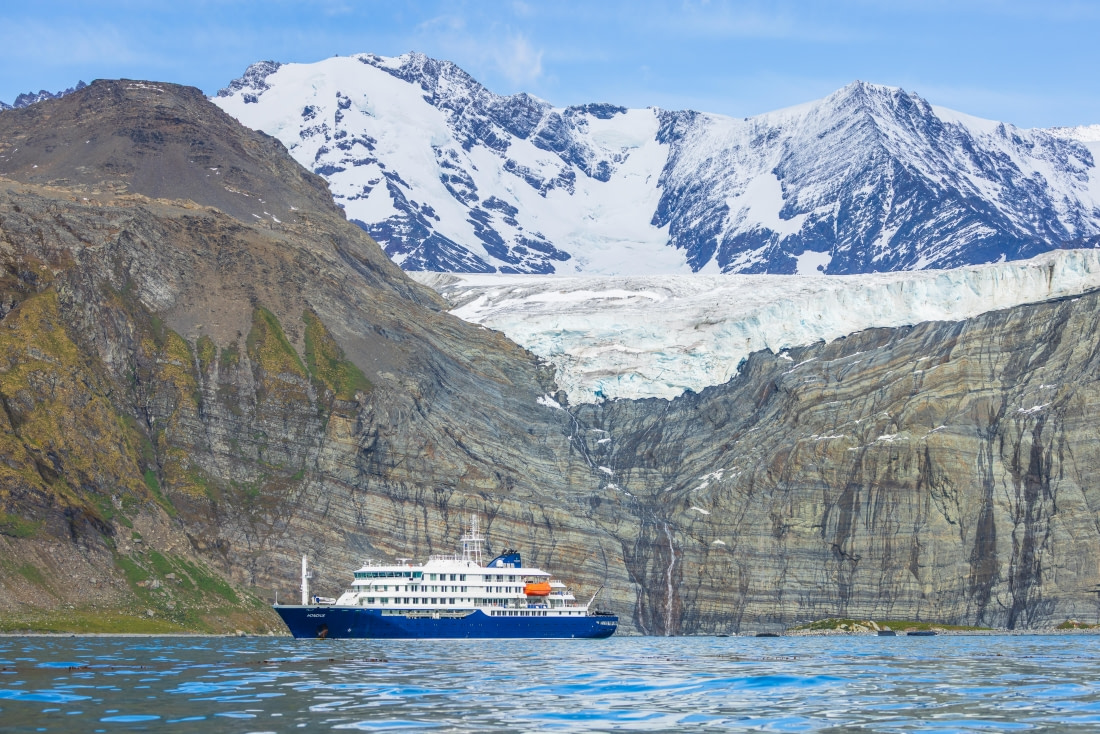
Over lunch the bridge team had repositioned the ship to another location, where we would go out that afternoon. We had arrived in the Neumayer Channel at a place called Damoy Point on Wiencke Island. The same logistics were arranged here, so that we could enjoy the island and cruise the bay around it. We were dropped off in Dorian Bay, which we entered close to the shore, to avoid a reef that was forming this protected, shallow bay. While driving in we were greeted by Antarctic Terns, adults and youngsters, sitting on the rocks and enthusiastically chirping away. On land we saw another Gentoo penguin colony and right at the landing site were two huts. The blue hut was an old Argentinian refuge hut that was built in 1953, which we were not allowed inside. The slightly bigger orange hut besides it was established by the British Antarctic Survey (BAS) in 1975 and was used as a waiting / transit station for staff of BAS who would be flown into the British Research station Rothera, further south on Adelaide Island, when sea ice conditions prevented the ship from sailing further south. On top of the glacier there was a 400-meter-long runway where the small planes could take off from. The hut was last used in 1993 and since then has been left as a historic site. It was interesting to see the small lounge / kitchen and the bedroom with several bunk beds. Sometimes they had to wait for days or even weeks when the weather didn’t allow planes to land. Besides everything there was to see on land, the view over the Channel to the other side was stunning as well. White mountains everywhere, covered in snow or glaciers and when the higher clouds lifted, we could even see the so-called “Seven Sisters’, seven daunting mountain peaks in a row.

After roughly 3 to 4 hours, we were back on the ship where Pippa gathered us in the lounge for the daily recap. Plans for the following day were shared and some short information put together by the expedition team. Then it was time for another dinner before some of us headed up to the library to compete in the chess competition that was set up by one of the guests. Others went for a nightcap before heading to our cabins. It was an amazing first day here in Antarctica!

Dive Log

Dive 1 – 24 divers

Water temperature: 2°C / 35.6°F

At last, our first immersion into Antarctic waters. Under overcast skies and light rain, we prepared for our check-out dive, a moment we had all been eagerly awaiting.

We descended into cold waters, between 7 and 10 meters, focusing on verifying our equipment, buoyancy, and configuration. The dive, lasting around 30 minutes, was both challenging and exhilarating. Despite the visibility conditions, 3 to 5 meters, life surrounded us—nudibranchs, kelp forests, sponges, sun stars, and even playful fur seals weaving effortlessly through the water. It was a humbling and unforgettable introduction to this extraordinary environment. As we came back to the surface and on our zodiacs, we made our way to the landing site, where Pippa, our Expedition Leader, and the rest of the Expedition Team were waiting for us.

Dive 2 – 24 divers

Water temperature: 2°C / 35.6°F

In the afternoon, we returned to the water. We explored a gently sloping wall north of Casa Bianca Island, to maximum depths of 16 to 18 meters.

Visibility remained modest, but the richness of life was undeniable. Sea stars, fish, limpets, nudibranchs, and dense kelp beds surrounded us as we moved slowly through the landscape.

A few among us experienced minor leaks in their equipment and were obliged to end the dive early, after approximately 10 to 15 minutes. The rest of us remained below for nearly 35 minutes, fully absorbed in the stillness of the underwater world. As we surfaced and made our way back to the Zodiacs, we realized that we were getting passed the nervous emotions of immersing ourselves in gelid waters, but gradually acknowledging the beauty around us, we were in Antarctica!

Day 5: Pleneau Island & Yalour Island

Pleneau Island & Yalour Island
Date: 14.03.2026
Position: 65°06.6’S / 64°02.2’W
Le vent: NE2
Météo: Overcast
Température de l'air: +2

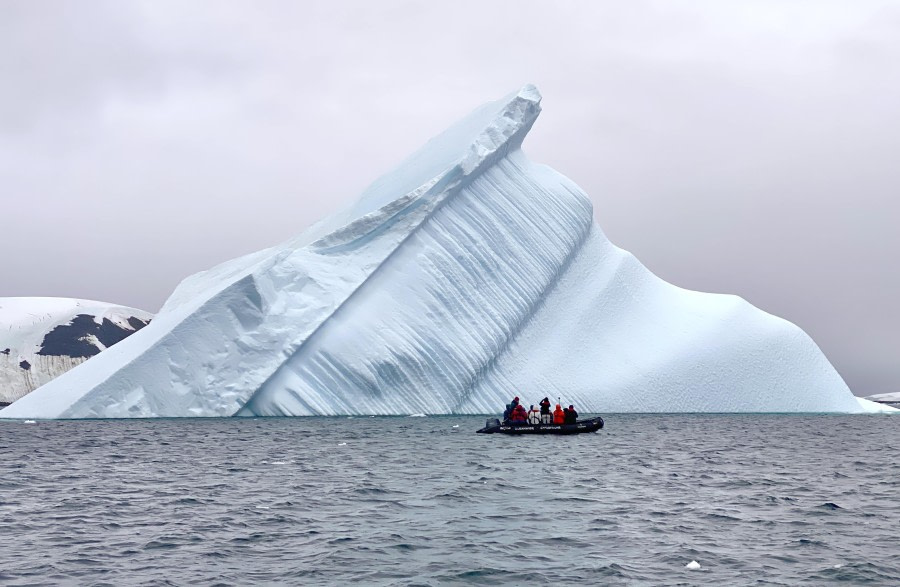
At 06:30, the expedition vessel began an early-morning southbound transit through the spectacular Lemaire Channel, its towering glacial walls rising steeply on either side. The stillness of the morning was broken only by the soft rumble of the ship and the distant crack of shifting ice. As the vessel approached the southern exit of the channel, the bridge team encountered an unexpected challenge: a large iceberg had drifted directly into the narrow passage. Having already thwarted the transit of the larger ship ahead of us, with careful coordination and delicate maneuvering, the captain guided the ship through the tight space, easing past the icy obstacle and continuing the journey safely onward.

With conditions and wildlife sightings encouraging flexibility, the expedition team made a change of plans for the day. Rather than heading straight to the Yalour Islands as originally scheduled, the morning would instead be spent exploring the nearby Pléneau Island.

Despite cold temperatures and overcast skies, the wildlife did not disappoint. The waters around the Pléneau Island were alive with activity, particularly from numerous Humpback Whale. Several individuals appeared unusually curious, surfacing close to and lingering near the zodiacs as if inspecting their visitors. On scattered icebergs nearby, the expedition team spotted formidable Leopard Seals resting between hunts, one observed actively predating on a Gentoo Penguin. Sharing the icy platforms were more docile Crabeater Seal, hauled out on the floes and seemingly indifferent to the drama unfolding nearby.

In the afternoon, the ship repositioned to the Yalour Island, where guests enjoyed both a zodiac cruise and a landing at a bustling colony of Adélie Penguin. The rocky outcrops and ice on the island were dotted with penguins in various stages of their annual molt. Many stood patiently on the ice, their feathers patchy and untidy as they shed their old plumage. Among them were a handful of individuals already in their pristine new plumage, their crisp black-and-white feathers looking particularly smart in contrast to their molting brethren.

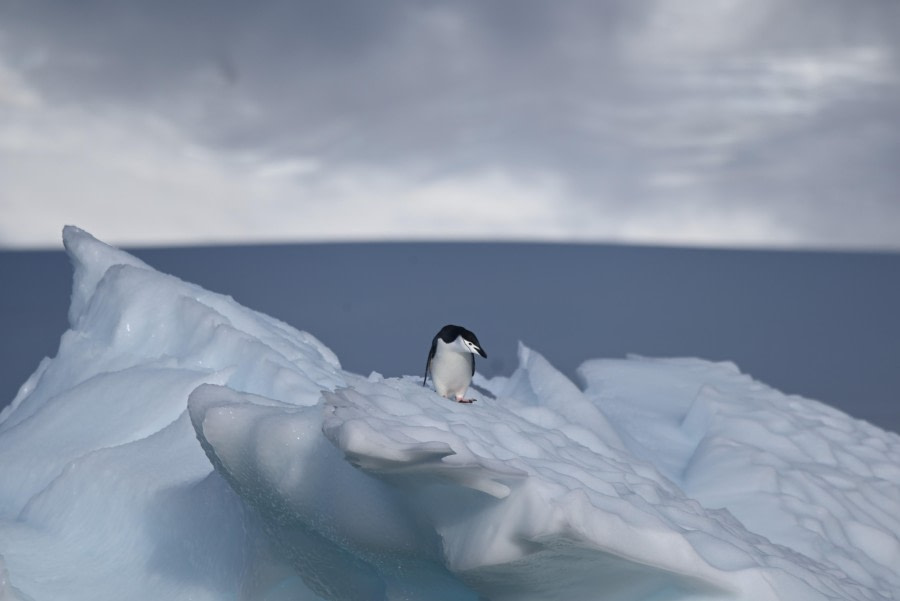
During the zodiac cruise around the islands, guides pointed out even more wildlife highlights. Additional Humpback Whale sightings delighted passengers as the whales surfaced in the cold Antarctic waters. Numerous Gentoo Penguin porpoised through the waves, and keen-eyed observers were rewarded with a single Chinstrap Penguin among the more common species.

Back on board, the evening program began with a recap of the day’s adventures and a preview of the plans for tomorrow. Expedition guide Jacob then delivered an engaging recap on iceberg formation, explaining how glaciers calve and describing the different shapes and types of icebergs commonly encountered in Antarctic waters.

The day concluded in celebratory style. As the ship once again transited the majestic Lemaire Channel, guests gathered on deck for the much-anticipated BBQ night, enjoying warm food against a backdrop of towering ice and fading evening light. Later, the atmosphere shifted from serene to festive as the traditional onboard disco began—an energetic end to a remarkable day of Antarctic exploration.

Dive Log

Dive 3 – 21 divers

Water temperature: 4°C / 39.2°F

We launched early, after traversing the Lemaire Channel with great proficiency from our bridge team and our captain Ian, boarding the Zodiacs with growing efficiency and confidence. Each of us checked our equipment with precision, now accustomed to the routine: first we checked our air and equipment, then we loaded our zodiacs with scuba kit, fins and mask and once zodiacs were ready, we finished dressing up and met our drivers at the shell door, super easy!

Conditions were calm, with gentle seas and a quiet atmosphere. The overcast sky lent an added sense of mystery and challenge to the experience.

This was our first iceberg dive, and we were carefully briefed by our dive guide on its particularities: potential buoyancy disturbances caused by freshwater layers from the melting ice, the risks associated with overhangs and possible iceberg movement, and the strict rule—despite the temptation—not to enter any caves or holes within the ice, among other important considerations.

We descended alongside a grounded iceberg, exploring its silent, frozen presence at depths of 10 to 12 meters. We observed how trapped air bubbles slowly found their way to the surface, carving delicate and ever-changing patterns into the iceberg’s face. For 30 to 35 minutes, we drifted through this surreal environment, where ice and ocean meet in perfect stillness. The ice seemed alive, creaking softly and reshaping itself as meltwater carved delicate patterns across its surface. Some of us even had the unique opportunity to dive with a leopard seal, apex predator in Antarctica, for more than 30 minutes!!!

After the dive some of the divers stayed around the dive site, playing on an iceberg and jumping from it! On our way back to Hondius for lunch, we came across a group of Humpback whales that the first but not the last…. What a wonderful morning!!!

Dive 4 – 9 divers

Water temperature: 2°C / 35.6°F

In the afternoon, a smaller group of us decided to go for a dive, the rest joined the Expedition team and explored the rugged coastline of the Yalour archipelago and the landing site.

We went to the dive site close to the landing site, where we were protected from the north wind. Once in the water, we followed a wall with a gentle slope, where rocky sea beds alternated with patches of kelp.

Visibility improved slightly, reaching up to 7–8 meters, allowing us to better appreciate the textures and colors of the underwater terrain.

The dive lasted around 40 minutes and offered a quiet, contemplative experience in this remote and isolated setting.

After finishing the dive, we landed together with the rest of the group.

Day 6: Wilhelmina Expedition Day

Wilhelmina Expedition Day
Date: 15.03.2026
Position: 64°40.1’S / 62°06.4’W
Le vent: W1
Météo: Overcast
Température de l'air: +2

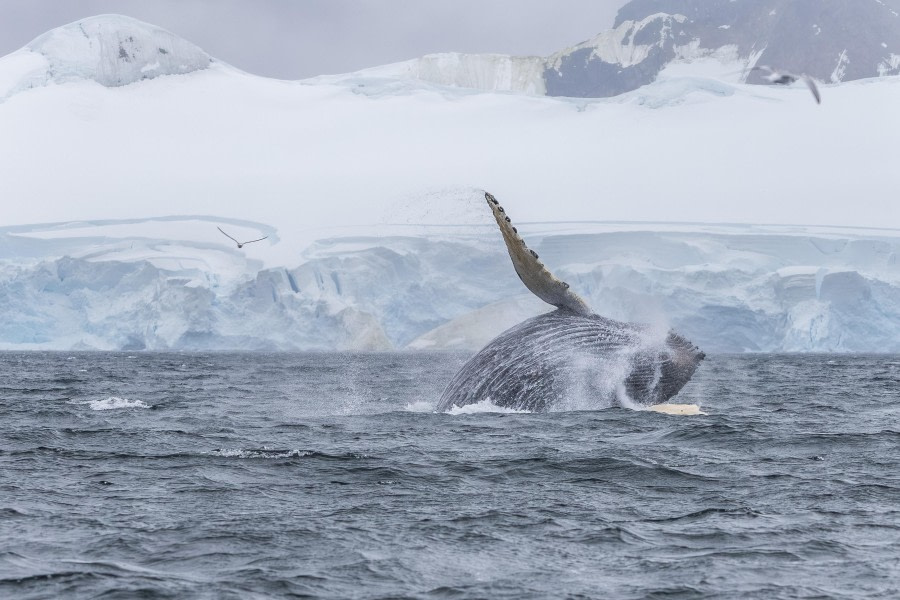
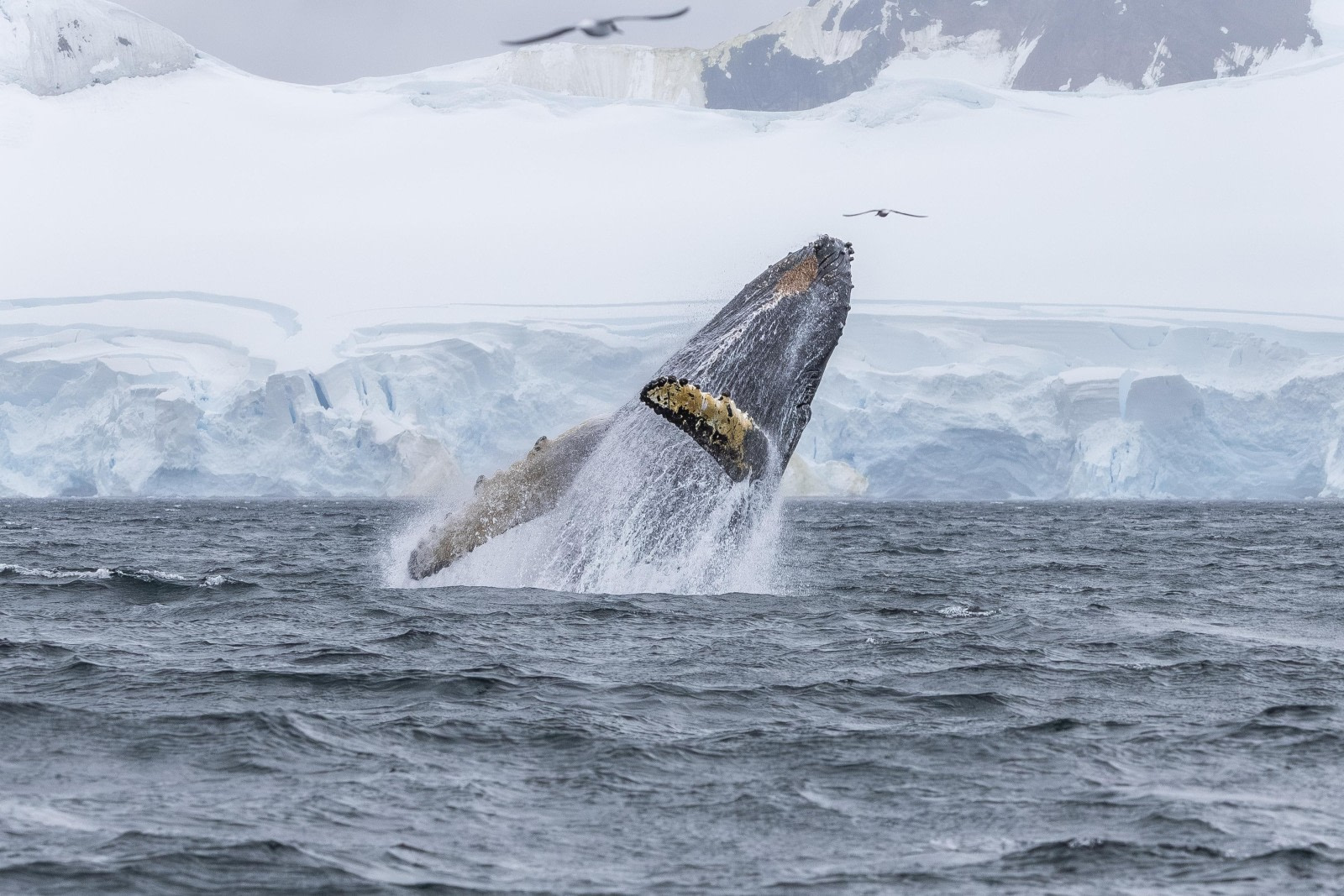
We started the day with a hearty breakfast on board the Hondius, heading out with calm conditions and excellent visibility across the bay. Once all zodiacs were in the water, it quickly became clear that humpback whales were present throughout the area. Several groups were moving slowly through the bay, and many of the encounters were spread across different boats. Juveniles showed curious behavior, approaching zodiacs, surfacing nearby, and occasionally rolling slightly to get a better look. Across the fleet, we observed relaxed movements—steady surfacing patterns, shallow dives, and occasional pectoral fin lifts and gentle slaps. In a few cases, whales passed directly beneath the boats, clearly visible in the cold, clear water. The overall behavior remained calm and inquisitive, allowing for extended encounters across multiple groups.

After the morning zodiac operations, we returned to the ship as a storm was expected to move into the area. The weather began to shift slightly, but we were able to reposition deeper into Wilhelmina Bay, where the surrounding landscape provided good shelter. This gave us a comfortable window to pause operations, have lunch on board, and wait while conditions developed outside the bay.

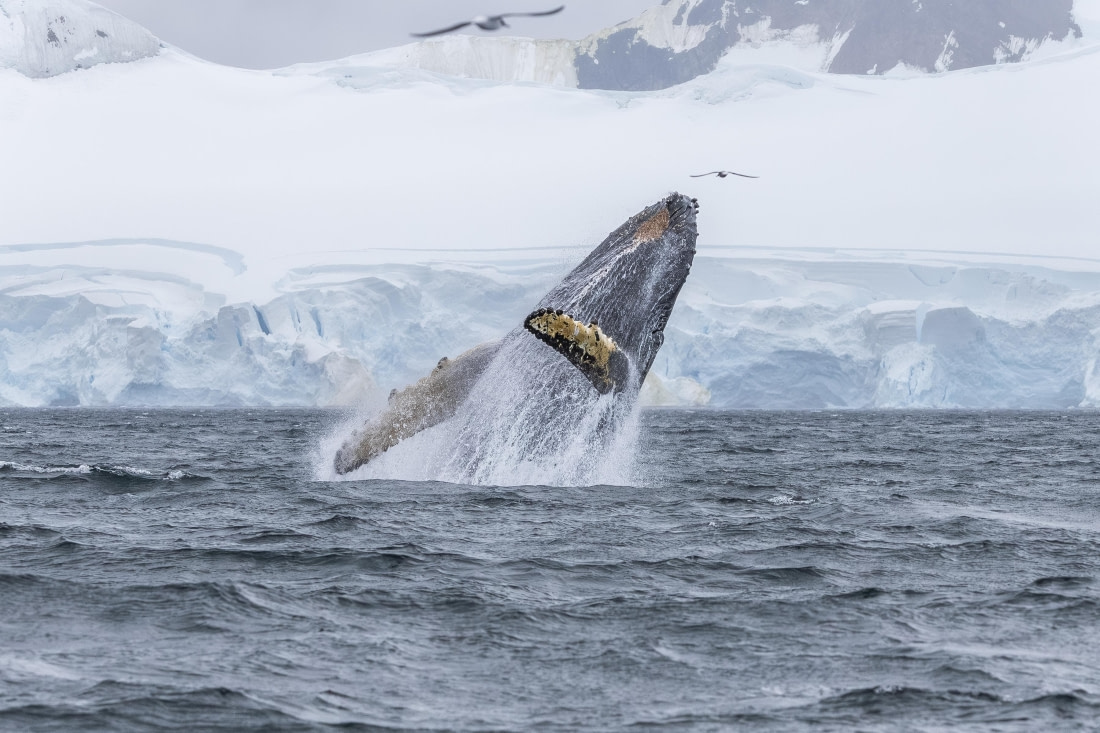
In the afternoon, we headed out again, and the situation had changed noticeably. Whale activity had increased significantly across the entire bay. What started as isolated breaches quickly turned into a widespread display, with multiple humpbacks breaching, tail-slapping, and lunging in different directions. Reports came in from different zodiacs simultaneously, making it clear that this was not a localized event but something happening across a wide area. The boats spread out to maximize coverage, and wherever we looked, there was movement—breaches in the distance, closer tail slaps, and occasional surface lunges.

During the outing, some of the zodiacs on the edge of the operation area reported a small pod of orcas passing through the bay. A few boats managed to get brief visual contact. The orcas were moving very quickly, significantly faster than the humpbacks, and maintained a clear, direct trajectory. Sightings were short—just a few fast passes before they disappeared—but enough to highlight the contrast in behavior and movement between the species.

By the end of the afternoon, we returned to Hondius. The day offered a strong contrast between the calm, curious interactions in the morning and the more energetic, large-scale activity later, with good conditions overall despite the approaching weather.

Dive Log

Dive 5 – 6 divers

Water temperature: 1.7°C / 35ºF

We awoke surrounded by whales. Wilhelmina Bay, with calm waters and no wind, greeted us with one of the most extraordinary spectacles of the expedition.

Some of us entered the water, while others remained at the surface, hoping for close encounters. Visibility was extremely limited—around 2-3 meters—but what we lacked in clarity, we gained in wonder. Being in the presence of Humpback whales, so close and so serene, was deeply moving.

In the afternoon, the wind increased, yet we remained in the bay. From the Zodiacs, we witnessed even more dramatic displays—breaching, tail slapping, mothers with calves, and whales surfacing just beside us.

It was, without question, a day we will never forget.

Day 7: Portal Point & Foyn Harbour

Portal Point & Foyn Harbour
Date: 16.03.2026
Position: 64°29.2’S / 61°45.2’W
Le vent: NN3
Météo: Overcast
Température de l'air: +2

Today, March 16th, was a milestone day that many of us will hold in our hearts forever. It was the day we didn’t just see Antarctica—we truly stepped onto the Great White Continent itself.

We fuelled up with an early breakfast at 07:00, the air buzzing with a special kind of excitement. By 08:15, we were making our way to Portal Point for our official continental landing! The weather was perfectly Antarctic—cloudy and atmospheric, yet remarkably calm.

Standing on the mainland felt different. We gathered around the Flag of Antarctica for those iconic "Seventh Continent" photos, marking a geographic achievement many of us have dreamed of for years. The site offered a poignant look at the past, as we saw the weathered foundations of an old UK base. For some, one of the most beautiful moments, however, was found at the "Silent Corner." Perched on the rocks just above the shoreline, we took turns in stillness, reflecting on the vast, untouched majesty of the landscape. It was a rare moment of pure connection with the wilderness before we swapped for a scenic Zodiac cruise and returned to the Hondius.

After a 12:30 lunch, we set out again at 14:45 for a cruise through Foyn Harbour, a place where history and nature collide in spectacular fashion.

The centrepiece of the harbour is the hauntingly beautiful wreck of the SS Governoren. This old whaling factory ship met its end in 1915 when a fire broke out during an end-of-season party. To save his crew, the captain heroically ran the ship aground, leaving the rusted remains to become a permanent fixture among the icy coasts. We drifted past the wreck, its iron hull now a haven for Antarctic terns, and spotted the skeletal remains of old wooden whaling boats nearby.

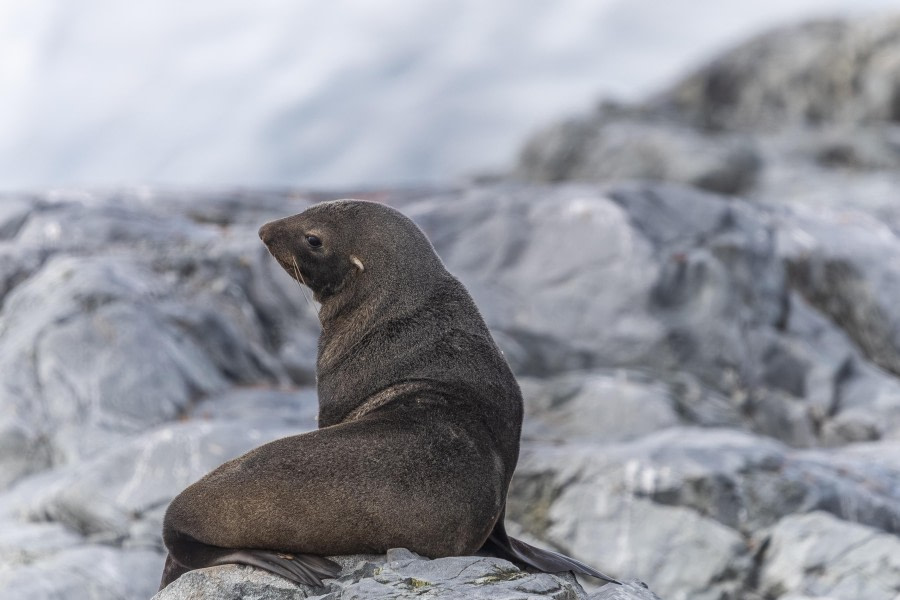
The afternoon only got better! Under a mild cloud cover and with practically no wind, we navigated between ice-covered islands and watched fur seals lounging on the rocks. Then came the highlight: the whales. Some of our Zodiacs were incredibly lucky to encounter curious humpback whales that seemed just as interested in us as we were in them, surfacing close enough for us to hear (and smell!) their powerful blows. It was a breathtaking display of trust and curiosity from the ocean's gentle giants.

We arrived back on the Hondius at 18:00, windswept and wearing wide grins. As we gathered for our evening recap and a warm dinner, the dining room was filled with the sound of shared stories and the clicking of cameras as we looked back at our first continental steps.

What a privilege it has been to explore this corner of the world together. Tonight, we rest well, knowing we’ve officially left our footprints on the bottom of the world.

Dive Log

Dive 6 - 10 divers

Water temperature: 1.7°C / 35ºF

With slightly improved weather, with no wind and occasional glimpses of blue sky, we continued our exploration. The Dive Team carefully selected an iceberg close to shore, one that would allow us to safely experience another unique Antarctic dive.

That morning, we formed a small group of divers, while others chose to cruise toward a nearby Chinstrap penguin colony or remain at the surface, delighting in the surreal landscape of icy pools and flushing seawater channels.

We entered the water for another cold-water dive, lasting between 20 and 40 minutes, reaching a maximum depth of 10 meters. Although visibility remained limited, the atmosphere felt noticeably lighter, and our confidence as a team had clearly grown.

Diving alongside the iceberg was nothing short of extraordinary, its sculpted walls revealed an ever-changing world of ice—translucent blues, intricate textures, and trapped air bubbles.

On our way to the landing site, we found a polar bear that was lost and asked for directions to get to the continental landing!

Dive 7 - 21 divers

Water temperature: 1.7°C / 35ºF

For some of us this was undoubtedly one of the most anticipated dives of the expedition. The Governoren, a Norwegian whaling ship.

We approached the wreck in well-organized groups, our operations by now smooth, efficient, and confident. While some remained at the surface to snorkel, others descended toward the ship’s propellers, resting at approximately 14-16 meters.

Visibility was exceptional compared to previous dives, revealing the wreck in striking detail. The biodiversity was equally remarkable: large sea stars of multiple species, sea cucumbers, anemones, brachiopods, and expansive sponge fields had transformed the wreck into a thriving artificial reef.

Gliding along the remains of the vessel, we could not help but feel a deep sense of connection—to history, to the ocean, and to the raw forces that shape this remote wilderness.

After 35 to 40 minutes, we surfaced in awe. For many of us, this was not only the finest dive of the journey, but one of the most memorable underwater experiences of our lives. After the dive we cruised around the islands finding Weddell seals, fur seals, humpback whales and penguins on our way back to Hondius.

Day 8: Elephant Point & Deception Island

Elephant Point & Deception Island
Date: 17.03.2026
Position: 62°41.2’S / 060°48.9’W
Le vent: NW3
Météo: Overcast
Température de l'air: +3

Today aboard Hondius delivered a classic Antarctic experience, combining wildlife, dramatic landscapes, and a touch of history.

Our morning began with a landing at Elephant Point, a rugged headland known for its sweeping beaches and abundant wildlife. As guests stepped ashore, they were greeted by the unmistakable sounds and sights of a large colony of Southern Elephant Seals sprawled across the shoreline. Massive bulls rested among groups of females, occasionally lifting their heads or issuing deep, echoing calls that carried across the beach. The peaceful atmosphere of the place made it easy to slow down and appreciate the quiet beauty of Antarctica. Many guests took time simply to sit, observe, and listen—the wind, the waves, and the distant calls of seabirds.

We organized a split landing, allowing part of the group to explore the beach and surrounding terrain while others boarded the Zodiacs for a coastal cruise around the island. Those on the water were treated to excellent views of penguin colonies, with numerous birds porpoising through the sea or standing along rocky outcrops. The Zodiac cruise provided a close look at the island’s rugged coastline, sculpted by ice and waves.

For those eager for a bit more adventure, the morning also offered an extended hike. Participants ventured further inland, climbing gentle slopes that opened into spectacular panoramic views of the surrounding islands, glaciers, and icy waters. It was a rewarding walk that highlighted just how wild and untouched this part of the world remains.

After returning to Hondius, everyone warmed up and shared stories over a well-earned lunch on board.

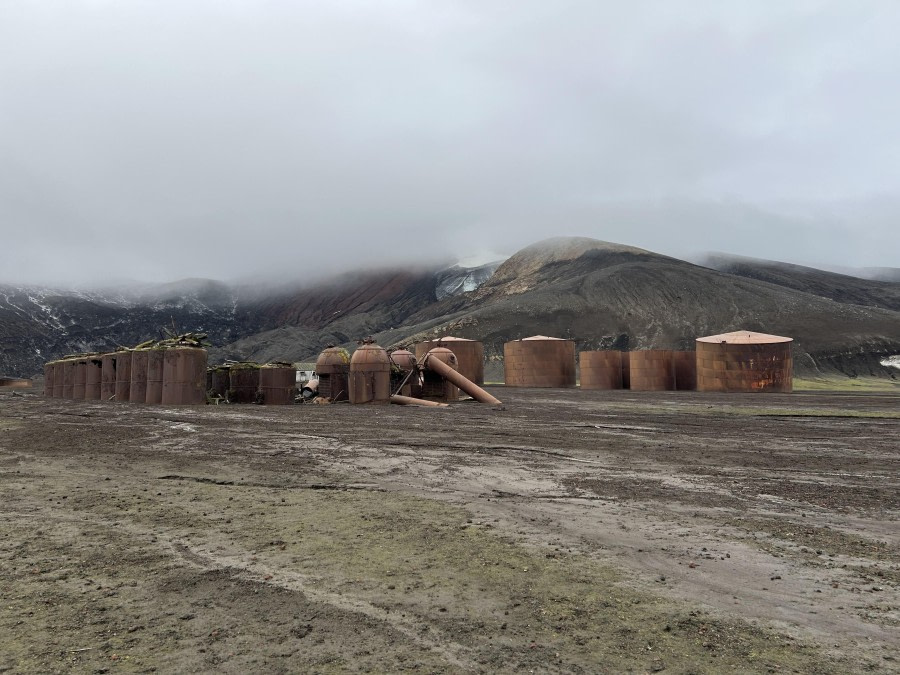
In the afternoon, we set out again for a split landing at Whalers Bay, located on Deception Island within the flooded caldera of an ancient volcano. This site holds one of the most fascinating pieces of Antarctic human history. The rusting remains of buildings, tanks, and boats mark the location of a Norwegian whaling station established in 1912 by Captain Adolfus Andresen. At its peak, the station processed thousands of whales each season, producing oil that was shipped around the world. Later, in the 1940s, the site was also used as part of a British Antarctic base (Base B) before volcanic eruptions in 1967 and 1969 damaged many of the structures and forced its abandonment. Walking among the weathered remains today offers a striking reminder of Antarctica’s industrial past and how nature gradually reclaims what people leave behind.

As the day drew to a close, the braves among us gathered on the beach for the traditional polar plunge. With cheers from fellow passengers and crew, participants ran into the frigid Antarctic waters before quickly retreating to dry land, laughing and exhilarated. It was the perfect—and refreshing—way to end a remarkable day of exploration.

With wildlife encounters, peaceful landscapes, a journey into history, and a splash of adventure, today was a wonderful reminder of why Antarctica leaves such a lasting impression on everyone who visits.

Dive Log

Dive 8 - 4 divers

Water temperature: 2°C / 35.6°F

A small group of us took part in a more intimate and demanding dive this morning. The day began with relatively calm conditions and signs of improving weather; however, as the morning progressed, we found ourselves enveloped by drifting mist that came and went, adding an element of uncertainty to the experience.

This was an exploration dive. The originally planned site presented very poor visibility, and therefore Mike, our dive team leader, made the decision to guide us toward a more exposed area where a series of small islands emerged from the sea.

As always, the cold waters demanded our full attention, yet at this stage of the expedition we moved with confidence and heightened awareness.

The dive, lasting between 35 and 40 minutes, proved to be truly spectacular, offering the best visibility we had encountered so far reaching up to 10 meters.

We followed a wall descending to approximately 20 meters, revealing what felt like a true underwater animal forest. It was teeming with life: crustaceans, sea stars, anemones, cold-water corals, and swaying kelp, all contributing to a rich and vibrant ecosystem.

Although our initial plan was to proceed with the rock face on our right shoulder, shifting currents required us to adapt and return to the more sheltered side of the promontory. From there, we continued our exploration around the island, deeply impressed by both the visibility and the remarkable biodiversity of the site.

Without a doubt, this is a location worthy of recognition among the dive sites of the South Shetland Islands.

Dive 9 – 22 divers

Water temperature: 2°C / 35ºF

Our final dive: inside the caldera of an active volcano! Descending into the bay, visibility initially seemed poor but improved with depth. What we encountered was extraordinary—vast fields of brittle stars covering the seabed, and the haunting remains of whale bones. Vertebrae and enormous ribs lay scattered, now home to sea urchins, anemones, sponges, and soft corals.

After 25-30 minutes, we surfaced, aware that this marked the end of our diving journey.

Later, we gathered once more—some of us returning to shore—to take part in the polar plunge, a final shared moment of exhilaration and camaraderie.

What an incredible trip! In total we visited 9 dive sites, and we performed 117 individual dives.

We experienced challenging conditions, extraordinary wildlife, and moments of profound connection with one of the last true wildernesses on Earth. We leave Antarctica not only as more experienced divers, but as witnesses to its beauty and fragility.
Day 9: At Sea to Ushuaia

At Sea to Ushuaia
Date: 18.03.2026
Position: 61°07.3’S / 063°00.4’W
Le vent: SE6
Météo: Overcast
Température de l'air: +3

Our day at sea began gently, with no wake-up call—an invitation to rest and reflect after our time exploring the icy wilderness. By 8:00 AM, we gathered in the dining room for a relaxed breakfast, the ship rolling steadily as we continued our journey north toward Ushuaia.

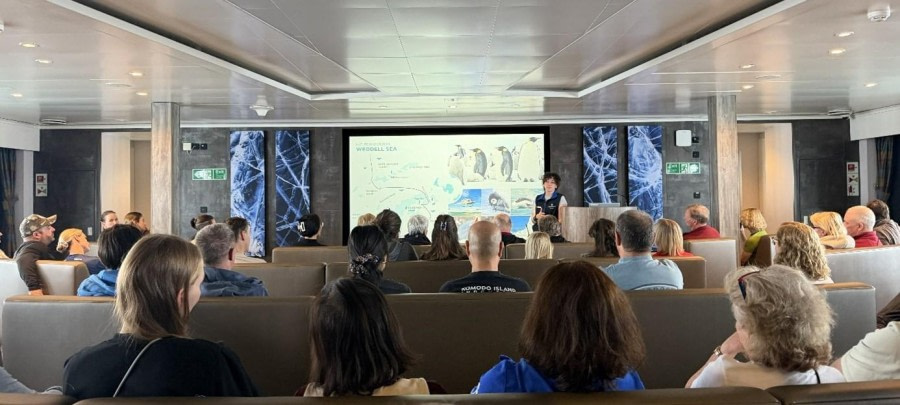
The morning’s learning program started at 9:30 AM in the lounge, where Saskia transported us back in time to the legendary Belgian Antarctic Expedition. Her storytelling brought to life the hardships faced by Adrien de Gerlache and his crew, who became the first to overwinter in Antarctica after being trapped in sea ice. Their resilience and scientific contributions added a deeper meaning to the places we had just visited.

By 11:30 AM, geology took center stage across the ship. In the lounge, Sven explored Antarctica’s tectonic story, explaining how the continent once formed part of Gondwana before drifting into isolation over millions of years. At the same time, in the lecture room, Rose delivered a dedicated Antarctic geology session in Chinese. Her talk provided a detailed introduction to the continent’s geological foundations, including volcanic activity and the fascinating landscape of Deception Island—a place shaped by a flooded caldera and known for its dramatic geothermal features.

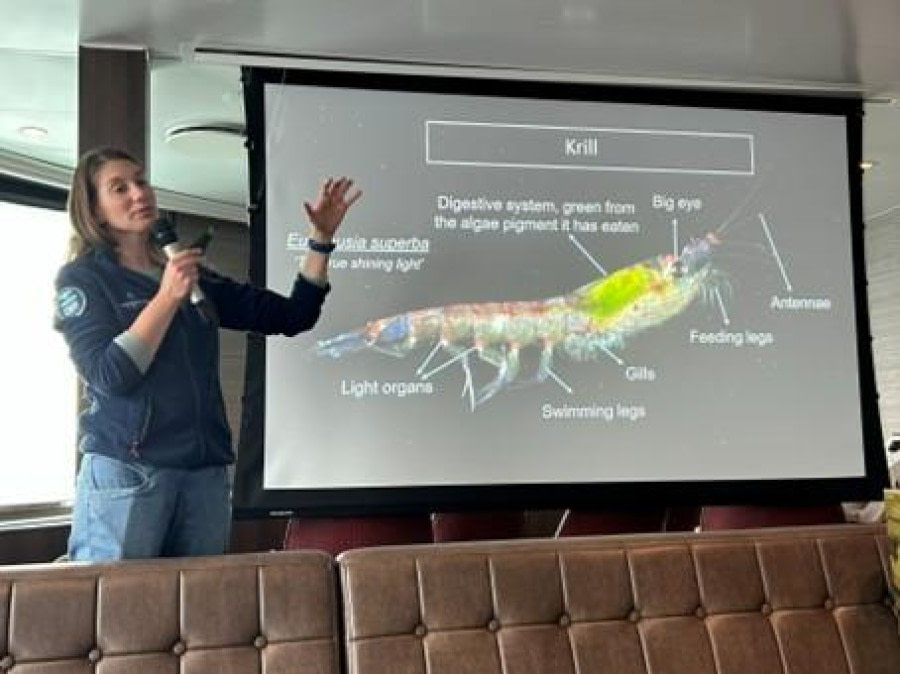
At 2:30 PM, Chloe energized the lounge with an enthusiastic and eye-opening lecture on plankton. One of the most astonishing facts: some species can grow up to 60 meters long, the length of a blue whale—reminding us just how mysterious and surprising ocean life can be.

The afternoon continued with laughter and camaraderie during Antarctic Trivia at 4:30 PM. Teams formed, creative names emerged, and we tested how much we had truly learned over the course of the voyage.

Later in the evening, around 8:30 PM, we gathered for the “Una Ventana al Mar” auction, hosted by Clara and Gonzalo. The event combined fun and purpose, raising funds for ocean conservation and education—an appropriate cause after witnessing the fragile beauty of Antarctica firsthand.

As always, we were reminded to move carefully around the ship—taking things slowly and keeping one hand steady—mirroring the calm, reflective pace of this final day at sea.

Day 10: Approaching Argentina & Cape Horn

Approaching Argentina & Cape Horn
Date: 19.03.2026
Position: 56°38.4’ S, 066°51.9’W
Le vent: S5
Météo: Overcast
Température de l'air: +5

We woke to a Drake Passage in a forgiving mood—an expanse of long, rolling swells rather than the fabled chaos we had braced for. The Hondius moved with an easy confidence, her bow lifting and settling as if breathing with the sea. After days in Antarctica, the return felt contemplative rather than hurried, and a quiet anticipation ran through us: a full day of lectures, reflection, and, eventually, farewell.

By morning, we gathered on deck, drawn by a name that had lived in our imaginations long before this voyage—Cape Horn. There it was at last, rising stark and weathered from the ocean’s edge, its cliffs etched by centuries of wind and wave. We learned that this lonely promontory marks the northern boundary of the Drake Passage and has long been one of the most treacherous maritime routes on Earth. Before the Panama Canal, ships rounding the Horn faced fierce westerlies, unpredictable currents, and towering seas; many never made it through. Yet today, under a gentler sky, it revealed a quieter side—still formidable, but almost solemn, as if aware of the stories it carried.

Back inside, the rhythm of the day shifted to learning and storytelling. Koen set the tone with an enthusiastic dive into Antarctic history, bringing to life the daring expeditions, fragile wooden ships, and relentless determination of those who first ventured south. We found ourselves transported to another era, imagining frostbitten crews and uncharted horizons, and felt newly connected to the landscape we had just left behind.

Lucas followed with a talk on Antarctic astronomy, opening a window not onto ice and sea, but into the vastness above. He explained how the continent’s cold, dry air and long, uninterrupted winter nights create some of the clearest skies on Earth—ideal for observing stars and probing the mysteries of the universe. It was humbling to think that the same place we had explored by zodiac and on foot was also a gateway to the cosmos.

Pippa then broadened our horizons even further, introducing us to the many destinations of Oceanwide Expeditions. From the icy fjords of Greenland to the wildlife-rich shores of South Georgia, the remote beauty of Svalbard, and even the far-flung isolation of Tristan da Cunha, she painted a world of future possibilities. Each place felt like a new chapter waiting to be written.

In the afternoon, we gathered again in the lounge where Andi spoke about the cultural evolution of whales. Her talk traced a powerful transformation—from the era when whales were hunted relentlessly for oil to their present role as icons of conservation. She wove together science, history, and human perception, showing how our relationship with these giants of the ocean had shifted from exploitation to reverence. It left us reflective, especially after our own encounters with whales in the Southern Ocean.

As the day drew toward evening, we assembled once more for the Farewell Toast and Trip Slideshow. Glasses were raised as the captain and expedition team said their goodbyes, and images from our journey flickered across the screen—penguin colonies, towering icebergs, moments of laughter and quiet awe. Watching it all unfold, we felt both gratitude and a gentle ache; the voyage had become something deeply personal.

Dinner that night carried a different tone—still warm and lively, but threaded with nostalgia. Conversations lingered longer, laughter came more easily, and there was a shared understanding that something special had been experienced together. Later, in the bar, we gathered for last drinks among fellow passengers who had, over the course of the journey, become friends. The sea continued its steady rhythm outside, and the Hondius carried us northward, away from Antarctica—but not, we knew, from the memories we had made.

Day 11: Disembarkation Day, Ushuaia

Disembarkation Day, Ushuaia
Date: 20.03.2026
Position: 54°48.5 S, 68°17.9 W
Le vent: NE2
Météo: Partly cloudy
Température de l'air: +7

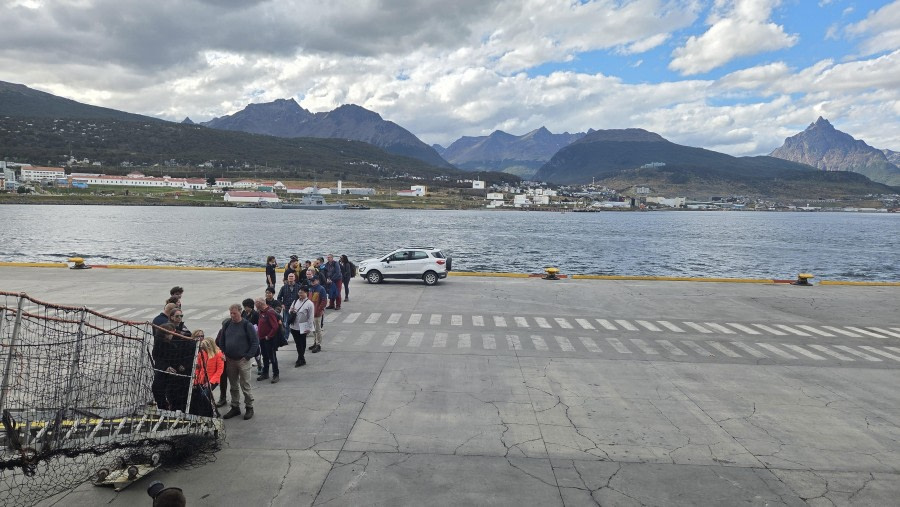
Our final morning arrived quietly as the ship had glided back into Ushuaia, the harbour wrapped in mist and steady rain under the dim early light. Even before breakfast, suitcases lined the corridors outside our cabins, a quiet reminder that the voyage was ending. Breakfast was relaxed and comforting, filled with calm conversation and shared laughter as everyone revisited their most memorable moments of the journey. Not long after, we went ashore where our luggage awaited us neatly arranged on the pier. Goodbyes echoed through the group as travellers embraced, shook hands, and offered heartfelt thanks to the crew who had cared for us so thoughtfully throughout the expedition. Casting one last look at our dear Hondius that had carried us across the Drake Passage and through extraordinary days among the ice, we stepped into the rainy Ushuaia morning, taking the memories of Antarctica with us, for life.

Détails

Code du voyage: HDS30-26
Dates: 10 mars - 20 mars, 2026
La durée: 10 nuits
Navire: m/v Hondius
Embarquer: Ushuaia
Débarquement: Ushuaia

Téléchargements

Avez-vous participé à ce voyage ?

À bord m/v Hondius

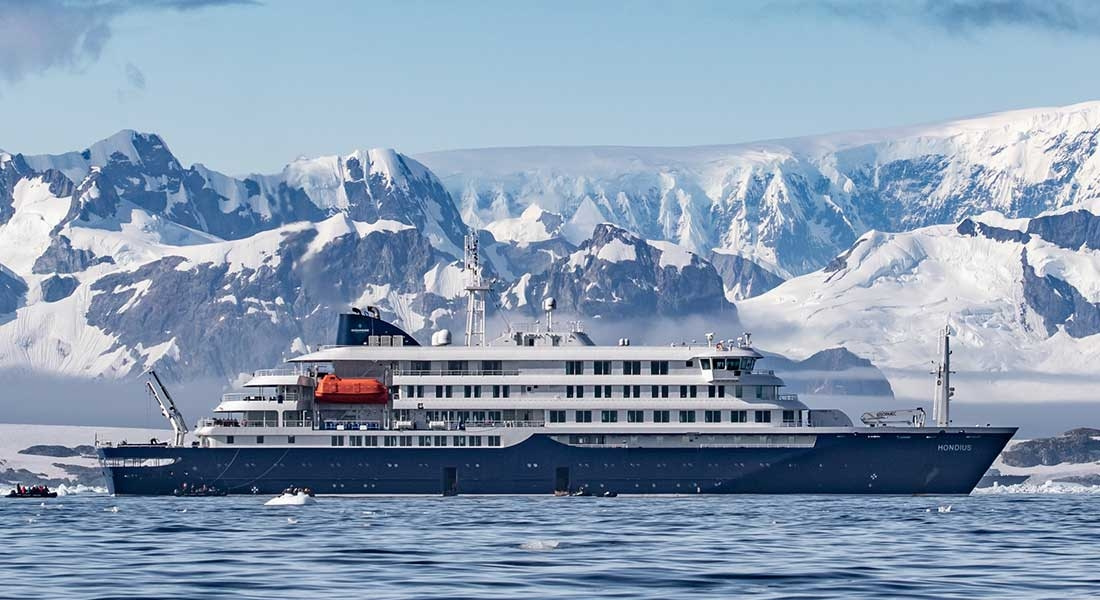
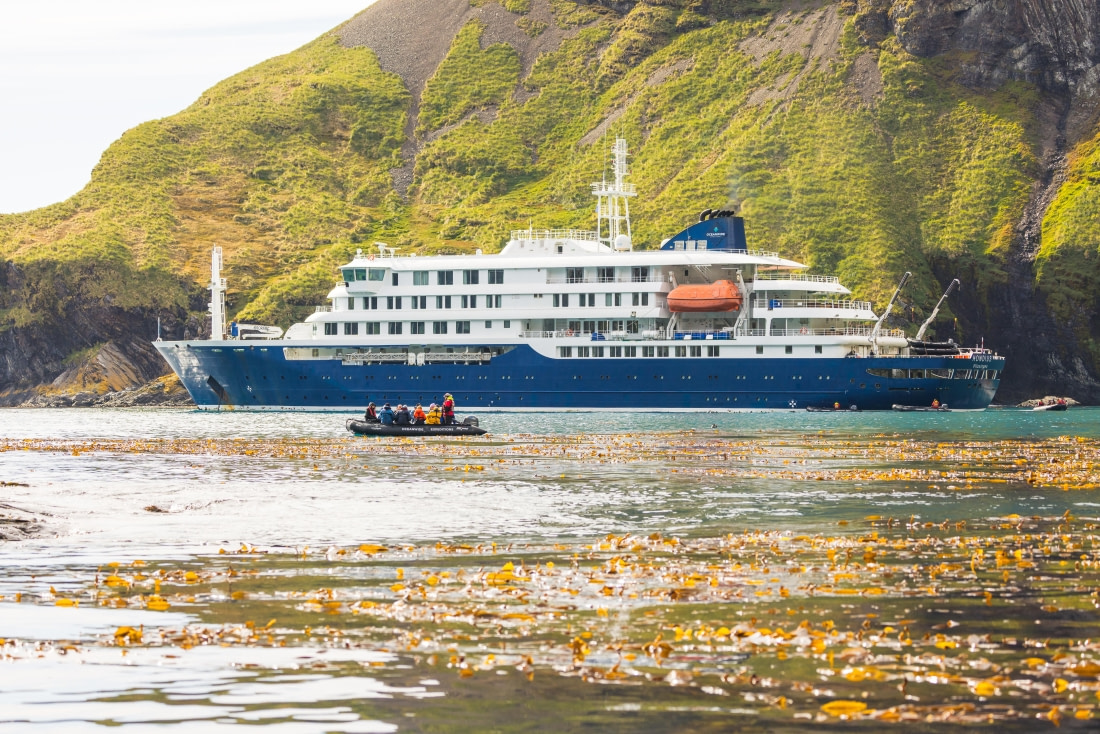
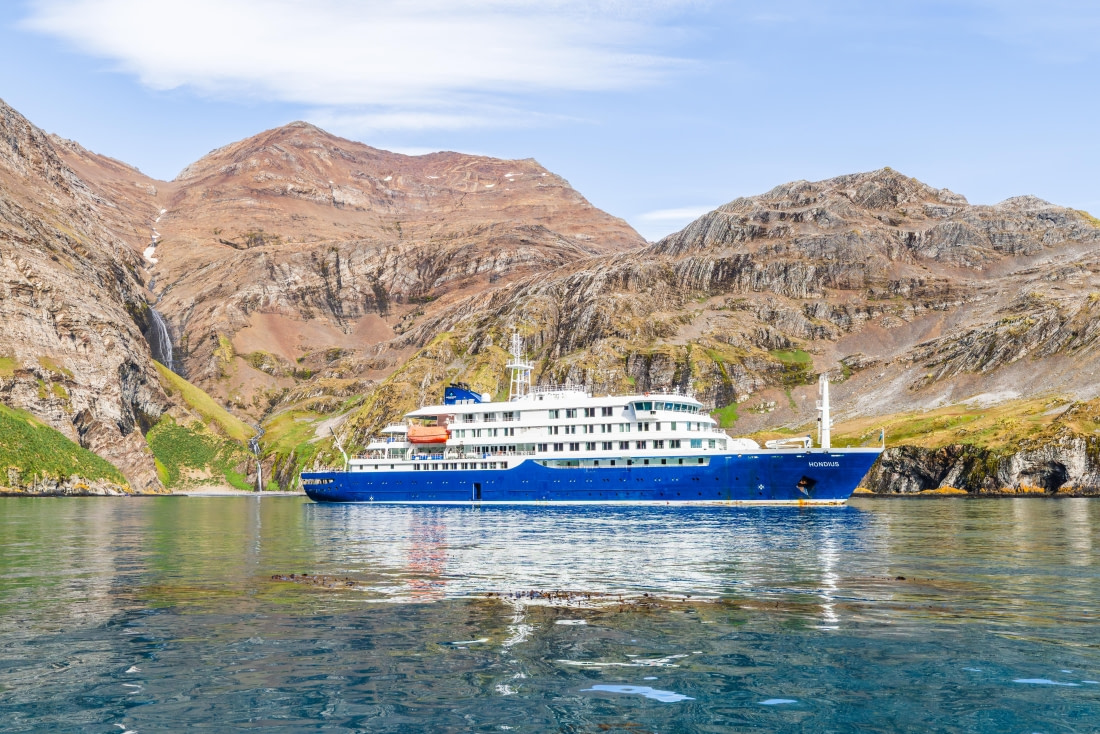
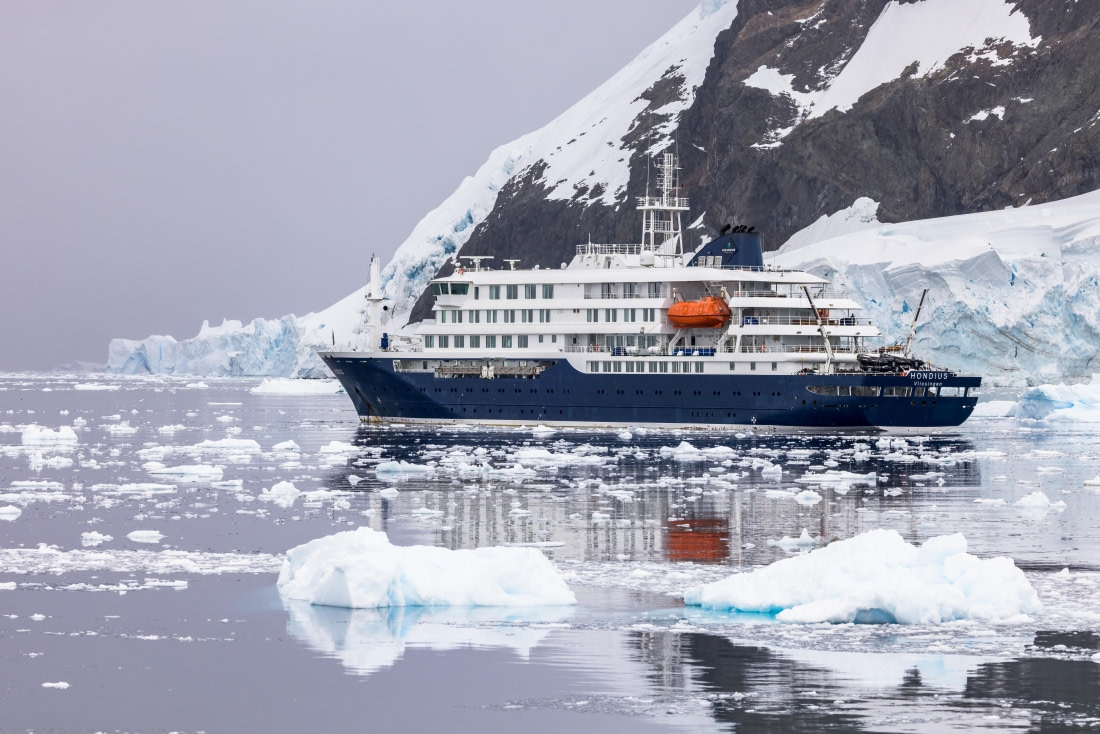
Hondius est le premier navire de classe polaire 6 enregistré au monde et a été conçu dès le départ pour les croisières d'expédition.

En savoir plus sur la m/v Hondius »
Loading