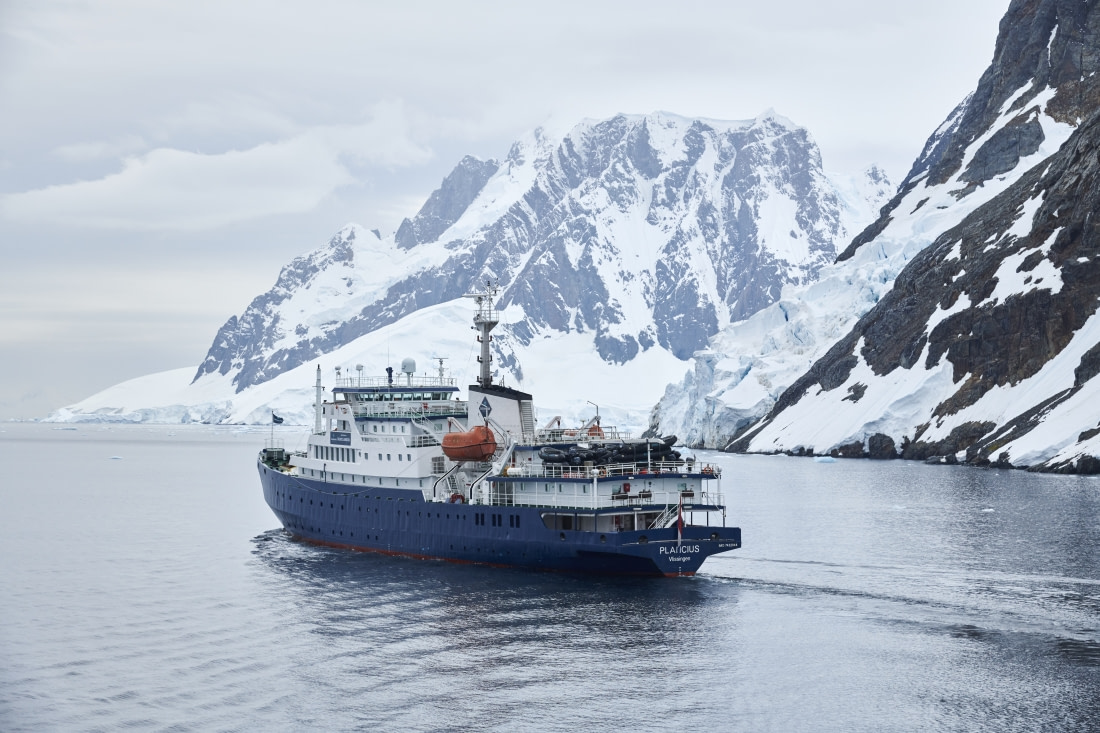
PLA27-26, trip log, Falkland Islands, South Georgia, Antarctica

by Oceanwide Expeditions

Fotogalerij

Logboek

Day 1: Embarkation Day

Embarkation Day
Datum: 19.01.2026
Positie: 54°48.6’S / 068°17.8’W
Wind: SW7
Weer: Sunny
Luchttemperatuur: +11

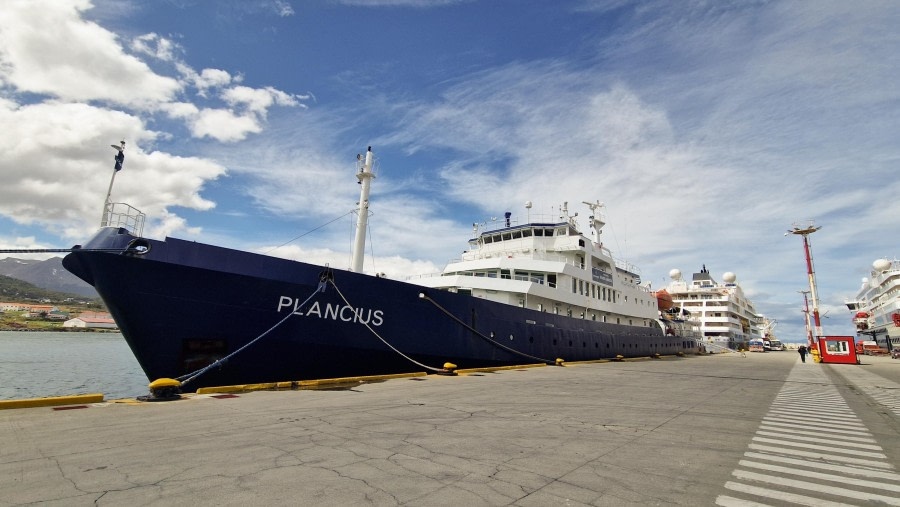
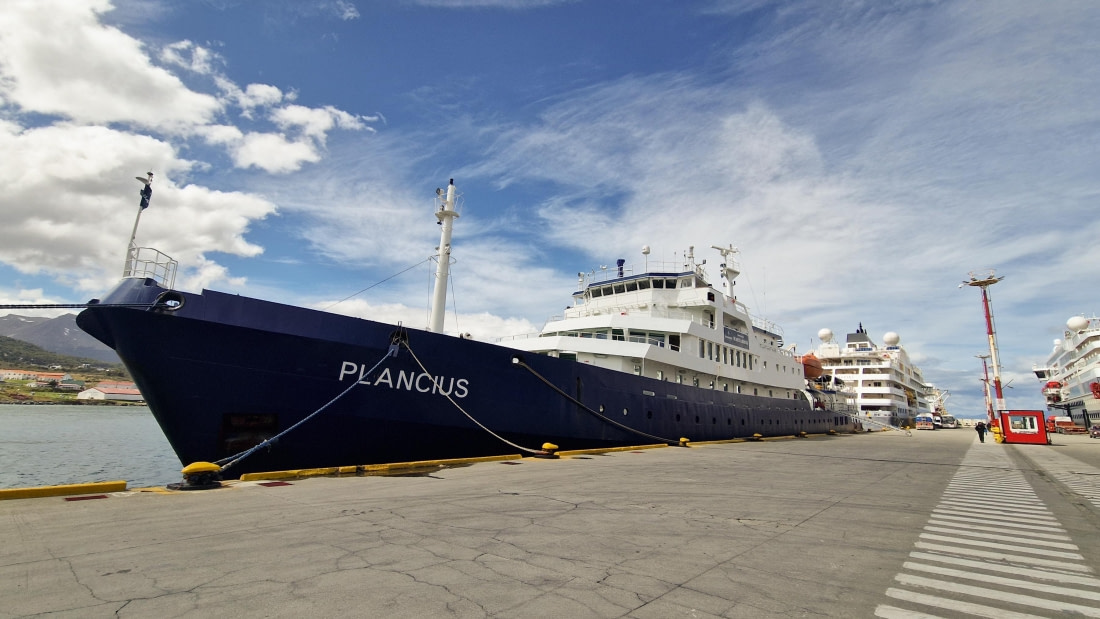
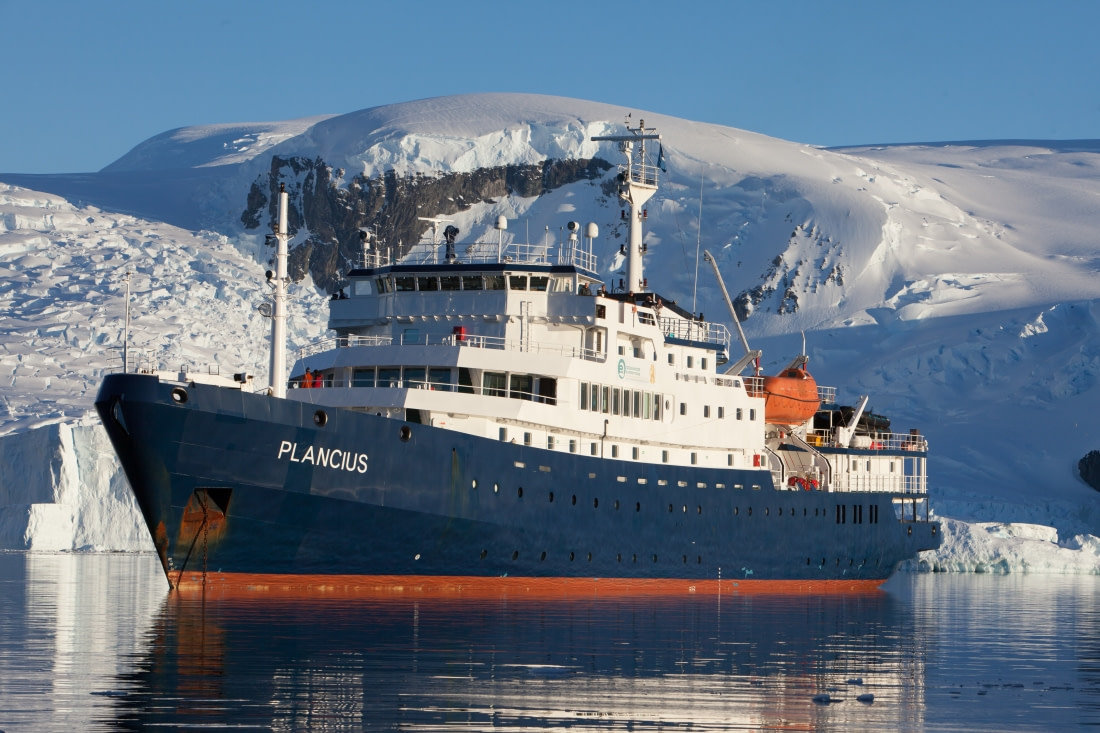
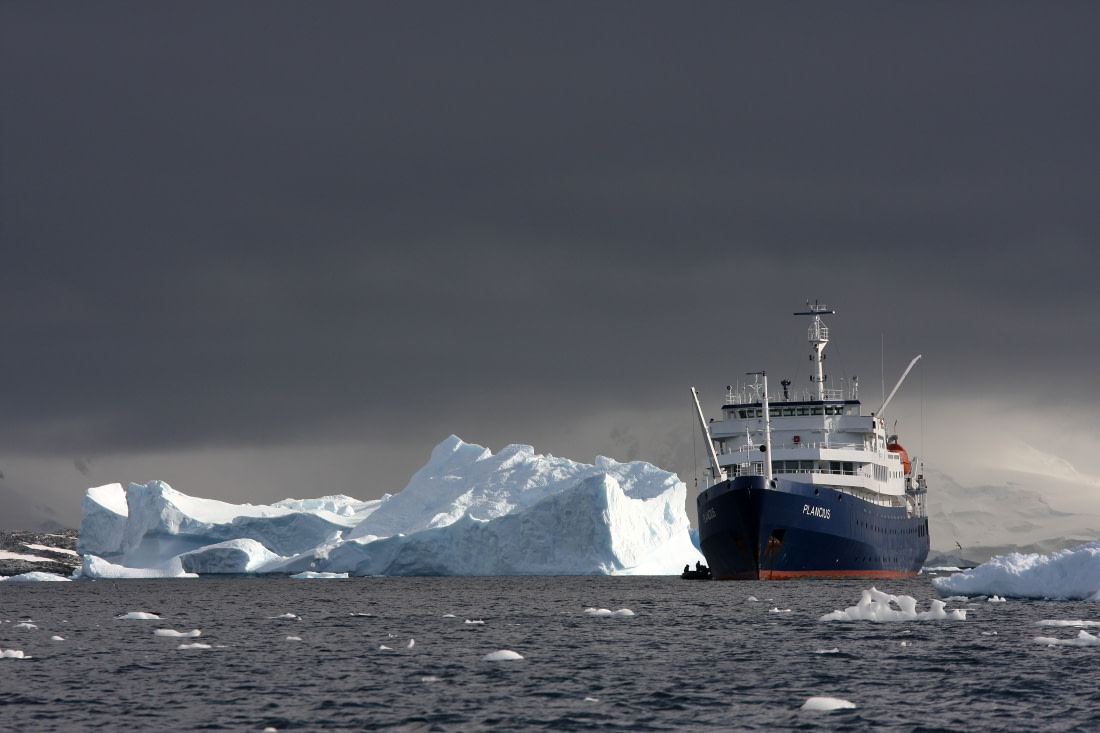
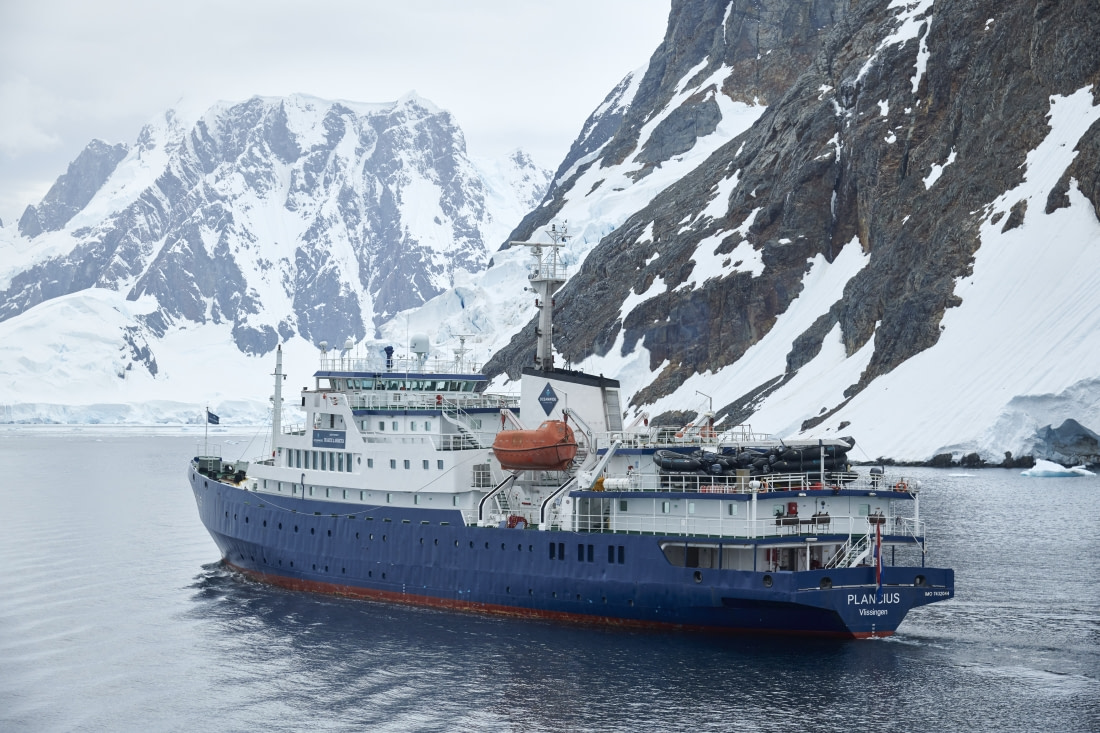
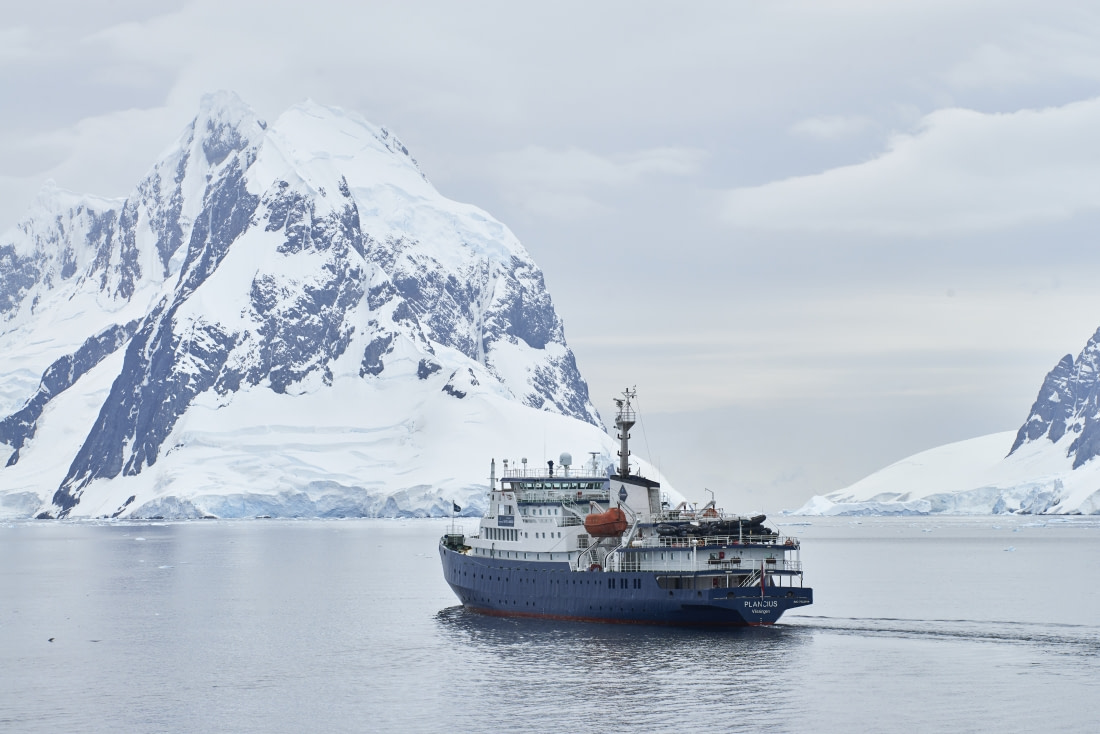
Finally! Most of us have travelled halfway around the world to come all the way down to Ushuaia. We spent the day with final preparations for the big adventure. The port of the small Argentine town is packed with cruise ships. We walked along the pier until we discovered our little blue ship among the other giants. When we could board Plancius in the afternoon we were warmly welcomed by the Expedition and the Hotel Team, who showed us to our cabins before we had some free time to explore the ship.

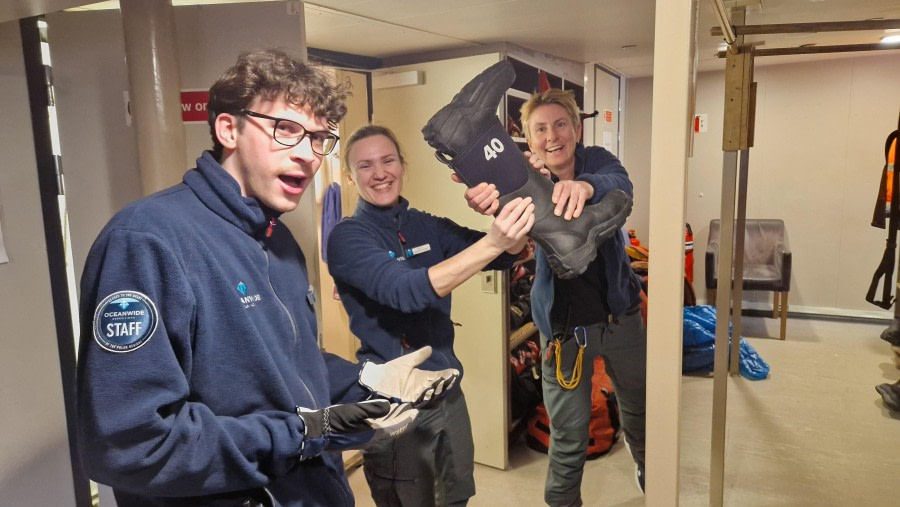
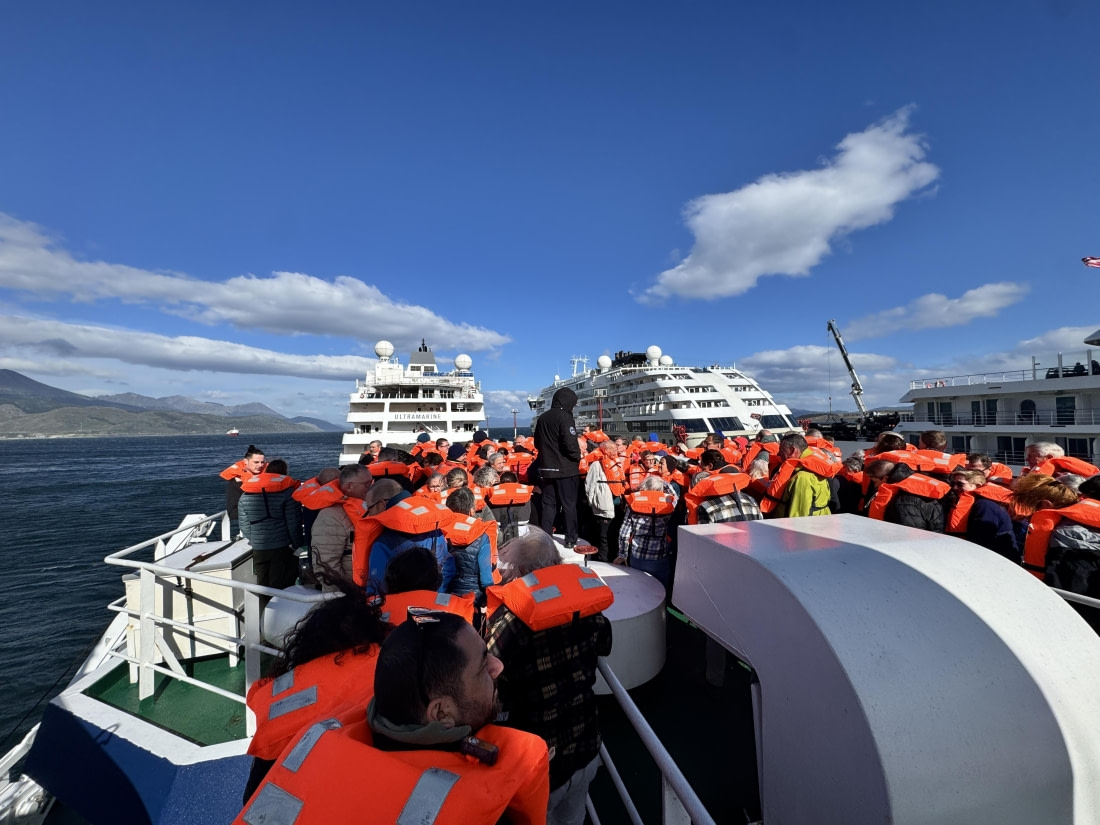
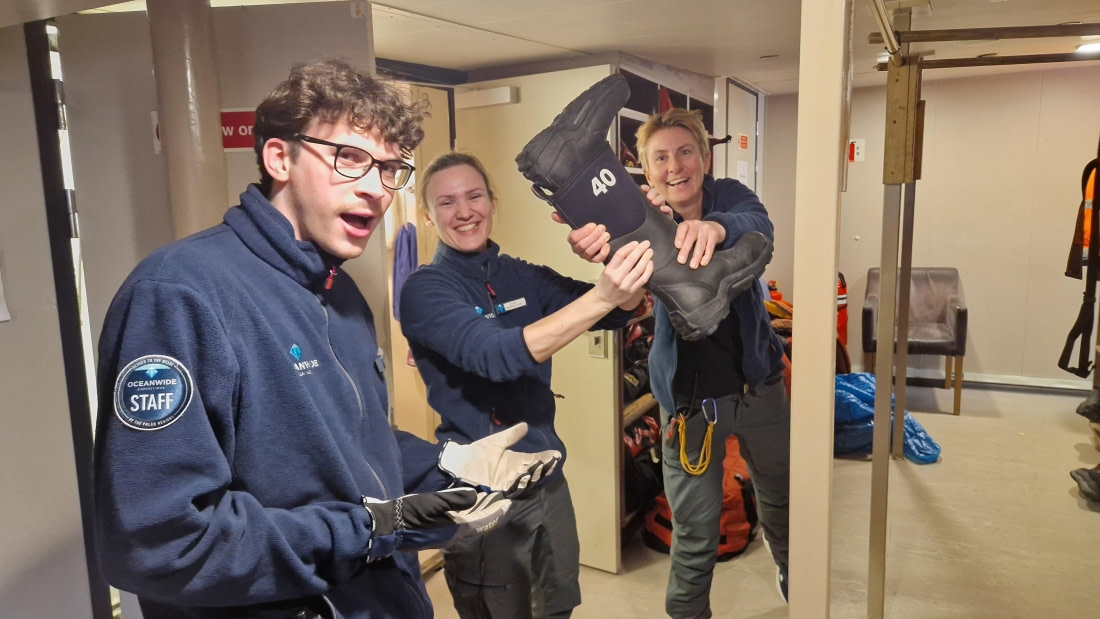
After all guests had come on board, we were invited to the lounge for a small introduction of our Expedition Leader Ali and our First Officer Don. Before the ship is allowed to leave port, we all had to attend a mandatory abandon ship drill. This was followed by a welcome drink and a speech of Captain Matei with whom we raised glasses to a great journey ahead of us. Alex, the Hotel Manager told us a bit more about the ship and Ali shortly introduced the Expedition Team. Due to strong winds, our departure got delayed by 2 hours and we eventually left Ushuaia in the evening. The team took the opportunity to hand out our rubber boots so we wouldn’t have to worry about that when we’re at sea and might be struggling with the movement of the ship. After a first delicious dinner aboard the Plancius, we got to enjoy the beautiful scenery around the Beagle Channel with the sun setting spectacularly over the rugged peaks of Patagonia. Let the adventure begin…

Day 2: At sea, heading towards The Falklands

At sea, heading towards The Falklands
Datum: 20.01.2026
Positie: 53°57.7’S / 064°01.1’W
Wind: NW7
Weer: Partly cloudy
Luchttemperatuur: +7

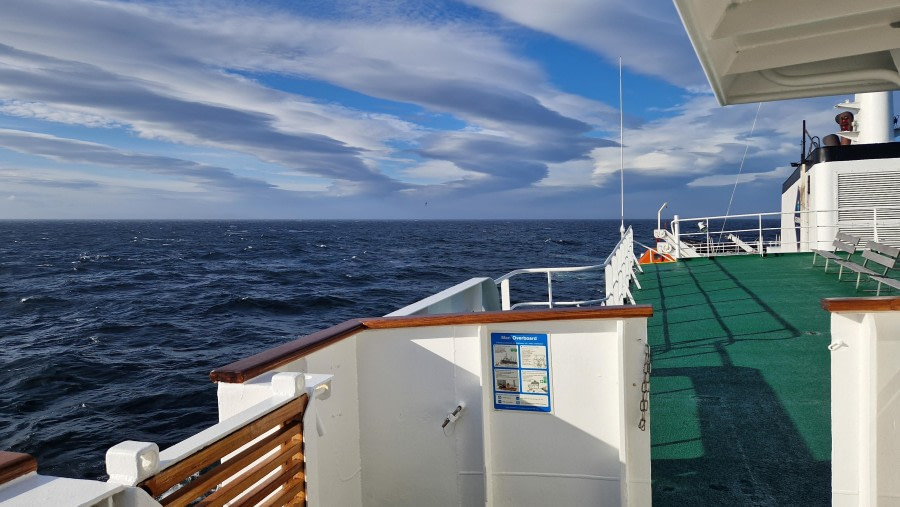
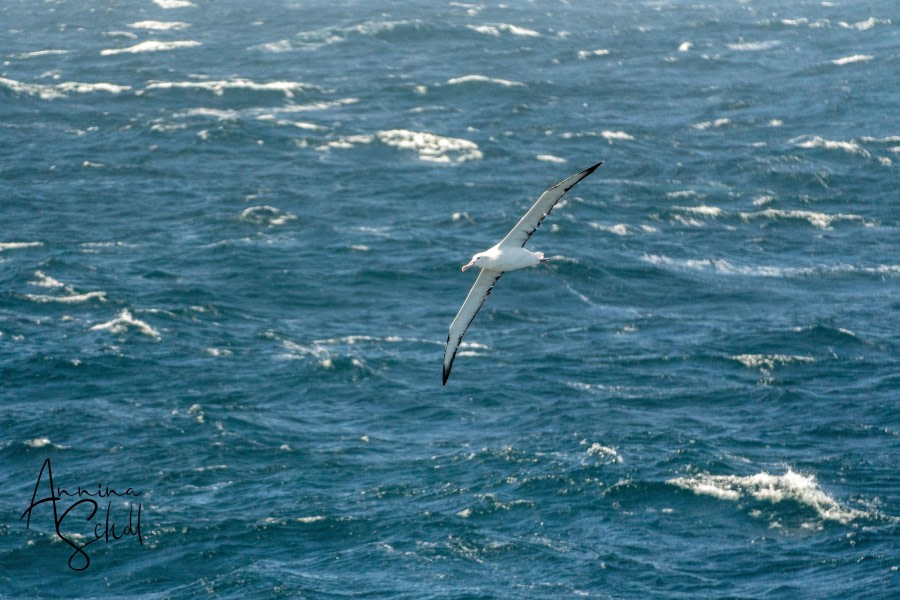
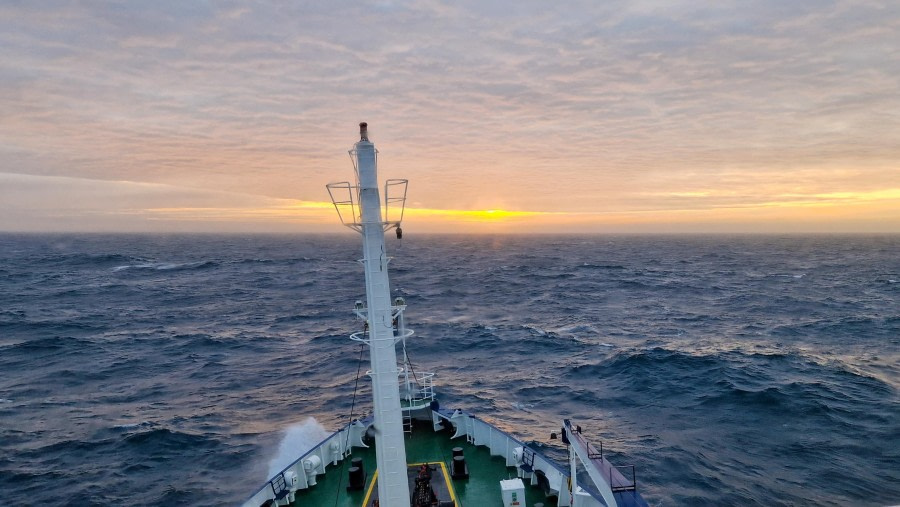
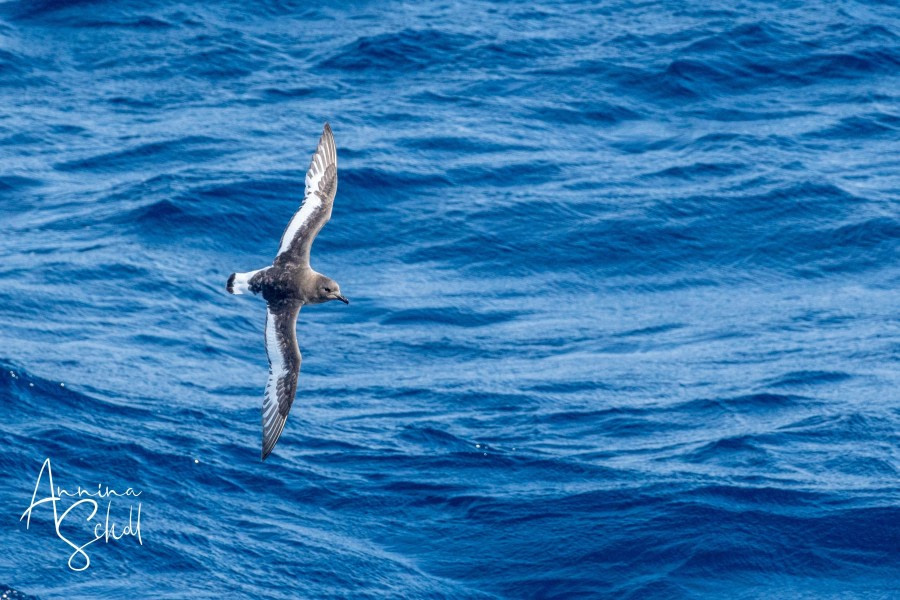
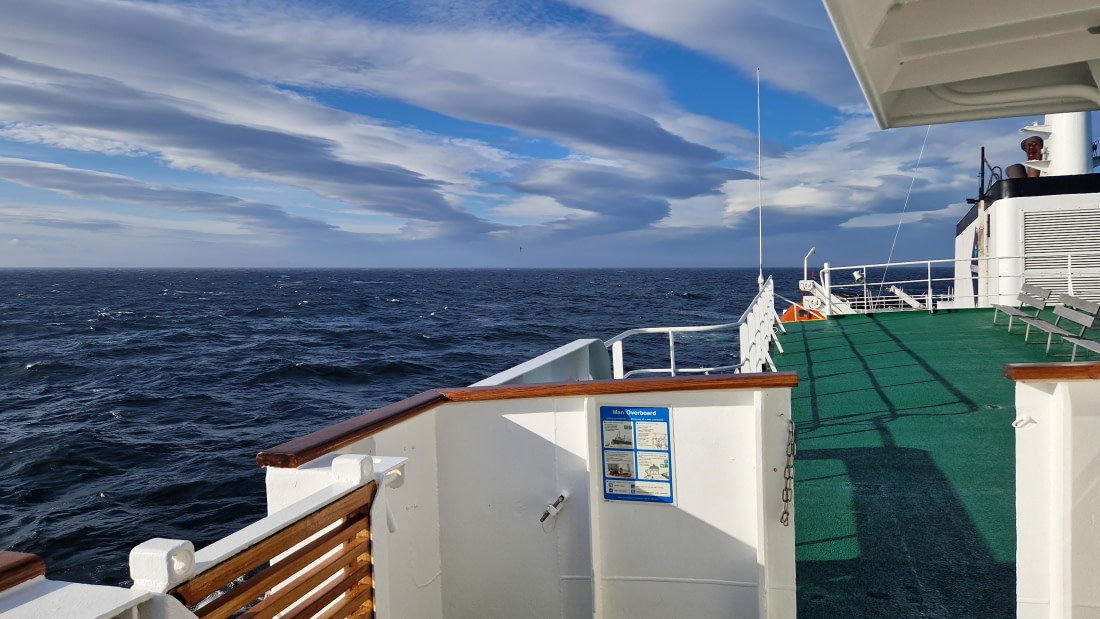
After we left Ushuaia later than anticipated, we passed through the Beagle channel during the night. This morning, we woke up far away from land. At first it felt a little strange to be in bed that moves and with new sounds and noises around us. But we all were exhausted and grateful to have some rest. The sea was moving Plancius quite a bit and some of us made our first experience with sea sickness. Others didn’t feel it at all – lucky them! The wind brought us quite a few seabirds – our first albatrosses – as well. We observed them as they followed the ship effortlessly without flapping their wings. Since the outside decks were closed due to the windy conditions we came up to the bridge to take fresh air and say hello to the captain, the officer and the AB on watch. The expedition team was there as well to explain and point out interesting things.

In the morning our expedition leader Ali told us more about the Falkland Islands, which were our first stop of the trip. She lived there for 15 years and experienced the life and the community first hand. A little bit later, Charlotte introduced us to whales and their biology. So far, we didn’t see any, but we all kept our eyes open.

In the afternoon the wind calmed down a little, so we all were able to be a little more active and enjoy the view and air outside. Even the sun came out for a little while. Black browed albatrosses, giant petrels, sooty shearwaters and other seabirds still followed the ship, while Matthias and Annina each gave a lecture about their biology and what makes a seabird a seabird. Since we planned on going on land the next day, we had to participate in a mandatory briefing, to learn about how to get in and out of the zodiacs safely and how to behave on land. We couldn’t wait to go out tomorrow and we hoped for good conditions that would allow us to land and discover the Falkland Islands.

Day 3: New Island

New Island
Datum: 21.01.2026
Positie: 51°45.9’S / 061°27.2’W
Wind: SW5
Weer: Partly cloudy
Luchttemperatuur: +10

We all slept well after the full day at sea and looked already much forward for touching land at the Falkland Islands. The Falkland Islands are an archipelago, consisting of two main islands (East and West Falkland) and 778 smaller islands. The archipelago is situated in the South Atlantic, some 400 miles from the South American mainland and 850 miles north of the Antarctic Circle. The published plan of the day was to do two landings on an Island called New Island. New Island is located at the extreme west of the Falklands’ archipelago. Dramatic cliffs contrast with sheltered sandy bays and natural harbours. New Island has a large concentration and great diversity of wildlife. The island, a Nature Reserve, is owned and run by the New Island Conservation Trust which relies entirely on donations to fund conservation and research.

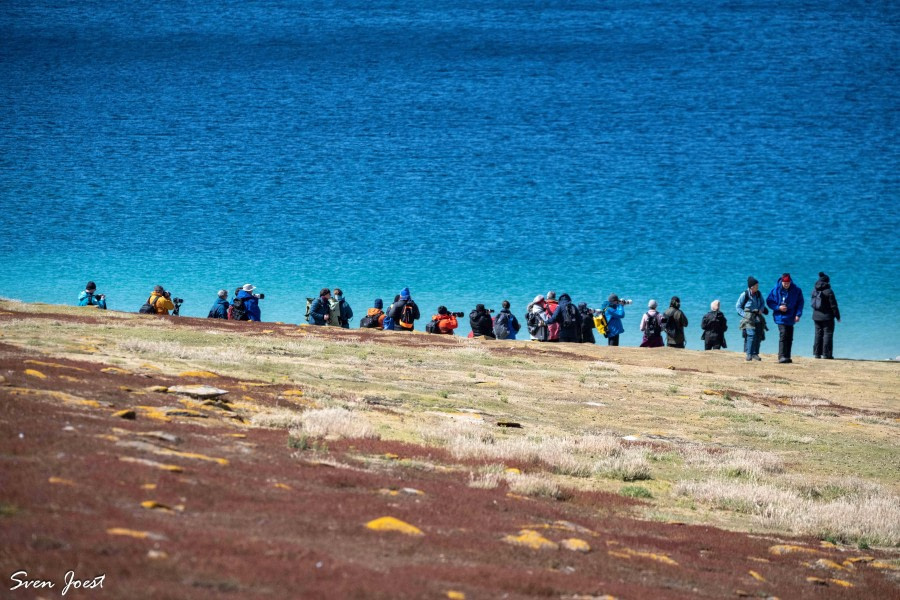
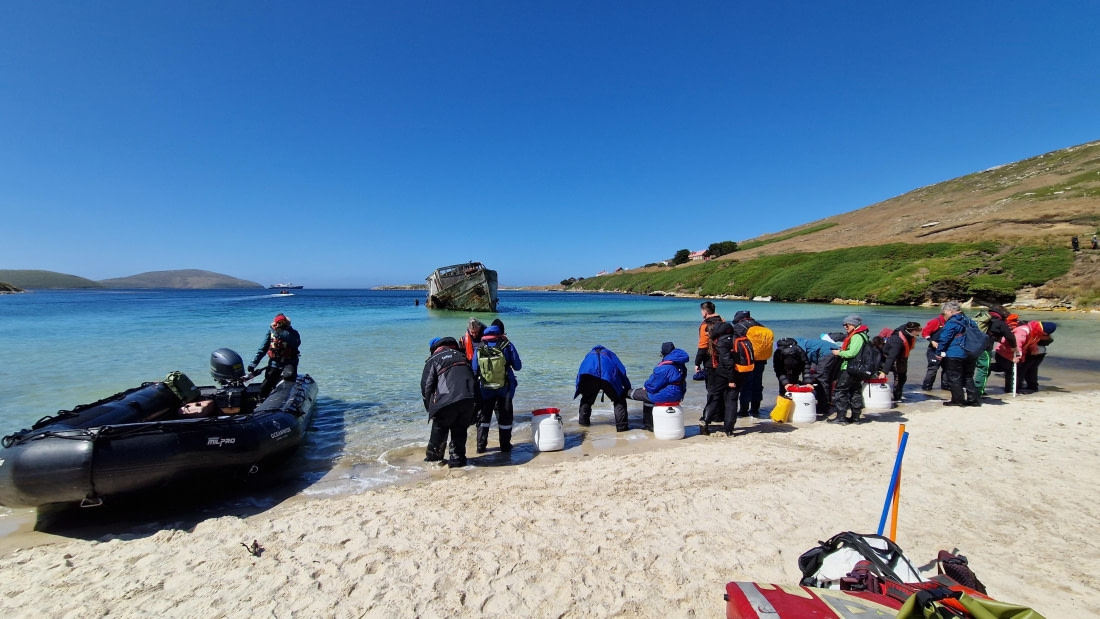
Right after a good breakfast our expedition team offered us a first landing right next to the Settlement, consisting out of just a few houses. The nice museum and a gift shop was just a few meters away. The landing site was a beautiful sandy beach. We walked uphill and crossed the whole island to visit a mixed species colony of Southern Rockhopper Penguins, Black Browed Albatross & Imperial Shags. It was amazing to see so many birds on such a small place, densely packed together. It was noisy and really interesting to watch all the interactions between and within the species. It was as well a busy place with adult birds returning from their feeding trips and feeding their chicks or leaving the colony.

The expedition team, together with the local guide Tim had marked a nice route to the most interesting places in that area. We all enjoyed the time on land at this beautiful spot close to so much wildlife. Back on the beach we all had to clean our boots, which was not easy and took quite a while.

After a short break, having lunch, the bridge team of Plancius repositioned to North Harbour, another nice and protected landing site. Already the Zodiac ride was spectacular because we were accompanied by a group of Peale’s Dolphins.

Again, perfect conditions with sunshine and just a little wind. The zodiacs headed towards a stretched sandy beach, which was the start of the hikes. It was a nice walk on grass. Here and there we could see Magellanic Penguins, standing right next to their burrows, that was their breeding place. On our way, crossing to the other side of the island we passed by a Gentoo Penguin rookery with already big chicks which start losing their down feathers. We approached a beautiful sandy beach were the penguins returned from their feeding trips, using a single path to reach their breeding or nesting sites. It was absolutely magical to see Penguins standing on white sand, in the background blue water and clear blue sky. Dolphins were again present on that side of the island.

The other place we could walk to was a colony of Black browed albatross, together with Rockhopper Penguins. It was a steep cliff and a canyon-like structure, allowing the penguins to get to this place. The albatrosses were nesting on top of cliff, but as well on the exposed side on lower levels. They had as well already quite big chicks filling the nest complete. Back at the landing site, we experienced a real low tide, the water was far away from the place we first touched land. It was very shallow, and the zodiacs picked us up in the middle of the bay, a hundred meters away from the dry sandy beach. On our way to the next destination, we passed a big group of Sei Whales, feeding in these productive waters off the Falkland Islands. By scanning the horizon, we could even see many more, those distant ones with just the obvious blow. It had been an amazing day, finished by a beautiful sunset at sea level, the crescent moon was a bit later visible.

Day 4: Stanley

Stanley
Datum: 22.01.2026
Positie: 51°41.2’S / 057°50.9’W
Wind: NW5
Weer: Partly Cloudy
Luchttemperatuur: +10

We woke up to another beautiful day in the Falkland Islands. During breakfast we were still sailing in between smaller and bigger islands with white sandy beaches and small rocky outcrops. As we passed through the narrows to reach today’s destination, Stanley, we noticed several squid fishing vessels that remain at anchor in the area. As we learned yesterday, the squid fishing industry is a major source of income in the Falklands. After breakfast, the expedition team shuttled us to shore with the zodiacs. We landed on a small jetty and were free to discover Stanley on our own.

The town has only about 3000 inhabitants, but it offers everything the population needs and also some souvenir shops for those of us that wanted to bring something home. We spent the entire morning walking around town, enjoying the sun, discovering the dock yard museum and soaking up the warmth of the day. By lunchtime we were ready to go back onboard Plancius. A male and a female south American sea lion had a nap on the jetty. We could clearly see the size difference between the two.

In the afternoon Ali told us about her time on the Falkland Islands during Covid. She spent most of her time during the pandemic on the remote sea lion island.

Later the expedition team gave recaps about peat, erosion and tussock grass and the sei whales, the species that we had seen yesterday after we left New Island.

After dinner we could enjoy a drink in the lounge, watching albatrosses and other sea birds following us in the sinking sun.

Day 5: Stanley and then at sea

Stanley and then at sea
Datum: 23.01.2026
Positie: 52°19.1’S / 051°08.8’W
Wind: NW6
Weer: Sunny
Luchttemperatuur: +10

Our day began with a wake-up call from our Expedition Leader, Ali, easing us into another full day at sea. Shortly afterwards, we gathered in the Dining Room to enjoy a relaxed breakfast buffet, giving us time to wake up properly and prepare for the day ahead. Later in the morning, we met in the Lounge for an introduction to South Georgia. Ali gave us a fascinating overview of the island, covering its history, economy, and incredible wildlife. This talk helped set the scene for what we could expect from our time in this remote and remarkable place.

We stayed in the Lounge as the morning continued to learn more about seals. Although we had already seen some during our time in the Falkland Islands, Charlotte expanded our knowledge of these marine mammals, explaining their behaviour, adaptations, and the challenges they face in the Southern Ocean.

After a morning full of learning, we headed to the Dining Room for lunch, enjoying a break and sharing conversations about everything we had learned so far.

In the afternoon, we returned to the Lounge for a presentation by Marcelo and Esther on Sir Ernest Shackleton and the Endurance Expedition. They both told the incredible story in English and German of Shackleton’s 1914 attempt to cross the Antarctic continent, highlighting the leadership, resilience, and determination that made the expedition legendary.

Later in the day, we relaxed with a BBC Iceworlds documentary screening in the Lounge, a welcome opportunity to unwind while still immersing ourselves in the polar world. As evening approached, we joined the expedition team for the daily recap, reflecting on the day’s highlights and hearing about plans for tomorrow. We ended the day with dinner, enjoying good food, good company, and a growing sense of excitement for the journey ahead.

Day 6: At sea

At sea
Datum: 24.01.2026
Positie: 52°59.9’S / 044°14.2’W
Wind: WNW3
Weer: Foggy
Luchttemperatuur: +5

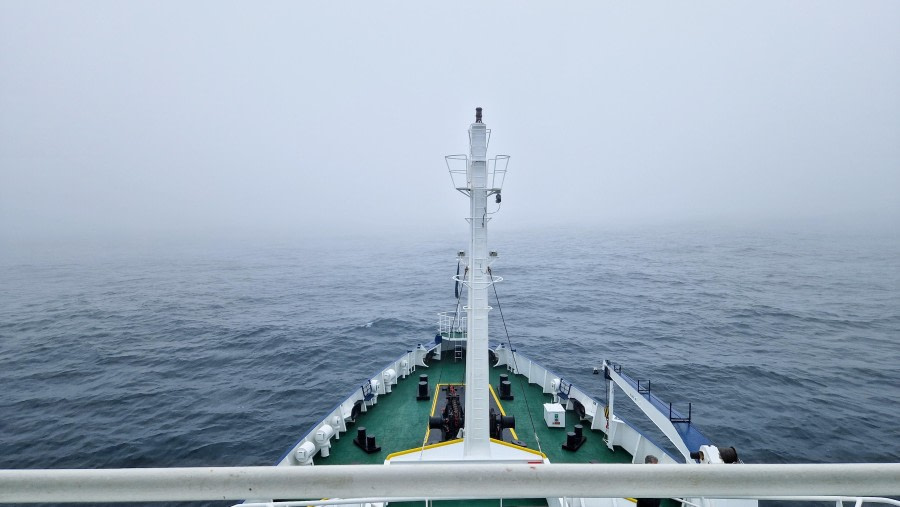
Another day at sea. The Antarctic convergence zone received us trying to keep South Georgia hidden from our eyes. The fog didn’t allow us to see anything more than 100 meters away from the bow. During the morning everybody was involved in taking care of their biosecurity. Firstly, receiving a mandatory briefing. Then we met in the Lounge, bringing all our outer gear for a deep check, being helped by the guides. After a couple of hours, we were ready and clean enough to land on this amazing island that was waiting for us somewhere beyond the fog.

In one of the armchairs closest to the windows in the fore section, on the port side, a wise man whispered to his guitar and then we would hear a faint melody we couldn't fully recognize, but it slowly soothed us.

In the afternoon, Ali gave us a complete lecture about penguins. All the species were explained in detail, this being very useful to understand their behaviour of these birds that cannot fly but swim in an incredible way.

For teatime, a short documentary about the wildlife in the polar regions created a good ambiance and led to friendly conversations with the other guests. Before we had dinner, we had our daily recap and the anticipation was growing that in the next days we will be walking and observing through our owns eyes wonderful landscapes and wildlife. I

believe that every day is unique. In words of L. R. Knost: “Life is amazing. And then it’s awful. And then it’s amazing again. And in between the amazing and the awful it’s ordinary and mundane and routine. Breathe in the amazing, hold on through the awful, and relax and exhale during the ordinary. That’s just living heartbreaking, soul-healing, amazing, awful, ordinary life. And it’s breathtakingly beautiful.”

Remember, we cannot lose any second, every moment counts!

Day 7: Elsehul and Right Whale Bay

Elsehul and Right Whale Bay
Datum: 25.01.2026
Positie: 54°00.8’S / 037°58.5’W
Wind: WNW4
Weer: partly cloudy
Luchttemperatuur: +15

Finally South Georgia! As we approached the north tip of the island the fog lifted, and we saw mountains and icebergs. The ragged peaks were covered in wisps of mist, and we spotted the first king pinguins in the water.

South Georgia is a long, narrow island known for its amazing wildlife, rugged mountains and deeply indented coastline. It stretches some 170 km from east to west, with Mount Paget towering at 2,935 m. The island was first sighted by Anthony de la Roché, in 1675 and later surveyed and claimed for Britain by Captain James Cook in 1775. In the 19th and early 20th centuries it became a centre for sealing and whaling, particularly at Grytviken. Today, the island’s small year-round population lives at King Edward Point, home to a British Antarctic Survey research station.

As we entered the little bay Elsehul (Else’s cove, named by Norwegian whalers) on the northwest side of the island we lowered all 10 zodiacs, and we started our first zodiac cruise of the trip. The steep beach and the high cliffs were home to hundreds of fur and elephant seals as well as numerous king pinguins. The fur seal cubs were playing in the swell while the large elephant seals were sleeping on the shore. The weather was good and we stayed in the boats for 2 hours before returning to the ship for lunch while we repositioned to Right Whale Bay for our first landing on the island.

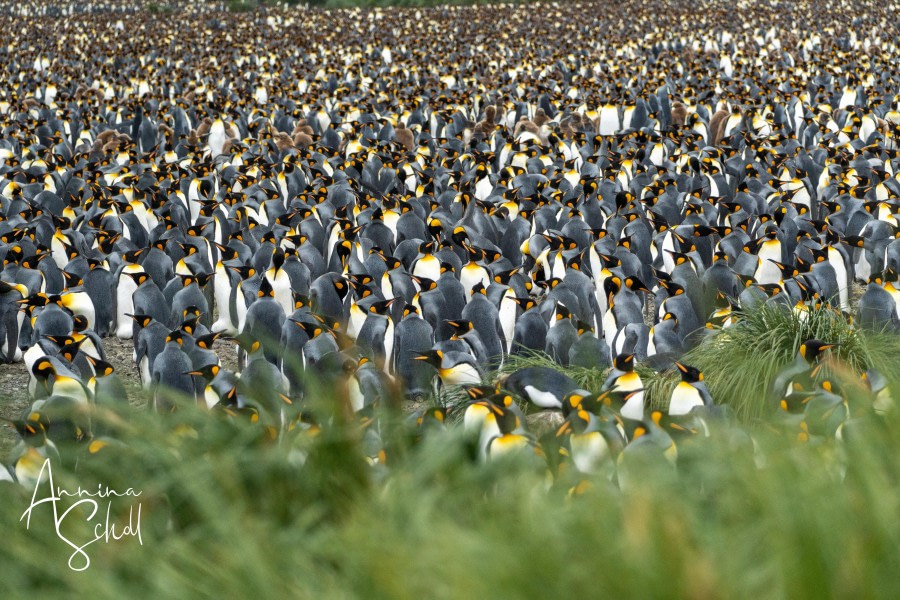
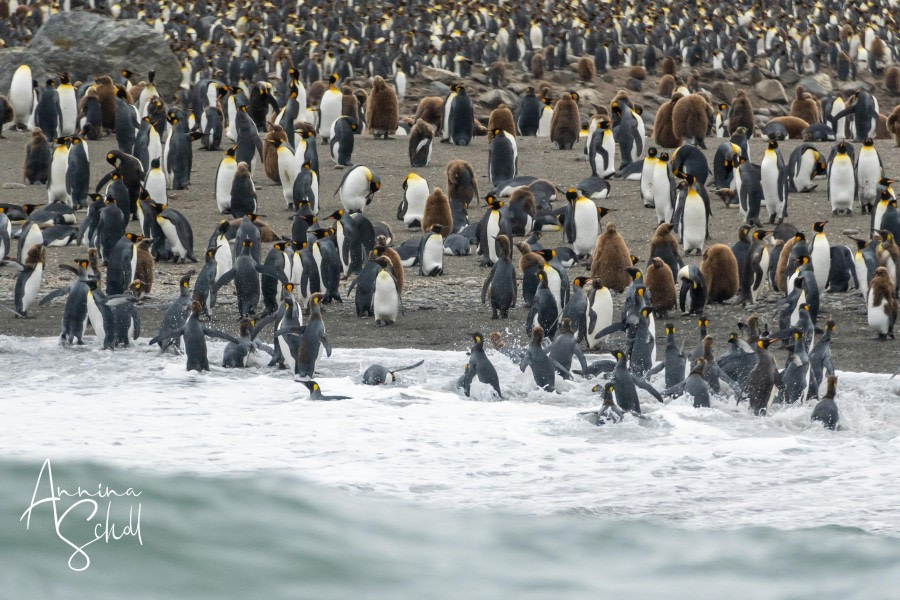
The conditions were perfect, and we were greeted on shore by a cacophony of sounds from thousands and thousands of fur seals and pinguins. The fur seals can be territorial and aggressive but a stern voice and lifted hands is usually enough to make them reconsider. The juveniles are playful and curious. The king pinguin with their characteristic colourful beak and neck is the second largest species of pinguin, up to 1m tall and weigh 10-15 kg. The chicks were downy grey with some partway through moulding. We spend 3 hours on land, observing, enjoying and photographing the incredible wildlife before returning to the ship for dinner, a ships cruise in the bay of isles and some much-needed photo editing. What a fantastic first day on South Georgia!

Day 8: Salisbury Plain and Fortuna Bay

Salisbury Plain and Fortuna Bay
Datum: 26.01.2026
Positie: 54°03.2’S / 037°19.1’W
Wind: N6
Weer: Partly cloudy
Luchttemperatuur: +12

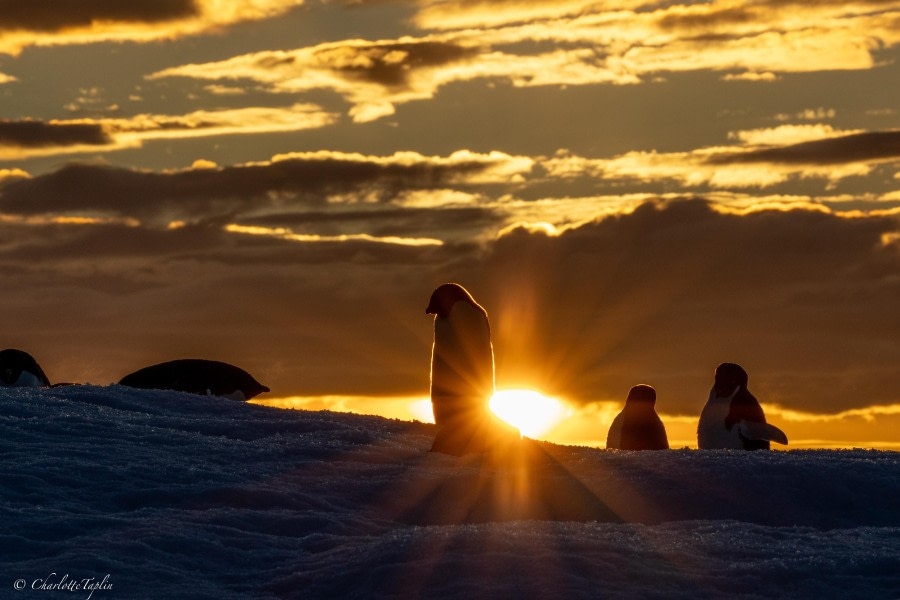
Another day in paradise started with the wake-up call, given by our dear expedition leader Ali. The published plan for today’s morning activities was to land at Salisbury Plain inhabited by a large King penguin colony with 60,000 breeding pairs. During the night our Plancius bridge team sailed the ship outside of the Bay of Isles. Conditions looked good and while we approached, the weather became better. Outside the bay it was quite foggy, coming closer, the visibility improved. After breakfast our expedition team offered us a landing at Salisbury Plain after assessing the conditions ashore. We touched land at a wide area of level ground formed by the retreat of the Grace Glacier, which we could see in the back within huge mountains. Right behind the grey sand beach was green short grass, which looked like a golf lawn but at this place crowded by Fur Seals and King Penguins. We made our way to the colony, the second largest penguin colony in South Georgia. On the approach there were many photo opportunities with beautiful scenery in combination with wildlife. Close to the colony we met the first chicks that looked quite funny in a way. It did not surprise us that those penguins with the long brown down feathers were formerly believed to be a separate species. We know now that those nice chicks will soon lose their fluffy down and will become a beautiful colourful King Penguin. It was amazing to see such a huge colony of sheer countless penguins. Some were incubating eggs, some probably guarding small chicks and the big brown chicks were in between. In addition, we saw the penguins in moult. We had enjoyed every moment on land, already looking forward for the afternoon.

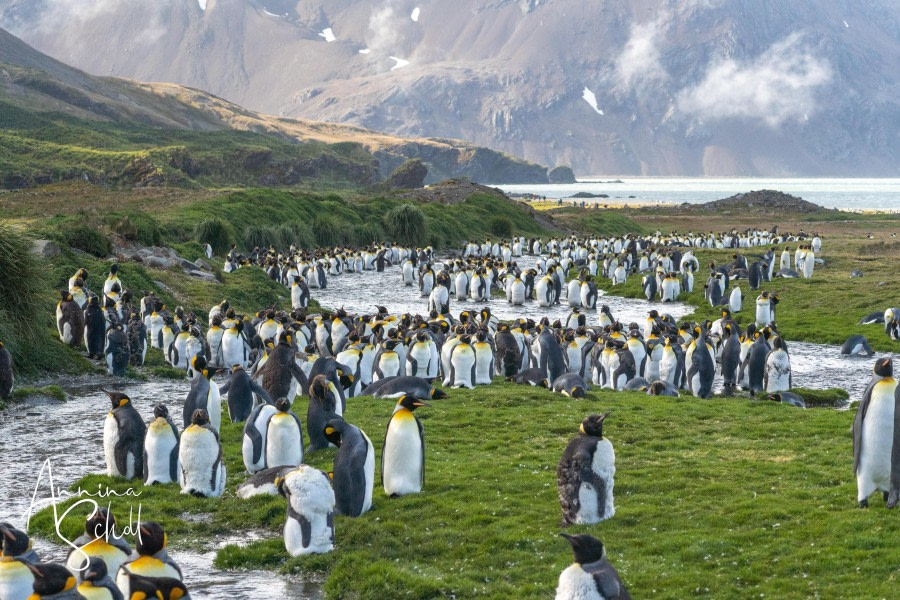
In the early afternoon hours Plancius entered Fortuna Bay. That bay is a 6km long fjord leading to the heart of South Georgia’s rugged interior. We faced a spectacular panorama with high mountains all around and the massive König Glacier in the back. Our expedition team assessed the conditions and set up the route for us. When they started it looked fine, however the wind picked up and with this as well the waves, so Ali decided to wait for a while in the hope that the conditions improve, and it calmed down. We still had some waves but the ride to the shore with our experienced drivers was possible and enjoyable. Right next to the landing site, on rocky outcrops, there were dozens of tiny Fur Seals and in higher places there were Elefant Seals, Tussock everywhere in the back. We all followed the sandy beach with beautiful small bays in which penguins and seals played in the waves. In the inner part of Fortuna Bay there was a massive iceberg, probably sitting on the ground in shallow water. The marked route led us to two scenic lookout points, overlooking a King Penguin colony, green grass, the glacier and high pointy mountains in the back. On the way to those far end points, we had to cross several melt water streams coming from the nearby mountains. The Penguins, but also the Fur Seals seemed to like those streams, they gathered in high numbers. Also, the South Georgia Pintail was present at small lakes, an endemic species of that island. We all enjoyed the scenery and the hikes surrounded by wildlife. However, the expedition team asked us to make the way back to the landing side because the wind did pick up in the bay. On the landing site we got prepared for a wet transfer to the ship. The experienced zodiac drivers brought us back and it was indeed wet, and we all tasted the salt water of Fortuna Bay. It was a outstanding experience which we will never forget, the teamwork was great, and all got back save. We left Fortuna Bay spending the night at the northern cost.

Day 9: Godthul and Grytviken

Godthul and Grytviken
Datum: 27.01.2026
Positie: 54°15.1’S / 036°13.8’W
Wind: SE1
Weer: overcast
Luchttemperatuur: +7

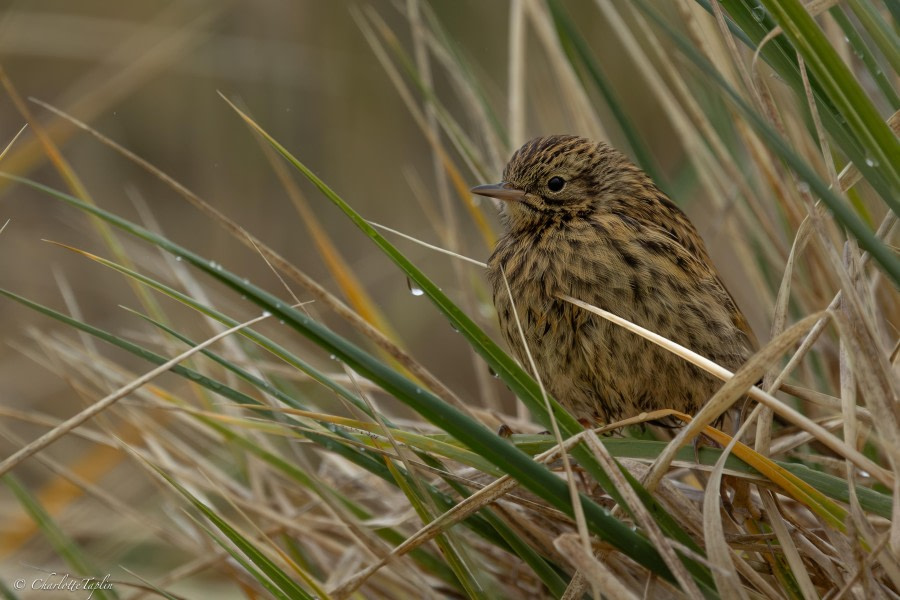
We started our day early in the morning making our way into “Godthul”. The place name originates from Norwegian whalers and translates into “Good Cove”. Upon our arrival the clouds were hanging lower on the hills in this old circuit glacial bay. After we had landed on the beach most of us made their way up the steep hill through the tussock grass with wildlife already around us. Leaving the King Penguins, Fur and Elephant seals behind at the beach we climbed higher to reach the Gentoo Penguin colony. For many of us this climb was very successful due to the spotting of the endemic South Georgia Pipit. With this motivation we scrambled on to reach the higher Gentoo colony and had the chance to observe these Penguins. Some of us rather wanted to Zodiac cruise in the bay of Godthul and we went closer to two bigger icebergs in the bay and had fur seals swimming around the Zodiac playfully.

After everyone was back onboard, we started to relocate to our afternoon destination in Grytviken. Over lunchtime all of us cleaned our gear again like we have been doing it since arrival in South Georgia. Upon arrival we got checked by the Authorities of King Edward Point and got a 100% biosecurity-approved. That meant we were ready to go ashore to visit the historical whaling Station of Grytviken. When we arrived, all of us worked our way through the fur seals scattered around towards the cemetery of Grytviken. In fashion, most of us visited Sir Ernest Shackelton’s grave and toasted to him with a glass of Whiskey. After giving the honours to this great explorer, we made our way towards the rusty whaling machinery and the old buildings in Grytviken. All of us wandered through the place looking at the relicts of this historical place. Many visited the museum to read up on the History of Grytviken and many joined a guided walk where more information about the history and the life of the whalers and sealers were explained. When the day came to an end the sky broke up and we had a blue sky over us with a great evening atmosphere in the King Edward Cove. As soon as were returned to Plancius we could smell the barbecue on the outer deck. The day ended with a delicious outdoor dinner, and everyone was enjoying the food and drinks outside on deck with a beautiful view of the surroundings at Grytviken.

Day 10: St. Andrews Bay, Gold Harbour, Drygalski Fjord

St. Andrews Bay, Gold Harbour, Drygalski Fjord
Datum: 28.01.2026
Positie: 54°29.1’S / 035°56.4’W
Wind: NW5
Weer: Overcast
Luchttemperatuur: +4

Plancius spent the whole night in open water. In the morning, we approached St. Andrew’s Bay. That bay is home to the largest King Penguin colony, counting no less than 250.000 breeding pairs. The wide bay is fully exposed to the open sea, and we could see quite a big swell going in. However, our expedition team checked the conditions at the landing side. They went out while we were still having breakfast. After a while the expedition team returned with a zodiac filled with water and the message that a landing is unfortunately not possible because of breaking waves at the beach. But instead of a landing Ali invited us to join a zodiac cruise. We set out and explored the 3km long beach, covered with penguins and elephant seals. In the background we could see high mountains with clouds on the top and two massive glaciers named Cook- and Heaney Glacier. We all had a great time in the zodiacs, enjoying the King Penguins in big numbers in the water and in amazing huge numbers on land. We cruised in the big swell, sometimes even the zodiacs disappeared in the lowest sections in the waves.

Back on Plancius we moved to Gold Harbour in the hope to be able to land on that beach. On the way to there, we moved out in the open ocean but stayed on the shelf, an obviously very productive area. Already from a distance we saw a lot of blows of whales. Coming closer, we found ourselves surrounded by Humpback whales, some came really close to the ship. An amazing experience in the open ocean.

Our Expedition team set out with two zodiacs and all the equipment they need to prepare a landing for us. After a while we got the message that it is not safe to land at that place. Also here are huge waves breaking on the beach, because of the swell entering the bay from an unfavourable direction for us. Gold Harbour is however one of the most beautiful visitor sites of South Georgia with a massive hanging glacier named Bertrab Glacier. Being nearly on the southern end of the island our dear expedition leader Ali decided to cruise into Drygalski Fjord, a 14km long Fjord system. By sailing in, we entered a totally new world. High mountains on both sides, glaciers and bare rock, the water was bright blue. Nothing green in this fjord. However, we spotted a lot of beautiful Snow Petrels. Everybody enjoyed the sailing, in the far inner side we celebrated the nice day, but as well the previous ones with sparkling wine on the sun deck, behind the bridge. Later it was unfortunately time to turn around, leaving Drygalski Fjord and with that South Georgia aiming for Antarctica.

Day 11: At sea towards Antarctica

At sea towards Antarctica
Datum: 29.01.2026
Positie: 56°14.4’S / 039°46.7’W
Wind: W7
Weer: overcast
Luchttemperatuur: +5

We started the day with a gentle wake-up call from our Expedition Leader, Ali, at 07:45. It was another day at sea, and the excitement was quietly building as we edged closer to the White Continent. Breakfast followed soon after in the Dining Room, where a generous buffet gave everyone plenty of time to ease into the morning and swap stories over coffee.

By mid-morning we gathered in the lounge to learn more about ice as we sailed steadily south. We were already beginning to see it along the way, small reminders that Antarctica was no longer just a point on the map. Karoline’s talk added a whole new layer of appreciation to the frozen world forming around us.

Later in the morning, Sven took us on a geological journey through the Falklands and South Georgia. Having already explored these islands earlier in the voyage, it was fascinating to hear how time, tectonics, and nature had shaped the rugged landscapes we had enjoyed so much. Lunch was served at 12:30, offering a welcome pause and a chance to recharge before the afternoon’s activities.

In the afternoon, Charlotte spoke about whale feeding, building on the incredible humpback whale encounters we had been lucky enough to witness. Learning more about how they forage for krill made those moments at sea feel even more special — and gave us plenty to talk about afterward. At the same time, Annina held a German lecture about krill which is the basis of all animal life here in the Southern Ocean.

As the day slowed, we settled into the lounge for a documentary screening on the Endurance Expedition, a comfortable way to spend the late afternoon while the ship continued her journey south. We rounded off the day with the evening recap, where the expedition team reflected on the day’s highlights and shared plans for tomorrow, leaving us feeling both informed and excited about what lay ahead. Dinner followed at 19:00, bringing another satisfying end to a day filled with learning, good company, and the quiet thrill of getting ever closer to Antarctica.

Day 12: At sea towards Antarctica

At sea towards Antarctica
Datum: 30.01.2026
Positie: 58°12.2’S / 045°38.2’W
Wind: WNW5
Weer: Foggy
Luchttemperatuur: +4

During the night, Plancius continued southwards. We changed back to Argentinian time, so we got an hour’s extra sleep. After breakfast we continued our lecture program starting with a lecture about Krill by Annina followed by Marcello giving an overview of South Georgias history. The wind was holding steady at 20-30kt and the swell still 2-3m with some rouge waves of 4-5m. After lunch we all saw the amazing documentary of the discovery of Shackleton’s ship Endurance in 2022, exactly 100 years after it sank. The movie ended with a scene from Shackleton’s grave in Grytviken, the exact spot where we were standing just 3 days ago. The five men in the 23-foot lifeboat James Caird used 14 days for the 1500km journey from Elephant Island to South Georgia, a stretch of the polar sea we now cover in 3 days on a very different ship and with all modern comforts.

A tradition on the South Georgia trips is the auction to the benefit of the South Georgia Heritage Trust. Items for sale included 7 postcards pictures of our journey painted by Deborah, a pinguin bracelet and engraved hip flask, a book and a bottle of Shackelton Whiskey both signed by Dr. John Shears, the expedition leader of the Endurance22 search mission and Nico Vincent the Expedition Sub-Sea Manager. Also for sale was a chance to do the morning wakeup call, the flag from the bow and a chance to join the expedition team as a guide for a day.

Day 13: At sea towards Antarctica

At sea towards Antarctica
Datum: 31.01.2026
Positie: 60°20.4’S / 052°23.3’W
Wind: W5
Weer: Partly Cloudy
Luchttemperatuur: +3

After breakfast, Annina gave a lecture named “Welcome to Antarctica” and therewith told us about many wonderful things we will see in our next destination, the White Continent is getting closer and closer.

Later, Sven invited us to the Lounge to share some history of the Antarctic plate tectonics and the formation of this special continent. It was very useful to understand what happened after the continental drifting, when all of them were part of a supercontinent named Gondwana.

Chef Ralf explained to us some of his many secrets and experiences for being able to cook delicious lunches and dinners for such a big group of people. He emphasized the importance of good logistics and acquiring fresh supplies and provisions, distributing different roles in the kitchen, and preparing the menus while considering not only the passengers' tastes but also the preservation of the food, preventing it from losing its quality, as well as the weather conditions.

The Race to the Pole is one of the most interesting and intense moments in Antarctic history. Charlotte (English) and Esther (German) told us how Amundsen and Scott carried on their owns plans to reach the South Pole, comparing both routes, gears, methods, teams, provisions, and finally, their goals and outcomes that they got. Sadly, Scott and his last four companions died after they reached the South Pole, knowing that Amundsen won the race. Cicero said that the life of the great dead consists in being present in the spirit of the living. I am sure that the spirits of Amundsen, Scott and Shackleton travelled with us onboard Plancius.

At 5:30pm we sighted Clarence Island, its typical mountainous silhouette, giving us a very first impression of Antarctic landscape. Not so much later, Elephant Island appeared in front of us.

The Captain decided to approach until we could see the monument of Luis Pardo, the Chilean captain who rescued the twenty-two Endurance crew members who were living there waiting for their boss and the help that he, Shakleton promised before leaving Point Wild heading to South Georgia in April 1916.

This great Leader never gave up until his men were saved after four attempts. It is almost impossible to imagine the hardships that all of them had to endure during the nearly two years that the expedition lasted, but they made it!

Now I understand how right Albert Einstein was when he developed the Theory of Relativity. These men surely experienced long days of sadness and just as many days holding onto the hope that a better future would come. For them, the eternal could have been a minute in their moments of sorrow and then, as fleeting as that eternal wait could have been, when they saw that they would finally be rescued.

During dinner, a couple of birthdays were celebrated. The stewards, with Maria leading the road, made us feel as happy as we were younger.

Day 14: Hope Bay & Antarctic Sound

Hope Bay & Antarctic Sound
Datum: 01.02.2026
Positie: 63°06.4’S / 056°58.7’W
Wind: 1
Weer: Partly Cloudy
Luchttemperatuur: +4

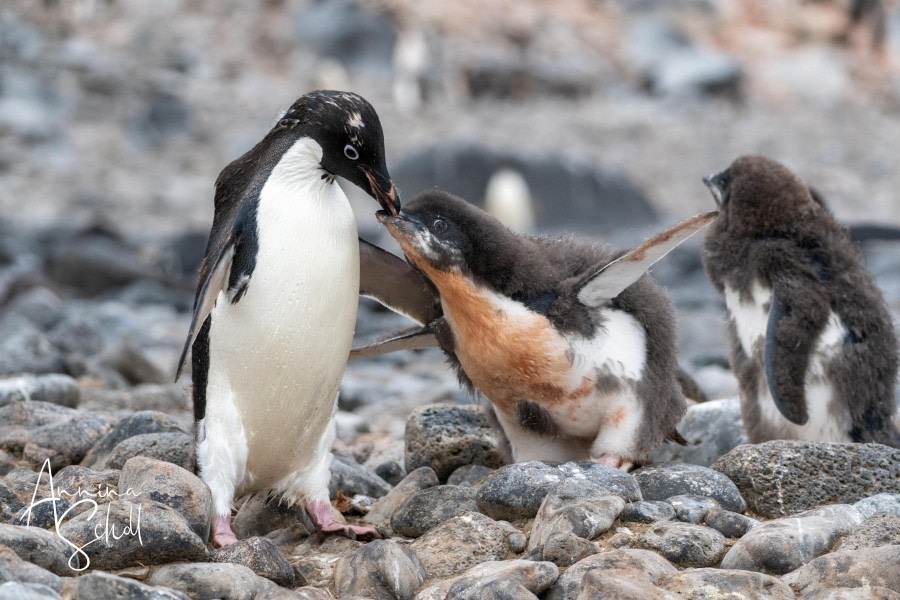
When we woke up in the morning, Plancius was on her way to the Antarctic Sound. After the talk about the Swedish Antarctic Expedition by Marcelo all of us gathered outside on deck to see the first massive icebergs passing by. Shortly we also saw at the horizon the start of the Antarctic Peninsula, covered in most places with a thick layer of ice. The sun was shining above us and nearly no clouds were covering the blue sky. As we sailed into the Antarctic Sound our afternoon destination, Hope Bay, became visible. As we entered the bay we passed the Argentinian Esperanza Base. As soon as we were in position half of us went ashore to look at the local Adelie penguin colony while the other half went for a Zodiac cruise around the bay. It was a beautiful afternoon with many interesting things to see onshore but also in the Zodiac. Especially the amount of porpoising penguins in the water was fascinating. After this successful afternoon we sailed deeper into the Antarctic Sound.

After Dinner, we were all surprised by Ali on the PA system. We were asked once more to get ready for an evening zodiac cruise through the ice. As soon as we entered the zodiac, we were stunned by the beauty around us. The light was surreal, reflecting on the water surface that looked like glass. As we slowly made our way through the ice we spotted Adelie penguins on ice flows, a big elephant seal on an ice flow and just before the end of the cruise two humpback whales passed by our zodiacs. The evening could have not been better. Except for the fact that just as most went to their cabins and the darkness started to settle the announcement of Orca’s came through the speakers. As we rushed outside, we got a great show of a larger pod of Orca’s swimming past Plancius and some even passed just beside the Ship. That was truly the cherry on top of the cake for this day.

Day 15: Paulet Island and Brown Bluff

Paulet Island and Brown Bluff
Datum: 02.02.2026
Positie: 63°36.5’S / 055°59.8’W
Wind: 1
Weer: partly cloudy
Luchttemperatuur: -1

This morning, we rose earlier again since we had a whole day of activities planned for the day. The morning was cold, and the decks were covered in a thin layer of snow. Overnight we had gone through the Antarctic Sound and reached Paulet Island around 7am. Right in front of the island there was a massive current that made it seem like the icebergs were drifting on a conveyor belt. The ship had to relocate shortly after anchoring as there was a gigantic tabular iceberg drifting towards us, easily ten times as big as our Plancius.

Today, our expedition team had another member, Hans, who bought his spot on the team during the South Georgia auction. Paulet Island is home to around 100,000 breeding pairs of Adelie penguins and it was difficult to find a path through the densely packed colony. We were greeting by countless curious chicks as we made our way up the island. We met Marcelo by the remains of the historic hut that Carl Anton Larson built in 1903 after their ship, the Antarctic was crushed by the ice and sank. 20 men overwintered in this tiny stone cabin before they set out the next spring to look for the remaining members of the Swedish Antarctic Expedition under Otto Nordenskjöld. We continued, carefully walking through the penguin colonies until we reached a viewpoint that overlooked a freshwater lake and another one where we could see over the whole bay with its many icebergs and the masses of penguins in the water. Our landing ended with a short zodiac cruise along the shore where we got a closer look at the nesting imperial cormorants and two Weddell seals relaxing at the beach.

After the morning at Paulet Island, we made our way back through the Antarctic Sound – which is actually named after the ship that sank here in the early 20th century. The clouds lifted, the sun came out and we enjoyed a spectacular cruise through towering ice bergs. Just to make this moment even more perfect, we encountered a group of feeding humpback whales, a truly majestic sight amidst this incredible landscape.

This wonderful experience, we had another landing planned for the afternoon: Brown Bluff, a rugged volcanic cliff in multiple shades of brown, red and yellow. The high towering cliffs are bordered by an imposing glacier front.

When we arrived at the landing site, there was a young male elephant seal sleeping on the beach that couldn’t be bothered by our presence. The expedition team had flagged a route along the shore through the numerous Gentoo and Adelie penguins and stranded pieces of ice. Another route led over a snow field and an area of volcanic debris until the edge of the glacier. We enjoyed great views and beautiful penguin encounters in the afternoon sunshine.

Before our return to the ship, some of us were brave enough to take a swim in the freezing Antarctic waters surrounded by floating icebergs! A proper polar plunge! The return journey on the zodiacs was splashy as the wind started to pick up but eventually, we were all safe and happy back on board where a warm shower and hot drinks awaited us.

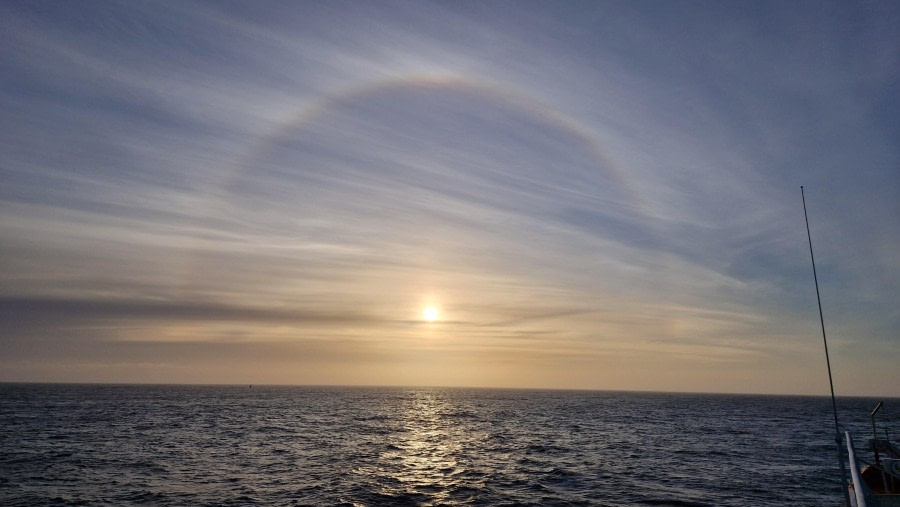
The evening was rounded off with a short recap and a briefing for our last expedition day followed by another delicious dinner and a beautiful sunset in the Bransfield Strait.

Day 16: Half Moon Island and Edinburgh Hill

Half Moon Island and Edinburgh Hill
Datum: 03.02.2026
Positie: 62°33.9’S / 059°51.5’W
Wind: W4
Weer: Overcast
Luchttemperatuur: +2

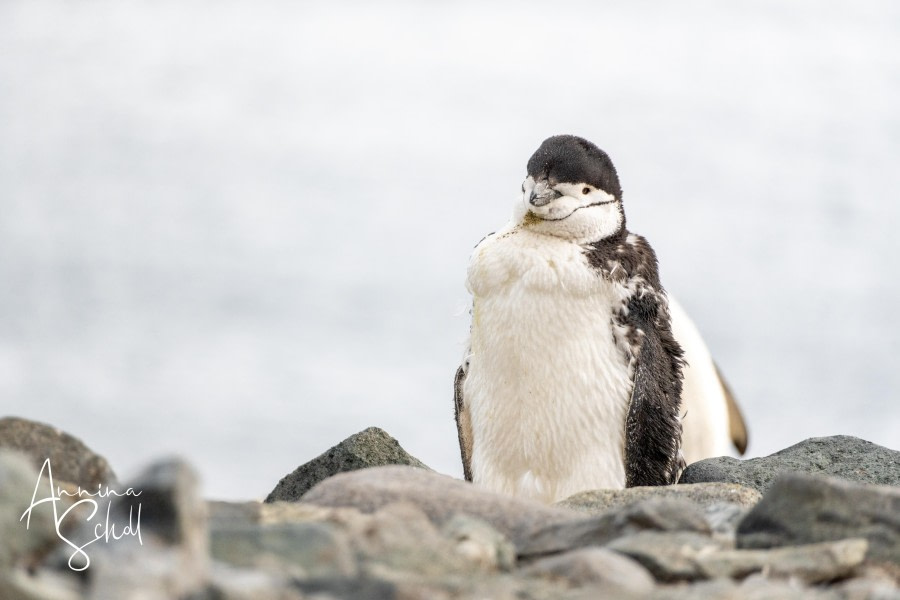
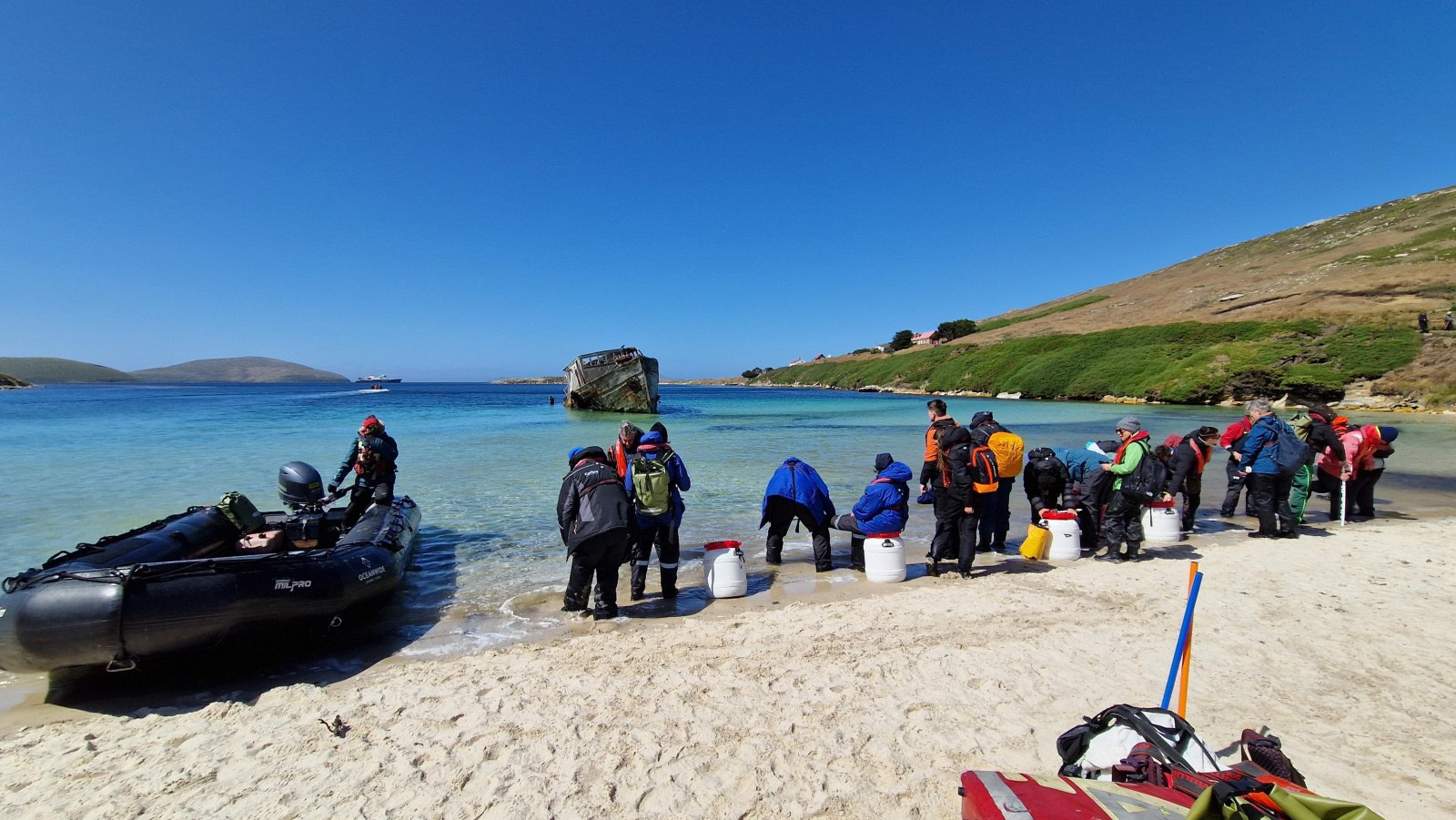
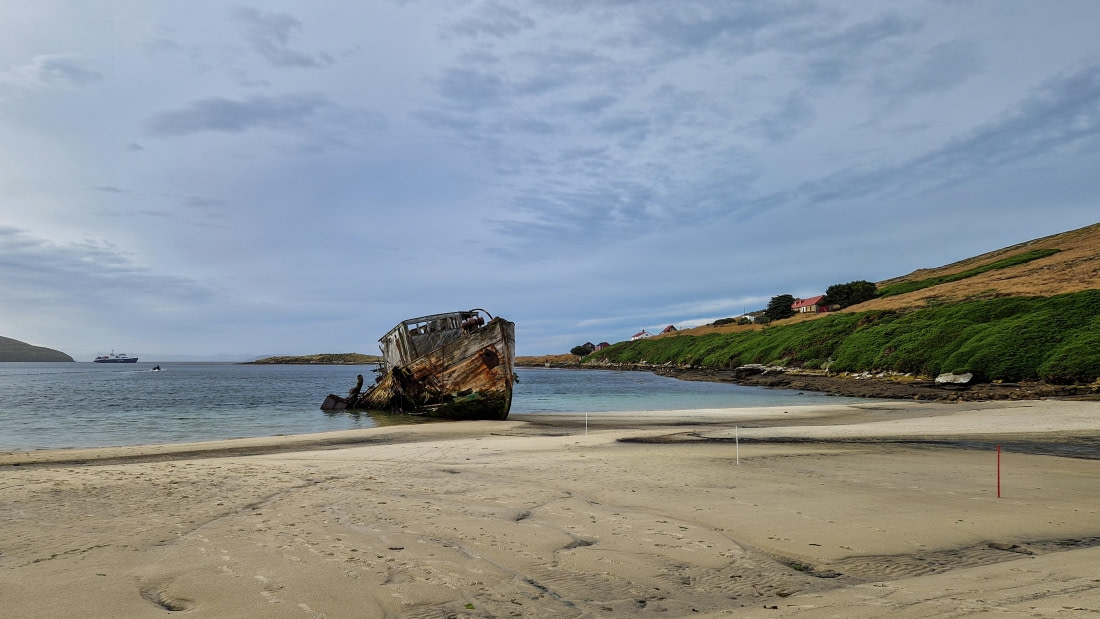
After a quiet night onboard Plancius we wake up around the South Shetland Islands. This morning’s destination was Half Moon Island with the shape giving the name. It is home to hundreds of breeding chinstrap penguins. There was barely any wind this morning, so that we arrived at the beach after an easy ride on the zodiacs. On the beach, there is an old wooden boat that were used during the whaling times in the early 20th century. We went uphill and reached the penguin highway with quite a lot of traffic this morning. We kept our respectful distance, and the chinstraps didn’t really mind our presence. Through a narrow gap between rock formations, we reached another beach. An elephant seal rested on the gravel while a few adult male fur seals squabbled over a few rocks in the water. The scenery was beautiful.

The island consists of sharp rock formations with many differently coloured lichens on it and long dark gravel beaches. In the background we saw islands covered by glaciers. On the higher rocks the chinstraps had established their colonies. In contrast to the other penguin species these were very vocal. They kept calling while stretching their necks out into the air. We could observe that they are very territorial. Whoever trespassed was attacked rather viciously. Even the chicks participated in that. In addition to visiting the colony we got to stretch our legs while walking over the long hills all the way to the beach on the other side of the island. Here we discovered the jawbone of a large whale, potentially of a fin whale. The size was unbelievable.

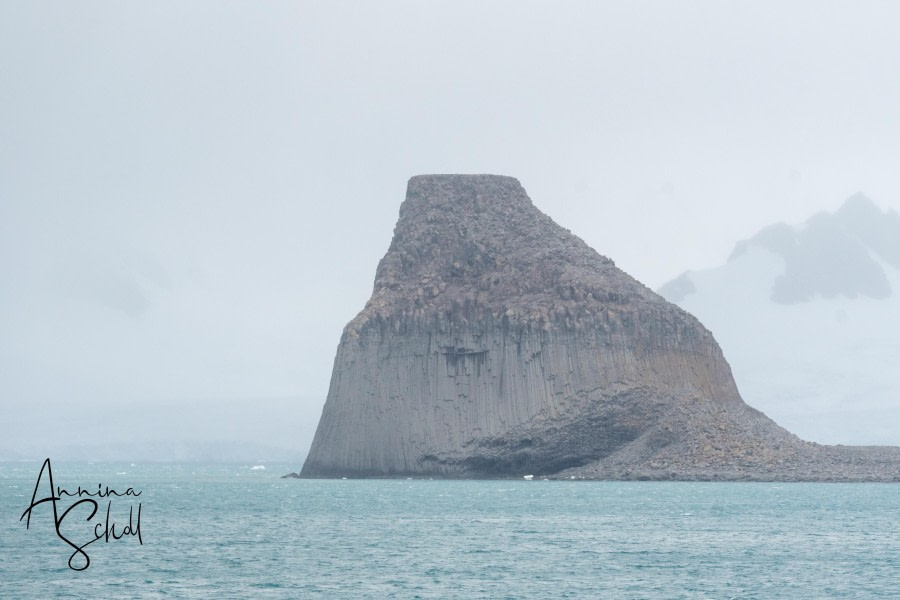
Finally, we returned to Plancius for a quick lunch. Our next planned landing site was just 30min of sailing away. Our expedition team rushed through lunch to then assess the conditions for the afternoon. Unfortunately, the wind picked up quite a lot and the swell increased so that the waves started to break. The expedition team returned wet after testing the waters. We couldn’t land at Yankee harbour. Instead, the captain offered a ship cruise to Edinburgh hill which is a basaltic rock formation of 180m hight. It rises from the sea in front of the glaciers, the dark grey forming a strong contrast to the white glaciers and the bright blue waters.

This was the last stop on our voyage. Unfortunately, it was time to set sails and return towards Ushuaia. We said our farewells to the last sights of Antarctica with hot chocolate on the forward deck with the expedition team.

Day 17: Drake Passage

Drake Passage
Datum: 04.02.2026
Positie: W5
Wind: 59°27.1’S / 062°16.8’W
Weer: Overcast
Luchttemperatuur: +3

A late call for a wake up let us rest well for facing the last day of this unforgettable trip. We needed extra energy because the farewell was coming. We spent days getting to know incredible and pristine places, flora and fauna never seen before, but also, we shared our time with amazing people from many different latitudes who told us their experiences, feelings and expectations.

The captain studied and ordered the best course to cross the Drake Passage or “Sea of Hoces”, as the Spanish call it. Then, Plancius headed to Tierra del Fuego, having hundreds nautical miles ahead us the emblematic Cape Horn, a small island that divides the Pacific Ocean from the Atlantic. It was a feared corner of the world during the era of the great Clippers, when Panama Chanel did not yet exist.

At 08:45 am we crossed the latitude of 60 degrees south, which marks the northern limit of the Antarctic continent. For this first day on the notorious Drake, the expedition staff had created an interesting lecture program again.

Charlotte spoke about the reproduction in whales, sharing unknown information, especially how long takes each stage in the life of these gorgeous mammals.

At little bit later, Ali spoke about the “Ice Maidens” – women in Antarctica which included the fascinating stories of some of the explorers’ wives who did never make it to Antarctica personally, but also women who actually wrote polar history through their own achievements, such as Jackie Ronne or Liv Arnesen.

During the afternoon there was a programme of three short lectures combined, both in English and in German. In the Lounge, Ali told us about the pets in South Georgia and in Antarctica, Karoline frightened us with her stories about giant isopods, and Charlotte spoke about fascinating species of orcas. In the restaurant, Annina talked about plankton, the base of the food web, Matthias shared his first-hand experiences with skuas, his favourite bird, and Esther spoke about the tourism management in Antarctica.

But going back again to the farewell. Are farewells a sad moment? Mmmmm……I read in “Illusions”, a book written by Richard Bach that: “A farewell is necessary before you can meet again. And meeting again, after moments or lifetimes, is certain for those who are friends" That means that farewells are not the end, they are the first step looking forward to the future, a moment or perhaps a day that is coming and that it will find us together again, maybe, forever.

I remember a thought from Benjamin Franklin. There are two kinds of people in the world: those who are happy and those who are not. The happy ones see the convenience of things in the good parts of a conversation, in well-prepared dishes, in a well-spent day, in the subtlest details of life, and they enjoy them with joy. Unhappy people think, talk, and always dwell on the negative. Happiness is not a reward, but a consequence, and suffering is not a punishment but a result.

The journey is slowly coming to an end and each of us will return to the respective activities of our lives. Meeting family and friends, going back to work, meeting at the club or a coffee shop to tell our stories and experiences. Maybe one day during the trip we will feel sad. We had time to reflect on our lives, our desires and future projects. And... If we still have something left without finding an answer, the rough waves and the icy Antarctic wind will be the custodians of that secret, perhaps until our next trip and adventure.
Day 18: Drake Passage

Drake Passage
Datum: 05.02.2026
Positie: 55°46.6’S / 065°46.9’W
Wind: SW6
Weer: Overcast
Luchttemperatuur: +3

During the night we experienced a good storm on the infamous Drake Passage. When we woke up in the morning, a few things in the cabin were not where they used to be. This morning, we were woken up by a unique wake up call. Tobias and Sabine had donated money for the wake-up call during the South Georgia auction and therefore were allowed to wake up the entire ship today. They were gentle to us, we maybe expected heavy metal, but instead, there was many kind words and peaceful music playing.
After breakfast, our educational entertainment on board continued. At 9:30 am, Karoline gave us a spectacular insight into her seven years of living in a remote trapping hut in Svalbard with her partner, their little boy, and a lot of dogs. In a very humorous way, she portrayed the solitude, the trapping and hunting life, as well as the darkness in winter.

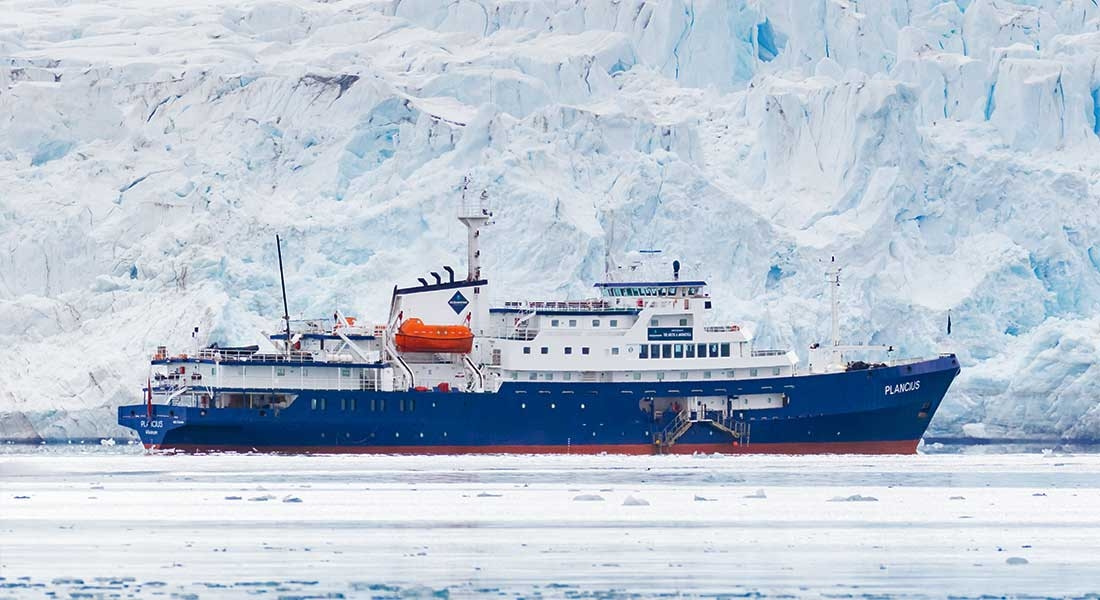
Shortly after her, we had two guest lecturers with quite an amazing story: Janneke and Wietze from the Netherlands told us the story of our dear ship Plancius, about times, when her name was still Tydeman and she was operated by the Dutch Navy and used for hydrographic work, mapping the ocean floor, and many other scientific purposes. They ended their lecture by pointing out, that whenever the keel is laid for a ship, something determines whether it is going to be a happy ship or not. Tydeman and now Plancius has always been a happy ship and we all got to experience this deep truth on our voyage to some of the most remarkable places on Earth, with some of the most remarkable we met.

In the afternoon, Ali had prepared some entertainment for all of us. We were to participate in a pub quiz where our knowledge got tested on all elements of this voyage: the Falkland Islands, South Georgia, Antarctica, the ship, the wildlife, and our guides. It was great fun coming together for a game in the lounge.

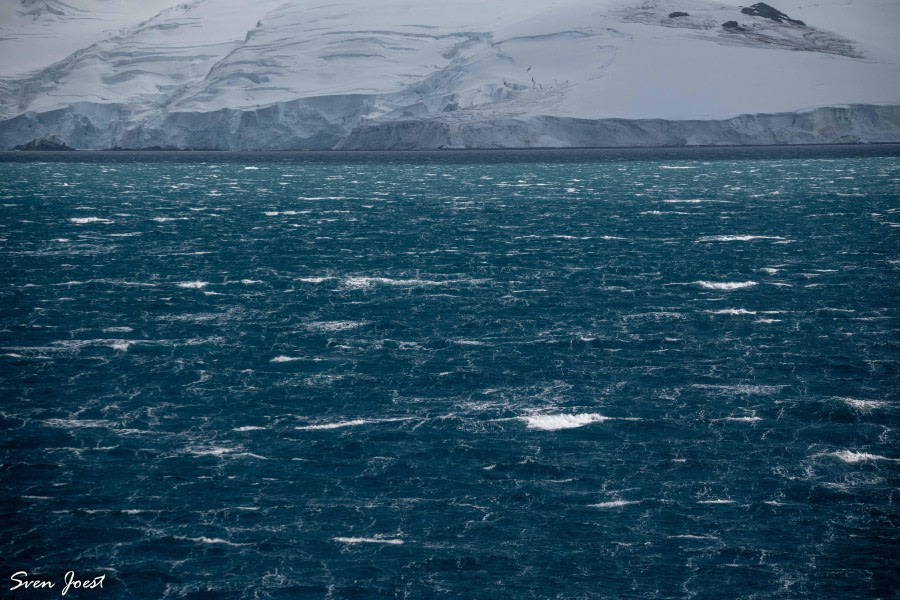
The wind did not drop this afternoon, it rather felt like it kept increasing. When we approached the notorious Cape Hoorn, it reached speeds up to 50 knots! It was crazy to see how the storm was whipping up the sea!

Cape Hoorn Island has a beautiful lighthouse, a few families are living close to the cape. Since 1992 there is a beautiful albatross sculpture dedicated to the sailors lost at sea. You can read the following poem by Sara Vial:

I am the albatross that awaits you

At the end of the world.

I am the forgotten souls of dead sailors

Who passed Cape Horn

From all oceans of the world.

But they did not die in the furious waves.

Today they fly in my wings.

Toward eternity,

In the last crack

Of the Antarctic winds.

We finished our last day on board with a glass of sparkling wine and a beautiful speech from Captain Matei. We clinked glasses with Ali and her team and got to see the wonderful slideshow that Sven and Annina prepared for us as a memory of this unforgettable voyage. One final delicious dinner on board and a huge round of applause for the kitchen and hotel team, and then some of us retreated in their cabins to pack their luggage, and others sat together for some more drinks at the bar.

Day 19: Disembarkation Day

Disembarkation Day
Datum: 06.02.2026
Positie: 54°48.6’S / 068°17.8’W
Wind: NW5
Weer: Mainly sunny
Luchttemperatuur: +12

It is time to go. Time to say our goodbyes, time to exchange contacts with new friends we made along the way, time to travel on. We walked down the gangway and back onto the pier of Ushuaia, looking back at the ship and the crew.

Farewell, goodbye, stay safe and fair winds until we meet again!

Total distance sailed on our voyage: 3,225.6 nm

Southernmost position: 63º37’S / 055º55’W

On behalf of Oceanwide Expeditions, the Captain, Crew and Expedition staff

we would like to thank you for a wonderful time, it has been a pleasure sailing with you.

Details

Reiscode: PLA27-26
Reisdatum: 19 jan. - 6 feb., 2026
Duur: 18 nachten
Schip: m/v Plancius
Inscheping: Ushuaia
Ontscheping: Ushuaia

Op deze reis geweest?

Aan boord van m/v Plancius

Ons oudste schip, de Plancius, is een klassieke keuze voor een aantal van onze populairste poolreizen.

Meer over de m/v Plancius »
Loading