How a Catholic saint becomes an Arctic elf
Christmas is celebrated in numerous ways all over the world, and nearly all of these ways involve the historic figure of St. Nicholas.
Who originally had nothing to do with Christmas.
In the Netherlands, where we’re based, Sinterklaas is technically a celebration of the St. Nicholas feast day on December 6, while Christmas, as its name indicates, is intended to observe Christ’s supposed birth on December 25.
But in Britain and especially the United States, both Christmas and St. Nick have been stretched, refitted, and patched together more than your oldest Christmas sweater.
Here we discuss a few of these evolutions, the oddest perhaps being St. Nick’s North Pole address. (No, we’re not giving it away.)

Dionisius [Public domain], via Wikimedia Commons
First of all, how does a Roman bishop become a portly elf in only fifteen centuries?
St. Nicholas, a fourth-century bishop who lived in the ancient Roman town of Myra, now Demre in Turkey, was reputed to be neither plump nor jolly, but did earn a longstanding reputation for charity and gift-giving.
This, naturally, was the linchpin that would eventually link him to Christmas.
After Dutch immigrants brought Sinterklaas (seen below) to America, several literary works began transforming both the character and Christmas in Britain and the United States.

Sander van der Wel from Netherlands [CC BY-SA 2.0], via Wikimedia Commons
These works were most notably Washington Irving’s A History of New York in 1809, Charles Dickens’s A Christmas Carol in 1843, the anonymous 1821 poem Old Santaclaus with Much Delight, and Clement Clark Moore’s 1823 The Night Before Christmas.
Book by book, poem by poem, St. Nick became known for his magic sleigh, flying reindeer, and love of children. He was also absorbed into Christmas itself, which since before the Middle Ages had been a riotous holiday often involving public drunkenness.
But how did the North Pole come into play? Was it simply the only place St. Nick and his rowdy crew could play all-night beer pong in peace?
Well, that’s not exactly why he ended up there…

Jonathan Meath [CC BY-SA 2.5], via Wikimedia Commons
St. Nick packs his pipe and moves to the North Pole
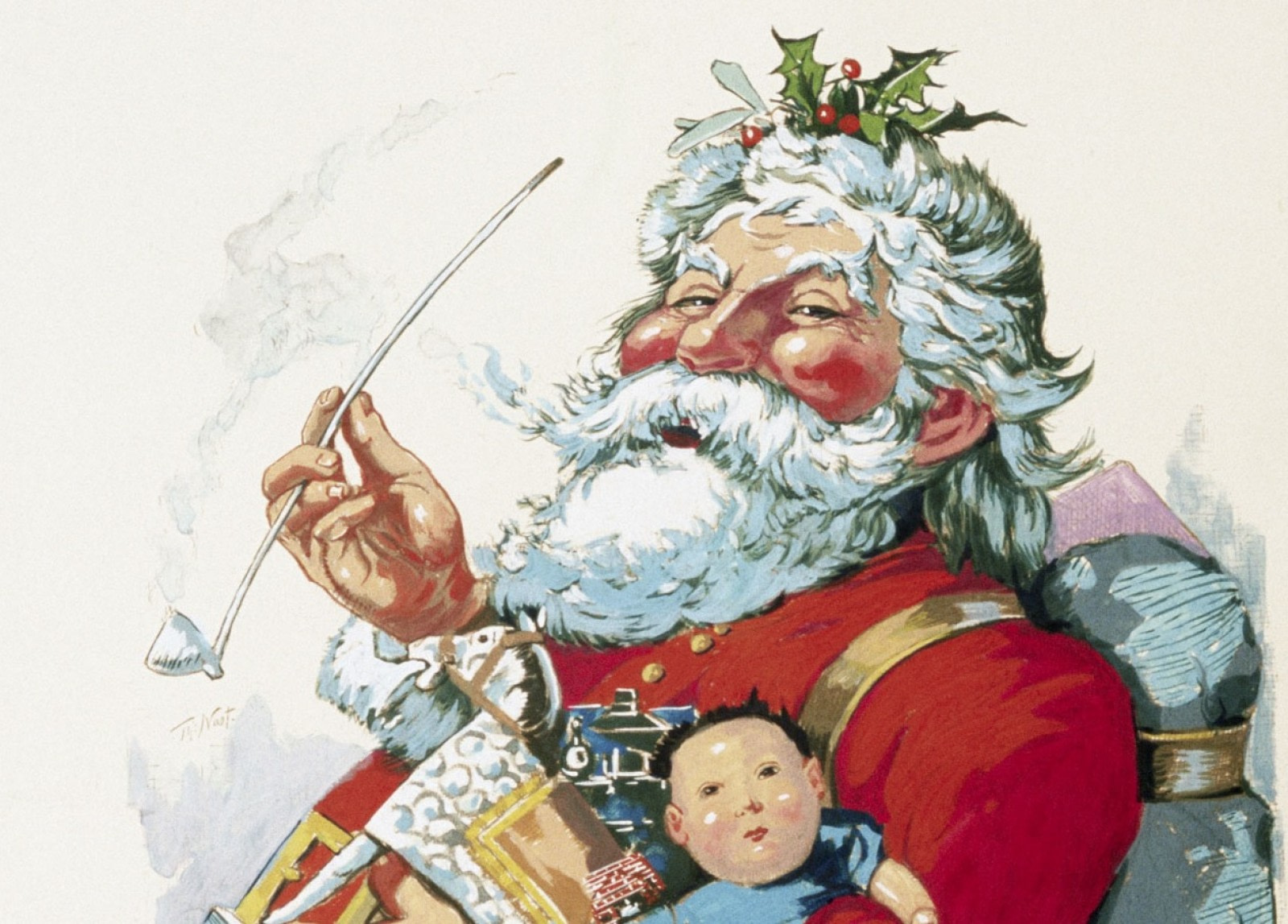
St. Nicholas’s migration to the North Pole is due most directly to Thomas Nast, an American cartoonist who submitted 33 Christmas drawings to Harper’s Weekly magazine between 1863 and 1886, one of which featured a village called “Santa Claussville, N.P.”
N.P., as you may have guessed, stands for the North Pole.
This was no random decision on Nast’s part. During the 1840s and 50s, public imagination in Europe and America was stirred by several highly publicized expeditions to the Arctic, which at that time was largely unexplored.
Not surprisingly, then, the Arctic acquired in the news, literature, and visual arts of the day an almost mythical status - particularly the North Pole, since no one would see it until Robert Peary took the honor in 1909, though his claim is still disputed.

Thomas Nast, for Harper's Weekly [Public domain], via Wikimedia Commons
Also, reindeer live in the Arctic, and as The Night Before Christmas had already demonstrated, reindeer were St. Nick’s preferred means of transportation.
The third and perhaps most compelling reason Nast chose the North Pole as St. Nick’s home is because it snows there all year long. And since snow is a symbol for Christmas in much of the world, the North Pole seemed a fitting refuge for this secularized Christmas figure.
But regardless of St. Nick’s reasons for relocating, whether they were due more to adventurous expeditions or speedy reindeer or an elfin love of snow, we think he made an excellent choice to set up in the Arctic.
We’ll be sure to tell him that the next time we’re there.